
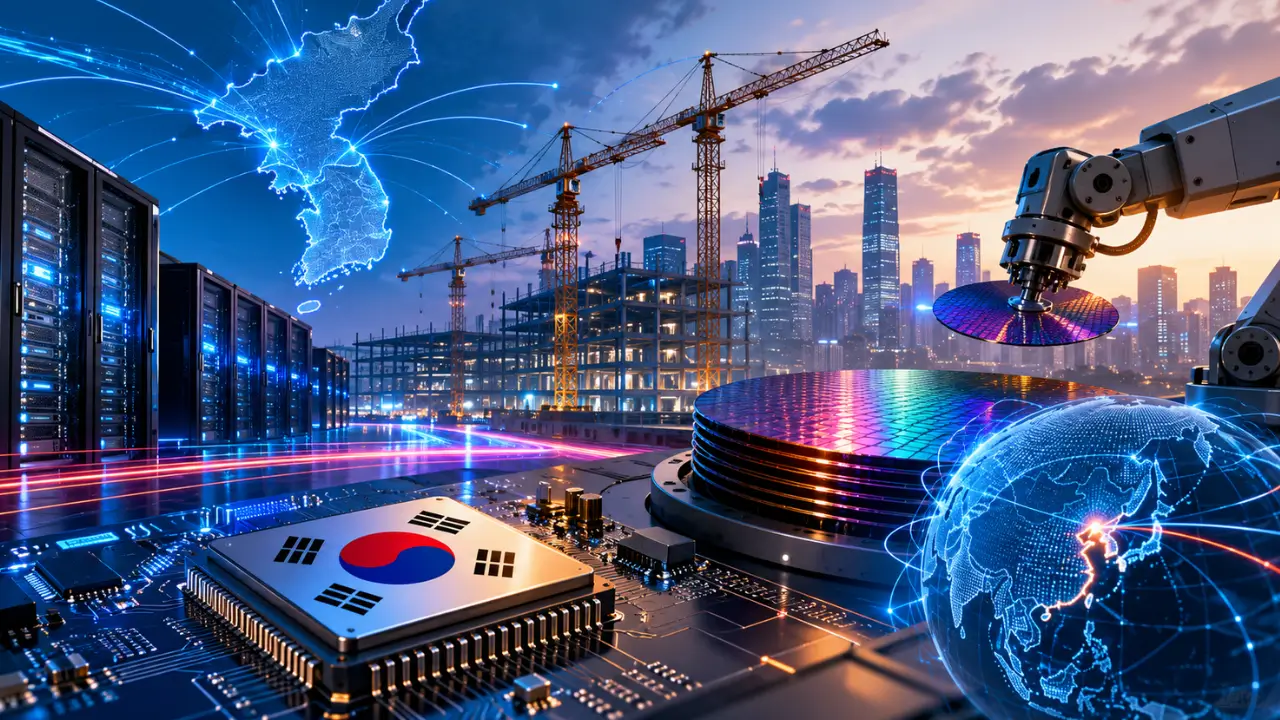
South Korea’s SK Group has outlined one of the world’s most ambitious artificial intelligence infrastructure strategies, committing 1,000 trillion won ($642 billion) to develop 15 gigawatts of AI data center capacity under SK Telecom. The long-term investment signals an aggressive effort to expand digital infrastructure as global demand for AI computing continues to outpace available capacity. Beyond new facilities, the initiative strengthens South Korea’s broader ambition to secure leadership across AI infrastructure, advanced semiconductors, and energy systems. The scale of the announcement reflects how technology companies increasingly view compute capacity as a strategic national asset rather than simply an enterprise investment.

The AI data center expansion forms one pillar of a wider capital deployment strategy that also targets semiconductor manufacturing. Together, the investments position SK Group across two of the industry’s most critical supply chains, AI computing infrastructure and memory production. The company is aligning those capabilities to support future demand from hyperscale cloud providers, enterprise AI deployments, and next-generation computing workloads. As AI adoption accelerates globally, the combination of infrastructure and chip production gives South Korea greater influence across the technology value chain.
Initial 5 GW Deployment Targets 2029 Milestone
SK Group plans to deploy the first 5 GW of AI data center capacity by 2029 as part of the broader 15 GW roadmap. The rollout will significantly expand domestic compute resources while creating a foundation for future hyperscale AI services managed through SK Telecom. Such capacity represents a substantial increase in infrastructure designed to support increasingly power-intensive AI models, inference workloads, and cloud platforms. Consequently, the phased deployment allows the company to scale infrastructure alongside market demand and supporting utilities.
Alongside the AI infrastructure buildout, SK Hynix will invest 1,100 trillion won ($706 billion) to expand semiconductor manufacturing facilities. The investment reinforces the company’s position as one of the world’s leading memory chip producers at a time when high-bandwidth memory and advanced DRAM remain central to AI system performance. Additional manufacturing capacity is expected to strengthen supply resilience while supporting the growing requirements of AI hardware vendors. The combined infrastructure and semiconductor strategy creates an integrated ecosystem capable of serving both domestic and international markets.

Government Strategy Reinforces National Semiconductor Leadership
SK Group’s investment aligns closely with South Korea’s national strategy to strengthen its position as a global AI and semiconductor hub. Government-backed industrial policies have increasingly focused on expanding advanced manufacturing, digital infrastructure, and technology competitiveness as countries compete to secure leadership in AI. Large-scale private investment from domestic technology companies complements those national objectives by accelerating infrastructure development across multiple sectors. The coordinated approach reflects growing recognition that AI competitiveness depends on compute, semiconductor production, and reliable energy operating together.
Samsung Electronics is pursuing a parallel expansion strategy through a planned investment of 400 trillion won ($256 billion) in new semiconductor fabrication plants in Gwangju. The company has also outlined a broader commitment totaling 2,100 trillion won ($1.34 trillion) for its semiconductor business through 2040. Those investments further reinforce South Korea’s role in the global semiconductor supply chain while increasing future production capacity for advanced chips. Collectively, the commitments from the country’s largest technology companies underscore the scale of long-term capital flowing into AI-enabling infrastructure.
Renewable Energy Partnership Supports Future AI Growth
Meeting the electricity requirements of large-scale AI infrastructure remains a central challenge for hyperscale expansion, prompting SK Group to pair its computing investments with significant energy development. The company has partnered with private equity firm KKR to establish what they describe as South Korea’s largest renewable energy company through the consolidation and expansion of existing energy businesses. The strategy seeks to ensure long-term access to cleaner electricity as AI infrastructure continues to scale. Reliable renewable generation also becomes increasingly important as operators face rising expectations around sustainability and energy security.
Under the partnership, SK Group and KKR intend to expand combined electricity generation capacity sixfold to reach 10 GW by 2031. The renewable energy platform is expected to support future AI data center deployments while strengthening the country’s broader clean energy infrastructure. Moreover, integrating power generation with compute expansion reflects a growing industry trend where technology investments increasingly depend on dedicated energy capacity. As AI infrastructure projects become larger and more power-intensive, companies are placing equal emphasis on electricity supply alongside compute deployment.











