
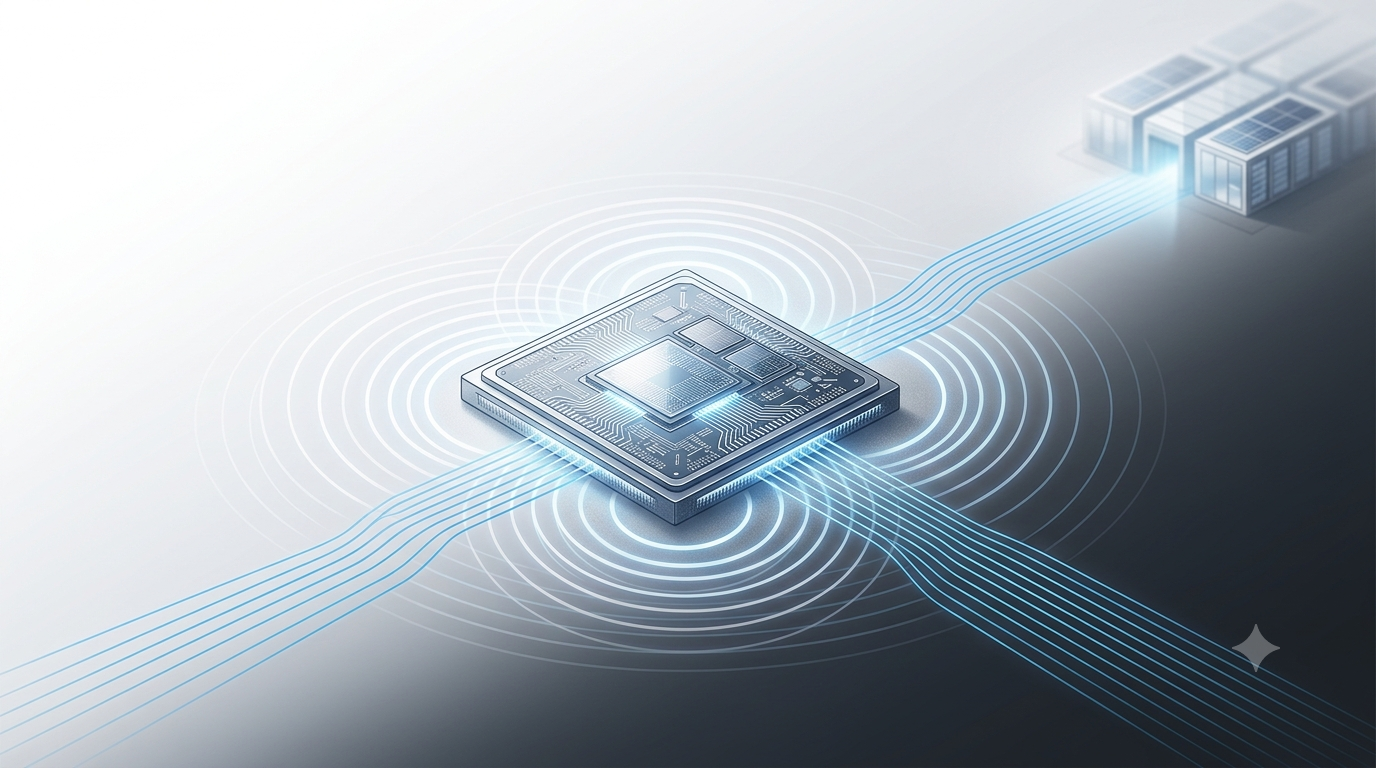
As artificial intelligence models grow larger and inference workloads surge worldwide, energy consumption has emerged as one of the industry’s biggest challenges. Addressing that bottleneck, Unconventional AI, a startup founded by former Databricks AI chief Naveen Rao, has unveiled a radically different computing architecture that it claims could reduce AI inference power consumption by as much as 1,000 times. The company introduced its first AI model, Un-0, alongside new research demonstrating an image-generation system built entirely on a software simulation of its novel oscillator-based computing architecture. While commercial hardware remains under development, the announcement offers an early look at an alternative approach that could reshape future AI infrastructure if the technology delivers on its ambitious promises.

Unconventional AI Debuts Oscillator-Based AI Architecture
Unlike today’s AI systems, which rely on conventional CPUs and GPUs, Unconventional AI is developing an oscillator-based computing architecture designed specifically for AI inference. The company’s newly released Un-0 model serves as the first public demonstration of the platform. According to the accompanying research paper, the software simulation achieves image-generation performance comparable to modern diffusion models, including systems such as Stable Diffusion and OpenAI’s GPT Image 1. Rather than showcasing a new foundation model, the release demonstrates that oscillator-based hardware can execute complex AI inference tasks while maintaining competitive output quality. Naveen Rao described the milestone as the “hello world” moment for an entirely new computing paradigm, signaling the beginning of a broader hardware roadmap.
Energy Efficiency Becomes the Primary Design Goal
The startup’s central objective is reducing the enormous electricity demands associated with AI inference. According to Rao, oscillator-based computing could ultimately lower inference power requirements by approximately 1,000 times compared with conventional AI hardware. Although current demonstrations rely on software emulation, the company plans to publish hardware schematics before developing physical accelerator chips. Eventually, Unconventional AI intends to operate its own inference infrastructure, allowing customers to submit AI prompts through cloud services powered entirely by its proprietary architecture. Instead of selling standalone processors, the company aims to offer complete inference capacity, integrating hardware, software, and system infrastructure into a unified platform.
Inference Demand Is Becoming AI’s Largest Infrastructure Challenge
The announcement arrives as hyperscalers and AI developers rapidly expand inference capacity worldwide. While model training remains computationally intensive, inference now accounts for a growing share of AI infrastructure investments as enterprise deployments accelerate across industries. Serving billions of AI queries each day requires vast clusters of GPUs, substantial electricity supplies, advanced cooling systems, and continuous infrastructure expansion. Consequently, energy efficiency has become a critical factor in determining long-term AI scalability. Rao argues that power availability, rather than semiconductor performance alone, will become the defining constraint for future AI growth. “AI scaling is hard because of energy,” Rao said. “It’s going to be the fundamental limit in the next few years.”

Hardware Roadmap Extends Beyond Software Simulation
Despite the ambitious performance targets, Unconventional AI remains an early-stage company with fewer than 50 employees. Currently, Un-0 operates entirely through software simulations that emulate the company’s future hardware architecture. The next milestone involves releasing chip designs before manufacturing physical silicon capable of running production AI workloads. The company also plans to build complete inference systems around its custom processors rather than licensing chip designs to third-party hardware vendors. If successful, customers would interact with Unconventional AI similarly to existing cloud inference providers. Prompts would enter through conventional APIs while the underlying computation runs on oscillator-based infrastructure engineered for dramatically lower energy consumption.
Alternative AI Hardware Gains Momentum
Unconventional AI joins a growing wave of startups seeking alternatives to traditional GPU architectures. As AI infrastructure spending accelerates worldwide, chip developers increasingly focus on specialized hardware optimized for inference rather than general-purpose computing. Major semiconductor companies continue investing heavily in custom AI accelerators, memory architectures, and energy-efficient processors to support the expanding deployment of large language models and AI agents. However, Unconventional AI differentiates itself by redesigning the underlying computing architecture instead of incrementally improving existing silicon designs. That approach carries significant technical risk. Yet it also offers the potential for transformational improvements if oscillator-based computing achieves the efficiency gains suggested by early research.
Energy Could Define the Next Era of AI Infrastructure
The rapid expansion of AI data centers has shifted industry attention beyond raw computing performance toward infrastructure sustainability. Electricity demand from AI inference continues climbing as organizations deploy increasingly capable models into production environments. At the same time, utilities across multiple regions are struggling to supply enough power for hyperscale data center growth. Against that backdrop, technologies capable of significantly improving performance per watt have become increasingly valuable. Although commercial deployment remains several years away, Unconventional AI’s announcement highlights a broader trend across the AI industry. Future competition may depend as much on energy efficiency as on model capability, making next-generation computing architectures a strategic priority for AI infrastructure providers.











