
NVIDIA H200 shipments delayed to Q3  · BREAKING: Microsoft confirms 3GW data centre expansion in Asia-Pacific ·  AWS announces new sovereign cloud regions in India and UAE  · Arm-based servers now 24% of hyperscale deployments ·  EU AI Act enforcement enters phase two  · Global data centre investment hits $612B in 2026 ·  TSMC Arizona yields improve to 68% on 3nm process  · OpenAI valuation reaches $400B after latest funding round ·  NVIDIA H200 shipments delayed to Q3  · BREAKING: Microsoft confirms 3GW data centre expansion in Asia-Pacific ·  AWS announces new sovereign cloud regions in India and UAE  · Arm-based servers now 24% of hyperscale deployments ·  EU AI Act enforcement enters phase two  · Global data centre investment hits $612B in 2026

Oracle’s Data Center Warning Is a Worst-Case Scenario for the Whole AI Boom

A Filing That Should Make Everyone Nervous Oracle’s fiscal 2026 annual report, filed with the SEC in late June, is

Share

A Filing That Should Make Everyone Nervous

Oracle’s fiscal 2026 annual report, filed with the SEC in late June, is not a routine document. It reads like a manual for how the entire AI infrastructure boom could unravel. The cloud giant raised its capital expenditure to $55.7 billion for the year ended May 2026. That figure was up from $21.2 billion just one year prior. For fiscal 2027, Oracle is guiding between $90 billion and $95 billion in capex. Those numbers are extraordinary by any measure. Yet buried inside that ambition is a candid acknowledgment of risk. Oracle’s filing lists construction delays, GPU shortages, power constraints, customer credit exposure, and regulatory obstacles as genuine threats. This is not standard boilerplate language. The disclosure is unusually granular. It tells investors and the rest of the industry exactly how a bet of this scale could go wrong.

The Infrastructure Physics Problem

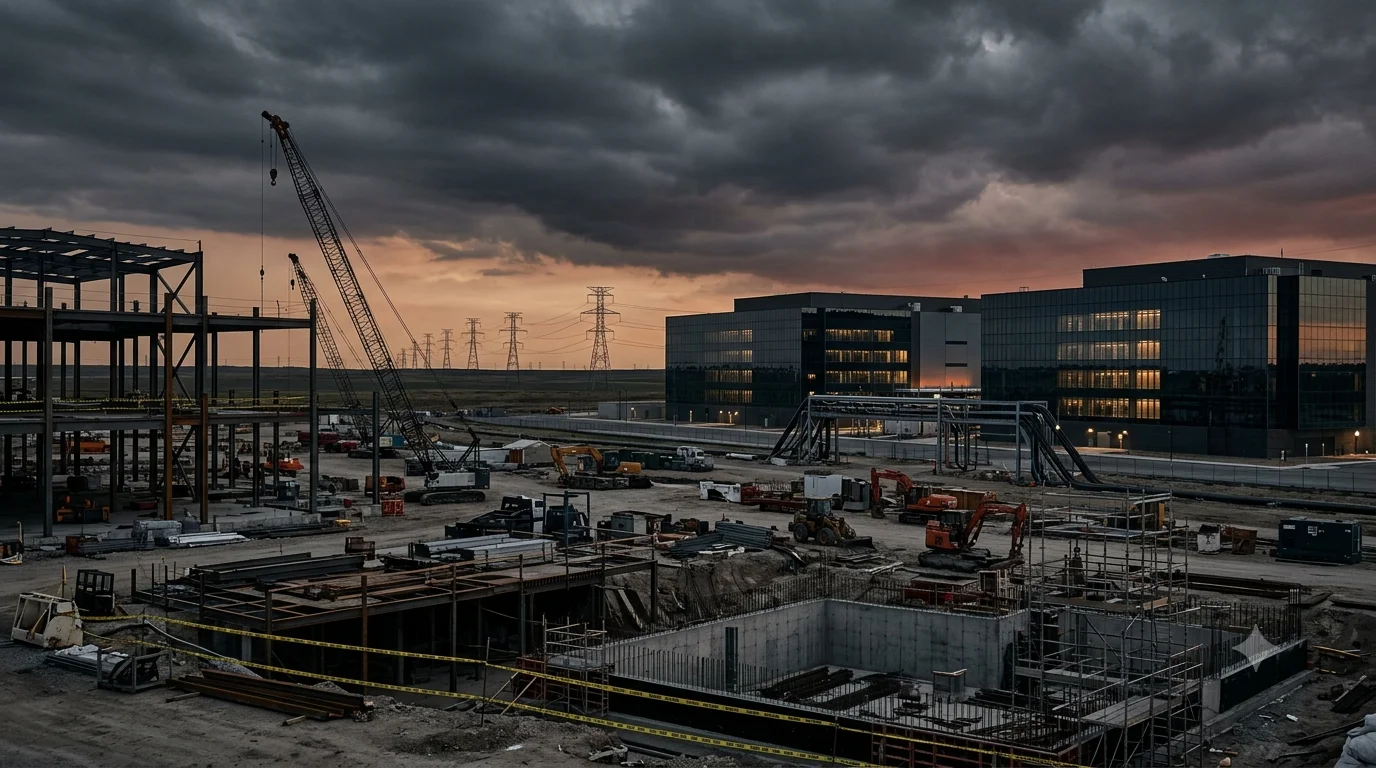
The core tension inside Oracle’s disclosure is a physical one. Building AI data centers is not simply a capital allocation challenge. It requires land, power, cooling infrastructure, and specialized hardware all simultaneously, at enormous scale. Oracle is simultaneously managing data center construction, GPU procurement, and client contracts with companies like OpenAI and Meta. Construction delays alone can cascade into serious financial damage. A delayed facility means delayed revenue. Consequently, Oracle’s remaining performance obligations totaling $523 billion as of recent filings cannot convert to actual revenue until infrastructure comes online. Furthermore, power availability is not a problem money alone solves. Grid interconnection queues in primary U.S. markets stretch to seven years in some areas. Therefore, even a company willing to spend aggressively cannot simply buy its way past a broken transmission queue. Oracle has responded by building on-site generation. Its Project Jupiter campus in New Mexico will run on Bloom Energy fuel cells rather than utility grid power. Still, that solution requires its own permitting, procurement, and commissioning timeline. The physical world has its own pace, and capital expenditure cannot override it.

When Debt Outpaces Demand

The financial architecture behind Oracle’s buildout deserves scrutiny. The company’s combined short- and long-term debt, including lease obligations, reached $111.6 billion as of August 2025. Moody’s warned that Oracle’s debt-to-earnings ratio could approach 4x — edging close to speculative-grade territory. Meanwhile, free cash flow turned deeply negative in Q2 2026 at -$13.2 billion. The company committed to $248 billion in data center leases over agreements spanning 15 to 19 years. The structural risk here is asymmetric. Oracle has locked in long-term lease obligations against short-term customer contracts. If enterprise demand for AI compute softens — or if a competing infrastructure provider undercuts Oracle’s pricing — that liability mismatch becomes acute. Analysts have noted that the current model, where spending outpaces monetization, could force Oracle to raise prices or tighten contract terms. Both responses carry client retention risk. Moreover, Oracle is not alone in this position. CoreWeave is projected to spend $20 billion this year while generating approximately $5 billion in revenue. The underlying assumption across the sector is that AI demand will grow fast enough to justify capital spending that currently has no near-term profitability path. That assumption may prove correct. However, it is an assumption, not a certainty.

The GPU and Supply Chain Dependency

Oracle’s filing specifically calls out GPU and hardware shortages as material risks. This dependency is structural. AI data centers without GPUs are simply buildings. The company’s deals with OpenAI and Meta require specific hardware at specific times. Any disruption to NVIDIA’s production schedule, or to the logistics chain moving specialized chips from fabrication to deployment, directly threatens Oracle’s ability to honor its contractual commitments.

The supply chain risks extend beyond GPUs. Specialized cooling systems, high-voltage power equipment, and precision-engineered busbars for high-density AI racks all carry lead times measured in months. Demand from hyperscalers has absorbed available manufacturing capacity for several product categories. INNIO reported that lead times for certain turbine classes reached nearly 243 weeks. That is not a temporary disruption. It reflects structural demand that has outrun industrial production capacity. Additionally, geopolitical risk sits underneath the entire semiconductor supply chain. Export controls, trade policy shifts, and manufacturing concentration in Taiwan all represent factors outside Oracle’s operational control. Its filing acknowledges these dependencies, but acknowledging them does not resolve them.

Regulation Is Not a Secondary Risk

Oracle’s filing identifies data security regulations and environmental rules as factors that could slow AI deployment. This is worth taking seriously. The EU’s Energy Efficiency Directive imposes waste heat recovery obligations on new data centers. Germany’s Energy Efficiency Act mandates binding energy reuse factors that escalate from 10 percent in 2026 to 20 percent by 2028. The EU’s CSDDD places due diligence obligations on large companies covering their entire value chain’s environmental impact. Meanwhile, Australian planning authorities are beginning to recognize that AI data centers compete directly with industrial land needed for freight logistics and housing supply chains.

The Guardian reported on 2 July 2026 that the acceleration of data center construction in Australia is creating measurable tension with freight and logistics operators over industrial land. Specifically, competition for well-located industrial sites near major population centers is intensifying. That planning conflict is not unique to Australia. It is emerging wherever data center campuses require large, grid-connected industrial parcels close to urban areas. Environmental permitting, community opposition, and competing land use claims are therefore compressing the pipeline of viable data center sites. Capital cannot manufacture a site that does not exist. Furthermore, a project blocked at planning cannot generate revenue regardless of how large the infrastructure investment behind it is.

The Bellwether That the Industry Needed

Oracle did not have to be this specific in its risk disclosure. The fact that it was tells the market something important. The company knows its infrastructure buildout is exposed to forces beyond its control. It knows investors are watching. And it knows that a company spending $90 billion in a single fiscal year cannot afford to appear unprepared for failure scenarios. Consequently, the filing functions as a sector-wide stress test. Every risk Oracle named applies, in varying degrees, to every AI infrastructure operator. Construction delays affect the entire hyperscaler cohort. GPU supply constraints are not Oracle-specific. Power grid limitations bind every developer regardless of financial strength. Environmental regulations apply across jurisdictions.The AI infrastructure boom is not collapsing. Demand remains real. Contracts are being signed. However, the honest acknowledgment from one of the boom’s central participants that things could go seriously wrong is the kind of signal the industry should treat as a calibration, not a warning to ignore.


[simple-author-box]

More from AI Infrastructure

Ireland’s nuclear debate is no longer arriving as an abstract argument about reactor technology.

AI campuses increasingly support workloads with different compute and infrastructure needs. They no longer

India’s AI infrastructure debate is beginning to resemble a question of location more than

COMPUTE WEEKLY

The briefing that 40,000+ tech leaders read every Monday. Sharp, fast, essential.

Great! We’ve received your information.

Building an AI Startup Without Owning GPUs

Not owning GPUs has become the default, deliberate strategy for building an AI company — not a compromise founders accept reluctantly. H100 rental rates fell 64-75% in fifteen months, a dense ecosystem of neoclouds and inference-as-a-service providers now lets startups skip infrastructure entirely, and credit programs can fund a company’s first year before a founder writes a check
Most Read

AI infrastructure decisions for high-density deployments increasingly involve what happens after electricity enters the

Demand is broadening across enterprise workloads APAC’s infrastructure story is changing in ways that

AI infrastructure decisions increasingly influence what enterprises can build, test, and deliver. They also

Why Infrastructure Planning Now Starts With Availability A data center project can have a

A property can look enormous from the site entrance and still offer almost no

Disruptor Spotlight

Cerebras Systems

The chip that makes Nvidia nervous. Cerebras’ Wafer Scale Engine is rewriting the rules of AI inference at scale.
Faster
0 x
YoY Revenue
0 x
Transistors
0 T
Market Pulse
MSFT
+1.02%
NVDA
+0.66%
AMZN
-0.078%
AMD
-6.95%
TSMC
-2.98%
Indicative only · Not financial advice
Upcoming Events
SEP
The AI Infrastructure Race (India)
WEBINAR · ONLINE
The AI Infrastructure Race: Won on Power, Land and Trust — Not Capital
MAY
0
AI Infrastructure Summit
DUBAI · IN PERSON
MEA’s premier AI infrastructure event.
JUN
0 0
Compute Forecast Summit
SINGAPORE · IN PERSON
Our flagship APAC event. Early bird open.
Latest Moves
Live
ecolab
Ecolab Deepens Cooling Strategy With $4.75B CoolIT Acquisition
Ecolab is making one of its biggest moves yet into AI infrastructure after completing its $4.75 billion acquisition of liquid cooling specialist CoolIT Systems
Pure DC AVK Europe data center microgrid Dublin 110MW AI infrastructure Ireland 2026
Pure DC and AVK Deploy Europe’s First 110 MW Data Center Microgrid in Dublin
The Pure DC Dublin microgrid has made history as Europe’s first large-scale on-site data center microgrid, launched in partnership with power solutions provider AVK at Pure DC’s campus in Ireland.
Pace Digitek
Pace Digitek Partners With MEGMEET to Expand AI Data Center Power Business
India’s AI infrastructure ecosystem continues to mature as domestic technology manufacturers move beyond traditional telecommunications and industrial markets toward high-growth digital infrastructure opportunities
Follow Compute Forecast
11K followers
1200 followers
Companies to Watch
CW
CoreWeave
Neo Cloud · $19B · IPO Watch
CB
Cerebras Systems
AI Hardware · $4.25B · Pre-IPO
G42
G42
Sovereign AI · Abu Dhabi
H
Humain
Saudi AI · $40B Fund
Latest Podcast
AI Capex, Cloud Margins & the Nuclear Bet
48 MIN · 25 APR 2026

Oracle’s Data Center Warning Is a Worst-Case Scenario for the Whole AI Boom

A Filing That Should Make Everyone Nervous Oracle’s fiscal 2026 annual report, filed with the SEC in late June, is

Share
56
847 SHARES

0
SHARES

[simple-author-box]

More from AI Infrastructure

AI infrastructure decisions for high-density deployments increasingly involve what happens after electricity enters the

Demand is broadening across enterprise workloads APAC’s infrastructure story is changing in ways that

AI infrastructure decisions increasingly influence what enterprises can build, test, and deliver. They also

Why Infrastructure Planning Now Starts With Availability A data center project can have a

COMPUTE WEEKLY

The briefing that 40,000+ tech leaders read every Monday. Sharp, fast, essential.

Great! We’ve received your information.

Global AI Infrastructure Outlook 2026

The briefing that 40,000+ tech leaders read every Monday. Sharp, fast, essential.
Download Free
Most Read

AI infrastructure decisions for high-density deployments increasingly involve what happens after electricity enters the

Demand is broadening across enterprise workloads APAC’s infrastructure story is changing in ways that

AI infrastructure decisions increasingly influence what enterprises can build, test, and deliver. They also

Why Infrastructure Planning Now Starts With Availability A data center project can have a

A property can look enormous from the site entrance and still offer almost no

Disruptor Spotlight

Cerebras Systems

The chip that makes Nvidia nervous. Cerebras’ Wafer Scale Engine is rewriting the rules of AI inference at scale.
Faster
0 x
YoY Revenue
0 x
Transistors
0 T
Market Pulse
NVDA
$924.60
+2.4%
MSFT
$421.30
+1.1%
AMZN
$192.80
-0.6%
NVDA
$924.60
+2.4%
NVDA
$924.60
+2.4%
Indicative only · Not financial advice
Upcoming Events
MAY
0 0
DCD Global — London
LONDON · IN PERSON
World’s largest DC event. CF is media partner.
MAY
0
AI Infrastructure Summit
DUBAI · IN PERSON
MEA’s premier AI infrastructure event.
JUN
0 0

Compute Forecast Summit

SINGAPORE · IN PERSON
Our flagship APAC event. Early bird open.
Latest Moves
  • Live
Sam Altman
OpenAI appoints new Chief Infrastructure Officer to lead $100B DC programme
27 APR · OPENAI
Sam Altman
OpenAI appoints new Chief Infrastructure Officer to lead $100B DC programme
27 APR · OPENAI
Sam Altman
OpenAI appoints new Chief Infrastructure Officer to lead $100B DC programme
27 APR · OPENAI
Follow Compute Forecast
18.4K followers
12.1K followers
9.3K subscribers
41 episodes
Companies to Watch
CW
CoreWeave
Neo Cloud · $19B · IPO Watch
CB
Cerebras Systems
AI Hardware · $4.25B · Pre-IPO
G42
G42
Sovereign AI · Abu Dhabi
CW
Humain
Saudi AI · $40B Fund
Latest Podcast
AI Capex, Cloud Margins & the Nuclear Bet
48 MIN · 25 APR 2026
Scroll to Top








