

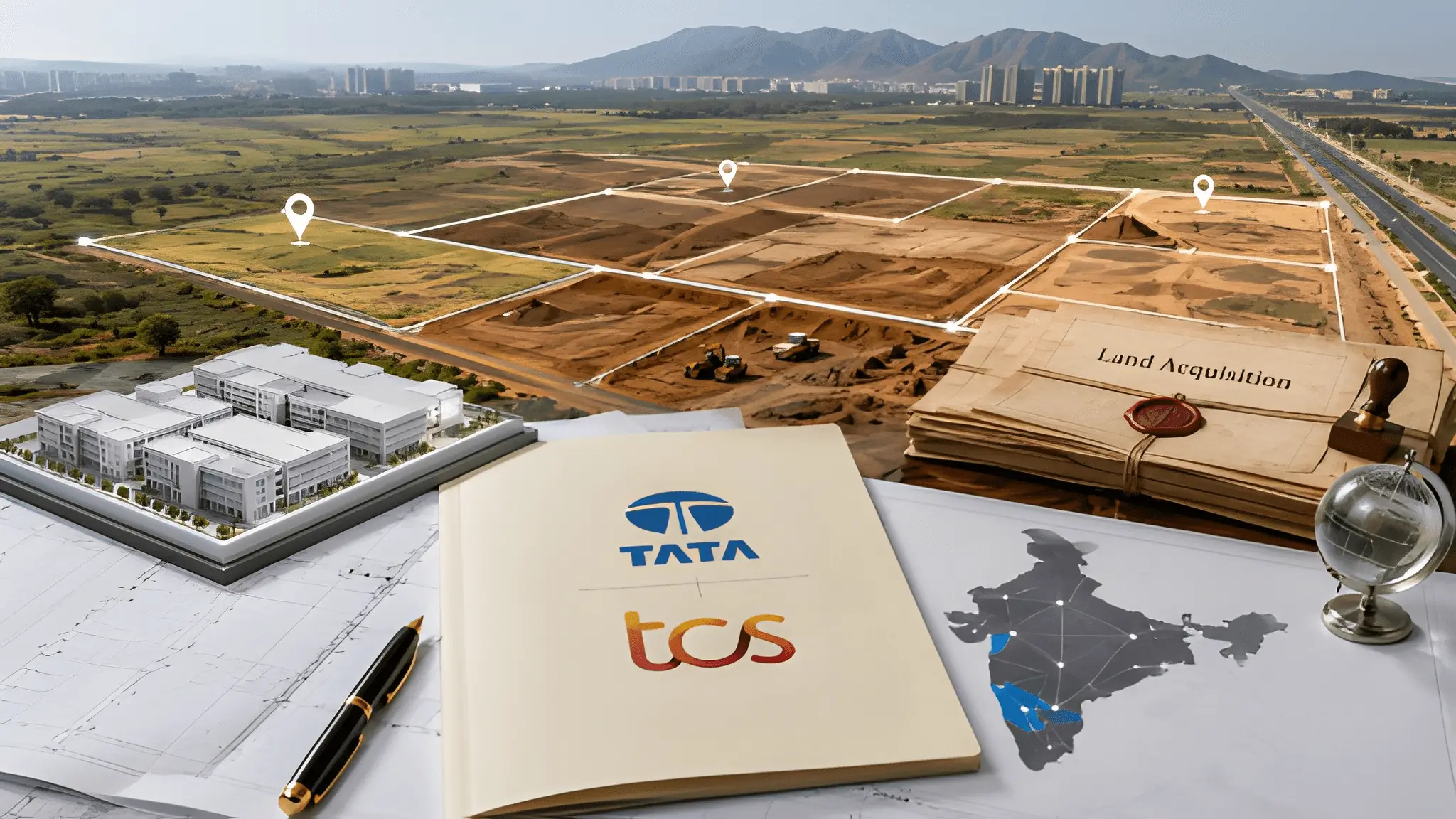
India’s artificial intelligence infrastructure ambitions may be entering a new phase as Tata Consultancy Services (TCS) secures large land parcels across two strategic locations. The acquisitions have fueled industry speculation that the sites could eventually support data centers aligned with OpenAI’s long-term expansion plans in India. While no official confirmation links the properties directly to OpenAI deployments, the purchases closely follow previously announced infrastructure commitments between the two companies. The developments also reinforce India’s position as an increasingly important destination for global AI compute capacity.
Land Acquisitions Strengthen Tata’s AI Infrastructure Position
Tata Consultancy Services has reportedly secured two significant land parcels in southern and western India that could support future hyperscale digital infrastructure. According to a report by The Economic Times, the Andhra Pradesh government allocated approximately 200 acres to TCS in Anakapalli, located around 35 kilometers from Visakhapatnam. Separately, the company acquired an 88-acre site in Bopkhel, situated roughly 25 kilometers north of Pune in Maharashtra. Together, the locations provide Tata with strategically positioned real estate capable of supporting large-scale infrastructure development across two major technology corridors.
The report does not explicitly state that either location has been designated for OpenAI-related operations. However, the timing has attracted attention because it closely follows Tata’s expanding role in OpenAI’s India strategy. Large land acquisitions of this scale typically signal long-term infrastructure planning rather than immediate commercial deployment. As demand for AI compute accelerates, access to land with future power and connectivity options has become a competitive advantage for hyperscale operators.
OpenAI Partnership Gives Context to the Expansion
The reported acquisitions come months after OpenAI announced Tata as a strategic partner under its OpenAI for India initiative. The collaboration aims to establish “local, AI-ready data center capacity” across the country to support advanced AI workloads and domestic computing demand. OpenAI also announced that it would become the first customer of Tata’s HyperVault data center business. The deployment is expected to begin with approximately 100MW of capacity while retaining the potential to scale toward 1GW over time.
That announcement significantly expanded Tata’s role beyond enterprise technology services into AI infrastructure development. HyperVault itself launched in October 2025 with plans to build 1GW of data center capacity, positioning the company to compete in India’s rapidly expanding hyperscale market. Although neither organization has confirmed the destination of future deployments, the newly acquired sites fit the profile of infrastructure required for long-term AI expansion. Therefore, the purchases have intensified expectations that Tata is laying the physical foundation for future compute investments.
HyperVault Signals Tata’s Long-Term Infrastructure Strategy
HyperVault represents one of Tata’s most ambitious infrastructure initiatives as demand for AI-ready facilities reshapes global digital investment. Rather than focusing solely on traditional colocation services, the business targets large-scale facilities capable of supporting next-generation AI training and inference workloads. High-density computing environments increasingly require substantial land availability alongside access to reliable electricity and future network expansion. The reported acquisitions align with those broader industry requirements.
The current size of Tata Consultancy Services’ own data center footprint remains unclear. Meanwhile, Tata Communications, another company within the Tata Group, reportedly operates approximately 22 data centers across 16 markets spanning India, the United Kingdom, Singapore, Portugal, and the United States. That international operational experience provides the wider Tata ecosystem with established expertise in operating critical digital infrastructure. As AI demand reshapes enterprise computing, infrastructure capabilities across the group could become increasingly interconnected.
OpenAI Continues Building a Global Data Center Network
India represents only one part of OpenAI’s broader infrastructure expansion strategy. The company continues advancing data center developments across the United States, Norway, the United Arab Emirates, Australia, and South Korea while also evaluating potential campuses in Argentina and Canada. The global rollout reflects OpenAI’s objective of expanding geographically distributed AI compute capacity to support future model development and deployment. Not every expansion has progressed at the same pace. Earlier this year, OpenAI stepped back from its previously announced investment plans in the United Kingdom. At the time, the company said future investments would proceed when the “right conditions” such as regulation and the cost of energy, enable long-term infrastructure investment.” That position highlighted the growing importance of policy certainty, energy economics, and infrastructure readiness in determining where AI capacity is ultimately deployed.
The reported land acquisitions illustrate how India’s AI infrastructure landscape is shifting from announcements toward physical development. Large technology companies are increasingly securing strategic assets well before construction begins, ensuring they can respond quickly as compute demand rises. Land availability, grid access, and scalable campus design now influence investment decisions as much as software innovation. For Tata, these acquisitions may represent another step in positioning itself at the center of India’s emerging AI infrastructure ecosystem. Although neither Tata Consultancy Services nor OpenAI has confirmed that the newly acquired properties will host OpenAI facilities, the broader strategic alignment remains difficult to ignore. The partnership, HyperVault’s long-term capacity ambitions, and India’s growing importance in global AI infrastructure collectively create a compelling backdrop for the reported transactions. If future deployments materialize, the sites could become part of one of the country’s largest AI infrastructure buildouts over the coming decade.










