
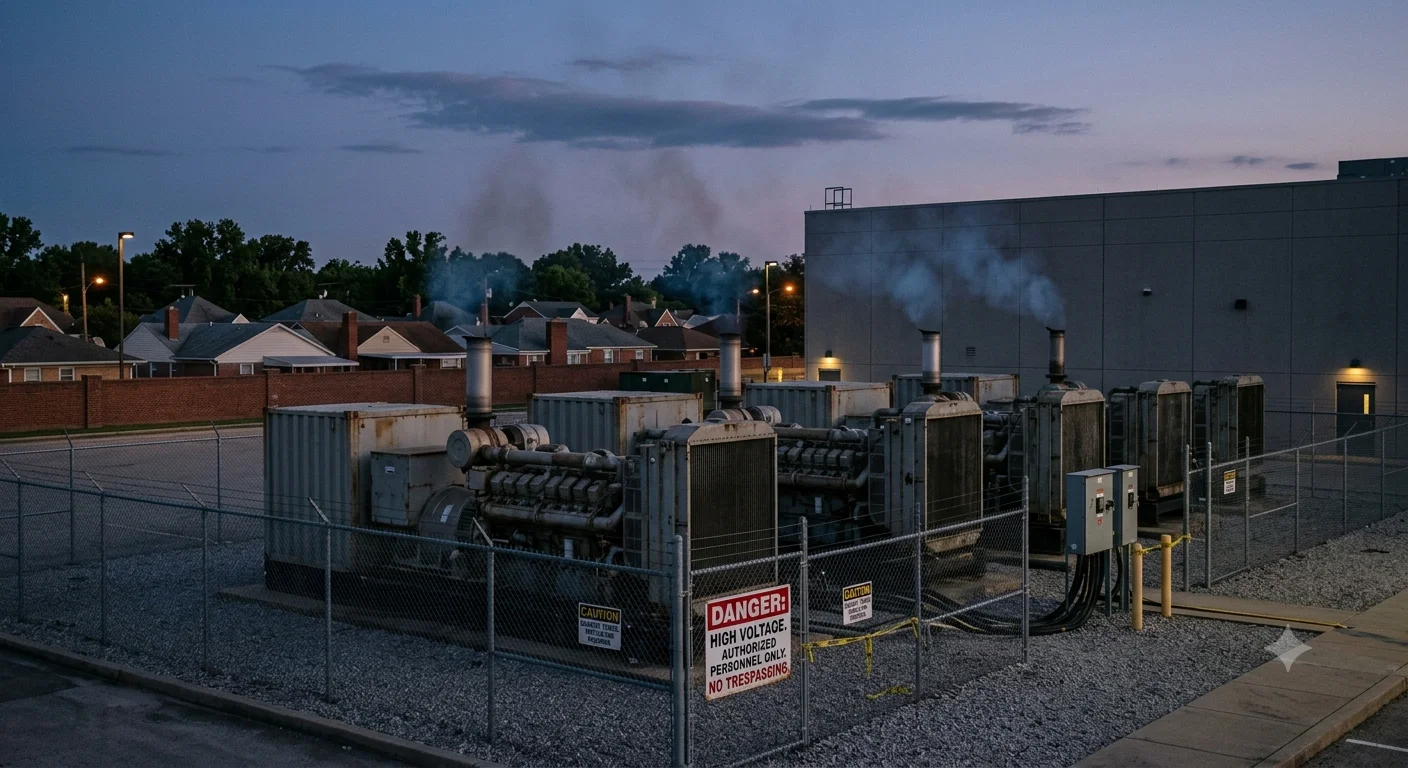
Data centers do not visibly smoke. They have no smokestacks, no visible exhaust, and no obvious signs of combustion under normal operation. However, that visual silence is misleading. Whether a data center contributes to local air pollution depends almost entirely on one variable: where its power comes from. As AI drives record electricity demand from data centers, that question has moved from academic to urgent — and communities from Virginia to Tennessee are already living with the consequences.

Under Normal Operation: Cleaner Than You Think
A data center in standard operating mode is, in strictly local terms, a relatively clean facility. It does not combust fuel on-site during routine operation. Moreover, it generates minimal vehicle traffic once construction ends, since most facilities run with small permanent staff. Consequently, transportation-related emissions from operating data centers are modest compared to factories, distribution centers, or manufacturing plants of similar scale.
The most common routine emission is water vapor from evaporative cooling towers — an environmental consideration tied to water consumption rather than air quality. However, that changes the moment you look at the electricity supply. A data center draws enormous amounts of power, and every kilowatt it consumes reflects the emissions profile of whatever generated it. Therefore, a facility powered by solar or wind carries a fundamentally different air quality footprint than one drawing from a coal-heavy grid at night. A data center running on renewable energy produces no local combustion emissions. In contrast, the same facility on a fossil-fuel-heavy grid indirectly drives emissions from plants several miles away. That upstream relationship is where most of the air quality story lives — and it is often invisible to the communities nearest the building.
The Diesel Generator Problem
The cleaner picture above applies only to normal operating conditions. Data centers maintain large fleets of diesel backup generators for grid outages, and those generators introduce a direct, localized air pollution problem that is growing harder to ignore.Virginia’s Loudoun County — home to the world’s largest concentration of data center capacity — holds approximately 9,000 generators, with roughly 4,700 in Loudoun County alone. Around 8,000 of those are Tier II generators, the older, dirtier standard. When a substation fire forced Loudoun County data centres to run backup generators for over 24 hours, nearby residents reported hearing a noise resembling continuous plane landings. Shoppers at a local Walmart parking lot reported smelling diesel fumes.

Diesel generators emit nitrogen oxides and fine particulate matter — PM2.5 — both directly linked to respiratory disease, heart disease, asthma, and cancer. Moreover, they emit 200 to 600 times more nitrogen oxides per unit of energy than natural gas plants. Furthermore, federal rules already allow data centers to use diesel generators for demand response — earning payments from grid operators to reduce stress on the grid — which means generators run not just in emergencies but as a routine grid management tool.
When Backup Becomes Primary: xAI in Memphis
The most visible current example of data center air pollution sits in Memphis, Tennessee. Elon Musk’s xAI installed more than 30 natural gas turbines at its Colossus facility for daily operational use not backup. Consequently, these turbines emit continuously, not just during grid outages. Meanwhile, Memphis already carries some of the highest asthma rates in the United States and faces longstanding environmental health disparities. As a result, local residents and the NAACP filed a notice with intent to sue under the Clean Air Act, arguing the project worsens already dangerous air quality.
The situation illustrates a critical distinction: generators used for emergency backup drive episodic emissions, but generators used as primary power create a continuous local pollution source. Therefore, the same equipment produces fundamentally different community health impacts depending on its operational role. xAI’s situation is not isolated. In Mississippi, similar unpermitted temporary combustion turbines supporting a neighboring Tennessee data center drew complaints and regulatory scrutiny. Novva Data Centers in Utah went further, formally asking the Trump administration for a presidential exemption from Clean Air Act standards — arguing that available emissions control technology was insufficient to meet permit limits while meeting a hyperscaler’s power demands.
Regulatory Frameworks Struggling to Keep Up
The regulatory environment around data center emissions is evolving rapidly — and unevenly. The EPA issues baseline national standards through New Source Performance Standards covering combustion turbines and stationary engines. However, state agencies set the operational rules that govern most day-to-day permitting. Virginia’s Department of Environmental Quality drafted new guidance in late 2025 that would expand the definition of an “emergency” to include planned utility outages, allowing dirtier Tier II generators to run during scheduled events. Environmental attorneys at the Southern Environmental Law Center called this an attempt to shoehorn planned outages into an emergency definition where they do not fit.
Illinois redesignated the Greater Chicago area to serious nonattainment status in January 2025, lowering the NOx major source threshold from 100 tons per year to 50 tons per year — a change that immediately affects how data centers in the region structure their generator fleets. Virginia’s DEQ drafted even stricter Tier 4 equivalent standards for future data center generators. Meanwhile, the EPA hinted in March 2026 at reclassifying truck-mounted turbines as mobile sources, which would effectively allow developers to bypass stationary source permitting requirements entirely. For data center developers, mobile source classification reduces permitting burden and accelerates timelines. For communities near those facilities, however, it removes the most substantive layer of air quality protection currently available.
The Renewable Energy Variable
The upstream emissions question resolves most cleanly when a data center sources genuinely renewable power. However, the reality of grid operation is more complex than a power purchase agreement suggests. During solar-heavy daytime hours on a renewable-rich grid, a data center may draw predominantly clean power. At night, or during periods of peak demand, the same facility likely draws from fossil-fueled plants. Consequently, a data center’s actual emissions profile shifts hour by hour based on grid conditions — not just on the annual renewable percentage cited in sustainability reports.
Grid power also tends to be cleaner per unit of output than on-site generation. Large centralized plants typically achieve better efficiency and incorporate emissions controls that small backup generators lack. Therefore, a data center connected to a reasonably clean grid and avoiding on-site combustion generally produces lower local air quality impact than one with extensive on-site generation, even if the on-site option uses lower-carbon fuels. For example, a facility drawing from the Pacific Northwest’s predominantly hydroelectric grid has a categorically different air quality footprint than one in a coal-heavy Midwest market, regardless of how the buildings themselves look.
Community Impacts and Environmental Equity
The air quality burden of data center development does not fall evenly. Research from California found that existing and planned data centers appear more frequently in areas of high air pollution. In South Carolina, new facilities and the fossil-fuel generation built to power them are disproportionately sited near Black and low-income communities. Moreover, construction phases are independently emissions-intensive, generating diesel exhaust from heavy equipment, truck traffic, and on-site machinery across months or years of active development. Consequently, communities near major data center clusters face compounding pollution exposure — construction emissions followed by years of generator testing, demand response activation, and potentially continuous on-site generation if grid power proves insufficient.
The NAACP’s Frontline Framework Community Guiding Principles and its Community Benefits Agreement template both address these dynamics, offering communities structured tools to demand transparency, emissions disclosure, and accountability from data center developers before permits are granted. However, those tools only help when communities are aware of the development and engaged early enough to use them — a condition that is not always met given the speed at which hyperscale projects move from announcement to construction.
The Power Decision Is the Pollution Decision
The conclusion from the available evidence is direct. Data centers do not inherently pollute. However, their power choices determine whether they become a meaningful source of local air quality degradation. A facility powered by renewables, connected to a clean grid, with battery storage replacing diesel backup, produces minimal local pollution. The same square footage powered by on-site gas turbines, reliant on Tier II diesel generators for grid events, and drawing from a fossil-heavy utility represents a continuous and compounding community health burden. Therefore, decisions made in power procurement, backup generation strategy, and site selection carry direct public health consequences — consequences that currently land on communities with limited ability to influence them. The regulatory frameworks that should mediate that relationship are evolving, but they are evolving more slowly than the data center industry is building.











