
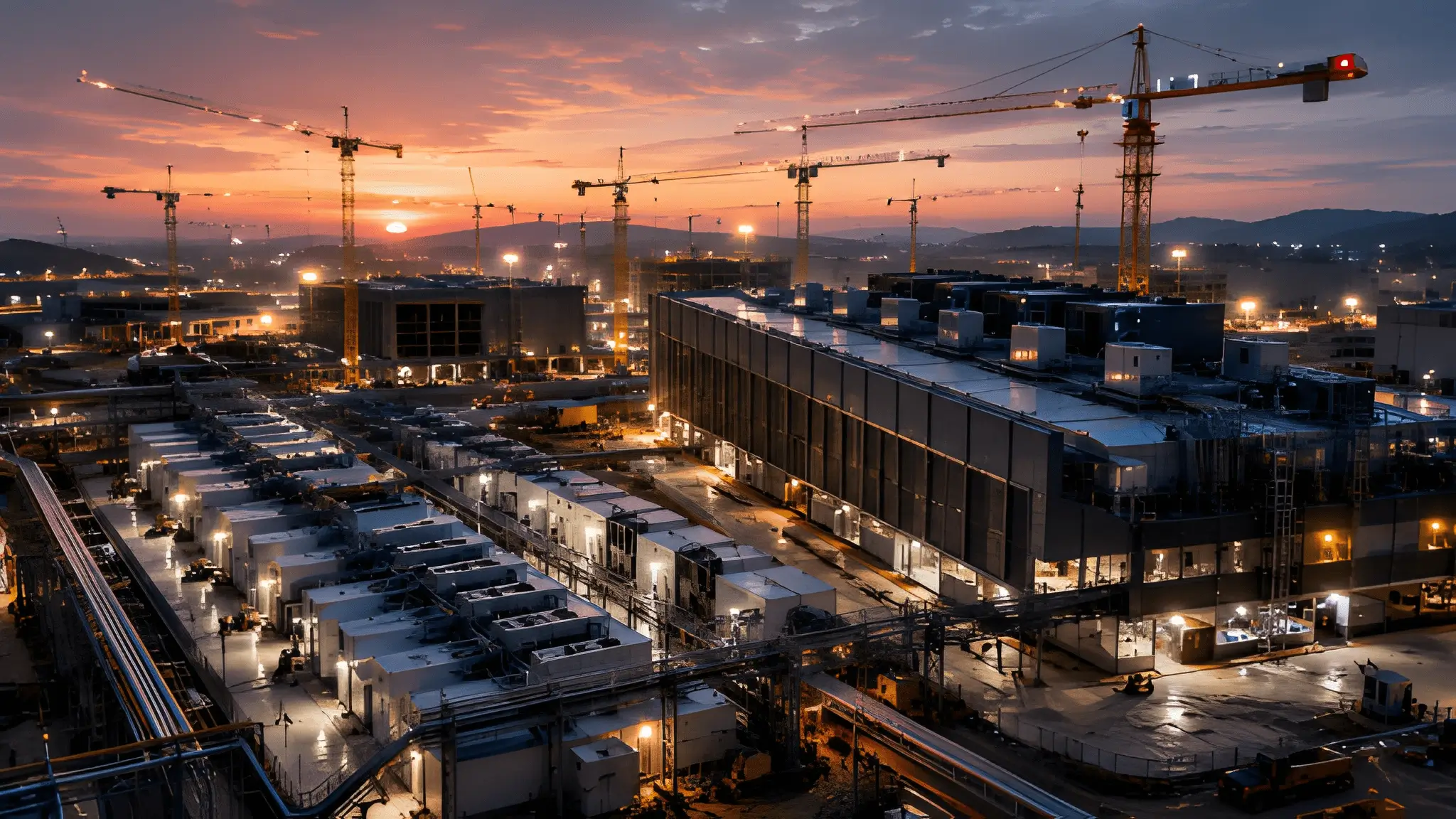
South Korea has unveiled one of the world’s largest industrial investment programs, committing nearly 1.8 quadrillion won (about US$1.2 trillion) toward semiconductor manufacturing and AI data center infrastructure over the coming decade. The initiative combines public and private capital to strengthen the country’s position in artificial intelligence while accelerating industrial development beyond the Seoul metropolitan region. Officials expect the strategy to reinforce South Korea’s leadership in advanced memory chips as global AI demand continues reshaping technology supply chains. The announcement also reflects a broader national effort to build regional technology ecosystems capable of supporting future AI infrastructure growth.

The investment package arrives as artificial intelligence continues driving unprecedented demand for high-performance memory, advanced semiconductor manufacturing capacity, and large-scale computing infrastructure. South Korea already plays a central role in the AI hardware ecosystem through its leadership in memory semiconductor production, giving policymakers an opportunity to deepen the country’s strategic advantage. At the same time, the government is attempting to distribute future industrial growth more evenly across regions that have historically received less investment. The combined strategy links semiconductor production, AI computing capacity, and regional economic development under a single national industrial framework. “Speed is the only path to survival. We must secure the core elements of artificial intelligence faster than any other nation,” South Korean President Lee Jae-myung said in Seoul at an event to unveil the public-private collaboration.
Samsung and SK Hynix Anchor New Semiconductor Manufacturing Hub
The government’s semiconductor strategy centers on an 800 trillion won investment led by Samsung Electronics Co. and SK Hynix Inc. The companies will jointly establish a new semiconductor manufacturing hub in South Korea’s southwestern region, representing one of the country’s largest chip production investments to date. According to the government’s plan, the project will consist of four semiconductor fabrication plants designed to expand national manufacturing capacity while diversifying production beyond existing industrial clusters. Each company will construct two fabrication facilities under the initiative. South Korean Minister of Trade, Industry and Resources Kim Jung-kwan said the project represents a major step toward creating a second semiconductor production center capable of supporting long-term industry growth.
The expansion also aligns with the administration’s objective of reducing regional economic disparities while strengthening national manufacturing competitiveness. Meanwhile, government officials indicated that regulatory procedures will be streamlined to accelerate project execution and shorten construction timelines. “We will develop the southwestern region into a second semiconductor production hub,” he said. “Permit approvals and construction timelines will be dramatically shortened to rapidly expand production capacity,” he said. “Through this, we will maintain an overwhelming market leadership and a decisive technological gap in the memory semiconductor sector.”

Government Maps Long-Term AI Data Center Expansion
Alongside the semiconductor investment, South Korea announced plans to direct 1 quadrillion won, or approximately US$650 billion, toward AI data center development over the next decade. The initiative aims to expand national computing capacity as demand for AI training and inference infrastructure continues increasing across industries. The program forms a key pillar of the country’s broader artificial intelligence strategy, supporting domestic AI development while attracting future technology investments. South Korean Minister of Science and ICT Bae Kyung-hoon outlined additional infrastructure targets extending beyond the initial investment period. Government projections call for significant expansion of national AI computing capacity through the mid-2030s as the country prepares for larger-scale AI workloads. The investment represents the largest AI infrastructure commitment ever announced by South Korea. “By 2035, an additional 10-gigawatt AI data center will be built, with a total investment exceeding 18.4 gigawatts and 1,000 trillion won,” Bae said.
The investment program places particular emphasis on South Korea’s Honam region, including Gwangju and the Jeolla provinces, areas that have traditionally lagged behind the country’s southeastern industrial corridor. Policymakers view semiconductor manufacturing and AI infrastructure as catalysts for creating a more balanced national economy while reducing dependence on the capital region. The strategy also reflects President Lee’s broader industrial development agenda focused on expanding advanced manufacturing into underserved regions. Industry observers note that regional diversification could create new economic opportunities while easing pressure on existing industrial clusters around Seoul. However, successfully building an entirely new semiconductor ecosystem will require substantial investment across suppliers, logistics, workforce development, and supporting infrastructure. The long implementation timeline could become a defining factor in determining whether the regional strategy achieves its intended economic impact.
Execution Risks Remain Despite Ambitious Scale
Although the investment announcement signals strong government support for AI infrastructure, analysts caution that execution challenges remain significant. Companies must balance the costs of constructing new manufacturing facilities with the practical realities of relocating operations and building supply chains outside established industrial centers. Financial commitments on this scale also require sustained policy support over multiple years to maintain momentum. Sejong University business administration professor Kim Dae-jong warned that insufficient incentives could discourage companies from relocating production, potentially weakening the broader industrial strategy.
“It is essential to minimize the financial burden, amounting to hundreds of trillions of won, as well as the time-related risks faced by companies,” he said. Analysts also point to the southwest’s renewable electricity resources as a strategic advantage for future semiconductor manufacturing and AI data center operations, particularly as technology companies increase commitments to cleaner energy sourcing. Therefore, access to renewable power could strengthen the region’s appeal for long-term infrastructure investment. Even so, experts believe creating a competitive semiconductor ecosystem from the ground up will require years of sustained development. “Establishing production lines from scratch could take more than five years,” Sangmyung University semiconductor engineering professor Lee Jong-hwan said. “The biggest challenge is that most skilled workers and suppliers remain concentrated around the Seoul metropolitan area.”
Market Response Highlights Investor Caution
Financial markets responded cautiously following the announcement despite the unprecedented investment scale. Samsung Electronics shares closed nearly 5% lower, while SK Hynix declined 1.7%, extending losses from the previous trading session. The pullback suggests investors remain focused on long-term profitability as global semiconductor manufacturers continue expanding production capacity to meet AI-driven demand. Although artificial intelligence has significantly increased demand for advanced memory chips, market participants continue monitoring supply growth and competitive pressures across the semiconductor sector. South Korea’s latest investment strategy positions the country to capture future AI infrastructure demand, but its success will ultimately depend on execution speed, regional industrial development, and the ability to sustain technological leadership in an increasingly competitive global market.











