
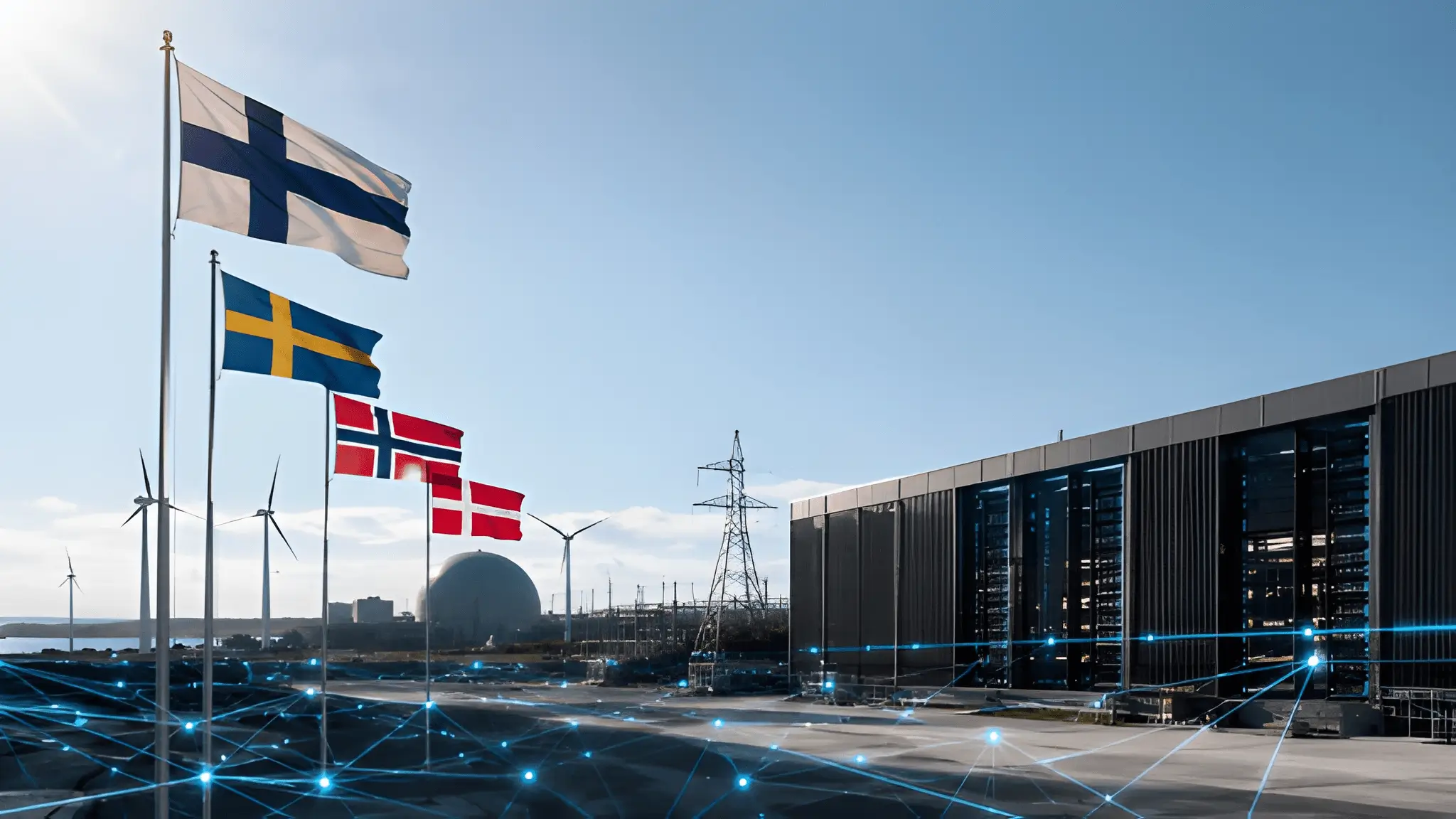
The Nordic region is entering a new phase of digital infrastructure expansion, where strong investor demand now meets stricter energy oversight. Sweden, Norway, Denmark, and Finland are either introducing or evaluating tighter licensing frameworks as governments seek greater control over the growing electricity demands of hyperscale facilities. The policy shift reflects increasing concern that rapid AI and cloud infrastructure development could place additional pressure on national power systems. Even so, developers continue to advance projects across the region, underscoring the long-term appeal of Nordic markets for large-scale data center investment.

The region continues to attract cloud and AI infrastructure capital because of its naturally cool climate, stable renewable power supply, and mature electricity networks. These advantages help reduce cooling costs while supporting corporate sustainability goals, making Nordic countries attractive destinations for international technology companies. Governments, however, are increasingly focused on ensuring new capacity does not compromise domestic energy security or raise electricity costs for consumers. As a result, policy discussions have shifted from encouraging investment alone to balancing growth with long-term grid resilience.
Finland Pushes New Power Requirements for Hyperscale Facilities
Members of the liberal-conservative Kokoomus (National Coalition) party want legislation requiring large data centers to secure matching new electricity generation capacity before connecting to the national grid operated by Fingrid. The proposal follows growing concern over the increasing volume of applications for hyperscale projects across the country. Heikki Vestman, a Kokoomus MP and chairman of the Eduskunta’s (National Parliament) Constitutional Law Committee (CLC), argued that tighter permitting standards are necessary to protect households and domestic industries from higher electricity costs. “The opportunities for investment and economic growth that datacentres present are welcomed but cannot be allowed to take place at the expense of households and Finnish industry.” The proposal has also received backing from Finland’s main opposition party, the Social Democrats (SDP). Deputy chairman Pinja Perholehto has called for stronger energy consumption obligations covering both future and existing data centers while encouraging greater operational flexibility and higher efficiency standards.
The cross-party support suggests that stricter oversight of large digital infrastructure projects could become a lasting feature of Finland’s energy policy. Finland is also reshaping the economics of data center operations through tax reform. Beginning July 1, 2026, electricity consumed by data centers will move from the lower industrial electricity tax category to the standard rate. The change will increase electricity taxes by 2.19 euro cents per kilowatt-hour and is expected to generate an additional €47 million in annual tax revenue for the government. The Ministry of Economic Affairs and Employment estimates that projects currently planned or under construction could collectively require more than 2,000 megawatts of electricity. By comparison, Finland produced approximately 9,700 MW of electricity from all generating facilities during 2025, illustrating how rapidly digital infrastructure could reshape national power demand.

Microsoft Expands Long-Term Commitment to Finland
Major technology companies continue to invest despite the evolving regulatory landscape. Microsoft recently completed the purchase of approximately 470 acres of land near Vaasa, Finland, for a potential future data center campus. The company is also pursuing cooperation with state-owned utility Fortum to recover waste heat from future facilities and supply district heating networks serving Espoo, Kauniainen, and Kirkkonummi. Teemu Vidgrén, Microsoft’s Managing Director in Finland, reaffirmed the company’s long-term plans. “Finland is becoming an increasingly important country for Microsoft, and this means we are committed to investing here for the long term.” The project reflects a broader shift toward integrating data centers into local energy ecosystems rather than treating them solely as large electricity consumers. Waste heat recovery has become an increasingly important component of Nordic infrastructure planning as governments encourage facilities to deliver measurable community benefits alongside economic investment.
Industry Forecasts Point to Multi-Billion-Euro Growth
Industry forecasts continue to indicate significant expansion across Finland’s digital infrastructure market. A joint study funded by the Finnish Data Center Association (FDCA) and the Confederation of Finnish Industries (CFI) estimates that data center investments, excluding ICT equipment, could reach €12 billion by 2030. The report projects approximately €1.7 billion in tax revenue during construction while forecasting annual sector tax contributions exceeding €400 million from 2030 onward. The study also expects industry turnover to increase from roughly €1 billion today to €4 billion by 2040.
These projections reinforce the growing importance of data centers within Finland’s broader industrial strategy, even as policymakers introduce stricter conditions governing energy consumption and grid access. Meanwhile, Sweden is pursuing a similar path by strengthening licensing standards for future facilities. Government projections value Sweden’s data center infrastructure market at approximately €900 million in 2025, up from €500 million in 2020, with expectations that it could expand to €2.5 billion by 2035. Consequently, Swedish authorities plan to require stronger energy efficiency and heat recovery measures for all new license applications to reduce pressure on national electricity networks.
Nordic Markets Shift From Capacity Race to Energy Discipline
The Nordic region is evolving beyond being simply a destination for inexpensive renewable electricity. Governments increasingly expect new data center developments to strengthen national economies while contributing to grid stability, energy efficiency, and heat reuse initiatives. Meanwhile, global hyperscale operators continue to commit capital, signaling confidence that stricter energy governance will shape, not slow, the region’s next wave of infrastructure investment. For investors and infrastructure developers, the emerging Nordic model points toward a future where access to electricity alone is no longer sufficient. Long-term project success will increasingly depend on demonstrating efficient power use, measurable economic value, and closer integration with national energy systems











