

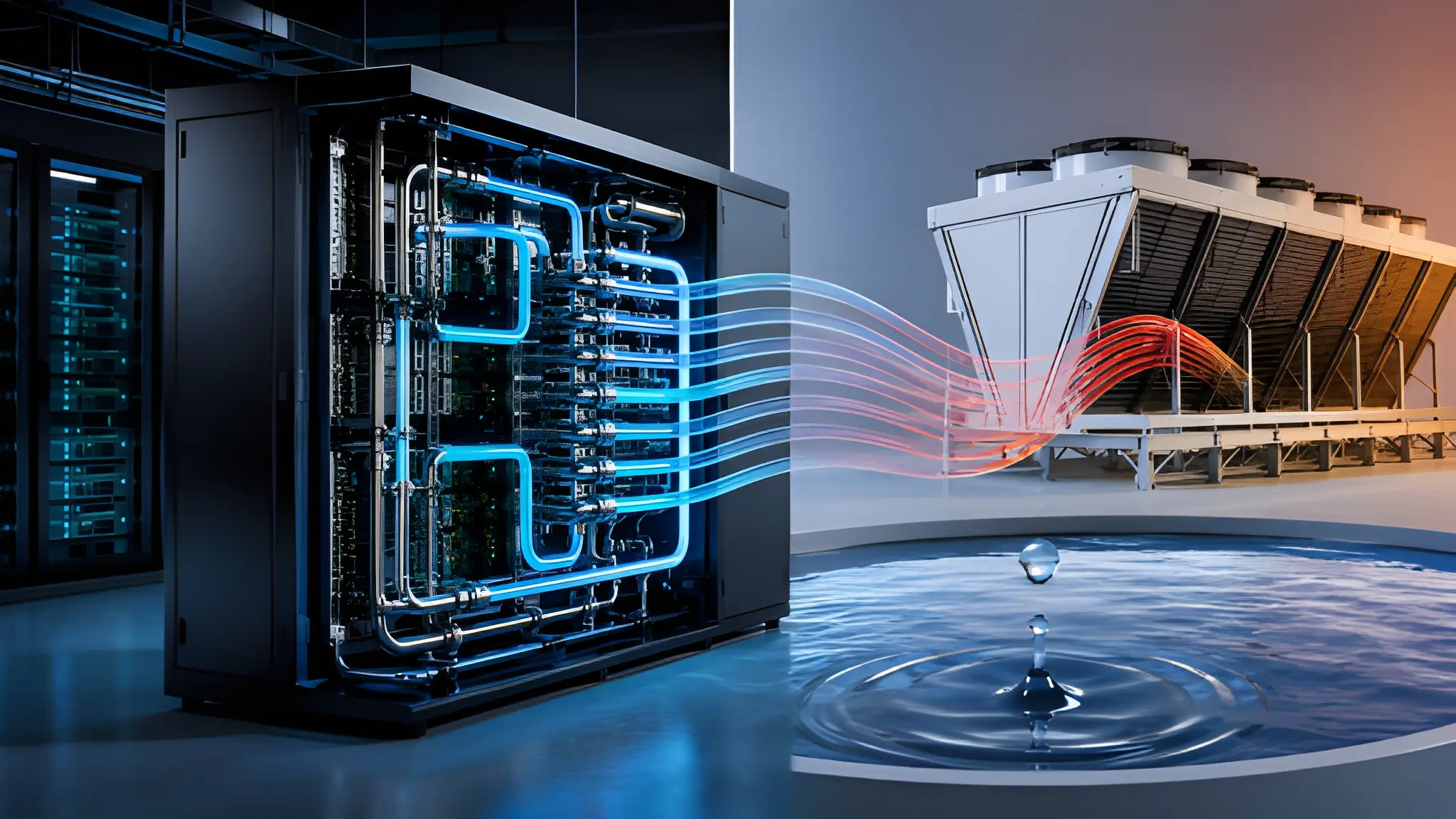
Data infrastructure has become part of a wider conversation about resource stewardship, yet discussions around cooling often blur engineering reality with simplified narratives. Reports frequently describe impressive reductions in water demand without explaining which parts of a cooling system actually consume water and which merely circulate it through controlled equipment. That distinction matters because operational decisions, infrastructure investment, and environmental planning depend on precise accounting rather than broad assumptions. Engineers evaluate cooling systems by examining where water exits the process boundary instead of how much volume passes through pipes during normal operation. Public debate rarely reflects that technical perspective, leaving stakeholders with an incomplete understanding of how thermal management has evolved. This article examines the mechanics behind water accounting, explains why recent cooling architectures change the equation, and explores how infrastructure design is reshaping long-term resource efficiency without relying on seasonal operating conditions.
The Real Leak Is Evaporation, Not Use
Water disappears from conventional cooling systems because cooling towers deliberately reject heat through evaporation rather than because equipment consumes it during circulation. Pumps continuously move water through chillers, condensers, and heat exchangers, yet most of that volume remains inside a controlled loop throughout normal operation. Evaporative cooling towers release a portion of that circulating water into the atmosphere as water vapor while also requiring periodic blowdown to control mineral concentration within the system. That lost volume must be replaced with fresh make-up water to maintain operating levels, creating the consumptive demand commonly associated with traditional facilities. Closed-loop liquid cooling changes this relationship because the coolant transfers heat within sealed circuits that prevent continuous atmospheric exposure during routine operation. Understanding this physical distinction forms the basis for evaluating water efficiency using engineering evidence instead of cumulative flow measurements that do not represent permanent loss.
Closed-loop cooling architectures rely on sealed piping, liquid distribution units, and heat exchangers that isolate the working fluid from ambient conditions throughout normal operation. Heat transfers from processors into circulating coolant before secondary systems move thermal energy toward dry coolers or other rejection equipment without requiring evaporation as the primary cooling mechanism. Equipment designers optimize these systems through improved thermal conductivity, lower flow resistance, and precise control over coolant temperature to maintain reliable processor performance under demanding computational loads. Liquid may circulate continuously for extended periods with only limited replenishment associated with maintenance activities or infrequent servicing instead of ongoing evaporative replacement. Consequently, the operational focus shifts away from replacing lost water toward maintaining thermal stability and equipment reliability across changing computational demands.
Withdrawn vs Consumed: The Metric Headlines Keep Mixing Up
Water reporting often becomes confusing because published figures combine fundamentally different measurements that describe separate aspects of facility operation. Water withdrawal refers to the total volume drawn from a source for cooling or other purposes, while water consumption represents the portion permanently removed from the local watershed through evaporation, incorporation into products, or other irreversible pathways. Large withdrawal values may appear alarming when presented without context even though a substantial percentage of that volume returns to the system or the surrounding environment after treatment. Infrastructure planners therefore distinguish between circulating inventories and consumptive losses because each metric reflects a different environmental consideration during project evaluation. Regulatory agencies, utilities, and engineering consultants rely on both measurements to assess infrastructure capacity, operational resilience, and long-term resource planning without treating them as interchangeable indicators.
Manhattan Institute analysis argues that discussions surrounding artificial intelligence infrastructure frequently overstate national water concerns by overlooking the difference between total system interaction and actual consumptive use, noting that data centers account for only a small share of overall United States water consumption relative to agriculture and thermoelectric generation. That perspective does not eliminate legitimate regional planning considerations because local water availability, drought exposure, and permitting requirements still influence infrastructure development. Meanwhile, accurate accounting allows investors, regulators, and communities to evaluate facilities using comparable environmental indicators instead of relying on aggregated numbers that combine recirculated volumes with irreversible losses. Transparent reporting also enables operators to demonstrate measurable improvements achieved through engineering modifications rather than through selective presentation of operational statistics. Consistent terminology therefore strengthens environmental governance by aligning technical reporting with the physical behavior of cooling systems operating under real production conditions.
Why Seasonal Efficiency Is Not the Same as Structural Zero
Lower ambient temperatures naturally improve the performance of conventional cooling infrastructure because cooler air increases the effectiveness of heat rejection equipment without requiring additional mechanical effort. Facilities operating in temperate climates often report lower water consumption during colder months because cooling towers run less aggressively and free cooling opportunities become available more frequently. Those improvements remain dependent on weather patterns, regional climate, and seasonal operating conditions rather than on a permanent change in system architecture. A sustained heatwave or prolonged period of elevated wet-bulb temperatures can quickly reduce those seasonal gains by increasing evaporative demand across conventional cooling systems. Engineering teams therefore distinguish climate-assisted efficiency from infrastructure that removes the underlying requirement for evaporative cooling regardless of external conditions.
Several commercially deployed dry-cooler architectures are engineered to operate at ambient temperatures approaching 45°C without relying on evaporative cooling during normal operating conditions, illustrating how structural design differs from seasonal optimization. Heat transfers from liquid cooling loops into finned heat exchangers where fans move air across the surface to dissipate thermal energy without intentionally converting water into vapor during normal operation. Performance depends on thermal engineering, equipment sizing, airflow management, and control strategies instead of continuous access to make-up water for cooling towers. Furthermore, advances in direct-to-chip liquid cooling, rear-door heat exchangers, and warm-water cooling have expanded the range of operating temperatures that support efficient heat rejection through dry systems while maintaining processor reliability. Structural elimination of evaporative loss therefore represents a fundamentally different achievement from temporary reductions that occur only when outdoor temperatures happen to support more favorable operating efficiency.
From Scarcity Story to Removal Story: The New Water Narrative
An increasing number of hyperscale operators and cooling technology providers now focus on reducing or eliminating routine operational water dependence through cooling system design rather than pursuing only incremental reductions in annual consumption. That shift reflects a broader engineering objective where infrastructure minimizes reliance on constrained local resources through design choices rather than operational adjustments alone. Eliminating evaporative cooling from routine operation reduces exposure to drought restrictions, municipal allocation uncertainty, and future permitting constraints that could otherwise influence facility expansion. The resulting approach supports long-term planning because cooling capacity becomes more closely tied to electrical infrastructure, heat exchanger performance, and airflow management than to continuous water availability. Operators also gain greater flexibility when selecting deployment locations because cooling systems place less demand on regional freshwater supplies under normal operating conditions.
Heat reuse provides a practical demonstration of this architectural transition because thermal energy that once required disposal can support productive applications beyond the data hall. Warm liquid exiting high-density computing equipment retains sufficient temperature for district heating networks, industrial processes, domestic hot water systems, or nearby commercial buildings when supported by appropriate infrastructure. Recovered heat transforms excess thermal energy into a usable resource, reducing the overall environmental footprint of both the computing facility and the connected energy ecosystem. Finally, this circular thermal model illustrates that efficient cooling extends beyond processor protection by integrating compute infrastructure into broader energy management strategies. Successful implementations across Europe have shown that thermal recovery can complement advanced liquid cooling while reducing waste heat discharged into the surrounding environment without increasing routine water consumption.
Water Efficiency Is No Longer About Doing Less Harm
Engineering priorities have advanced beyond incremental reductions in operational water demand because the most significant improvements now originate from eliminating the mechanisms responsible for routine consumptive loss. Closed-loop liquid cooling, dry heat rejection, and higher-temperature thermal architectures collectively demonstrate that infrastructure performance no longer depends on continuous evaporative replacement under normal operating conditions. Clear differentiation between withdrawn water and consumed water provides a more accurate framework for evaluating environmental performance and comparing cooling technologies across different deployment models. Public discussions become more meaningful when they focus on physical system behavior instead of aggregated volume figures that overlook recirculation and permanent loss as separate engineering outcomes. Continued investment in advanced thermal management will remain essential as computational density increases and artificial intelligence workloads place greater demands on cooling infrastructure.
Closed-loop cooling does not eliminate the need for responsible environmental planning because facilities still require comprehensive assessment of power availability, land use, permitting, and regional infrastructure capacity before construction begins. It does, however, establish a demonstrated pathway for facilities that combine closed-loop liquid cooling with dry heat rejection to separate future compute growth from routine evaporative freshwater consumption through engineering decisions that remove evaporation from normal cooling operations. That distinction represents a meaningful threshold for an industry expected to support increasingly intensive computational workloads over the coming decade. Reliable thermal management now depends more heavily on system integration, heat transfer efficiency, and equipment design than on continuous replenishment of evaporated water. Organizations evaluating future infrastructure strategies should therefore examine cooling architecture through the lens of structural resource independence rather than seasonal operational performance alone.










