
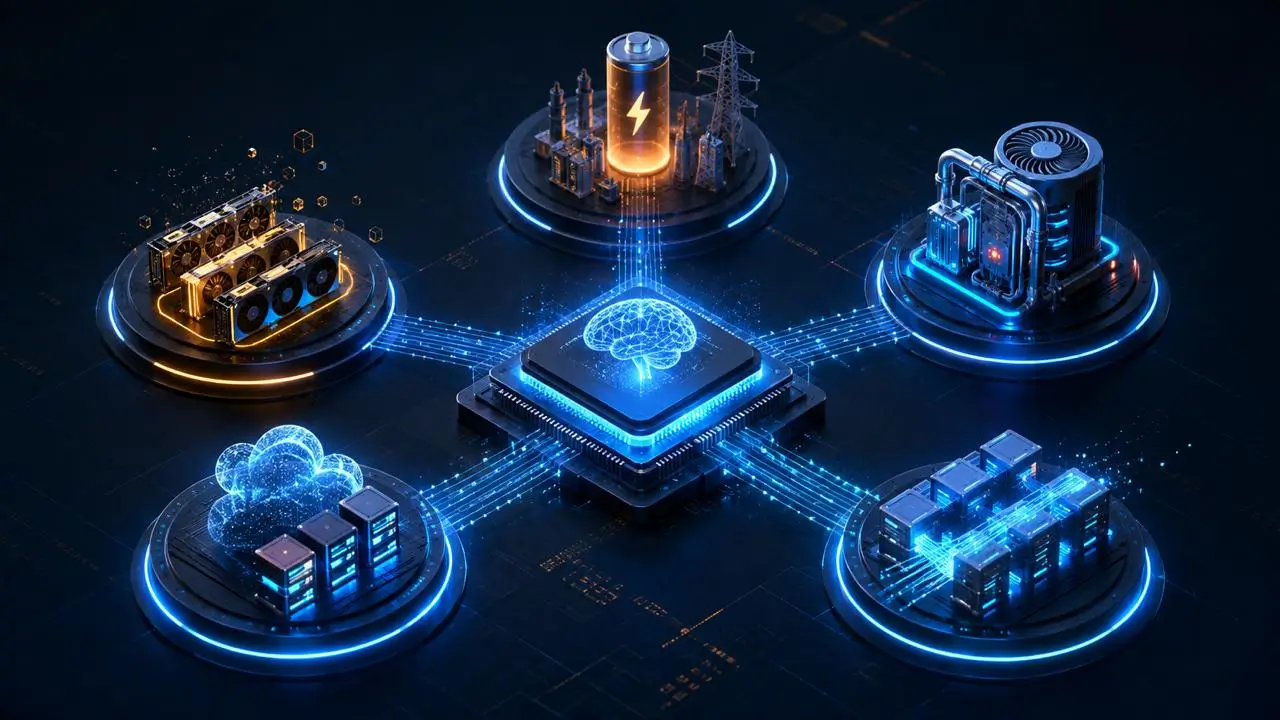
AI is reshaping data center design as AI workloads increase requirements for accelerated computing, electricity, cooling, networking, and supporting infrastructure. The infrastructure supporting advanced models now has to accommodate concentrated compute, increasingly demanding inference workloads, tighter power availability, and higher thermal loads without sacrificing operational resilience. For technology leaders, the challenge is no longer simply acquiring enough accelerators to support model development, because the surrounding architecture increasingly determines how efficiently those accelerators can operate at scale.

Power delivery, cooling, networking, facility design, and workload orchestration increasingly interact in the design and operation of infrastructure supporting large-scale AI workloads. The International Energy Agency estimates that global data center electricity consumption could reach around 945 TWh by 2030, while accelerated servers driven largely by AI adoption are projected to grow faster than conventional server demand. In 2026, these pressures highlight five infrastructure trends that are relevant to investment decisions, deployment models, and operational priorities across the enterprise technology landscape.
1. AI Compute Is Moving Toward Higher-Density Architectures
Compute architecture is increasingly incorporating accelerated servers and tightly integrated systems designed to support AI workloads alongside conventional computing environments. GPUs and other specialized processors increasingly operate as coordinated clusters. These systems require high-bandwidth interconnects and low-latency communication to keep distributed workloads moving efficiently. This changes the infrastructure equation. Performance now depends not only on processor capability but also on how quickly data moves between processors, memory, storage, and networking. The resulting architecture places greater importance on topology, memory bandwidth, interconnect performance, and workload placement when organizations evaluate capacity. Data center operators therefore increasingly need to evaluate the complete compute fabric when deploying distributed AI workloads rather than considering individual servers in isolation.
This shift also increases the value of infrastructure designs that can support dense accelerator configurations without creating disproportionate power, cooling, or network bottlenecks. From a C-level perspective, higher density changes capital planning because a facility designed for conventional workloads may not translate directly into an efficient environment for large-scale AI deployments. The IEA estimates that accelerated servers could account for almost half of the net increase in global data center electricity consumption through 2030, highlighting how strongly compute architecture influences future energy requirements. Higher-density clusters can make infrastructure imbalances more consequential, because insufficient network capacity, power delivery, or cooling capability can limit the effective utilisation of compute resources.

This makes infrastructure utilisation a business metric as much as an engineering metric, particularly when accelerator capacity represents a significant portion of technology expenditure. Enterprises evaluating new facilities or cloud commitments therefore need to examine performance per unit of power, usable compute capacity, interconnect efficiency, and workload throughput together. The central question in 2026 is increasingly how much productive computation an organisation can extract from its entire infrastructure investment rather than how many processors it can procure.
2. Power Availability Is Becoming a Strategic Infrastructure Constraint
Electricity has moved closer to the centre of AI infrastructure strategy because large-scale computing requires substantial and predictable power availability. The IEA reported that global data center electricity demand increased by 17% in 2025, while electricity demand from AI-focused data centers grew even faster, creating additional pressure on grids and energy supply chains. The organization also identified constraints involving transformers, gas turbines, advanced chips, and other infrastructure components that can limit how quickly new capacity comes online. These constraints mean that a technically viable data center project may still face delays because the required grid connection, electrical equipment, or supporting infrastructure cannot arrive on the same schedule as the computing hardware.
Consequently, site selection is increasingly influenced by access to dependable electricity and the practical timeline for securing that capacity. Power strategy now extends beyond estimating annual electricity consumption because AI workloads can create concentrated demand that affects facility design and local grid planning. The IEA highlights that data centers are becoming increasingly significant sources of electricity demand and that the geographic concentration of large facilities can create additional challenges for grid integration, illustrating why power requirements are an important consideration in AI-oriented infrastructure planning. The United States Department of Energy has highlighted projections from Lawrence Berkeley National Laboratory indicating that data centers could account for a substantially larger share of U.S. electricity consumption by 2030 as demand from computing and AI workloads expands.
These figures do not imply that every enterprise will build facilities at hyperscale, but they demonstrate why power procurement, grid interconnection, backup capacity, and energy strategy now belong in senior technology investment discussions. For executives, electricity availability is increasingly a prerequisite for compute expansion rather than a secondary operating consideration after the facility location has already been selected.
3. Liquid Cooling Is Moving Into the Core Facility Design Conversation
Thermal management is becoming a defining consideration as higher-density computing increases the amount of heat generated within individual racks and systems. Traditional air cooling remains relevant across a wide range of enterprise environments, but higher-density accelerator deployments create situations where air alone may become less practical or less energy efficient. Direct-to-chip liquid cooling provides a different approach by transferring heat from high-power components through a liquid-based cooling loop, reducing reliance on moving large volumes of air through increasingly dense equipment. Industry research presented through a 2026 451 Research market report indicates that operators are evaluating combinations of liquid and air cooling technologies, including direct-to-chip systems, as they respond to the thermal requirements of higher-density computing environments. The implication for infrastructure leaders is that cooling decisions increasingly need to align with processor selection, rack design, power density, facility configuration, and long-term expansion plans.
Cooling strategy also affects facility efficiency because the thermal architecture determines how much supporting energy the site consumes and how flexibly it can accommodate future hardware. NVIDIA’s 2026 discussion of its Rubin-generation infrastructure describes a fully liquid-cooled design and highlights operation with coolant temperatures as high as 45°C, providing a vendor example of integrated thermal architecture for high-density AI systems. Such vendor-specific implementations should not be treated as universal benchmarks, but they demonstrate the direction of engineering development toward closer integration between compute hardware and cooling systems. Organisations planning AI capacity therefore need to evaluate cooling at the system and facility levels rather than treating it as an auxiliary mechanical requirement. The resulting investment decision involves balancing capital cost, energy efficiency, maintenance complexity, water considerations, equipment compatibility, and the expected evolution of processor power density.
4. Networking Is Becoming as Important as Compute Capacity
Large AI workloads depend heavily on communication between processors, which increases the importance of high-performance networking throughout the infrastructure stack. Training and inference systems can distribute workloads across large numbers of accelerators, making latency, bandwidth, congestion management, and network topology important factors in overall application performance. A powerful accelerator cluster cannot deliver its full potential if data movement between components becomes the limiting factor, because processors may spend time waiting for information rather than performing useful computation. This makes network architecture an important part of workload performance engineering for distributed AI systems rather than solely a supporting layer considered after compute capacity. For enterprise leaders, the implication is straightforward: infrastructure procurement must evaluate compute and networking as a coordinated system when workloads depend on distributed processing.
The networking challenge also extends beyond raw bandwidth because AI environments require predictable performance across increasingly complex infrastructure stacks. High-density accelerator clusters place greater demands on switches, interconnects, optical systems, cabling, and software that manages communication between distributed resources. This creates new operational requirements around monitoring, congestion, fault isolation, and capacity planning. A single network issue can reduce the utilization of an entire compute cluster instead of affecting just one application. Infrastructure teams therefore need better visibility into the relationship between application performance and network behaviour, especially as AI workloads become more distributed across facilities and cloud environments. In practical terms, the value of additional compute capacity depends partly on whether the surrounding network can sustain the required data movement without introducing avoidable bottlenecks.
5. AI Infrastructure Is Becoming an Integrated Power, Compute, and Operations System
The final trend is less about one specific technology and more about how infrastructure decisions are increasingly connected across the entire operating model. Compute procurement, electrical capacity, cooling architecture, networking, facility construction, and workload orchestration now influence one another, which makes isolated optimisation increasingly difficult. The 2026 451 Research analysis identifies high-voltage DC distribution, solid-state transformers, energy storage, and advanced liquid cooling among technologies being explored as organisations respond to demanding AI workloads. These developments indicate growing integration between electrical, thermal, and computing architectures as infrastructure providers respond to the requirements of high-density AI workloads. For senior leaders, this means traditional technology planning cycles may need to incorporate facility engineering, energy procurement, and infrastructure operations much earlier in the decision process.
The operational model is changing as well because infrastructure performance increasingly depends on coordinating resources across multiple layers rather than optimising each component independently. Google’s 2026 State of AI Infrastructure report, based on a survey of more than 1,400 senior IT leaders, highlights the growing infrastructure demands associated with agentic AI and reports that 83% of surveyed organisations need infrastructure upgrades to support those workloads. That finding represents Google’s survey rather than a universal industry benchmark, yet it reinforces a broader pattern in which new AI workloads create requirements that existing environments may not satisfy without architectural changes. Organisations therefore need infrastructure strategies that can evolve as workloads shift between training, inference, retrieval, and increasingly autonomous task execution. In 2026, the strongest infrastructure decisions will likely come from treating compute, power, cooling, networking, and operational software as parts of one performance and capacity system rather than as independent technology purchases.
Conclusion
AI infrastructure in 2026 is being shaped by higher compute density, growing power requirements, evolving cooling architectures, increasing networking demands, and closer integration between facility and technology operations. These trends do not operate independently because each one can influence the economics and feasibility of the others, creating a more interconnected planning environment for technology executives. Deploying denser accelerator systems increases power demand. That affects site selection, electrical architecture, cooling requirements, and network design simultaneously. Similarly, improvements in model efficiency can reduce the resources required for individual tasks while growing adoption increases the overall volume and complexity of workloads.
The IEA’s 2026 analysis captures this tension by noting that power consumption per AI task is declining rapidly even as broader adoption and energy-intensive applications continue to increase demand. For C-level decision-makers, the priority is therefore not simply expanding capacity but building an infrastructure strategy that can balance performance, reliability, energy availability, thermal management, and long-term capital efficiency.











