 Skip to content
The heat problem is becoming an infrastructure problem
AI data centers now face a thermal challenge tied directly to compute density. High-performance GPUs place substantial electrical loads inside increasingly compact rack designs. As rack power rises, conventional air cooling becomes harder to scale economically. Uptime Institute identifies rack density and processor heat loads as leading drivers of direct liquid cooling adoption. Its broader research also shows that air cooling remains dominant across much of the data center sector. That creates an important choice for operators planning new AI capacity. Immersion cooling changes the thermal equation by placing compatible hardware inside a dielectric fluid. The question for end users is whether that thermal advantage justifies the operational changes that follow.

Immersion cooling changes where the heat goes
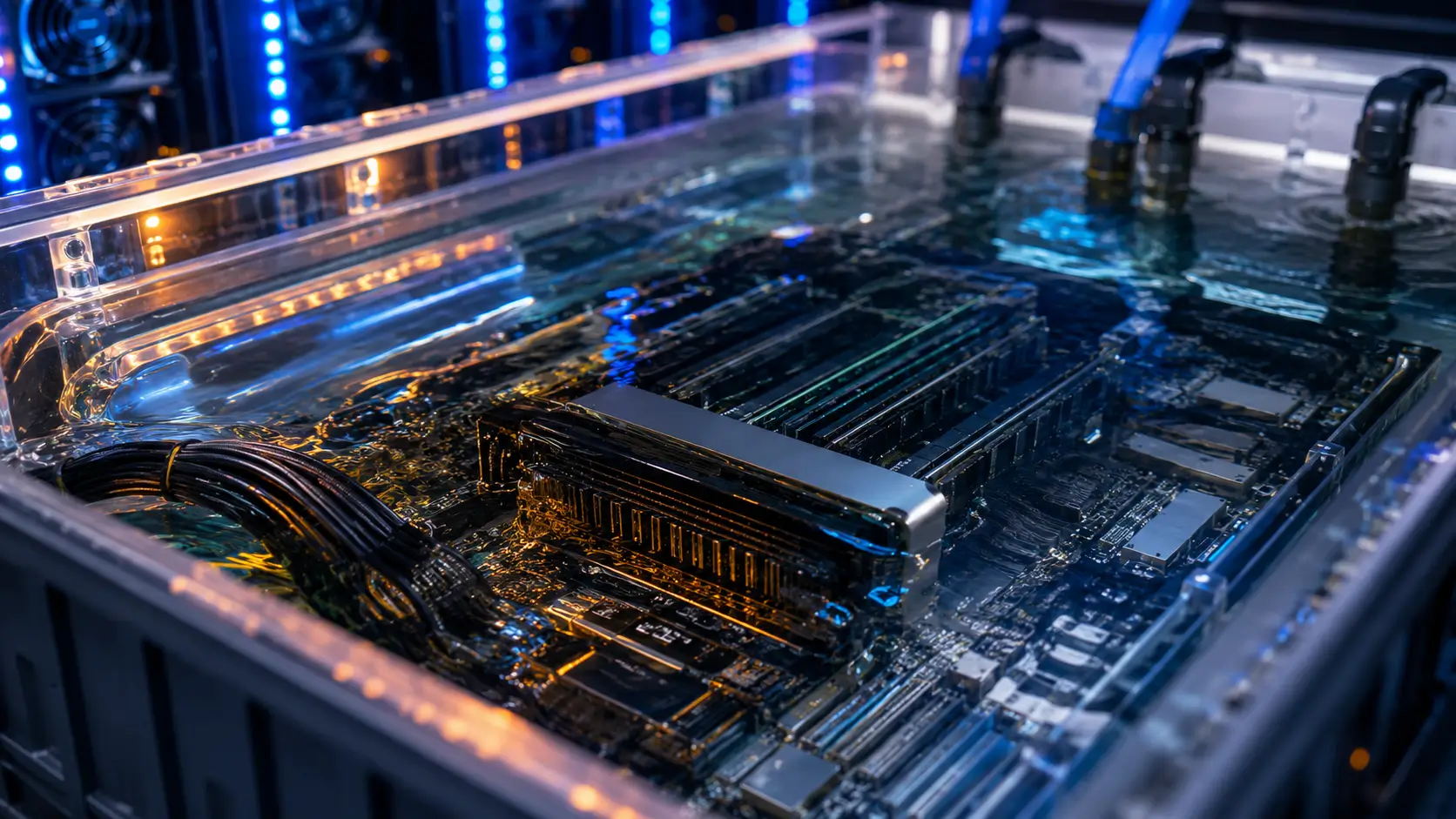
Immersion cooling moves heat away from components through direct contact with a dielectric liquid. Single-phase systems circulate liquid through pumps and heat exchangers during normal operation. Two-phase systems instead use evaporation and condensation to transfer heat. Both approaches can handle thermal loads that challenge conventional air-based systems. Immersion can also reduce dependence on IT airflow management inside high-density environments. Uptime Institute says immersion systems can support vat loads above 150 kW without air-cooling support. Newer industry activity also shows growing interest in immersion for AI infrastructure. For an end user, the main attraction is greater thermal headroom during sustained compute workloads.
The efficiency argument needs more precision
The efficiency case for immersion cooling needs more than a simple comparison between air and liquid. Liquids transfer heat more effectively than air under comparable engineering conditions. That advantage can reduce some energy requirements within the cooling system. However, the complete efficiency result depends on the surrounding infrastructure. Pumps, cooling distribution units and heat exchangers all consume energy. Heat rejection equipment also influences the final power requirement of the facility. Higher coolant temperatures can create opportunities for free cooling or heat reuse in suitable designs. End users should therefore assess cooling performance alongside total facility power rather than one component alone.
Density is where immersion becomes more compelling
The strongest case for immersion appears when AI workloads create extreme rack power. Uptime Institute places liquid cooling among technologies typically used above 50 kW per rack. It also expects more complete liquid cooling at rack powers approaching 150 kW or higher. These figures should not become universal engineering limits for every facility. They instead illustrate how cooling choices increasingly follow workload density. High-power accelerator racks create different thermal requirements from conventional enterprise CPU deployments. Immersion can become attractive when air-cooling capacity becomes a major deployment constraint. That makes the technology particularly relevant where power or space limits further expansion of high-density compute.
The operational trade-off is harder to ignore
Thermal performance represents only one part of the immersion cooling decision. Hardware compatibility becomes important because not every system can operate with every dielectric coolant. Uptime Institute notes that operators must confirm immersion support for each hardware type. Liquid cooling can also narrow equipment choices compared with conventional air-cooled environments. Service procedures change when technicians work around tanks, coolant and submerged equipment. Those changes can affect maintenance processes and responsibilities between IT and facilities teams. Mixed environments may also create more complex support requirements when only some systems use immersion. Operators should therefore treat immersion as an infrastructure redesign rather than a simple cooling replacement.
The fluid itself becomes part of the infrastructure equation
Coolant selection creates another long-term consideration for operators evaluating immersion architectures. Single-phase systems keep dielectric fluid in a liquid state during normal operation. Two-phase systems depend on evaporation and condensation to move heat through the system. That difference creates distinct requirements for fluid management and equipment design. Fluid availability also matters when operators plan infrastructure for long service lives. Uptime Institute has highlighted the impact of 3M’s PFAS production withdrawal on Novec fluids. Those fluids have been used in some two-phase immersion applications. End users should therefore evaluate availability, compatibility, service requirements and environmental considerations before deployment.

Immersion should not become the default answer
The industry evidence does not support immersion cooling as a universal answer for AI infrastructure. Uptime Institute’s research shows that liquid cooling adoption remains gradual across the wider data center market. Traditional air cooling still serves a large share of existing data center environments. Liquid cooling remains especially relevant where air cooling becomes difficult to scale. That distinction matters because AI workloads do not all create identical thermal requirements. Smaller inference systems may have less economic justification for full immersion. Direct-to-chip cooling and rear-door heat exchangers can address some high-density requirements. The right architecture should therefore depend on workload density, hardware and facility constraints.
The end-user decision should begin with workload economics
End users should begin their cooling evaluation with the workload rather than the technology. Operators should establish expected rack power before selecting a thermal architecture. Accelerator utilization also matters because sustained workloads create different cooling requirements. Deployment duration and future capacity growth should enter the same assessment. High-density AI training can present a stronger case for advanced liquid cooling approaches. Enterprise inference workloads can have different utilization patterns and thermal requirements. Financial analysis should include facility upgrades, coolant distribution, maintenance and hardware compatibility. The objective should remain reliable compute delivery at the lowest sustainable total cost.
Immersion can solve the heat problem, but not the whole infrastructure problem
Immersion cooling has a credible role in high-density AI infrastructure. The technology directly addresses the thermal challenge created by concentrated compute power. It can transfer heat efficiently while supporting very high equipment densities. It can also reduce dependence on IT air cooling in suitable deployments. Uptime Institute’s recent research suggests liquid cooling will remain concentrated in high-density applications. That makes immersion a targeted infrastructure choice rather than an automatic replacement for air cooling. End users should judge the technology by the constraints it removes and the complexity it introduces. The strongest solution will create thermal headroom without replacing one infrastructure bottleneck with another.












