
Starcloud has raised $250 million in a Series A extension, giving the space-computing startup a post-money valuation of $2.3 billion as investors place a larger bet on putting AI infrastructure into orbit. Manhattan West led the round, with existing backers including Benchmark, EQT, Soma Capital, NFX and 776 joining new investors NVIDIA, Cisco Investments, Cedar Capital, Goanna Capital and Standard Capital. The financing takes Starcloud’s total capital raised since its 2024 founding to $450 million, according to the company. The latest financing marks a sharp escalation in Starcloud’s ambitions from demonstrating computing hardware in orbit to building an industrial-scale space infrastructure business.

Cisco’s participation adds expertise in networking, optical systems and AI infrastructure, areas that will become increasingly important if orbital computing expands beyond individual demonstrations. Ken Abdalla and Lauren Selig led Manhattan West’s investment, while Selig will join Starcloud’s board as an observer. Starcloud plans to direct the new capital toward manufacturing expansion, continued engineering work with NVIDIA and securing future launch capacity. The strategy reflects the company’s effort to solve several infrastructure problems at once: producing spacecraft at scale, adapting advanced computing hardware for the space environment and obtaining enough launch opportunities to deploy the resulting systems. The company is therefore positioning orbital compute as an infrastructure market rather than simply another satellite application.
NVIDIA partnership moves toward purpose-built space compute
The investment from NVIDIA follows Starcloud’s November 2025 launch of an NVIDIA H100 GPU aboard its Starcloud-1 satellite. That mission gave Starcloud experience operating high-performance computing hardware in orbit and has since become the foundation for a deeper collaboration with NVIDIA on the company’s Space-1 Vera Rubin Module. NVIDIA describes the module as a space-focused accelerated-computing platform designed for demanding orbital workloads, with the company saying it can deliver up to 25 times more AI compute per GPU than the H100 for space-based inference. Philip Johnston, Co-Founder and CEO, Starcloud, said, “Last November we put the first NVIDIA H100 in orbit. Today this fresh capital empowers us to build the infrastructure to launch many more of NVIDIA’s most advanced GPUs into space.”
Aleem Rizvon, Vice President, Cisco Investments, said, “Cisco has long been a leader in secure data center infrastructure and looks forward to bringing that expertise to the emerging world of orbital data centers. Cisco Investments is excited to invest in Starcloud as they expand data centers into space.” Starcloud-1 has already supported several computing demonstrations, including training an AI model, running a version of Google’s Gemini and performing inference and fine-tuning workloads on high-performance computing hardware. Those demonstrations matter because the economics of orbital computing depend not only on putting processors above Earth, but also on proving that complex workloads can operate reliably under space constraints. NVIDIA’s broader space-computing strategy similarly centers on processing data closer to where satellites generate it, reducing dependence on transmitting large volumes of raw information to Earth.
Starcloud targets 88,000-satellite computing network
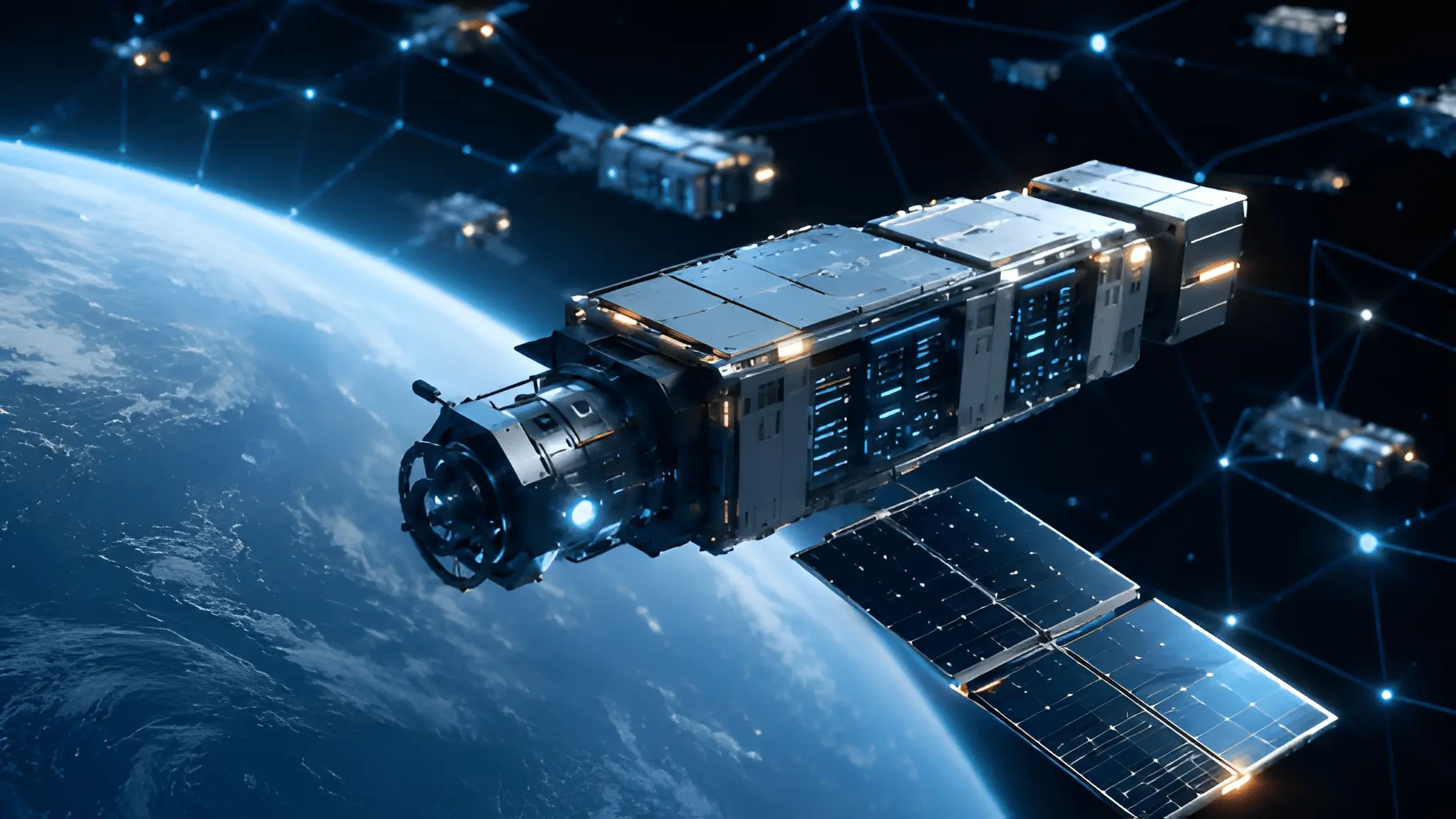
Starcloud’s longer-term plan is considerably larger than its current spacecraft operations. The company is targeting a constellation of 88,000 satellites with 20 gigawatts of computing capacity, a scale that would transform its proposal from an experimental orbital platform into a distributed computing network. The ambition also creates a substantial dependency on launch availability, manufacturing throughput and the economics of deploying large numbers of spacecraft. The company is building a 100,000-square-foot manufacturing facility in Woodinville, Washington, where production of its next-generation Starcloud-3 spacecraft is underway.
Starcloud-3 represents the next step in its hardware roadmap as the company seeks to move from a successful orbital demonstration toward repeatable production. The facility gives the startup a physical manufacturing base from which it can pursue the much larger deployment volumes implied by its proposed constellation. Starcloud’s latest funding therefore arrives at a pivotal point for the orbital data-center sector. The company now has substantial investor backing, a growing relationship with NVIDIA and a manufacturing program designed for larger spacecraft deployments. The central test will be whether those advantages can translate into reliable launch access and economically competitive computing capacity at the scale required to make orbital data centers a meaningful part of the global AI infrastructure stack.












