
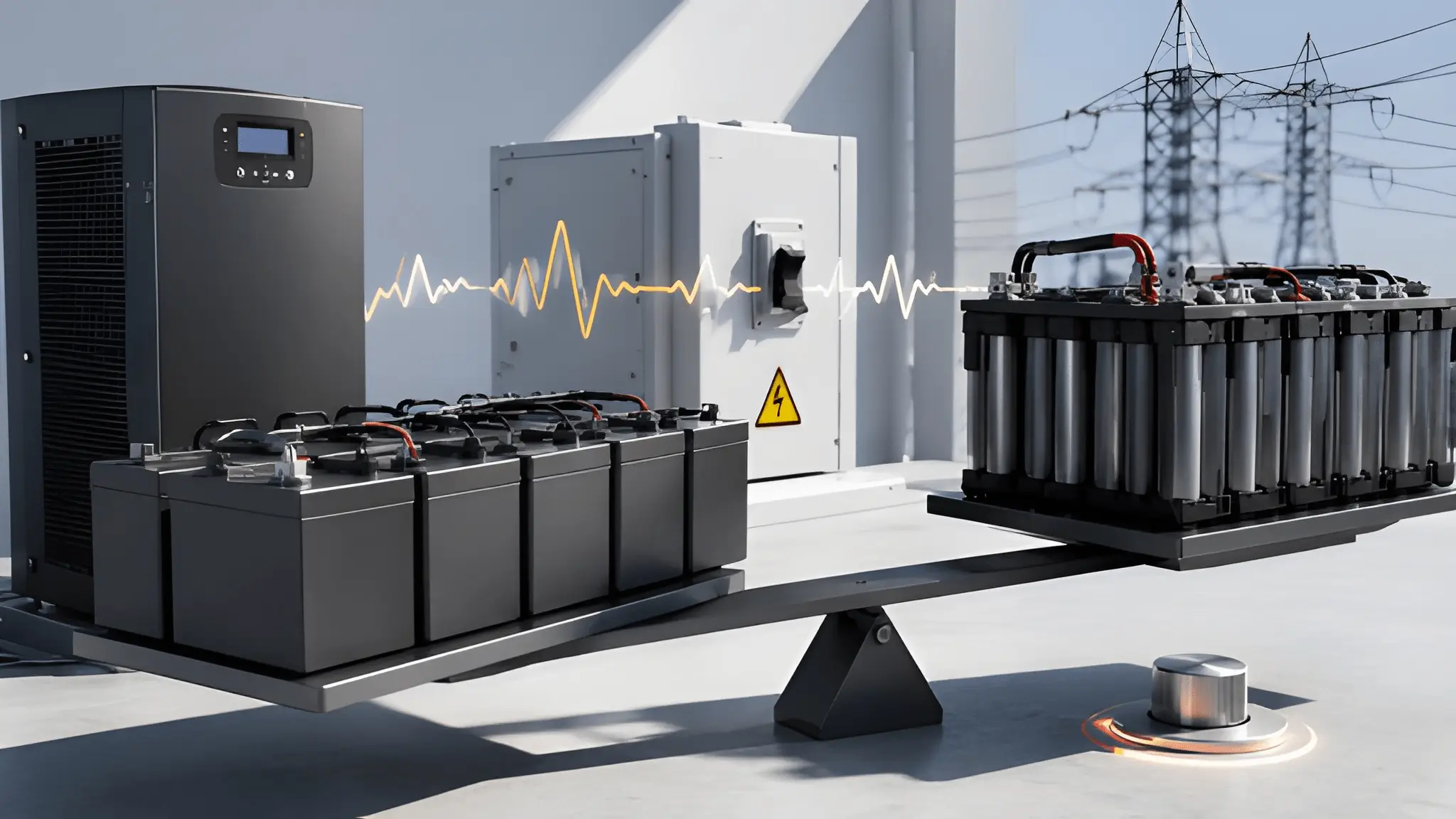
A conventional UPS string exists primarily to buy seconds or minutes, not to serve as a substitute power plant for hours at a stretch. Engineers typically size these systems around a defined ride-through requirement: utility power drops, and the generator needs time to spin up and stabilize. That gap typically runs somewhere between ten and thirty seconds in generator-backed configurations, while some systems specify longer battery runtimes depending on site requirements. Engineers therefore generally specify battery blocks, breakers, chargers and thermal management around the required backup duty rather than automatically around a multi-hour dispatch signal from a utility desk. When a flexibility program asks a site to stay off the grid for an hour or more, it can ask conventional UPS hardware to perform a role beyond the duty for which that particular system originally specified it.

Bridging asks a battery string to deliver near-instantaneous power for a short interval, drawing limited depth of discharge from the available battery capacity. Dispatch asks the same string to sustain current for tens of minutes or hours, potentially pulling it toward depths of discharge that the original UPS duty cycle may not have anticipated. Battery manufacturers typically tie cycle life data to specific operating conditions, including depth of discharge, charge and discharge rates and temperature, rather than assuming that every UPS battery will experience only genuine outages. As a result, additional cycling and deeper discharge can shorten battery life, and any flexibility business case needs to account for that degradation. Retrofitting a bridging asset into a dispatch asset therefore requires teams to assess the chemistry, controls, thermal management and operating limits against the proposed service rather than assuming the existing configuration can simply absorb the new duty.
The Recharge Window No One Accounts For
Shedding load on batteries feels like the easy half of a flexibility event, and some proposals stop the analysis right there. Recovery is the harder half, because a discharged lead-acid string can require several hours to recharge depending on the depth of discharge, charger capacity and battery configuration. Lithium packs can recover faster in systems designed for higher charge acceptance, yet they still draw sustained current from the rectifier while the site resumes normal operations. During that recharge window, the string may provide less protection against a second grid event because its available state of charge has fallen, while maintenance teams must also account for the effect of testing or taking a string offline during a period when backup reserves may already have run low. A dispatch commitment that ignores this window can therefore promise more flexibility than the site can reliably deliver across successive events.
Charger sizing compounds the problem, since conventional rectifiers generally maintain battery charge rather than maximize rapid recharge after a dispatch event. Pushing more current through a charger beyond the battery system’s specified charging capability can raise heat and accelerate battery degradation, while a properly engineered system can support higher charging rates within its operating limits. Utility flexibility programs therefore need to account for what a second dispatch signal, arriving before recovery completes, would do to available runtime for the actual critical load. Facility teams that model flexibility revenue against nameplate capacity, rather than against usable energy, state of charge and realistic recharge curves, can overstate what a site can deliver on a given day. Consecutive event days can expose this gap particularly quickly because the available state of charge may not have returned to its required reserve before another event begins.
When Safety Systems Say No
Every battery installation operates within defined thermal and safety limits, and those limits do not bend for a utility’s dispatch schedule. Battery management systems in lithium-ion installations monitor parameters such as cell temperature and voltage, and protection functions can throttle or disconnect equipment when systems exceed specified operating limits. Repeated deep discharge cycles can accelerate battery degradation, and increasing internal resistance can increase heat generation for a given current. Detection and suppression architecture, from off-gas sensors to fire detection and suppression systems, addresses the hazards that the particular battery technology and installation present rather than a single assumed operating profile. Running a string harder to meet a flexibility target can therefore increase the thermal, degradation and safety constraints that the protection system manages. Facility managers must ultimately operate within those protective limits if a dispatch event conflicts with the battery system’s safe operating envelope.
Lithium chemistries generally handle repeated cycling better than legacy lead-acid in applications where their higher cycle life and operating characteristics are advantageous, but they are not immune to the same underlying constraints. Cell-level monitoring exists because lithium-ion systems require protection against abnormal voltage, current and temperature conditions that can contribute to thermal events. A battery management system does not simply become more conservative after a particular number of cycles; instead, it continuously operates within programmed voltage, temperature, current and state-of-charge limits that protect the battery and preserve its required reserve. Sites that lean on flexibility programs without assessing cooling, spacing, detection and battery-management requirements may increase the operating demands placed on their safety systems. If a protective interlock trips because a system reaches a defined operating limit, the dispatch commitment must yield to the requirement to protect the battery and facility.

What Your String Was Actually Sized For
Original sizing calculations for conventional UPS systems typically protected a defined critical load rather than the full electrical footprint of the site. Mechanical cooling, general power and support infrastructure often sat outside the UPS boundary because the system primarily served designated critical loads during an outage. Nameplate kVA describes power capability, while a dispatch commitment is also a promise about sustained energy, measured in kilowatt-hours, not simply kilowatts. Converting between the two requires knowing usable depth of discharge, battery voltage and performance under load, together with derating associated with battery condition and age, none of which owners can infer from the UPS’s kVA rating alone. Owners who skip that conversion can end up selling a kilowatt-hour figure their kilowatt-rated equipment never specifically sized to sustain.
Most conventional UPS rooms also used a redundancy strategy built primarily around component failure and maintenance rather than around daily or weekly full-string cycling. Pulling a redundant module into active service during a dispatch event can reduce the very margin that redundancy was designed to guarantee. End-of-life derating makes this worse, since a string rated for a given runtime on day one can deliver less as it ages toward replacement. The original battery specification may also contain depth-of-discharge assumptions that differ from the deeper, more frequent cycling that some flexibility services demand. Facility-level shed, depending on the program, can require power and energy beyond what a UPS room protecting only the critical load originally held. Treating the existing string as a free source of that capacity can therefore confuse what the room protects with what the grid is asking it to provide.
You Need Storage Built for Staying Off, Not Just Staying On
Genuine flexibility calls for storage architecture or UPS configurations designed around the required discharge duration, recovery time and cycling profile. It can mean separating the asset that protects critical load from the asset that serves the grid, although properly controlled grid-interactive UPS systems can perform both functions while preserving a defined backup reserve. Utilities and system operators are developing programs that use data-center storage and UPS capacity for grid services, but the duration and repetition of those services vary by program. Facilities that want to participate credibly need to budget for whatever additional storage capacity they require to meet the program’s power, energy, reserve and cycling requirements, rather than simply relabeling their existing UPS room as a grid resource. The sites that get this distinction right can make more defensible flexibility commitments, while the rest risk discovering the gap during an event a utility is counting on them to deliver.
Boards evaluating flexibility revenue should ask whether their storage supports sustained grid participation, or whether teams merely considered it for a second role after engineering it primarily for backup. Vendors pitching UPS-based flexibility programs should provide cycle life data at the actual depth of discharge the program requires, not marketing figures based on operating conditions that do not match the proposed service. Ultimately, the strongest flexibility offers are likely to come from storage purpose-built for the task and sized in kilowatt-hours from day one, while appropriately configured UPS batteries can also provide flexibility when their operating limits and required backup reserves remain intact. Facilities that make this distinction early can reduce the risk of discovering the gap live, during an event a utility is counting on them to deliver.











