
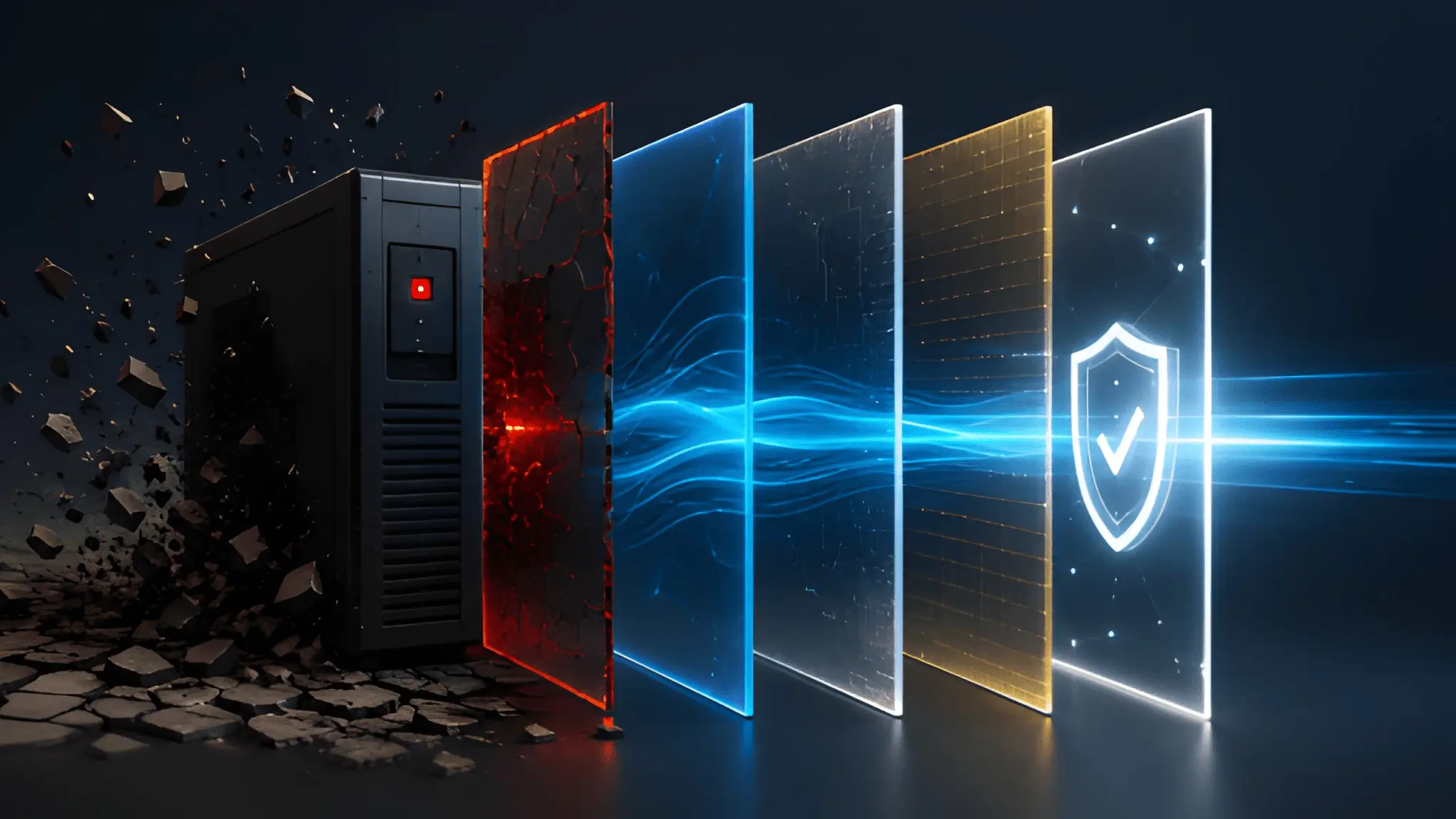
In conventional backup architectures, a power failure often made the UPS the principal ride-through mechanism while generators and transfer equipment established the alternate source. The UPS sat between the electrical disturbance and the IT load, absorbing the first shock while the rest of the backup chain tried to wake up behind it. That architecture reflected the operating sequence of systems in which generation required time to start and transfer equipment had to verify that the alternate source had reached acceptable electrical conditions before connecting the load. A UPS therefore became more than a power-conditioning device because its battery effectively represented the site’s available reaction time. Modern architectures are changing that assumption because resilience can now begin before the UPS discharges and continue through several coordinated layers after it does.

The Architecture That Made the UPS Look Like the Whole System
The old mental model was elegantly simple because each part of the backup sequence had a recognizable job, and the UPS occupied the most visible position between failure and recovery. Utility power disappeared, the UPS carried the critical load, a generator started, an automatic transfer switch waited for an acceptable alternate source, and the load eventually moved away from the stored energy path. That sequence encouraged engineers to treat the battery-backed interval as the central resilience resource rather than one phase inside a larger chain of events. The longer the transition might take, the more attention naturally moved toward extending UPS autonomy and protecting the battery-backed interval from uncertainty elsewhere in the system. That approach also created an operational bias because every weakness in generation, switching, or detection could appear to be a reason for adding more energy behind the UPS.
The distinction matters because a UPS cannot compensate indefinitely for weaknesses outside its own electrical boundary, even when its battery has adequate stored energy. A battery can sustain a load, but it cannot make an unavailable generator available, repair a failed transfer mechanism, interpret a degraded upstream source, or determine which computing workloads deserve continued power. The UPS controller can monitor its own condition and support diagnostics, but broader resilience requires visibility across generators, transfer equipment, electrical sources, storage systems, and connected loads. Modern power-monitoring systems already expose this wider architecture by collecting information from UPS equipment, generator systems, automatic transfer switches, and related electrical devices rather than treating the UPS as an isolated object. That shift creates an important design principle for high-density computing environments: the backup system should not ask one component to compensate for every uncertainty elsewhere in the power path.
The Battery Was Carrying More Uncertainty Than Energy
The most important legacy function of UPS autonomy was not simply supplying electricity during an outage; it was buying time while the rest of the electrical system established a usable alternate source. That distinction becomes clearer when the UPS is viewed as a bridge rather than a destination. Traditional backup architectures use stored energy to address the rapid transition between the interruption of normal power and the arrival of an alternate source, which means the battery’s role depends heavily on the behavior of generation and switching downstream. If those systems become faster, more observable, and more capable of coordinated action, the required role of the UPS changes without making the UPS itself obsolete. The architecture can then reserve UPS capacity for disturbances that actually require instantaneous conditioning instead of treating every possible failure as a reason to preserve the entire load indefinitely.
That change also alters how end users experience resilience because the critical question becomes whether computing remains stable during each transition rather than whether a battery can sustain the entire environment for a predetermined duration. A training workload, a storage subsystem, a management plane, and a control system do not necessarily have identical tolerance for interruption, which makes uniform battery-backed endurance an increasingly blunt design instrument. A layered system can preserve the electrical path for the workloads that genuinely need uninterrupted power while allowing other loads to respond differently when the source changes. Such an arrangement does not weaken the UPS because it gives the UPS a narrower and more technically defensible mission. The result is a resilience architecture in which stored energy protects continuity while other layers handle detection, source preparation, transfer, workload prioritization, and recovery.
Detection Is Now the First Resilience Layer
A power event can produce measurable changes in source voltage, frequency, status and other electrical conditions before an operator acts on the information, allowing monitoring and control systems to provide earlier operational visibility. Modern monitoring can turn those signals into an operational picture before a person understands that something has changed, moving resilience closer to the moment of detection rather than leaving it entirely inside the battery-backed interval. The practical consequence is subtle but important: the UPS no longer needs to absorb every uncertainty created by a poorly understood event because monitoring can establish what happened, where it happened, and which backup path remains available. This turns resilience into an information problem as well as an energy problem, with sensing and control becoming active participants in the handoff between power sources.

From Alarm Visibility to Electrical Awareness
Monitoring becomes a resilience layer when it does more than display a warning after the system has already entered an emergency state. Generator status, transfer-switch state, UPS condition, battery health, and electrical measurements can be collected together so that operators and control systems can distinguish an actual source failure from an equipment problem or an incomplete transfer sequence. That visibility matters because backup power contains multiple moving parts, and a failure in one part can leave another component appearing healthy while the overall power path remains unavailable. The architecture therefore provides broader operational evidence about backup-system condition rather than relying exclusively on the UPS display to represent the state of the wider power chain.
Condition awareness becomes more useful when the system treats equipment status as part of the power decision rather than as information stored separately for maintenance. A generator with an unresolved starting problem is not a resilient alternate source merely because its name appears on a single-line diagram, while a transfer switch with a known mechanical problem cannot be treated as an invisible link between healthy sources. Monitoring can expose these weaknesses during normal operation, allowing maintenance teams to address them before an outage turns the weakness into a live power event. The same principle applies to UPS batteries because battery health information can reveal a condition that runtime estimates alone may not communicate clearly.Resilience can therefore begin with equipment-condition awareness before an outage occurs, giving operators and control systems information that can influence the response when a source eventually fails.
The UPS Gets a Smaller Job, Not a Less Important One
Once detection and source monitoring become active parts of the architecture, the UPS can be assigned a more clearly defined ride-through role while other systems handle source qualification, transfer and sustained backup. Its most valuable function remains immediate continuity for the critical load during a change in electrical conditions, particularly when another source has not yet become stable enough for transfer. That role is fundamentally different from asking the UPS to carry uncertainty created by slow diagnosis, unclear generator readiness, or delayed operational decisions. A properly instrumented system can identify the source event, initiate the appropriate backup sequence, monitor the condition of the alternate source, and expose transfer progress while the UPS continues protecting the load. The battery consequently becomes one element of a coordinated response rather than the only component standing between the user and an interruption.
That distinction is particularly important as computing systems become less tolerant of poorly coordinated power transitions, because electrical continuity alone does not guarantee application continuity. A monitoring layer can establish whether a source has failed, whether the alternate source has started, whether the transfer mechanism has reached the intended state, and whether the electrical path remains healthy after the handoff. Those observations can give control logic better information for deciding what should happen next rather than leaving every source or transfer uncertainty to be absorbed solely by stored UPS energy. The UPS remains the immediate stabilizer, but its value now depends on how cleanly the surrounding architecture uses the time it provides. Resilience becomes stronger when the system treats every second of stored energy as an opportunity for another layer to take responsibility rather than as permission to postpone the handoff.
When Faster Generation Changes the UPS Handoff
Faster-start generation can change the architecture’s transition requirements, but the actual time available for the UPS-to-generation handoff depends on generator technology, source configuration, controls, load characteristics and the applicable emergency-power requirements. The exact response depends on generator technology, starting conditions, source configuration, load characteristics, controls, and the requirements applied to the emergency power system, so no single start-time promise should become a universal design rule. What has changed is the availability of generation and transfer systems with increasingly sophisticated control and monitoring capabilities, allowing some architectures to coordinate source availability and transfer more deliberately. That shift creates room for a different architecture in which the UPS bridges an electrical transition while generation becomes the sustained source.
When Generator Speed Changes the Meaning of Autonomy
The traditional autonomy question asks how long the battery must sustain the load while the alternate source starts, reaches acceptable operating conditions and becomes available for transfer. A faster generation path changes that question into a coordination problem because the value of additional stored energy falls when the alternate source can become usable sooner. The UPS must respond immediately to the interruption, while the alternate source must reach the electrical conditions required by the transfer system before the load can be moved. Automatic transfer equipment already follows a sequence that monitors the normal source, waits for the alternate source to become suitable, and then moves the load to that source. When those functions operate as a coordinated chain, UPS endurance can be evaluated against the actual transition sequence rather than an assumed generator response time.
The distinction becomes particularly useful when engineers separate electrical ride-through from sustained backup because the two functions place different demands on equipment. UPS systems excel at delivering immediate continuity, while generators provide sustained energy once they have started and stabilized, and storage systems can occupy the space between those functions without simply duplicating the UPS. That framing supports a more distributed view of resilience in which no individual source needs to perform every function across the entire disturbance. The design objective becomes a sequence of controlled handoffs in which each layer performs the task for which its electrical characteristics make the most sense.
The Battery Window Becomes a Handoff Window
A faster generation transition does not make the UPS unnecessary because the UPS still provides continuity during the initial interruption and until the alternate source becomes acceptable for transfer. The more useful interpretation is that the battery-backed interval becomes a defined handoff window in which detection, source preparation, transfer control, and load management operate together. That window can also expose weaknesses that a simple runtime calculation conceals because a system might possess sufficient stored energy while still lacking a healthy alternate path or a reliable transfer mechanism. The UPS therefore becomes a participant in a timed electrical sequence rather than the final authority on how long resilience exists.
For the end user, this changes what “backup” should feel like during an event because the best architecture should make the transition almost boring even when individual components are working hard underneath it. The user should not need to know whether the UPS carried the load briefly, whether a generator started immediately, or whether the transfer controller had to evaluate several source conditions before completing the handoff. Those details matter intensely to the engineering team because they determine whether the architecture behaves predictably under stress, but they should disappear behind stable computing when the system works correctly. A resilience strategy built around handoffs therefore measures success by whether responsibility moves cleanly from one layer to another without forcing the UPS to become an indefinite energy reservoir.
Designing the Second Chance Into Transfer
A transfer sequence is often described as though it has only one meaningful decision: determine that the preferred source has failed, then move the load to the alternate source. Real electrical systems do not always behave that neatly, because a source can become available without being acceptable, a switching mechanism can fail to complete its movement, or the alternate source can become unsuitable during the transition. That makes transfer logic an important resilience function because the control sequence determines how the system responds when source conditions change or a transfer does not complete as intended.
The First Transfer Should Not Be the Last Decision
The conventional resilience diagram tends to make the transfer switch look deceptively simple because two power sources enter the device and one load leaves it. Inside the control sequence, however, the switch must determine whether the normal source has actually failed, whether the alternate source has become stable, and whether the intended transfer can occur without creating another electrical problem. That sequence gives designers an opportunity to build recovery logic around the possibility that the first transfer attempt does not produce the desired state, rather than treating every failed movement as a direct path toward UPS depletion.
A recovery strategy should therefore begin with clear state recognition because the control system needs to distinguish source availability, source qualification and transfer status before determining its next permitted action. The control architecture needs to distinguish between an unavailable alternate source, an alternate source that has not yet reached acceptable electrical conditions, a transfer mechanism that has not completed its commanded position, and a load that remains on the original path despite the command. Those conditions can require different responses, and treating them as the same failure can turn a recoverable switching problem into an unnecessary escalation of the emergency sequence. Any retry strategy also requires defined control conditions and switch-state feedback so that a subsequent command does not conflict with the actual electrical state of the transfer equipment. The resilience value comes from controlled recovery inside a defined operating envelope, not from blindly issuing another transfer command.
Five Minutes Should Be an Envelope, Not a Target
The recovery interval in this architecture should not become a universal equipment specification because actual transfer requirements depend on the emergency-power classification, source configuration, equipment characteristics, load behavior and applicable requirements. The more useful idea is to establish a site-specific operating envelope in which the system can detect an unsuccessful handoff, preserve the critical load, reassess source conditions and execute an approved recovery response. This approach gives engineers a way to ask a more useful question than “How many minutes of battery do we need?” because the relevant question becomes “What sequence of decisions must complete before stored energy is no longer the preferred source?” That distinction becomes increasingly important when faster generation and intelligent switching reduce the amount of time during which the UPS must carry the full burden of uncertainty.
A retry architecture also needs electrical feedback rather than software confidence because a command sent to a transfer switch does not prove that the load has actually moved. Source voltage, frequency, switch position, breaker status, and downstream electrical conditions provide the evidence required to establish whether the intended state exists. The control system can then decide whether the next action should be another controlled transfer attempt, continued operation on the present source, load reduction, or escalation to another backup layer. Such an approach keeps the decision chain grounded in electrical reality instead of assuming that the commanded state and actual state are automatically identical.
The Bridge Layer Between UPS and Generation
Battery energy storage introduces a different architectural possibility because storage no longer has to mean only the battery attached directly to a UPS. A BESS can be engineered to support a position between short-duration ride-through and sustained generation, depending on its power-conversion architecture, controls, duration and connection point. That distinction matters because a bridge layer works precisely by occupying the space between two established functions instead of attempting to absorb both. The architectural mistake is to describe every battery system as an oversized UPS because the two technologies can contain similar electrochemical building blocks while serving very different system roles.
The potential user-facing benefit appears when a suitably configured storage system can support a transient event without requiring the entire backup architecture to rely on the UPS alone while generation establishes its operating state. That can create a cleaner sequence in which monitoring identifies the disturbance, the UPS protects instantaneous continuity, the BESS supports the transition where designed to do so, and generation takes over when it becomes the appropriate sustained source. The architecture gains another decision point without requiring the end user to manage the underlying complexity. This is particularly relevant to computing environments where different loads have different operational priorities and where the electrical system needs to preserve the most consequential workloads rather than simply treat every connected device as equally important.
The Bridge Creates Separation Between Fast and Long-Duration Power
The strongest case for a dedicated bridging layer comes from separating electrical timescales because instantaneous continuity and sustained energy delivery are different engineering problems. The UPS addresses immediate power continuity, while generation addresses prolonged source replacement, and an appropriately designed storage layer can help connect those functions without forcing either system outside its intended operating role. This separation also gives engineers more freedom to design each layer around its own failure modes, controls, maintenance requirements, and operating constraints.
The bridge also creates a useful opportunity to manage source transitions without immediately exposing the IT load to every mechanical or electrical uncertainty occurring upstream. Where the architecture includes appropriately configured storage, that system can support an intermediate electrical condition while generation establishes the alternate source required for sustained operation. The UPS can remain focused on the most sensitive portion of the electrical path instead of becoming the default energy source for every connected load. This separation becomes particularly valuable when the system contains several independent generation paths or when different loads can tolerate different responses to a prolonged disturbance. Resilience becomes a choreography of electrical resources rather than a contest over which single device can remain energized the longest.
Not Every Workload Deserves the Same Electrical Priority
A computing environment can contain workloads with different operational and recovery requirements, making a uniform response to every electrical disturbance unnecessarily rigid in some architectures. Critical control functions, storage services, networking components, and active computational jobs may require different continuity decisions depending on their architecture and recovery behavior. A graceful-shutdown strategy gives the system a way to remove lower-priority demand before the remaining electrical margin becomes dangerously narrow. This approach also aligns with the broader concept of intelligent load management found in transfer and distribution equipment, where connected loads can be treated differently when the available source changes.
The important distinction is that graceful shutdown should occur while the system still has enough electrical stability to execute it deliberately rather than after a cascading failure has already begun. A suitably integrated control architecture can use information about source availability, UPS condition, storage state and generation status to support predefined load-priority decisions. The shutdown sequence then becomes another handoff because computing responsibility moves from active execution toward a controlled stopping state rather than being terminated by electrical collapse. Such coordination can protect the remaining capacity for workloads that cannot easily restart or that serve as dependencies for other services. Resilience therefore includes the ability to decide what not to power when preserving everything would threaten the systems that matter most.
Protecting the Critical Cluster Can Mean Letting Other Loads Go
High-density AI and accelerated computing make this distinction more consequential because the electrical and thermal characteristics of a computational cluster can differ substantially from those of the supporting systems around it. A resilient architecture can define a workload hierarchy in which critical computational work, supporting systems and restartable workloads receive different responses to a power event. The exact priority scheme must come from the application architecture rather than from the power system alone because an apparently noncritical service can become essential if another workload depends on it. This is why graceful shutdown requires cooperation between electrical controls and workload orchestration instead of treating IT load shedding as a simple breaker operation.
That interface becomes the real engineering challenge because a power controller should not make assumptions about application state, while an application orchestrator should not assume that electrical power will remain available simply because the software has not received an outage notification. The two domains need explicit signals, defined priorities, timeout behavior, and recovery procedures so that a graceful shutdown remains a controlled action under pressure. Testing must also account for partial failures because a shutdown command that reaches one workload but not another can create dependencies that are harder to recover than the original electrical disturbance. Where workload orchestration is integrated with the electrical architecture, graceful shutdown can be treated as a designed operating state with defined entry and recovery conditions rather than an improvised emergency action.
Stop One Fault From Becoming a Site Event
Layered resilience only becomes meaningful when the layers can fail independently, because adding more backup equipment does not improve continuity if one fault can disable several layers at once. Where local electrical controls are designed to operate independently of supervisory monitoring, loss of the monitoring layer does not necessarily prevent the electrical system from executing its essential transfer functions. The same principle applies to bridging storage and generation because each resource needs a defined electrical and control boundary that limits how far its failure can propagate. This moves resilience away from equipment redundancy alone and toward failure-domain design, where the architecture asks what happens when one component, control path, communication link, or source becomes unavailable at the worst possible moment.
Independence Matters More Than Equipment Count
A system can contain several backup technologies and still behave like a single-point architecture if those technologies depend on the same controller, switchgear section, communication path, maintenance procedure, or upstream electrical component. The more useful question is whether the failure of one component can prevent the other components from performing their intended functions. Electrical separation, independent sensing, appropriately coordinated protection, and clearly defined control boundaries can prevent a localized problem from becoming a common-mode event. The principle resembles the broader redundancy concepts embedded in reliable emergency power systems, where alternate sources and transfer equipment must operate as a coordinated sequence without allowing one component’s failure to erase the availability of the alternate path.
Monitoring deserves particular attention because it can simultaneously improve resilience and introduce a new dependency if designers assume that every control action must pass through a single software layer. A monitoring platform should provide operational awareness, but the essential electrical sequence should not become incapable of protecting the load simply because a supervisory application, network connection, or visualization interface becomes unavailable. The architecture can separate local protective and transfer functions from higher-level monitoring so that loss of visibility does not automatically mean loss of electrical control. That separation gives operators an important distinction between a system that cannot report its condition and a system that cannot maintain the required electrical state.
The Architecture Must Survive the Missing Layer
A useful resilience test can begin by evaluating the system’s response when an individual component, source or control function is unavailable, provided the test scenario is consistent with the equipment’s approved operating procedures. Where the architecture provides independent local controls, loss of supervisory monitoring can occur without necessarily removing the UPS’s immediate power-protection function or the transfer equipment’s programmed local logic. This approach forces designers to examine the actual dependencies between layers rather than counting equipment as though every device represented an independent source of resilience. The result is closer to fault containment than conventional backup planning because the goal is to prevent one abnormal condition from becoming the next abnormal condition.
This is also where maintenance becomes part of resilience rather than an activity that sits outside the power architecture. A layer that exists only on paper because its breaker has been left unavailable, its battery has degraded, its generator has an unresolved starting problem, or its transfer mechanism has not been tested cannot provide meaningful protection during an event. Testing should validate the intended operating sequence and, where applicable, the system’s response to defined failure conditions rather than confirming only that individual components operate in isolation. The emergency power system should demonstrate that detection, source availability, transfer, storage, generation, and load response still behave coherently when one element is intentionally removed from the expected path. That discipline changes the definition of readiness from “all equipment reports healthy” to “the system knows what it will do when one piece is not healthy.”
Common-Mode Failure Is the Enemy of Layering
The hardest failures to eliminate are not always the dramatic equipment failures because a shared dependency can quietly connect otherwise independent layers. A shared controller, communications path, switchgear section or common operational dependency can connect otherwise separate resilience functions and create a potential common-mode failure path. The architecture should therefore identify significant common-mode dependencies during design reviews and testing, particularly where digital controls connect equipment that previously operated through more independent control paths. The purpose is not to eliminate every shared element because that may be impractical, but to ensure that no shared dependency undermines the exact resilience function it is supposed to coordinate.
For the person relying on the computing environment, this complexity should remain almost invisible because the purpose of failure-domain isolation is to prevent the user from experiencing the internal failure sequence as a single outage. Where the electrical architecture separates supervisory monitoring from essential local power controls, a monitoring-system failure can occur without necessarily interrupting the electrical functions required to maintain the intended source. Those outcomes do not happen automatically because they require deliberate electrical design, control logic, testing, and operational discipline. Layered resilience earns its name only when the system can lose one piece and continue behaving like a coherent system. The measure of architectural maturity is therefore not the absence of failures but the ability to stop individual failures from acquiring permission to become site-wide events.
Resilience Is How You Hand Off, Not How Long You Hold
The UPS is not disappearing from resilient power architecture, and it should not disappear because instantaneous ride-through remains a fundamental requirement for sensitive computing loads. What is changing is the architectural opportunity to assign different resilience functions to monitoring, UPS systems, transfer equipment, storage, generation and workload controls rather than relying on UPS autonomy as the sole measure of backup capability. Detection can identify the disturbance, transfer controls can establish the next source, storage can support an intermediate electrical state, generation can provide sustained energy, and workload orchestration can reduce demand when preserving everything would compromise the most important computing functions. Each layer takes responsibility for a different part of the event, which makes resilience a coordinated process rather than a single measurement of battery autonomy. The end user’s experience improves when those handoffs occur without requiring one component to absorb every failure mode in the chain.
A Transfer Window Is Not the Same as Battery Autonomy
A defined transition envelope does not by itself determine whether a power architecture is resilient because the required response depends on the applicable power-system classification, source characteristics, load requirements and transfer sequence. It depended on whether the system could preserve the required electrical state until another reliable source or operating condition became available. Faster generation, intelligent transfer, improved monitoring, storage technologies, and workload controls can redistribute that responsibility so that the UPS does not need to remain the sole provider of continuity throughout the entire event. The more useful design question therefore asks how much time each layer needs to perform its function and what happens when that function does not complete as expected. That framing avoids treating autonomy as the only meaningful measure of resilience and instead evaluates the complete chain from detection through recovery.
The same logic changes how UPS capacity should be evaluated because the required capacity depends on the role assigned to the UPS within the complete architecture. A UPS designed to provide immediate ride-through until a qualified alternate source arrives has a different mission from a UPS expected to sustain every connected workload while generation, transfer, diagnosis, and operator intervention remain uncertain. The former can be optimized around electrical continuity and power quality, while the latter must carry additional uncertainty that may belong more appropriately to other layers. This does not imply that shorter autonomy is automatically better because the correct autonomy remains dependent on the specific power system, load, source characteristics, and failure scenarios. It means that autonomy should emerge from the resilience sequence instead of becoming the sequence itself.
The New Definition of Resilience
Resilience ultimately becomes a question of handoff quality because every backup architecture depends on something eventually taking responsibility from something else. Depending on the architecture, resilience can require coordinated transitions among the utility source, UPS, transfer equipment, storage, generation and controlled load responses. A failure in any handoff can matter more than the nominal capacity of the equipment waiting on either side of it. The architecture therefore becomes stronger when each transition has clear detection, confirmation, fallback behavior, and a defined failure boundary.
The resulting architecture is less dramatic than the old idea of a giant battery standing between the grid and the computing load, but it is considerably more deliberate. Its resilience comes from knowing what should happen before an outage, what should happen when the source disappears, what should happen if the first transfer fails, what should happen when another layer becomes unavailable, and what should happen when the system cannot justify keeping every workload online. The UPS remains central to that sequence because it provides immediate continuity for its connected load, while monitoring, transfer equipment, storage and generation can perform complementary functions within the wider power architecture. The stronger architecture is the one in which responsibility moves cleanly from detection to control, from control to bridging, from bridging to generation, and from full operation to controlled reduction when the electrical system demands it.











