...
NVIDIA H200 shipments delayed to Q3  · BREAKING: Microsoft confirms 3GW data centre expansion in Asia-Pacific ·  AWS announces new sovereign cloud regions in India and UAE  · Arm-based servers now 24% of hyperscale deployments ·  EU AI Act enforcement enters phase two  · Global data centre investment hits $612B in 2026 ·  TSMC Arizona yields improve to 68% on 3nm process  · OpenAI valuation reaches $400B after latest funding round ·  NVIDIA H200 shipments delayed to Q3  · BREAKING: Microsoft confirms 3GW data centre expansion in Asia-Pacific ·  AWS announces new sovereign cloud regions in India and UAE  · Arm-based servers now 24% of hyperscale deployments ·  EU AI Act enforcement enters phase two  · Global data centre investment hits $612B in 2026

Air Cooling Is Progress, Not India’s Water Solution

India’s data center cooling debate has increasingly treated water as the most visible constraint, but the harder engineering question may

Share
AI rack density

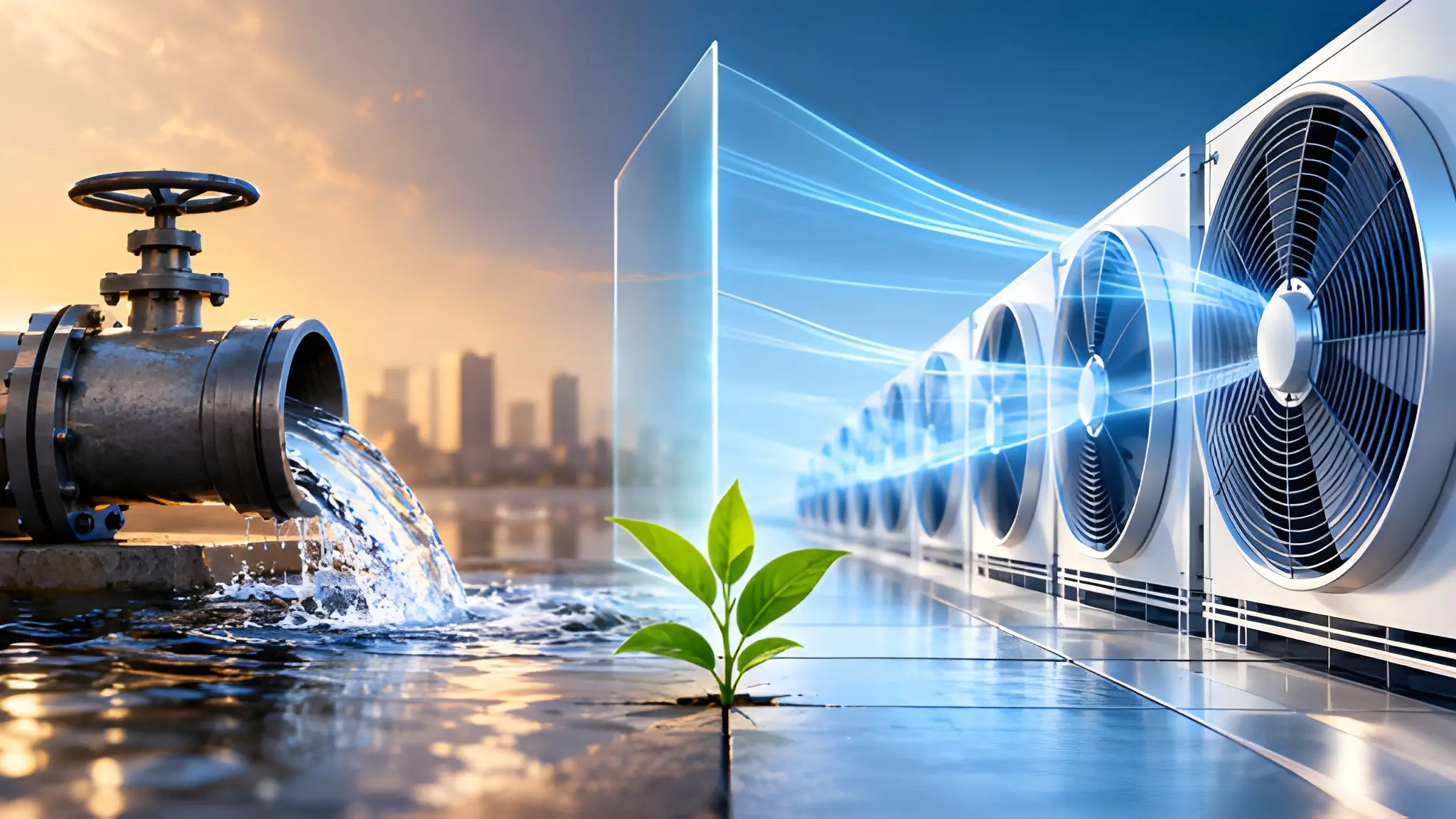
India’s data center cooling debate has increasingly treated water as the most visible constraint, but the harder engineering question may sit much closer to the silicon: how much compute can a rack physically carry before air can no longer remove the resulting heat? Air cooling deserves credit because it can reduce or eliminate direct reliance on evaporative water consumption in the thermal-management chain, particularly when operators combine it with dry cooling, economization and disciplined airflow management. The problem begins when the industry treats that achievement as proof that air can remain the default cooling architecture as AI compute density accelerates.

Every watt consumed by a processor eventually becomes heat, and increasing the amount of computing equipment inside the same rack therefore increases the amount of heat that must leave that rack through a finite physical pathway. That changes the question from how many litres of water a facility consumes to how many kilowatts of thermal load its cooling system can transport without compromising chip temperatures, airflow, reliability or usable floor space. The implication for India is uncomfortable but useful: removing water from the immediate cooling equation does not remove the thermal problem created by increasingly concentrated AI workloads.

The Rack Is Becoming the Real Cooling Unit

The industry’s traditional mental model starts with the data center room, yet AI increasingly makes the rack a more consequential unit of infrastructure planning. Many conventional data center racks operate at substantially lower power densities than current AI rack-scale systems, while accelerated-computing racks can concentrate significantly higher electrical and thermal loads into a much smaller physical footprint. NVIDIA’s GB200 NVL72, for example, combines 72 Blackwell GPUs and 36 Grace CPUs within a rack-scale system and uses liquid cooling as part of its architecture, while NVIDIA’s documentation lists approximate rack power consumption of 120 kW for the system. At 120 kW, the cooling system is not dealing with a vague increase in room temperature; it must continuously move a very large thermal load away from tightly packed computing hardware.

The engineering challenge then becomes increasingly local, because the temperature at the processor, memory and power-delivery components matters even when the wider room appears comfortably controlled. Air can move large volumes of heat, but its comparatively low heat capacity and lower density mean that increasingly large airflow paths, fans and heat-exchange surfaces are required as thermal density rises. That creates a physical trade-off between compute density and the infrastructure required to move air around it. India therefore should not measure the success of water-free cooling only by the litres it avoids consuming, but also by how much useful compute each cooled rack can sustain.

India’s Water Advantage Could Become a Density Trade-Off

The strongest case for air cooling in India is not that it can replace every other technology, but that it can preserve water resources where the workload and facility design make air-based heat rejection practical. This distinction matters because water efficiency and compute density are separate engineering objectives, even when infrastructure planners evaluate them within the same sustainability framework. A facility can pursue very low water consumption through dry cooling, although its resulting energy performance, rack density and mechanical requirements will depend on climate, equipment and system design. That opens a more interesting design question for India: should the industry optimize for minimum water consumption, maximum compute per square metre or the best balance between the two? The answer will vary by workload, climate, chip generation, facility design and local power conditions rather than follow a single national formula.

Lower-density AI workloads can make greater use of advanced air management and air-based heat rejection, while tightly packed AI clusters may require liquid-assisted architectures as rack-level thermal loads increase. Treating both environments as identical simply because they occupy the same category of “AI data center” risks producing inefficient infrastructure decisions. The objective should therefore shift from making cooling waterless to making cooling appropriate for the amount of compute that the rack is expected to deliver.

The Best Indian Cooling Architecture May Be Hybrid

The emerging answer does not require India to choose between air cooling and liquid cooling as mutually exclusive camps. Hybrid architectures can retain air cooling for lower-density equipment while directing liquid cooling toward the components and racks that generate the highest thermal loads. Rear-door heat exchangers can provide another intermediate step by transferring heat from rack exhaust air into a liquid loop without requiring every component to adopt direct-to-chip cooling. Such architectures give operators a way to increase density without immediately redesigning every part of the facility around liquid distribution.

They also allow existing infrastructure to evolve as accelerator generations change, which matters because a rack specification that looks adequate during procurement can become restrictive when the next generation of processors increases power density. The end-user benefit is flexibility rather than allegiance to one cooling technology. Operators can reserve the most sophisticated thermal infrastructure for workloads that actually require it while maintaining simpler, lower-cost cooling for systems that do not. In that model, air cooling stops being framed as the alternative to liquid cooling and becomes one layer in a broader thermal architecture.

India Should Stop Asking Whether Cooling Uses Water

The more consequential question for India is not whether air cooling can reduce water consumption, because it clearly can under the right design and operating conditions. The harder question is whether a water-efficient cooling architecture can continue supporting the rack densities required by India’s AI infrastructure ambitions. That distinction matters because every new accelerator generation can alter the relationship between power consumption, heat density and usable rack capacity. A facility designed around today’s thermal assumptions can therefore encounter a cooling bottleneck even when its electrical and physical infrastructure remains available. The industry should consequently stop treating water consumption as the sole scoreboard for cooling efficiency.

A system that saves water but forces lower rack utilization, consumes disproportionate fan energy or prevents deployment of higher-density accelerators may solve one resource constraint while creating another. Conversely, a carefully designed liquid-assisted system can reduce the thermal bottleneck while supporting higher compute density and, with appropriate heat-rejection architecture, still pursue low-water operation. India’s opportunity lies in optimizing the complete thermal system rather than declaring one cooling medium the winner. Air cooling is progress because it can reduce water dependence, but it becomes a durable solution only when it can keep pace with the compute densities India’s AI infrastructure ambitions require.

[simple-author-box]

More from AI Infrastructure

China’s AI expansion is creating an unusual economic question: where should increasingly power-hungry computing

A reserved GPU can look reassuringly tangible on a procurement sheet. Accelerator procurement commonly

Getting the megawatts may turn out to be easier than living with the contract

COMPUTE WEEKLY

The briefing that 40,000+ tech leaders read every Monday. Sharp, fast, essential.

Building an AI Startup Without Owning GPUs

Not owning GPUs has become the default, deliberate strategy for building an AI company — not a compromise founders accept reluctantly. H100 rental rates fell 64-75% in fifteen months, a dense ecosystem of neoclouds and inference-as-a-service providers now lets startups skip infrastructure entirely, and credit programs can fund a company’s first year before a founder writes a check
Most Read

A data center can look remarkably successful on the day it opens and still

A modular deployment becomes strategically different when the next site is already waiting before

A data center master plan can establish a defined technical basis before all future

A transformer can leave a refurbishment shop looking almost indistinguishable from a new unit,

Why Samsung Is Taking AI Infrastructure Offshore AI infrastructure now faces a practical challenge

Disruptor Spotlight

Cerebras Systems

The chip that makes Nvidia nervous. Cerebras’ Wafer Scale Engine is rewriting the rules of AI inference at scale.
Faster
0 x
YoY Revenue
0 x
Transistors
0 T
Market Pulse
MSFT
+1.02%
NVDA
+0.66%
AMZN
-0.078%
AMD
-6.95%
TSMC
-2.98%
Indicative only · Not financial advice
Upcoming Events
SEP
The AI Infrastructure Race (India)
WEBINAR · ONLINE
The AI Infrastructure Race: Won on Power, Land and Trust — Not Capital
MAY
0
AI Infrastructure Summit
DUBAI · IN PERSON
MEA’s premier AI infrastructure event.
JUN
0 0
Compute Forecast Summit
SINGAPORE · IN PERSON
Our flagship APAC event. Early bird open.
Latest Moves
Live
ecolab
Ecolab Deepens Cooling Strategy With $4.75B CoolIT Acquisition
Ecolab is making one of its biggest moves yet into AI infrastructure after completing its $4.75 billion acquisition of liquid cooling specialist CoolIT Systems
Pure DC AVK Europe data center microgrid Dublin 110MW AI infrastructure Ireland 2026
Pure DC and AVK Deploy Europe’s First 110 MW Data Center Microgrid in Dublin
The Pure DC Dublin microgrid has made history as Europe’s first large-scale on-site data center microgrid, launched in partnership with power solutions provider AVK at Pure DC’s campus in Ireland.
Pace Digitek
Pace Digitek Partners With MEGMEET to Expand AI Data Center Power Business
India’s AI infrastructure ecosystem continues to mature as domestic technology manufacturers move beyond traditional telecommunications and industrial markets toward high-growth digital infrastructure opportunities
Follow Compute Forecast
11K followers
1200 followers
Companies to Watch
CW
CoreWeave
Neo Cloud · $19B · IPO Watch
CB
Cerebras Systems
AI Hardware · $4.25B · Pre-IPO
G42
G42
Sovereign AI · Abu Dhabi
H
Humain
Saudi AI · $40B Fund
Latest Podcast
AI Capex, Cloud Margins & the Nuclear Bet
48 MIN · 25 APR 2026

Air Cooling Is Progress, Not India’s Water Solution

India’s data center cooling debate has increasingly treated water as the most visible constraint, but the harder engineering question may

Share
AI rack density
0
847 SHARES

0
SHARES

[simple-author-box]

More from AI Infrastructure

A data center can look remarkably successful on the day it opens and still

A modular deployment becomes strategically different when the next site is already waiting before

A data center master plan can establish a defined technical basis before all future

A transformer can leave a refurbishment shop looking almost indistinguishable from a new unit,

COMPUTE WEEKLY

The briefing that 40,000+ tech leaders read every Monday. Sharp, fast, essential.

Great! We’ve received your information.

Global AI Infrastructure Outlook 2026

The briefing that 40,000+ tech leaders read every Monday. Sharp, fast, essential.
Download Free
Most Read

A data center can look remarkably successful on the day it opens and still

A modular deployment becomes strategically different when the next site is already waiting before

A data center master plan can establish a defined technical basis before all future

A transformer can leave a refurbishment shop looking almost indistinguishable from a new unit,

Why Samsung Is Taking AI Infrastructure Offshore AI infrastructure now faces a practical challenge

Disruptor Spotlight

Cerebras Systems

The chip that makes Nvidia nervous. Cerebras’ Wafer Scale Engine is rewriting the rules of AI inference at scale.
Faster
0 x
YoY Revenue
0 x
Transistors
0 T
Market Pulse
NVDA
$924.60
+2.4%
MSFT
$421.30
+1.1%
AMZN
$192.80
-0.6%
NVDA
$924.60
+2.4%
NVDA
$924.60
+2.4%
Indicative only · Not financial advice
Upcoming Events
MAY
0 0
DCD Global — London
LONDON · IN PERSON
World’s largest DC event. CF is media partner.
MAY
0
AI Infrastructure Summit
DUBAI · IN PERSON
MEA’s premier AI infrastructure event.
JUN
0 0

Compute Forecast Summit

SINGAPORE · IN PERSON
Our flagship APAC event. Early bird open.
Latest Moves
  • Live
Sam Altman
OpenAI appoints new Chief Infrastructure Officer to lead $100B DC programme
27 APR · OPENAI
Sam Altman
OpenAI appoints new Chief Infrastructure Officer to lead $100B DC programme
27 APR · OPENAI
Sam Altman
OpenAI appoints new Chief Infrastructure Officer to lead $100B DC programme
27 APR · OPENAI
Follow Compute Forecast
18.4K followers
12.1K followers
9.3K subscribers
41 episodes
Companies to Watch
CW
CoreWeave
Neo Cloud · $19B · IPO Watch
CB
Cerebras Systems
AI Hardware · $4.25B · Pre-IPO
G42
G42
Sovereign AI · Abu Dhabi
CW
Humain
Saudi AI · $40B Fund
Latest Podcast
AI Capex, Cloud Margins & the Nuclear Bet
48 MIN · 25 APR 2026
Scroll to Top
Seraphinite AcceleratorOptimized by Seraphinite Accelerator
Turns on site high speed to be attractive for people and search engines.