
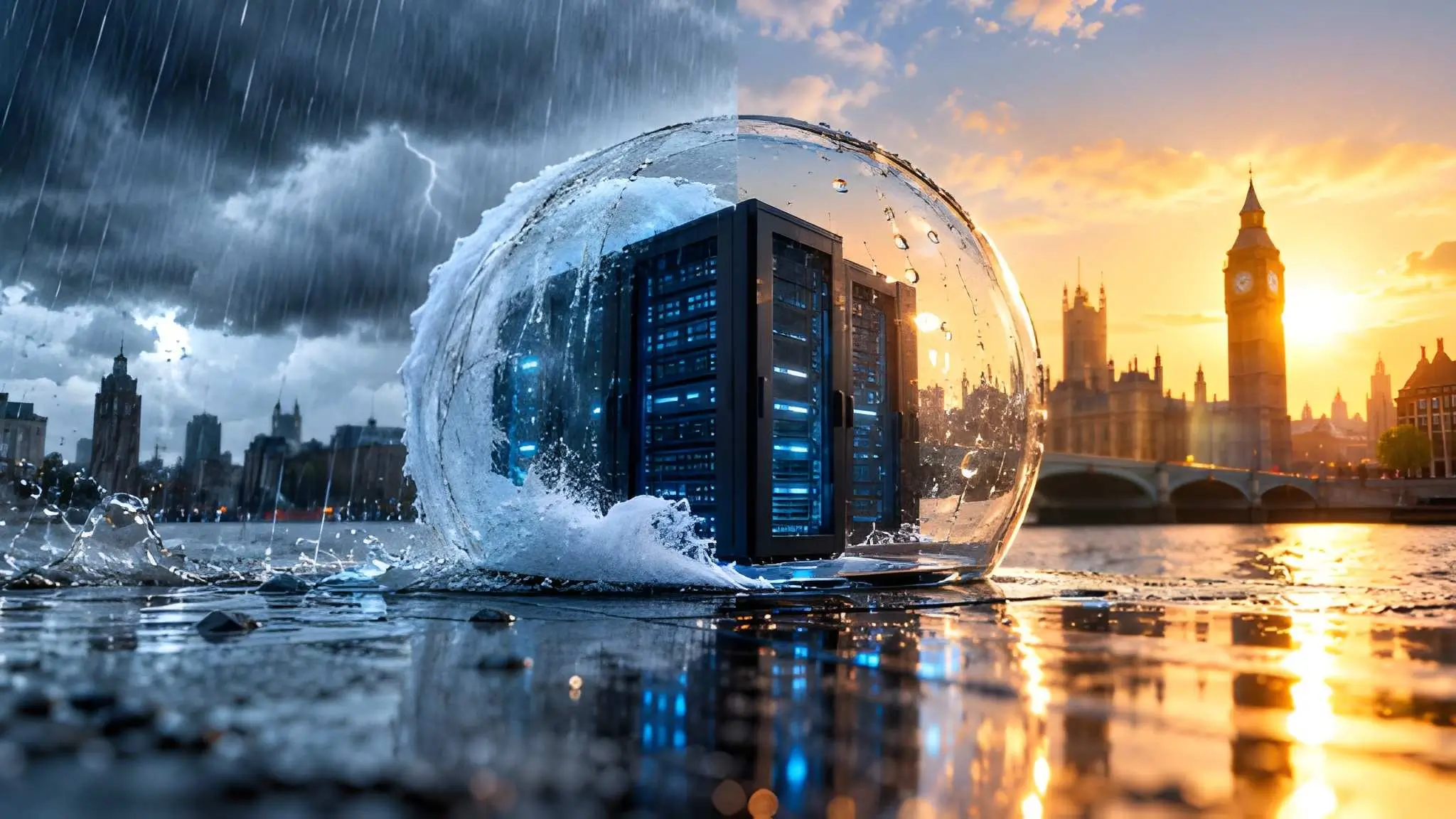
Britain’s digital economy depends on infrastructure that must keep working even when the weather turns hostile. Climate projections and assessments of physical climate risks provide a stronger basis for long-term infrastructure planning than historical weather patterns alone. Rising temperatures and water stress are recognized climate risks for UK data centers, while flooding and extreme rainfall can threaten facilities where local exposure and drainage conditions create vulnerabilities. These pressures demand more than additional cooling capacity or another layer of backup equipment. They require operators to reconsider how they select sites, allocate capital and protect services against several interconnected failures. For Britain’s data center industry, climate resilience is a strategic consideration in planning infrastructure that must continue supporting digital services under changing environmental conditions.

Why Britain’s Data Centres Face a Climate Reckoning
The University of Cambridge’s Dawn supercomputer experienced a heat-related disruption in 2026 that reportedly left it offline for more than a week. The incident drew attention to a vulnerability that Britain’s digital infrastructure has faced before. During the July 2022 heatwave, Google and Oracle experienced cooling-related disruptions at UK facilities as temperatures reached exceptional levels. Guy’s and St Thomas’ NHS Foundation Trust also suffered failures affecting data centers that supported clinical IT systems, disrupting access to essential digital services. The NHS reported additional costs of £1.4 million following the incident. These events demonstrate how environmental stress can reach beyond equipment rooms and interfere with services that people depend on every day.
The implications extend well beyond individual outages. The UK recognizes data centers as critical national infrastructure because they support essential services and economic activity across multiple sectors. That designation places digital infrastructure within a wider national resilience conversation, alongside the systems that supply electricity, water and communications. However, strategic importance does not guarantee protection against extreme weather, particularly when facilities depend on shared utilities and external networks. Operators must examine how their infrastructure performs when cooling, electricity and connectivity encounter pressure simultaneously. The central question is whether individual facilities can maintain reliable services as climate conditions place new demands on their cooling, power and supporting infrastructure.
Heatwaves Are Changing the Economics of Cooling
Every data center converts electricity into computing activity and heat, making thermal management fundamental to reliable operation. Cooling systems must remove that heat continuously while keeping servers and supporting equipment within acceptable operating conditions. Facilities that rely on outside-air cooling can benefit from Britain’s cooler weather, although the extent of that benefit depends on their design, operating conditions and local climate. For facilities that use outside-air cooling, prolonged heat can reduce the hours when ambient conditions support that approach and increase the need for mechanical cooling. Consequently, a facility can face higher cooling demand precisely when the surrounding energy system also experiences additional pressure.

The problem is not simply whether equipment can survive a particular afternoon’s temperature. Extended heatwaves can increase cooling demand and reduce available operating margins in facilities whose cooling systems approach their design limits. Facilities with limited cooling capacity may face greater thermal-management challenges when high outdoor temperatures persist overnight. These conditions make the duration of an extreme-weather event as important as its peak temperature. Operators therefore need to evaluate thermal performance across sustained periods of stress, rather than relying exclusively on conventional design conditions. Climate projections should inform decisions about cooling architecture, redundancy, maintenance schedules and future equipment upgrades.
Water Scarcity Creates a Second Cooling Challenge
Heat rarely arrives as an isolated infrastructure problem. Dry conditions can place additional pressure on water resources, creating difficult choices for operators whose cooling systems depend on evaporation to reject heat. Water-based cooling can deliver thermal advantages under appropriate conditions, but its reliability also depends on local supply and environmental constraints. Waterless alternatives can reduce dependence on freshwater, although some designs require more electricity or perform less efficiently as outdoor temperatures climb. Operators must therefore assess cooling performance alongside water availability, electricity demand and the environmental conditions surrounding each facility.
These trade-offs have strategic implications for infrastructure investment. A cooling design that performs well under ordinary conditions may become less attractive when water restrictions coincide with prolonged heat. Conversely, a waterless system may increase electrical demand during the hottest periods, potentially adding pressure to an already constrained supply. Site selection must account for these relationships before construction locks operators into long-term infrastructure commitments. The industry also needs to distinguish between reducing water withdrawal and reducing actual water consumption, since the two describe different environmental outcomes. A credible resilience strategy should evaluate both water security and the energy required to maintain safe operating conditions.
Power Grid Pressure Could Compound Climate Risks
Data centers cannot maintain reliable cooling without dependable electricity. Extreme heat can reduce the capacity of overhead transmission lines under certain operating conditions, while higher temperatures increase demand for cooling across homes, businesses and industrial facilities. This combination can create a difficult operating environment for electricity networks and the facilities connected to them. If a grid disturbance coincides with a cooling failure, operators may have little time to prevent thermal conditions from deteriorating. The outcome depends on the site’s electrical design, backup arrangements, control systems and ability to maintain cooling during a power interruption.
Meanwhile, Britain’s wider infrastructure requirements complicate the challenge of expanding digital capacity. Data center developers must secure grid connections, plan for dependable electricity supplies and account for the demands of increasingly intensive computing workloads. These requirements make power resilience a strategic consideration rather than a routine facilities-management concern. Backup generators, batteries and redundant electrical feeds can reduce exposure to particular failures, but they cannot eliminate every risk associated with shared infrastructure or prolonged disruption. Operators need to test how their electrical and cooling systems interact under realistic emergency conditions. They must also understand whether backup arrangements can sustain critical workloads for the duration of a disruption, rather than merely bridge a short interruption.
Climate Resilience Must Shape Infrastructure Investment
Climate adaptation requires decisions long before extreme weather arrives. Operators need to incorporate credible climate projections into site selection, engineering specifications, equipment replacement and expansion planning. They should also evaluate whether existing facilities can accommodate changing conditions without costly redesigns or prolonged interruptions. Such assessments require cooperation between infrastructure teams, energy suppliers, water providers and emergency planning organizations. The objective is to identify vulnerabilities early enough to address them through investment rather than emergency intervention.
The challenge also extends to the governance of digital infrastructure. Boards and executive teams need a clear understanding of which climate hazards threaten service continuity, how much protection existing systems provide and where significant exposures remain. This requires more than a general commitment to sustainability or a record of routine maintenance. Organizations need practical stress tests, documented recovery procedures and evidence that critical systems can operate together during adverse conditions. Public authorities also have a role in coordinating infrastructure planning where data centers depend on shared power, water and transport networks. Better coordination can help align private investment with the resilience requirements of essential national services.
Britain’s Digital Future Depends on Preparation
Britain’s data center industry faces a climate challenge that cannot be resolved through a single technology or engineering upgrade. Heatwaves and water stress can increase cooling challenges, while electricity constraints and flooding can disrupt supporting infrastructure; the extent to which these hazards compound depends on the facility and its local environment. The industry must therefore evaluate resilience across the entire chain that connects computing equipment to power supplies, cooling infrastructure and external networks. That approach should guide new construction and assessments of existing facilities, with operators reviewing whether their original design assumptions remain appropriate for projected climate conditions. It should also influence how organizations assess the risks associated with expanding computing capacity in increasingly demanding environments.
Ultimately, the measure of resilience will be whether essential digital services can withstand disruption and recover without unacceptable consequences. Britain’s dependence on data centers makes climate adaptation a matter of economic continuity and public service protection, not simply an engineering preference. Operators must account for future environmental conditions when making decisions that will shape infrastructure for decades. Policymakers, utilities and industry leaders must also recognize that individual facilities cannot secure the wider digital economy without reliable supporting networks. The next phase of Britain’s digital development will depend not only on how much computing capacity the country can build, but on how reliably that capacity can operate when the climate puts it to the test.









