 Skip to content

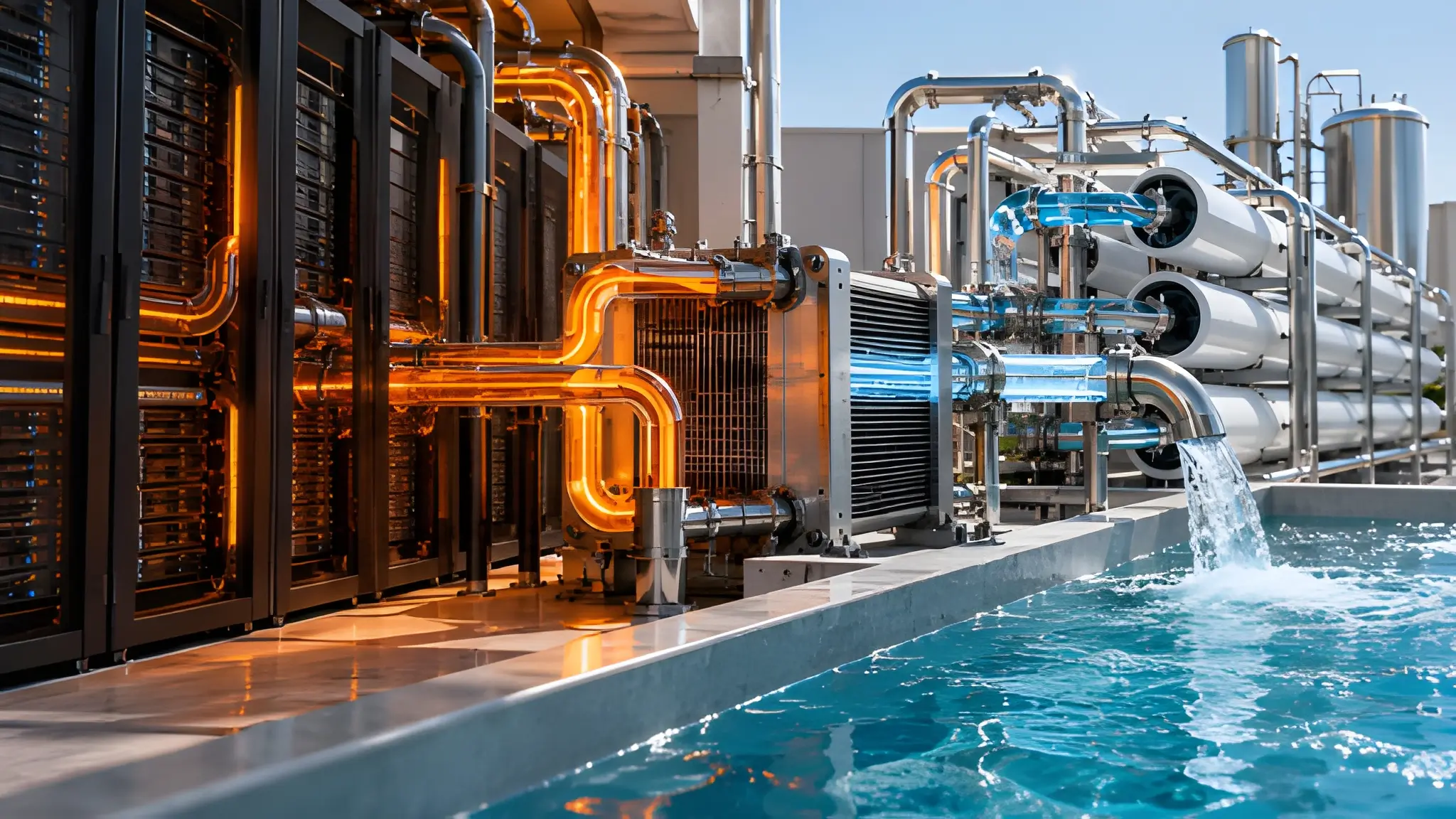
A data center’s thermal output presents an unusual engineering contradiction. The same computing equipment that generates heat requiring continuous removal could also provide an energy input for producing freshwater. Yet the opportunity becomes more complicated when engineers examine what that heat can actually accomplish. Heat does not carry a universal energy value, and a thermal stream that supports one industrial process may prove inadequate for another.

Cooling engineers generally focus on moving heat away from processors, maintaining acceptable operating temperatures, and protecting equipment performance. Water engineers approach the problem from another direction, concentrating on the energy needed to separate dissolved salts from seawater or brackish water. Connecting these disciplines requires more than routing a warm liquid toward a desalination unit. It requires matching the quality, timing, and location of available thermal energy with the specific demands of water treatment. The provocative possibility is that AI infrastructure could eventually produce more than computing capacity. Under suitable conditions, it could help support freshwater production as part of the same engineered system. The challenge is determining whether that arrangement delivers a genuine operational advantage or simply moves energy losses into another part of the facility.
The Temperature of Heat Matters More Than Its Existence
Waste heat sounds valuable because it represents energy that a facility already generates. However, its usefulness depends on temperature, heat-transfer characteristics, and the work required to convert it into something productive. A stream of warm coolant and a high-temperature industrial heat source do not offer equivalent capabilities, even when both carry substantial thermal energy. This difference matters because AI processors do not automatically generate heat at temperatures suitable for every downstream application. Direct-to-chip liquid cooling can capture a larger share of processor heat in a recoverable liquid stream than some air-cooled configurations, although the advantage depends on equipment specifications, operating conditions, and the cooling architecture. Engineers must distinguish between capturing heat and capturing heat at a temperature that another process can use.
A desalination process may require a particular temperature range, a separate source of electricity, or additional heating to achieve its intended operating conditions. If the available coolant cannot meet those requirements, the system must bridge the gap through heat pumps, supplementary energy, or a different treatment process. Every additional conversion introduces equipment costs, operating requirements, and potential losses. The central engineering question is therefore not whether AI facilities generate enough heat in an abstract sense. It is whether their recoverable heat can perform useful work without requiring so much additional energy that the original advantage disappears.

Desalination Does Not Have One Universal Energy Requirement
The term desalination covers several processes with fundamentally different energy requirements. Thermal desalination uses heat to evaporate water or support related separation processes, while membrane-based reverse osmosis relies primarily on electricity to pressurize water and force it through selective membranes. Engineers cannot treat these methods as interchangeable simply because both produce freshwater from saline sources. This creates a critical design choice for any facility seeking to connect computing with water production. A thermal process may offer a more direct route for using recovered heat, depending on the temperatures involved and the specific technology. Reverse osmosis, meanwhile, cannot replace its principal electrical input with a supply of low-grade heat. Recovered thermal energy might still support auxiliary operations or a compatible heat-pump arrangement, but it does not eliminate the process’s fundamental pressure requirements.
The most interesting possibilities may emerge from processes designed to operate with modest temperature differences. Certain thermal separation configurations can exploit lower-temperature heat, although their performance depends on operating conditions, equipment design, and the characteristics of the incoming water. Such compatibility could make otherwise difficult-to-use thermal energy more valuable. Still, a lower temperature threshold does not automatically establish commercial viability. Engineers must consider evaporation rates, heat-exchanger performance, fouling, corrosion, pumping requirements, and the quality of the resulting water. A process that functions technically may remain unattractive if it consumes too much electricity, requires extensive maintenance, or produces freshwater at an unacceptable cost.
AI Infrastructure Needs a Better Definition of Useful Heat
The emerging opportunity is not a promise that every AI data center can become a desalination plant. It is a challenge to the way infrastructure designers define waste. Thermal output should not qualify as a useful resource merely because engineers can capture it, but neither should they dismiss it simply because it cannot perform every industrial task without additional energy. A more rigorous design process would evaluate heat by its usable temperature, recoverable quantity, operating consistency, and proximity to a compatible demand. Engineers could then compare candidate treatment technologies against the actual thermal profile instead of selecting a process first and assuming the cooling system will accommodate it.
A project might gain value by coordinating cooling and water treatment from the beginning, rather than retrofitting heat recovery after the main infrastructure decisions have already constrained temperatures, piping routes, and equipment placement. The opportunity to recover AI waste heat for freshwater production depends on engineering discipline, not on an assumed production figure. Without a defined operating period, a specified treatment process, and a clear energy balance, that volume cannot establish what a real facility could deliver. The number is a starting point for investigation, not proof of a commercially viable outcome.
AI infrastructure may eventually find a productive use for some of the heat it currently works to remove. The breakthrough, if it comes, will depend on matching that heat to a process that can use it efficiently, maintaining cooling performance, and demonstrating that the complete system makes economic sense. The next meaningful advance may therefore happen after the processors finish their calculations, when engineers determine whether the resulting heat can do another useful job.










