
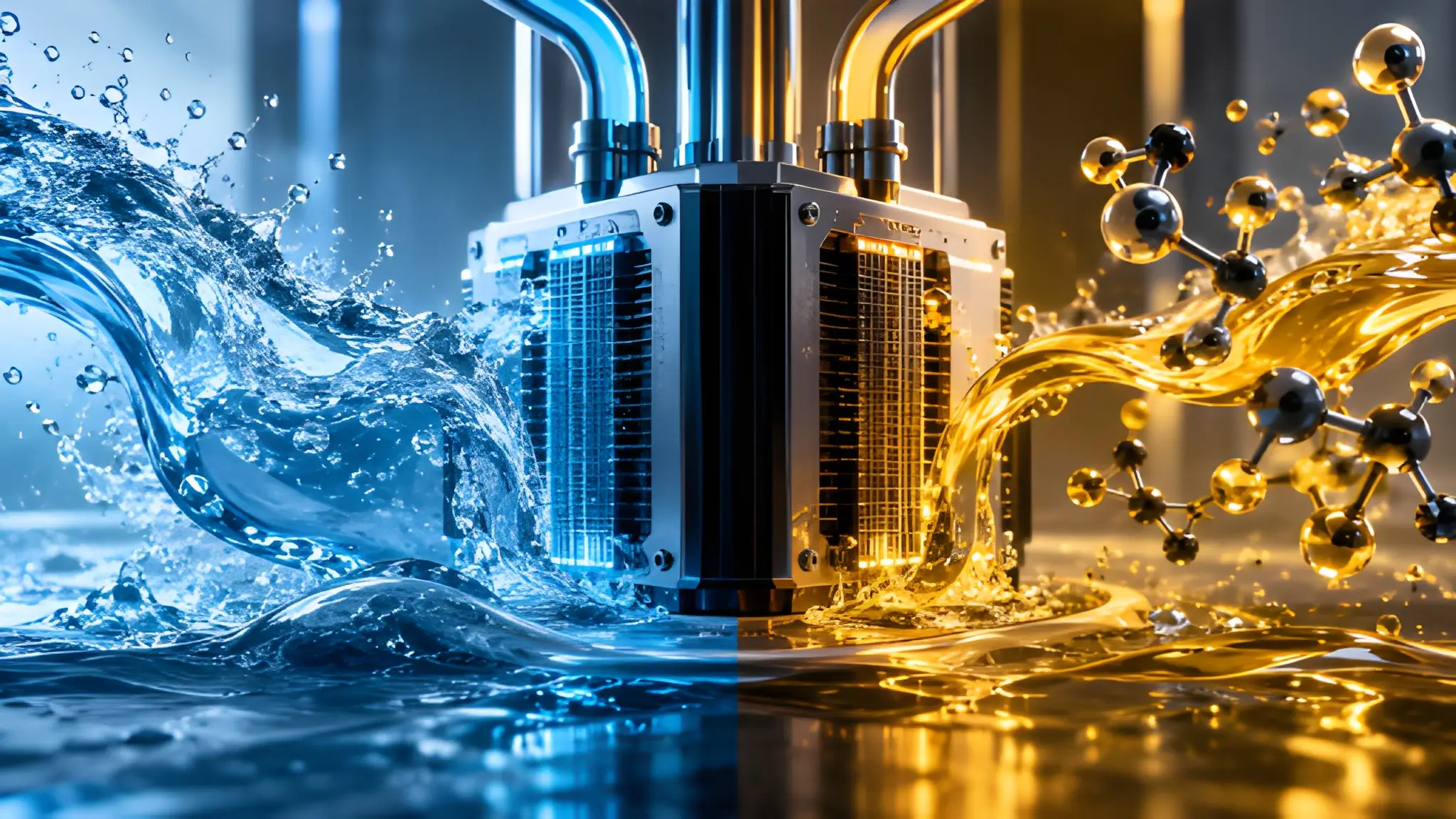
The hardest part of scaling AI may no longer sit entirely inside the processor. It is moving into the material surrounding the processor. As GPU power densities climb, cooling systems must remove more heat from smaller physical spaces without consuming proportionally more electricity or water. That pressure has pushed data center engineers toward liquid cooling, including immersion systems that place computing hardware directly into specialized fluids. The engineering logic is compelling. A liquid can move heat more effectively than air, allowing cooling systems to operate closer to the source of heat. Two-phase immersion cooling takes that principle further: a fluid absorbs heat, changes phase and carries thermal energy away from the electronics. Some fluorinated fluids have properties that make them useful in demanding electronics environments. They can offer electrical insulation, thermal stability and chemical compatibility that make them suitable for applications where conventional water-based cooling cannot directly contact energized electronics.

Research into electronic fluorinated liquids has specifically examined their thermal behavior for immersion cooling applications. That creates an uncomfortable twist in the AI infrastructure story. The same chemistry that makes some fluorinated materials attractive for difficult thermal environments can also make their environmental management difficult. PFAS is a broad chemical category rather than a single substance, and individual compounds differ significantly in structure, persistence and risk. But EPA notes that many PFAS break down very slowly and that some can persist in people and the environment. AI cooling, in other words, is beginning to expose a problem that mechanical engineering alone cannot solve.
The attraction of fluorinated fluids is rooted in chemistry
The appeal of fluorinated cooling fluids does not come from environmental irresponsibility. It comes from physical performance. High-density computing creates an unforgiving thermal environment. GPUs and other accelerators can generate substantial heat within compact assemblies, while operators increasingly want to maximize compute density inside constrained electrical and physical footprints. Immersion cooling changes the relationship between the chip and its surroundings. Instead of forcing air across increasingly hot components, the cooling fluid surrounds the hardware and directly captures thermal energy. That makes the coolant itself part of the computing architecture.
The distinction matters because cooling infrastructure traditionally looked like a collection of pumps, heat exchangers, fans, pipes and water loops. In an immersion system, the fluid becomes a functional engineering component with its own chemistry, supply chain, handling requirements and end-of-life considerations. The cooling question therefore becomes more complicated than, “How much water does this system save?” It becomes: What replaces the water, how stable is that replacement, where does it go at the end of its useful life, and what happens if the material escapes the tightly controlled environment for which engineers designed it? Those questions receive less attention than headline metrics such as power capacity, rack density and compute performance.

Water efficiency can move the burden somewhere else
Reducing water consumption remains an important engineering objective, particularly for data centers operating in regions where freshwater availability already constrains industrial development. But a reduction in one environmental input does not automatically eliminate environmental impact. It can redistribute it. That is particularly relevant when cooling systems rely on highly engineered chemical fluids. A system may reduce direct water demand while increasing the importance of chemical procurement, containment, recovery and disposal.
The comparison is not as simple as water versus chemicals, either. Water itself can carry a substantial energy and infrastructure burden when operators must pump, chill, treat and circulate it. Immersion cooling can change those requirements and potentially improve thermal management. The point is that water efficiency should not become the only environmental metric. A data center that consumes less water but depends on materials with difficult end-of-life pathways has not necessarily solved its cooling problem. It has changed the problem. That distinction matters as AI infrastructure scales into long-lived industrial assets.
“Forever” is a chemistry problem before it becomes a policy problem
The phrase “forever chemicals” can flatten a complicated scientific category into a single idea. PFAS includes thousands of substances, and regulators use different definitions depending on the purpose. EPA’s current explanation also emphasizes that scientists continue to study how individual PFAS behave, how exposure occurs and how they can be managed. Still, persistence remains central to the concern. The strength of carbon-fluorine bonds contributes to the durability of many fluorinated substances. EPA research has described the environmental persistence associated with these bonds, while current EPA material notes that many PFAS break down very slowly. That creates an unusual engineering paradox.
A cooling fluid becomes attractive because it remains chemically stable under demanding conditions. Yet that same stability can complicate what happens when the cooling system reaches the end of its operational life. The industry therefore has to think about durability twice: first as an asset during operation, and later as a liability during disposal, recovery or accidental release. The contradiction is not necessarily evidence that immersion cooling should be abandoned. It is evidence that coolant selection deserves the same lifecycle scrutiny already applied to power, water and carbon.
AI infrastructure cannot treat coolant as an invisible component
The rapid expansion of AI infrastructure has made power availability a strategic concern. Water availability has become another. Cooling materials may be the next layer of scrutiny. That shift would change procurement decisions. Data center operators could increasingly need detailed information about the chemical composition of cooling fluids, their regulatory status, containment requirements, recovery systems and end-of-life pathways. Equipment manufacturers may face pressure to design systems around fluids that deliver comparable thermal performance with fewer environmental complications.
Researchers are already comparing different coolant families rather than treating fluorinated fluids as the only route to immersion cooling. Recent research has evaluated fluorocarbon and hydrocarbon coolants across thermal and system-level performance criteria, illustrating that coolant selection involves trade-offs rather than a single universally optimal material. That is an important distinction for the AI industry. The question is not whether one material is simply “good” or “bad.” The question is whether the entire cooling architecture remains defensible when its operational performance, resource consumption and material lifecycle are considered together.
The real test is what happens after the GPU stops running
AI infrastructure is commonly discussed through metrics such as uptime, power capacity, rack density and compute performance. If a cooling fluid enables substantially denser computing, reduces water demand and improves thermal performance, those benefits matter. But so does the material’s journey after deployment. Can facilities contain it throughout decades of maintenance, replacement and eventual decommissioning? And can the industry demonstrate that the chemistry selected today will not create a disposal problem that future operators must solve? These are not abstract environmental questions. They are infrastructure questions.
The central irony of PFAS-based AI cooling is that some fluorinated chemistry used for demanding thermal applications is valued for properties that can also complicate environmental management. Its chemical stability is one of the properties that can make some fluorinated fluids attractive for demanding thermal applications, alongside their dielectric and thermal characteristics. That may be the most important question hiding inside the cooling debate: Is AI solving the physics of heat by choosing materials whose performance depends partly on chemical properties that can complicate their environmental management? If so, the next generation of cooling innovation cannot stop at moving heat more efficiently. It has to address what happens to the material that moved it. The future of AI cooling may therefore depend as much on materials science and chemical lifecycle management as it does on pumps, heat exchangers and thermal design. The industry has learned to move heat away from the chip. It now has to decide what happens to the chemistry that carries it away.











