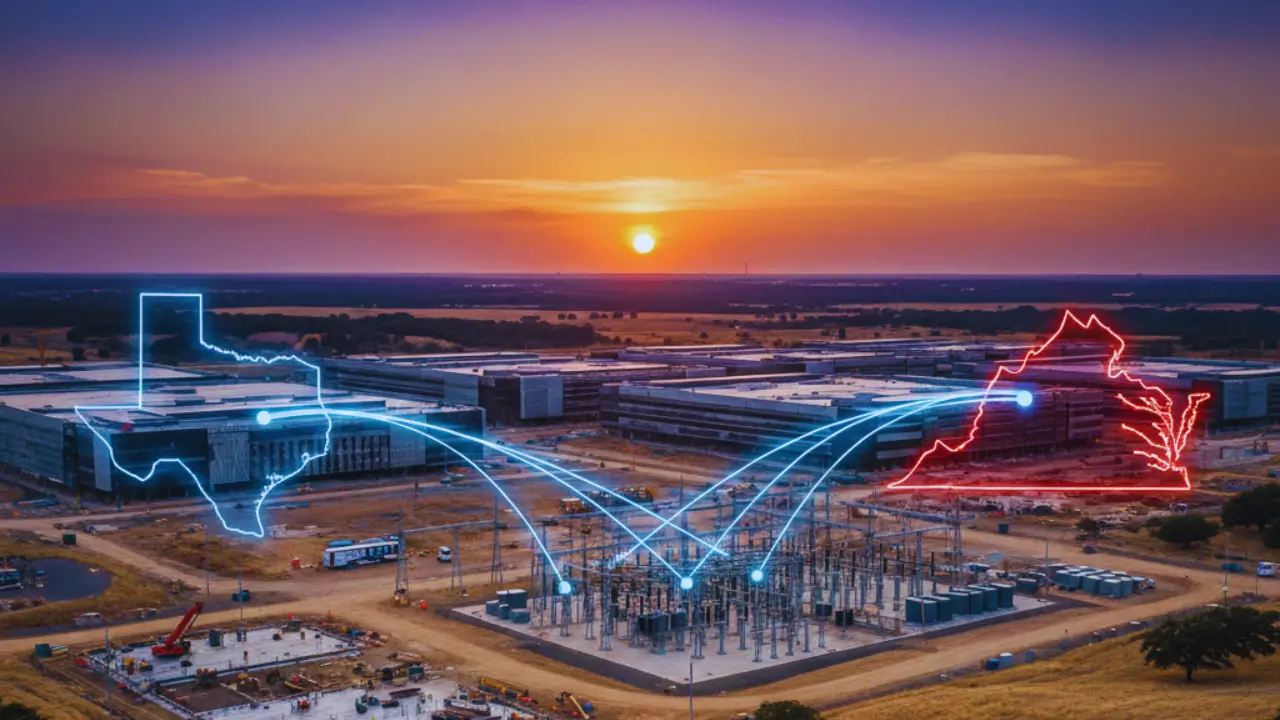
For decades, Northern Virginia stood at the center of the global data center industry, anchored by dense network connectivity and major internet exchanges. Today, that dominance faces mounting pressure as limits on power, land, and environmental capacity push new development into emerging regions, particularly across the American South. This shift points towards a structural realignment in how companies build digital infrastructure, driven by energy availability and the scale of modern compute demand.
Frontier markets such as Texas, Tennessee, Ohio, and Georgia now capture a growing share of new capacity. According to Jones Lang LaSalle, 64 percent of the nearly 35 gigawatts under development sit outside traditional hubs. Texas alone accounts for 6.5 gigawatts. At this pace, the state could overtake Northern Virginia as the world’s largest data center market by 2030.
Legacy Hubs Face Limits
Virginia rose to prominence through exceptional connectivity, favorable business conditions, and a deep ecosystem of service providers. However, that position relied on assumptions that no longer hold. Power shortages, network congestion, and rising land costs now create serious bottlenecks. Developers find it harder each year to scale in established markets.
Utilities in legacy regions have responded with aggressive capital spending plans to meet projected load growth. Some forecasts suggest annual peak demand could jump by more than 50 percent in certain areas. Even with these investments, constraints remain.
Developers can no longer assume they can simply “build more here.” Many legacy markets now struggle with strained transmission networks, delayed interconnection timelines, rising energy prices, and community opposition. These pressures force developers, tenants, and investors to rethink their strategies.
The Southern Surge: Power, Land, and Policy
Southern and frontier markets share several clear advantages. First, they offer abundant land at lower cost. Developers can build large campuses to support hyperscale and GPU-intensive AI workloads without competing for scarce real estate. Projects move faster and often cost less.
Second, many Southern states actively encourage infrastructure investment. Incentives, favorable tax policy, and streamlined permitting reduce friction. In contrast, stricter zoning rules and environmental reviews in some legacy states often delay projects.
Third, grid capacity and energy planning play a central role. Texas, for example, operates a more flexible power market and can accommodate large industrial loads more quickly. Utilities across the region have launched multi-billion-dollar capital programs to expand generation, transmission, and distribution. Much of this expansion responds directly to data center load requests.
This trend extends beyond Texas. Southern Company recently expanded its five-year capital plan to meet rising electricity demand across Alabama, Georgia, and Mississippi, partly due to data center growth. Utilities increasingly view data centers as anchor loads that justify major generation investments. At the same time, they must balance economic gains with environmental and grid reliability concerns.
Hyperscale Capital Follows Energy
Large cloud and AI platform operators drive this migration. Leading hyperscalers have announced capital expenditure plans measured in the hundreds of billions of dollars. These commitments determine where development occurs. Companies now prioritize locations that can deliver long-term power, connectivity, and regulatory certainty.
In Louisiana, Amazon announced plans to invest more than $12 billion in data center construction. This move signals that the region serves as a strategic priority, not a secondary option. The company paired its investment with water and energy planning designed to support AI and cloud workloads.
In Texas, CyrusOne secured more than 1,100 megawatts of long-term power agreements through direct partnerships with producers. These contracts illustrate how operators now lock in energy supply early in the development cycle. Grid expansions and new generation projects often follow these commitments.
Economic Opportunity and Growing Pains
Communities across the South view data center investment as a source of economic growth. Local governments expect construction jobs, higher tax revenue, and broader industrial development. Projects often involve billions of dollars in capital spending and generate substantial short-term employment.
However, long-term job creation remains modest relative to investment size. Operational staffing levels at modern facilities tend to stay small. Policymakers must therefore align incentives with realistic employment expectations to avoid public backlash.
Rapid growth also strains local infrastructure. In cities such as San Antonio, officials have raised concerns about electricity and water demand. Population growth compounds the challenge. Leaders must balance economic development with sustainability and resource planning.
Strategic Implications: Balance and Flexibility
This geographic shift highlights a broader lesson. Concentrating development in a handful of legacy markets exposes operators to risk when demand patterns change. Power availability, grid access, and sustainability requirements now evolve faster than traditional real estate strategies.
Companies that diversify geographically gain resilience. They secure access to varied power sources, regulatory environments, and land availability. Regions that pair infrastructure investment with thoughtful policy and community engagement will attract a larger share of global digital infrastructure capital.
A New Digital Map
North America’s data center industry has entered a new phase defined by sustained demand and geographic decentralization. Vacancy rates remain low even as construction accelerates. These signals point to durable structural demand rather than speculative overbuilding.
Frontier markets in the American South now sit at the center of this transformation. Power availability, land scale, and supportive policy frameworks drive their rise. Hyperscale operators increasingly treat these regions as core strategic assets. As AI and compute demand continue to expand, this rebalancing will shape where digital infrastructure grows and how communities integrate large-scale technology investment. The South’s ascent marks one of the defining shifts in the modern digital economy.