
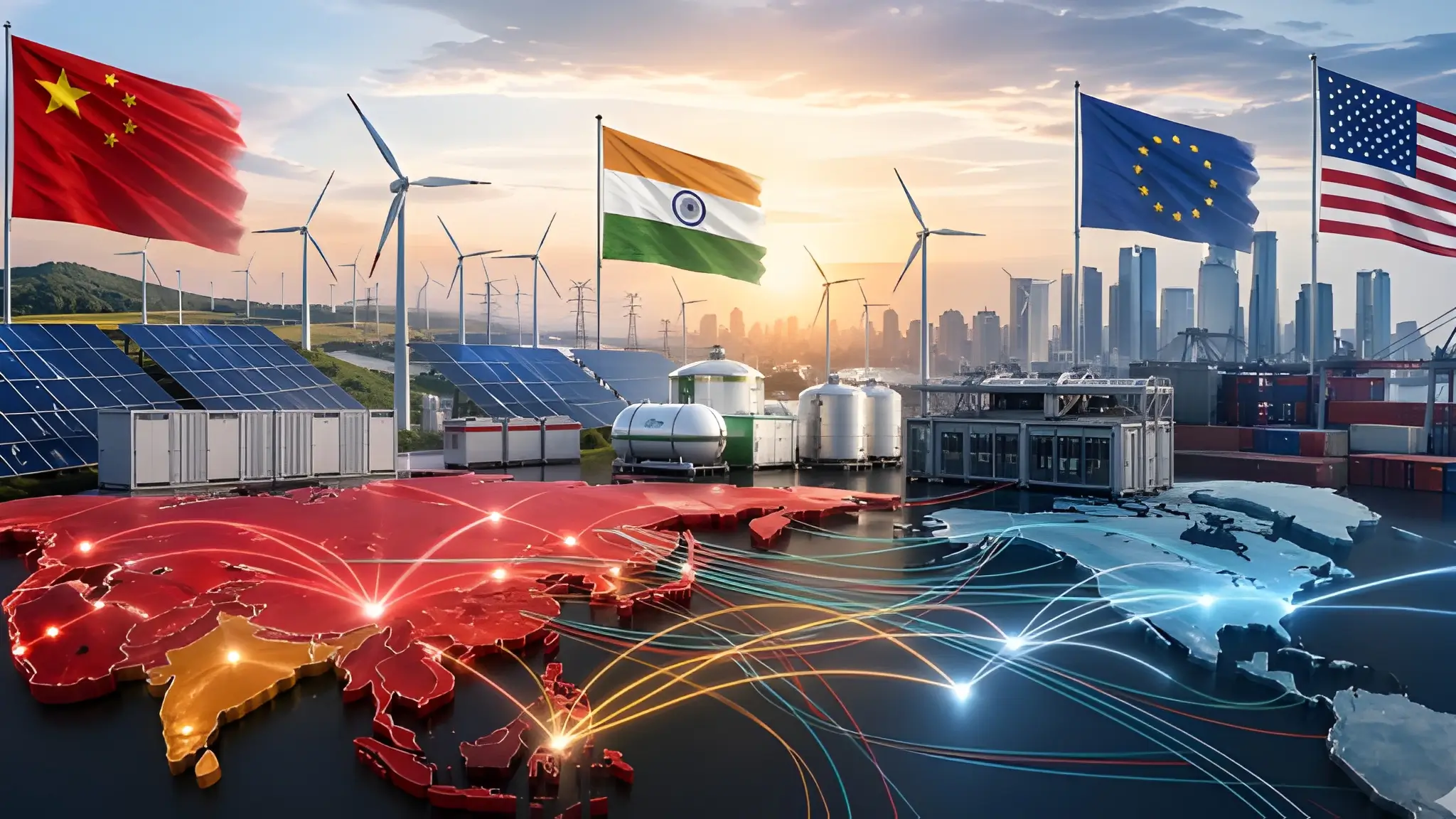
The global energy transition is entering a decisive phase, where ambition is no longer the defining variable. Execution is. Across the industry, a structural divergence is emerging between regions that are scaling clean energy systems at industrial speed and those navigating economic and political friction.

China and India have positioned themselves at the forefront of this shift. Their strategies extend beyond emissions reduction. Both countries are expanding capabilities across solar manufacturing, battery supply chains, and green hydrogen production through coordinated policy support and investment. These efforts reflect a coordinated alignment between industrial policy, infrastructure investment, and long-term national planning.
In contrast, much of the Western world is confronting constraints that are slowing deployment timelines. Rising project costs and policy adjustments are creating challenges across multiple segments of the clean energy value chain. The result is a widening gap in both capacity addition and supply chain control.
Clean Energy as Industrial Strategy
China and India are not treating clean energy as a standalone climate initiative. They are embedding it within broader industrial and geopolitical frameworks. This distinction is critical.

China continues to scale solar and battery manufacturing at unmatched levels, leveraging state-backed financing, vertically integrated supply chains, and export-oriented production. The country’s dominance in photovoltaic modules and battery components has significantly contributed to lowering global clean energy technology costs, reinforcing its central role in the clean energy economy.
India, while at a different stage of maturity, is adopting a similarly strategic posture. Through domestic manufacturing incentives, renewable capacity expansion, and investments in green hydrogen, the country is aligning its energy transition with economic development goals. The emphasis on local production reflects a deliberate attempt to reduce import dependence while capturing value across emerging energy markets.
This approach positions clean energy as a contributor to industrial expansion and economic activity. It also signals a shift in how national competitiveness will be measured in the coming decades.
Western Markets Face Friction
While Western economies remain central to innovation and capital markets, their clean energy transitions are encountering increasing resistance at the execution level.
Financing conditions and project economics remain key considerations influencing renewable project development. Supply chain disruptions and inflationary pressures have increased equipment and construction costs. In parallel, subsidy programs that initially accelerated deployment are facing scrutiny, leading to policy recalibrations and, in some cases, delays.
Regulatory processes and policy frameworks continue to shape project timelines and implementation. Public resistance to large-scale infrastructure projects, combined with regulatory bottlenecks, has slowed approvals and implementation timelines. These factors are not halting progress, but they are reducing the speed at which new capacity can come online.
The divergence is not rooted in a lack of technological capability or capital availability. It is a function of execution efficiency, policy coherence, and the ability to sustain long-term commitments without disruption.
Speed and Scale Redefine Leadership
The clean energy transition is increasingly defined by two variables: speed and scale. Countries that can deploy infrastructure rapidly while maintaining cost competitiveness are gaining a structural advantage.
China’s ability to build and commission large-scale renewable projects within compressed timelines demonstrates the impact of centralized planning and streamlined approvals. India’s rapid expansion of solar capacity highlights how emerging markets can leverage scale to accelerate adoption while driving down costs.
This dynamic is reshaping global supply chains. Manufacturing capacity is increasingly concentrated in regions with established supply chains, cost advantages, and infrastructure readiness. As a result, control over key components, such as solar modules, batteries, and electrolyzers is becoming a strategic asset.
The implications extend beyond energy. They influence trade flows, industrial competitiveness, and geopolitical alignment.
From Climate Cooperation to Competitive Race
For years, the energy transition was framed as a collective global effort. That narrative is evolving. Clean energy is increasingly associated with economic and industrial positioning, with nations expanding efforts to strengthen their roles in future markets.
This shift does not eliminate the need for international collaboration. Climate goals still require coordinated action. However, the underlying motivations are diversifying. Energy security, supply chain resilience, and economic growth are now driving policy decisions alongside environmental considerations.
China and India’s strategies illustrate this transition. By prioritizing domestic manufacturing and infrastructure, they are reducing exposure to external dependencies while strengthening their positions in global markets.
Western economies, meanwhile, are reassessing their approaches. Efforts to localize supply chains and incentivize domestic production are gaining momentum. However, aligning these initiatives with existing market structures remains a complex task.
The Role of Policy Conviction
Long-term policy frameworks are playing an important role in shaping investment and deployment across clean energy sectors. Long-term visibility enables industries to invest with confidence, scale operations, and optimize supply chains.
China’s multi-year planning frameworks provide a clear roadmap for stakeholders across the energy ecosystem. India’s policy initiatives, while evolving, are increasingly focused on creating predictable investment environments.
In contrast, policy volatility in some Western markets has introduced uncertainty. Changes in subsidy structures, regulatory requirements, and political priorities can disrupt project pipelines and delay decision-making. The ability to maintain policy conviction over extended periods will influence how quickly regions can transition from pilot projects to industrial-scale deployment.
Supply Chains as Strategic Infrastructure
Control over supply chains is becoming as important as energy generation itself. The concentration of manufacturing capacity in specific regions has created dependencies that extend across the global energy system.
China’s leadership in solar and battery manufacturing illustrates how supply chain dominance can translate into pricing power and market influence. India’s push to develop domestic capabilities reflects an awareness of these dynamics and a desire to mitigate risk.
Western economies are responding with initiatives aimed at reshoring production and diversifying supply sources. However, building competitive manufacturing ecosystems requires time, capital, and sustained policy support. The outcome will shape not only energy markets but also broader industrial landscapes.
A Fragmented Transition Path
The global energy transition is progressing at varying speeds across regions, reflecting differences in policy, investment, and infrastructure capacity. Instead, it is fragmenting into distinct pathways defined by regional priorities and capabilities.
Eastern markets are advancing through state-driven models that emphasize speed, scale, and integration. Western markets are navigating a more complex environment, balancing market forces, regulatory frameworks, and political considerations.
This divergence does not imply that one model is universally superior. Each reflects specific economic structures and governance systems. However, it does highlight the importance of aligning strategy with execution capacity.
The Next Phase of Energy Leadership
The next phase of the clean energy transition will be determined by outcomes rather than intentions. Countries that can translate policy into infrastructure, and infrastructure into economic value, will define the global energy landscape.
China and India have demonstrated that coordinated strategies can accelerate deployment and reshape markets. Western economies, with their strengths in innovation and finance, still hold significant influence. The challenge lies in converting these advantages into scalable, timely execution.
The emerging reality is clear: clean energy leadership is no longer a shared trajectory. It is a competitive race shaped by industrial policy, geopolitical priorities, and the ability to deliver at scale.
As the transition progresses, the balance of power in global energy markets will continue to evolve. The regions that move fastest, and most decisively will set the terms of the next energy era.











