Electric grids were not designed for customers that vanish.
For decades, reliability planning has focused on preventing shortages. Operators prepare for heat waves, polar vortices and fuel supply disruptions that push demand beyond available generation. They build reserves to withstand the sudden loss of a large power plant. They simulate worst-case scenarios in which supply falters. What they have not traditionally modeled is the coordinated disappearance of demand on a scale comparable to a major generator.That is no longer hypothetical.
In February 2025, about 40 data centers in Virginia, together consuming enough electricity to power more than one million homes, simultaneously switched to backup generators after a high-voltage transmission line fault, according to reporting by The Wall Street Journal. The sudden drop in demand forced PJM Interconnection to rapidly scale back supply to avoid damaging equipment. A similar episode occurred in July 2024, when roughly 70 facilities disconnected following another transmission failure.
In both cases, the lost load was under 2,000 megawatts. The incidents did not trigger emergencies. A senior PJM executive said they were manageable. Yet manageable does not mean trivial. Events of that magnitude, happening instantaneously, raise questions about what occurs if the scale multiplies.
The Inversion of Reliability Risk
The grid’s operating logic assumes that large disturbances come from the supply side. When a power plant trips offline, frequency dips and operators respond within seconds. Systems are engineered with that risk in mind.
But when dozens of hyperscale data centers automatically disconnect at the first sign of instability, the effect can resemble a generator tripping, only inverted. Instead of supply collapsing, demand evaporates. Operators must reduce generation just as quickly as they would ramp it up in a shortage scenario. This reversal challenges conventional thinking. Reliability is no longer solely about meeting peaks; it is also about managing cliffs.
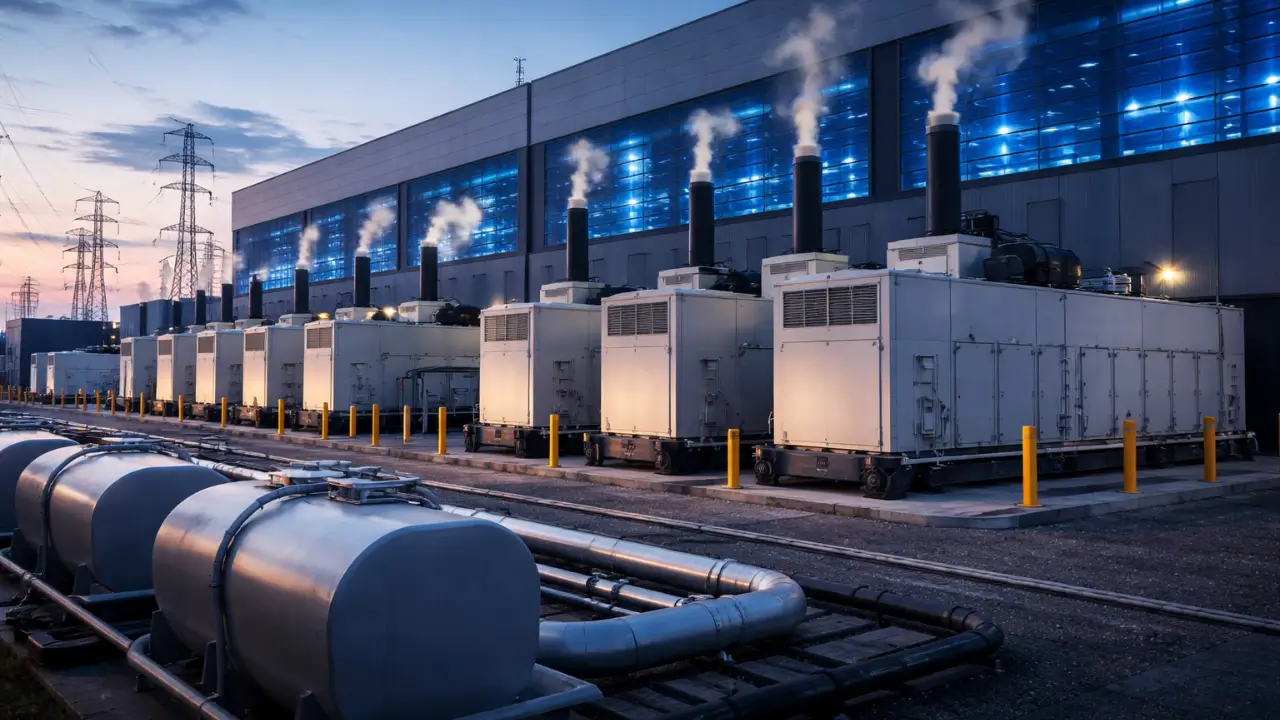
The underlying cause is not mysterious. Many data centers are programmed to protect sensitive equipment by immediately shifting to on-site backup power during grid disturbances. From an individual facility’s perspective, this is prudent engineering. The business case for avoiding even milliseconds of disruption is clear.
The complication arises when protection schemes are synchronized across dozens of facilities connected to the same transmission network. What protects one building may unsettle the broader system when executed en masse.
Scale intensifies the stakes. Industry projections cited in the Journal indicate that data centers could account for up to 57% of Virginia’s electricity use by 2030 and as much as 17% nationwide. Today, they represent about 4% to 5% of U.S. electricity consumption. The growth trajectory is steep, particularly in regions such as Northern Virginia, which has become a global hub for digital infrastructure.
As that share expands, so too does the potential impact of coordinated behavior.
Scale Changes the Social Contract
The concern is not limited to the Mid-Atlantic. In Texas, the grid operator Electric Reliability Council of Texas has flagged the risk of large customers tripping offline at the same time. Ercot has estimated that a sudden loss exceeding roughly 2,600 megawatts could endanger system stability. That threshold is not theoretical; it reflects modeling of what the system can withstand without cascading consequences.
At the continental level, the issue has drawn attention from reliability authorities. A senior official at the North American Electric Reliability Corporation described large-scale automatic disconnections as one of the most pressing new threats to grid stability, according to the Journal. Utilities and regulators are working with technology companies to limit unnecessary automatic disconnections during brief disturbances. Those efforts signal recognition that the grid’s risk profile is evolving.
Yet the broader policy conversation remains underdeveloped. The phrase “flexible load” has become a centerpiece of energy transition narratives. Electrification advocates highlight flexible demand as a tool to balance variable renewable generation. Large industrial customers are often encouraged to modulate consumption in exchange for financial incentives.
Data centers are frequently included in that flexible load category. They can, in theory, shift workloads or rely on backup systems. But recent episodes illustrate a crucial distinction: flexibility can be voluntary and coordinated, or automatic and simultaneous. The former supports grid stability. The latter may undermine it.
When 40 facilities disconnect at once because a protective setting is triggered, the result is not a managed demand response program. It is an abrupt shock. When roughly 70 facilities do the same months earlier, it ceases to look like coincidence and starts to resemble a structural vulnerability.
Coordinated Protection vs. Collective Exposure
None of the reported incidents resulted in blackouts. None required emergency declarations. That is precisely why they matter. They are early warnings occurring within manageable bounds. Reliability risks rarely announce themselves through catastrophe at first appearance. They surface as near misses, stress tests and anomalies that operators can contain, until scale outpaces safeguards.
The digital economy depends on high-density computing, cloud services and artificial intelligence infrastructure. That dependence will not diminish. Policymakers across states actively compete for data center investment, often emphasizing economic development and tax revenue.
But electricity systems are shared infrastructure. When a class of customers grows large enough to represent double-digit percentages of statewide consumption potentially 57% in Virginia within this decade, its operational characteristics become system-wide considerations. The concept of responsibility must scale alongside consumption.
Traditional large generators must comply with ride-through requirements, frequency response obligations and other reliability standards. Transmission owners adhere to strict planning criteria. Even industrial demand response participants operate under predefined rules.
Automatic disconnection settings inside private facilities, by contrast, have historically been treated as internal design choices.The recent episodes suggest that those settings now have public consequences.
The policy question is not whether data centers should protect their equipment. It is whether protection mechanisms can be calibrated to distinguish between minor, momentary disturbances and events that truly warrant full separation from the grid. If dozens of facilities respond identically to brief faults, the aggregate effect may exceed the original disturbance.Grid operators are already engaging with technology companies to reduce unnecessary trips. That collaboration is encouraging. It recognizes that reliability is a shared enterprise.
Still, the framing of data centers as “flexible load” risks obscuring an asymmetry. Flexibility implies choice and coordination. Automatic withdrawal at the first signal of instability shifts balancing responsibility back onto operators in real time.
Private Safeguards, Public Consequences
As electricity demand patterns change, reliability frameworks must adapt accordingly. The United States has long managed the risk of supply shortages with layered reserves and contingency planning. It may now need equally robust strategies for managing concentrated demand withdrawals.
The events in Virginia and the warnings in Texas do not signify failure. They demonstrate foresight in identifying emerging threats before they escalate. But they also underscore a simple principle: scale transforms private safeguards into public variables.
Flexible load can be an asset. It can help integrate renewables, reduce peak strain and provide operational agility. Yet flexibility detached from coordinated responsibility introduces new forms of instability. Electric grids function because every participant generator, transmission operators, large customers and regulators operates within shared guardrails. As data centers expand from niche infrastructure to dominant consumers, those guardrails must evolve.
When demand begins to rival supply in its capacity to disrupt, flexibility alone is not enough. Responsibility must expand in equal measure.