 Skip to content
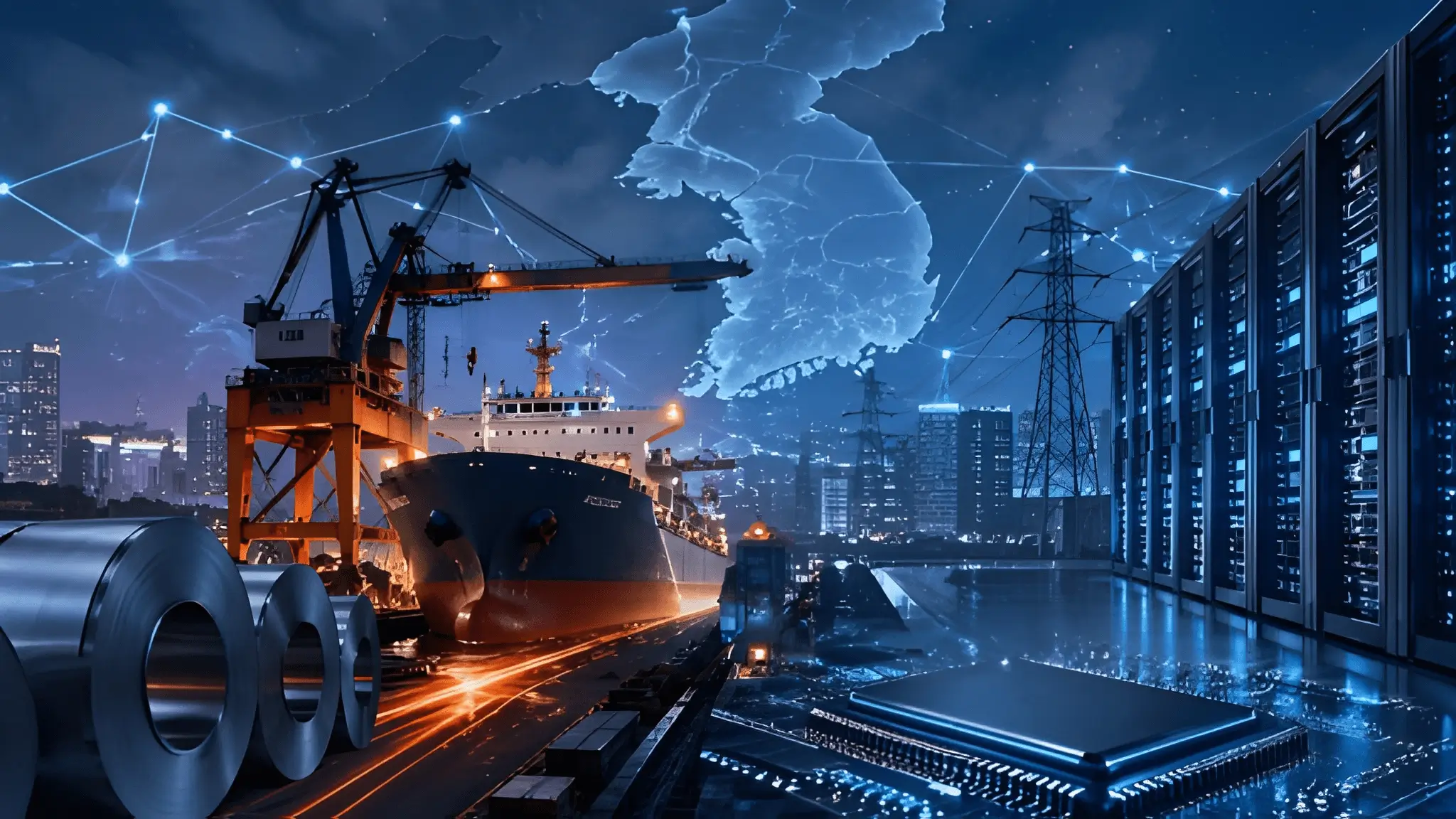
The Quiet Rewiring of an Industrial Power
South Korea’s industrial transformation is no longer unfolding at the margins. It is happening at the core of its economic identity. Conglomerates once synonymous with shipbuilding, petrochemicals, and steel are redirecting capital, talent, and strategic focus toward AI infrastructure. Data centers, power systems, and compute-enabling facilities are emerging as the new anchors of industrial ambition.

The shift appears rational. AI demand continues to surge, hyperscalers are expanding globally, and infrastructure capacity has become a bottleneck in digital economies. South Korea’s industrial groups possess the engineering depth, construction scale, and energy integration capabilities required to compete in this space. On the surface, this pivot signals alignment with future demand.
However, this transition is not simply a story of evolution. It reflects mounting pressure within legacy sectors. Shipbuilding cycles have grown increasingly volatile. Steel demand faces structural shifts tied to decarbonization and global overcapacity. Manufacturing exports remain exposed to geopolitical fragmentation and fluctuating trade flows. Under these conditions, AI infrastructure presents not just an opportunity, but a necessity.
This distinction matters. Strategic pivots driven by opportunity tend to be deliberate and controlled. Realignments driven by pressure often carry higher execution risk and longer-term uncertainty.
Data Centers as the New Industrial Backbone
Data centers now occupy a position once held by heavy industry. They represent scale, capital intensity, and national strategic importance. Governments view them as critical infrastructure. Corporations treat them as long-term growth engines. Investors see them as proxies for the AI economy.
South Korean conglomerates are moving accordingly. They are not merely building facilities; they are integrating across the value chain. Power generation, cooling systems, construction, and even energy optimization technologies are being bundled into cohesive offerings. This reflects a familiar industrial logic, vertical integration to control cost, reliability, and delivery timelines.

Yet, data centers operate under a fundamentally different economic model than traditional heavy industry.
Steel plants and shipyards generate employment across multiple skill levels and sustain extensive supplier ecosystems. Data centers, by contrast, require fewer workers once operational. Their value lies in uptime, efficiency, and computational throughput rather than labor intensity. This creates a structural divergence between industrial output and employment generation.
The implications are significant. Economic expansion tied to data centers may not translate into proportional job creation. Regional development patterns could shift. Industrial zones that once supported thousands of workers may evolve into high-value, low-employment clusters.
Energy Dependency and Structural Exposure
The rise of data centers introduces a new axis of vulnerability: energy dependence. Compute infrastructure demands continuous, large-scale power. As AI workloads intensify, energy consumption scales accordingly. This places pressure on national grids, energy pricing mechanisms, and sustainability commitments.
South Korea already operates within a constrained energy environment. It relies heavily on energy imports and faces ongoing challenges in balancing cost, security, and decarbonization goals. The expansion of data centers amplifies these tensions.
Power availability becomes a competitive factor. Electricity pricing influences site selection and long-term viability. Renewable integration introduces variability that must be managed through advanced grid systems or backup solutions. Each of these elements adds complexity to what might otherwise appear as straightforward infrastructure expansion.
This is not a marginal concern. It is central to the sustainability of the entire strategy. Without stable and cost-effective energy, data centers cannot deliver the economic returns that justify their scale.
Capital Intensity Without Guaranteed Control
AI infrastructure attracts substantial capital. Data centers require significant upfront investment, long development timelines, and ongoing operational expenditure. For South Korean conglomerates, this aligns with their historical strength in managing large-scale projects.
However, ownership of infrastructure does not equate to control over the value chain. The primary drivers of demand global technology firms and AI platform providers operate at a different layer. They control workloads, software ecosystems, and user access. Infrastructure providers serve as enablers rather than primary beneficiaries of AI value creation.
This creates a structural imbalance. South Korean firms may build and power the backbone of AI, but they do not necessarily capture the highest-margin segments of the ecosystem. Their returns depend on utilization rates, long-term contracts, and pricing stability rather than direct participation in AI-driven revenue streams.
Such dependence introduces exposure to external cycles. If global AI investment slows, infrastructure demand may adjust accordingly. If hyperscalers shift strategies or diversify locations, existing assets could face underutilization risks.
The Illusion of Stability
Data centers are often perceived as stable, long-term assets. They generate recurring revenue, support mission-critical operations, and attract institutional investment. This perception reinforces their appeal as replacements for cyclical industrial sectors.
However, stability in this context is conditional. Technology evolves rapidly. Hardware requirements shift. Cooling technologies advance. Energy efficiency standards tighten. Facilities built for current workloads may require significant upgrades to remain competitive. This introduces a continuous cycle of reinvestment.
At the same time, geopolitical considerations are becoming increasingly relevant. Data sovereignty, cross-border data flows, and regulatory frameworks influence where and how infrastructure can operate. South Korea’s position within global alliances and trade networks adds another layer of complexity.
The result is a paradox. Data centers appear stable compared to traditional industries, yet they operate within a dynamic and often unpredictable ecosystem.
Industrial Identity at a Crossroads
South Korea’s industrial model has historically combined scale, export orientation, and employment generation. It has delivered consistent growth by leveraging manufacturing excellence and global integration.
The pivot toward AI infrastructure challenges this model. Scale remains, but its nature changes. Export orientation becomes less tangible, tied to digital flows rather than physical goods. Employment generation weakens as automation and efficiency take precedence. Economic value shifts toward intangible outputs.
This does not imply decline. It signals transformation. However, the direction of that transformation raises important questions.
Will the new model deliver the same level of economic inclusivity? Can it sustain regional development patterns established by traditional industries? Does it provide sufficient resilience against external shocks?
These questions do not have immediate answers. They require long-term observation and policy alignment.
A Strategic Bet With Asymmetric Risks
South Korea’s move into AI infrastructure reflects both foresight and necessity. It aligns industrial capability with emerging demand. It positions the country within a critical segment of the global technology landscape.
At the same time, it represents a strategic bet with asymmetric risks. The upside depends on sustained AI growth, stable energy conditions, and favorable geopolitical dynamics. The downside includes underutilized assets, rising operational costs, and limited control over value capture.
This asymmetry defines the current moment. The transition is not inherently flawed, but it is not inherently secure.
Evolution or Substitution
South Korea’s industrial shift cannot be reduced to a narrative of reinvention. It is more accurately described as substitution under pressure. Legacy industries are losing momentum. AI infrastructure offers a path forward, but it introduces a different set of dependencies and constraints.
The outcome will depend on execution. It will also depend on whether South Korea can extend its role beyond infrastructure into higher-value segments of the AI ecosystem.
If it succeeds, the transition may redefine industrial leadership for the digital era. If it falls short, the country risks anchoring its future to a sector it enables but does not control. The gamble is already in motion. Its consequences will shape not just industrial strategy, but the broader trajectory of economic resilience.












