
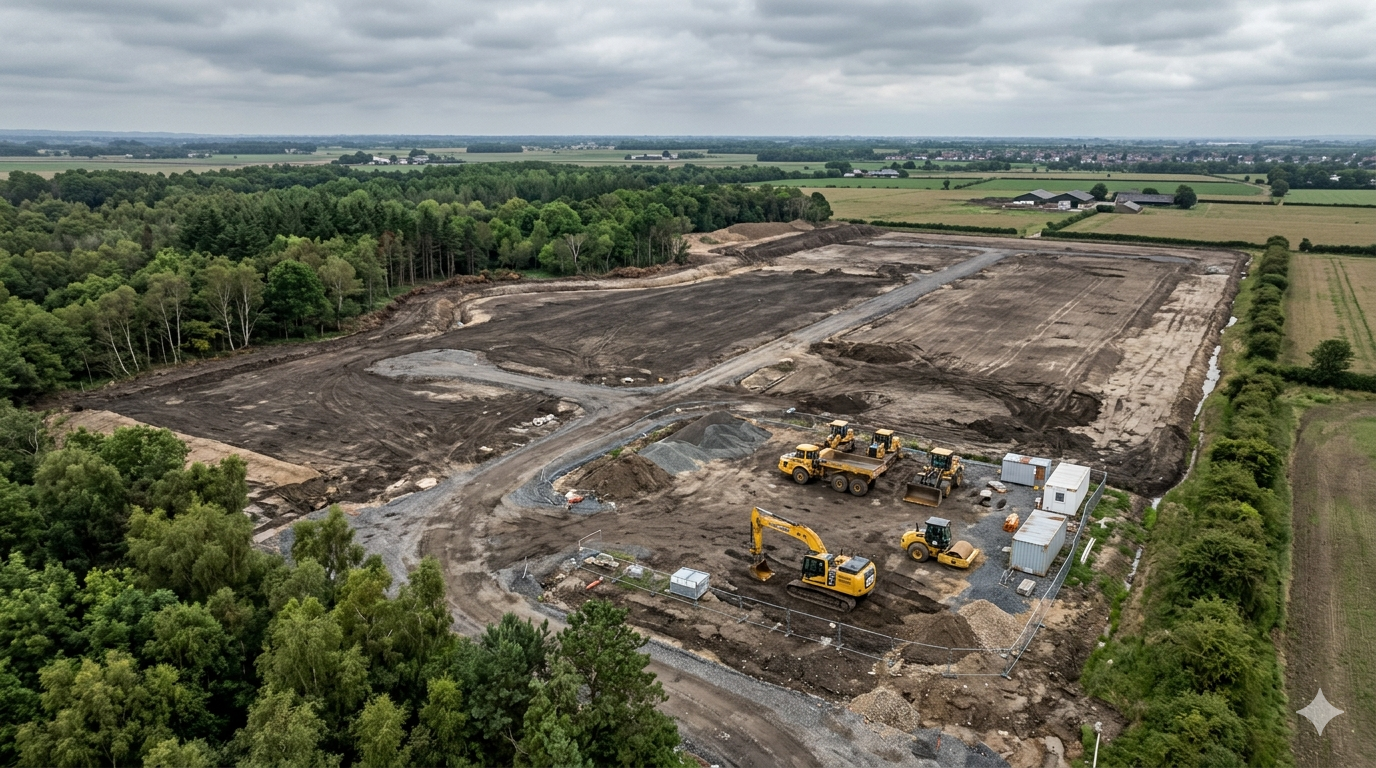
Analysts at Bloomberg and Sightline Climate published findings in April 2026 that the industry has been slow to absorb. Approximately 12 gigawatts of AI data center capacity are currently under active construction in the United States. Another 21.5 gigawatts sit in plans described as targeting 2027. Of that planned capacity, only 6.3 gigawatts have broken ground. The rest exists as announcements, pre-leases, and site acquisitions. Set against the 50-plus gigawatts publicly committed to, the gap between announcement and active construction is the most uncomfortable number in the industry right now.

This is not a liquidity problem. The capital exists. It is not a demand problem either. Enterprise AI adoption is accelerating, not slowing. The problem is, specifically, operational. Announcing infrastructure and actually building it are separated by a set of constraints that capital cannot simply buy its way through. Those structural prerequisites, specifically confirmed power access, cooling supply chains, anchor tenant commitments, and permitting clearance, are not being resolved at the pace that announcement timelines implied.
Why the Gap Keeps Widening
Every capital-intensive infrastructure sector produces optimistic forward pipelines that compress against operational reality. AI infrastructure is, in that sense, not unique. What is, however, distinctive about this particular gap is its scale and its consequences for public market valuations. What is growing exponentially is not the infrastructure. The announcements, however, are.
The root causes are, at this point, well documented. Grid interconnection queues in the most attractive US markets run five to seven years for loads above 100 megawatts. The transformer and substation supply chain is running 18 to 36 months on critical components. Cooling infrastructure for rack densities above 100 kilowatts per rack requires engineering and procurement lead times incompatible with the 12-to-18-month timelines that announcement press releases typically imply. As we have covered in our analysis of the gigawatt campus problem, the projects that are actually delivering capacity are the ones that solved power access and anchor tenant commitments before breaking ground. The ones that did not are sitting in the gap.

What the 50 GW Number Actually Means
The 50 gigawatt figure refers to the aggregate of announced hyperscaler and AI infrastructure commitments across the United States over the next three to five years. It includes Microsoft’s stated $80 billion data center investment plan and Google’s $75 billion capex commitment for 2025. Amazon’s ongoing expansion and commitments from AI labs, neoclouds, and co-location operators make up the rest. The number is real in the sense that these companies have genuinely committed this capital. It is, however, misleading in the sense that committed capital and delivered capacity are not the same thing.
Microsoft demonstrated this distinction in early 2026, when it walked away from approximately 2 gigawatts of preleased capacity. The decision reflected a reassessment of both demand timing and the operational readiness of development partners involved. It was, indeed, a rational financial decision. It was also, however, a data point. The 50-gigawatt pipeline contains projects at very different levels of operational maturity, and the headline number conflates them in ways that obscure the actual delivery risk. Not all of the gap is equal. It concentrates, in other words, in projects that locked in announcements before solving the structural prerequisites.
The Investor Implications Are Not Yet Priced In
Financial markets have begun adjusting to the announced-versus-built reality, but the adjustment is, notably, incomplete. Fermi America’s stock declined more than 80 percent from its IPO high when the gap became visible in that single, high-profile case. The broader repricing of the AI infrastructure sector’s valuation premium has, however, been more gradual and is not yet complete.
Hyperscalers have, however, disclosed capex plans that assume delivery timelines the supply chain and regulatory environment cannot currently support. When those timelines slip, the financial models built around them consequently slip too. The investor issue is that the 50 GW pipeline appears in analyst models as support for sustained revenue growth at power companies, equipment manufacturers, cooling vendors, and construction firms. If a significant portion of that pipeline delivers two to three years later than projected, those revenue models are wrong. The downstream effects are, consequently, material. As we have covered in our analysis of how investors are rethinking data center valuation, the methodology for evaluating AI infrastructure investments is changing rapidly. Projects with confirmed power access, executed anchor tenant leases, and equipment procurement already underway trade at a different risk premium than those with only an announcement and a site. The market is beginning to price that difference.
What Closing the Gap Actually Requires
The 50 GW pipeline gap will not close through more announcements. Closing it, therefore, requires resolving the underlying constraints project by project. Power access requires utility relationships, patient capital for queue positions, and in some cases direct investment in transmission upgrades. None of these, notably, can be assembled in the weeks between an announcement and a groundbreaking. Equipment supply chains require procurement decisions 24 to 36 months before planned commissioning, not after a lease is signed. Anchor tenant commitments require developers to sequence their engagement with hyperscalers before breaking ground rather than after.
The industry that emerges from the current reckoning will look different from the one that created it. Developers who survived the gap will have built the supply chain relationships, utility partnerships, and operational processes that large-scale delivery requires.
Those capabilities are not something well-capitalised competitors can replicate quickly without going through the same operational cycle. That advantage compounds over time.
The 50 GW pipeline gap is not a crisis. It is, rather, a filter. The operators who can demonstrate delivery at this scale will command a structural premium that no amount of capital can shortcut. The projects and operators that emerge from the current period with operational credibility intact will define the next phase of AI infrastructure development. Those that relied on announcements alone will not. As we have covered in our analysis of how electrical equipment shortages are quietly stalling the AI infrastructure buildout, the constraint is not capital. It is execution capability. And execution capability is not something that can be acquired quickly.











