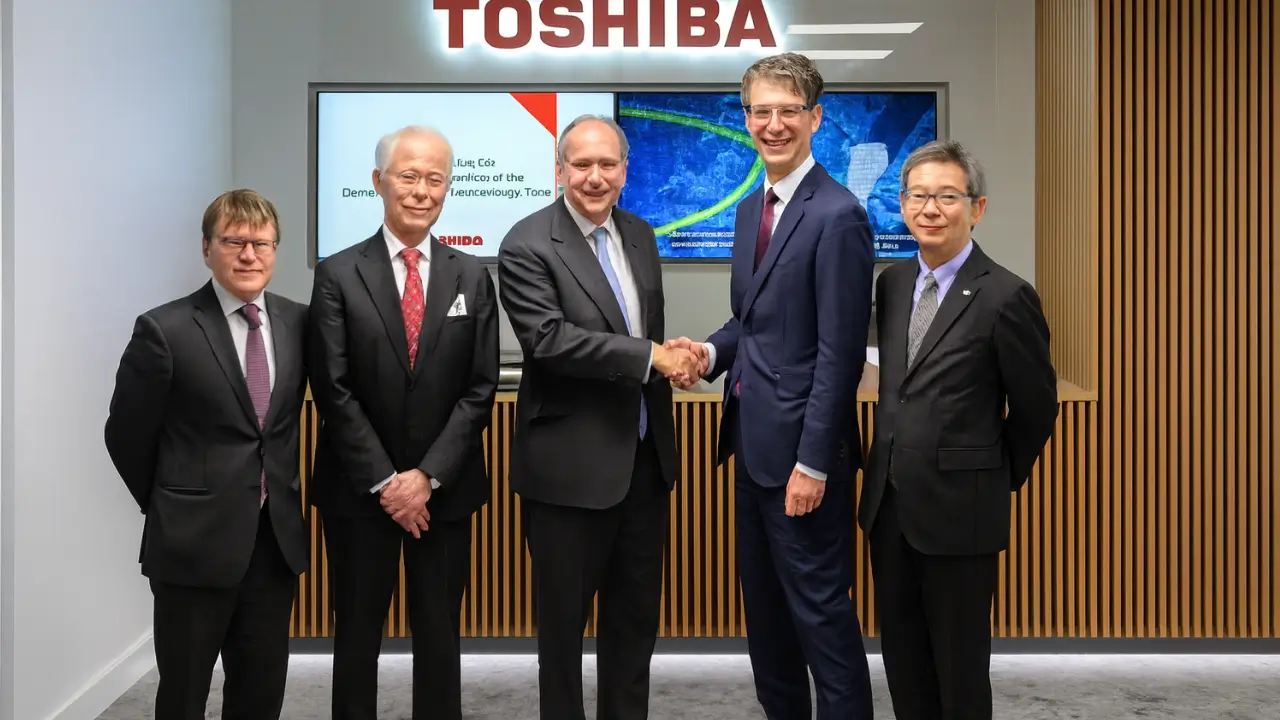
In our assessment, this quantum security venture marks a crucial step forward as the world steadily moves closer to quantum-era communication needs. Furthermore, the recent achievement announced by Toshiba and Quantum Corridor demonstrates how quantum-secured communication is becoming increasingly viable for commercial environments. The companies successfully executed a live demonstration of quantum-secure transmission over commercial fiber routes spanning Illinois to Indiana, confirming that Quantum Key Distribution (QKD) technology can deliver continuous secure key generation and stable high-throughput encryption.
Moreover, as quantum computing progresses toward commercialization, secure connectivity between data centers and organizations becomes a global requirement. This milestone shows how both companies are developing capabilities that help prepare communication networks for advanced computing environments. Additionally, by validating QKD performance in a real-world scenario, Toshiba and Quantum Corridor highlight the importance of moving beyond theoretical discussions toward practical deployment frameworks.
Advancing Quantum Connectivity Through New Technical Capabilities
Demonstrating Secure Transport Across Live Commercial Fiber
The demonstration leveraged a 21.8-kilometer segment of Quantum Corridor’s optical network. Consequently, the test verified that Toshiba’s QKD system could maintain a continuous flow of secure keys while supporting high encryption throughput. Therefore, the results confirm that quantum-resilient cryptography can operate effectively over commercial infrastructure that enterprises already depend on.
Preparing for Distributed Quantum-Enabled Computing Ecosystems
Ryan Lafler, President, Founder, and CTO of Quantum Corridor, explained that organizations should anticipate how quantum computers will eventually connect across distributed environments. Furthermore, he noted that future computing clusters will combine classical systems with quantum hardware to create new efficiencies for AI and other advanced workloads. Consequently, this demonstration serves as an early step in building the type of infrastructure needed to support those hybrid environments.
Industry Signals Strengthening the Quantum Security Venture
Leadership Perspectives Reflect Market Momentum
Terry Cronin, Vice President for Business Development at Toshiba, stated that companies must begin addressing quantum-security risks now rather than later. Additionally, he pointed to roadmaps from major manufacturers projecting that meaningful quantum computers may arrive by 2030, reinforcing the need for early planning. Consequently, his remarks underscore how critical it is for organizations to prepare network systems before quantum decryption threats emerge.
Rising Demand for Distributed Quantum Networks
Moreover, Lafler emphasized that emerging commercial use cases will likely increase demand for distributed quantum networks. Quantum computers require highly specialized environments with extreme cooling, humidity control, and electromagnetic shielding, which makes on-premises deployment impractical. As a result, organizations will rely on quantum-secure networks to reach remote quantum computing resources without compromising sensitive workloads.
Quantum Security Venture Readiness Across Commercial Applications
Anticipating Industry Adoption and Urgency
Quantum computing is expected to transform sectors such as pharmaceuticals, materials science, logistics, energy optimization, and AI. Additionally, its ability to break traditional encryption standards has prompted many organizations to search for long-term security solutions. However, some companies may not realize how rapidly quantum capabilities are approaching mainstream readiness.
Similarly, Cronin compared quantum-security preparation to purchasing insurance,an investment made today to protect data in the near future. Every day, new cybersecurity incidents reinforce the need for organizations to act proactively. Consequently, the industry is beginning to acknowledge the urgency of deploying secure communication methods ahead of quantum disruption.
Technical Achievements Strengthening the Quantum Security Venture
High-Performance Results From the Demonstration
Toshiba reported that its QKD system achieved secure key rates averaging 1,500 kbps, surpassing expected performance levels. Furthermore, the quantum-generated keys were successfully integrated into Ciena Waveserver5 800G coherent encryption models. The companies also obtained fresh QKD keys every 90 seconds, demonstrating interoperability and scalability in a commercial environment.
Additionally, the system maintained 100% line-rate throughput and zero packet loss across 48 hours of continuous encrypted traffic. These results show how quantum-secure communication can coexist with demanding high-bandwidth requirements typical of modern enterprise applications.
Academic Perspective on Real-World Deployment
Michael Manfra, Director of the Purdue University Quantum Science and Engineering Institute, noted that the demonstration represents an important transition toward commercially viable quantum-secure communication. Moreover, he emphasized that seeing QKD deployed under real-world conditions highlights the progress toward secure quantum key distribution across state boundaries.
Broader Implications for the Future of Secure Communication
In conclusion, this quantum security venture illustrates how quantum-resilient communication technologies are evolving to address the demands of tomorrow’s computing landscape. As organizations worldwide prepare for advanced AI systems, distributed computing models, and increasing digital threats, secure connectivity becomes essential. Furthermore, this achievement reinforces how strategic collaboration and technical innovation can accelerate readiness for the quantum era.
Finally, as development continues and more commercial use cases emerge, milestones like this one highlight the growing importance of resilient, next-generation communication systems capable of supporting the future of global digital infrastructure