 Skip to content
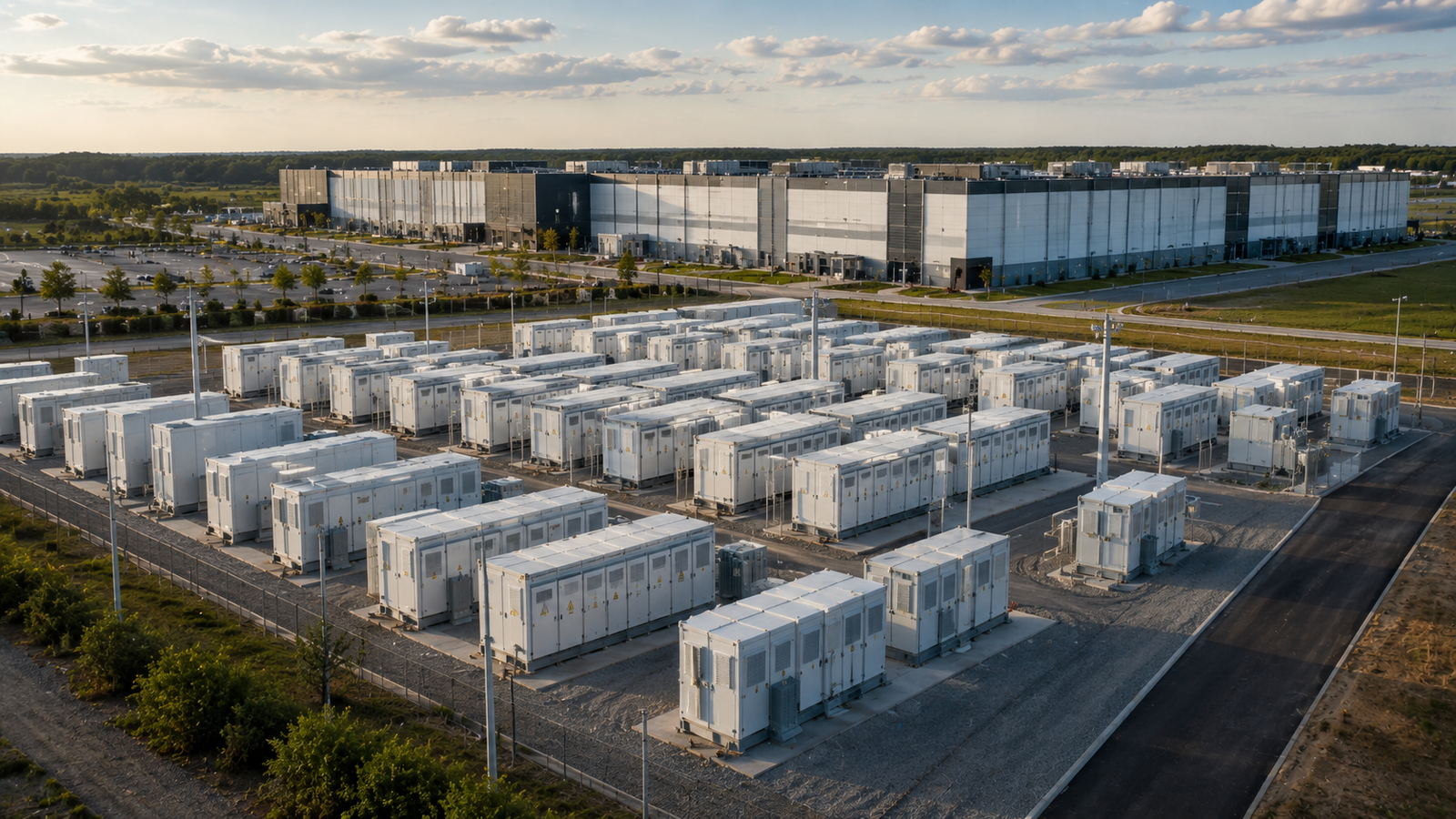
Battery energy storage systems have existed at the edge of data center infrastructure strategy for years. They were sized for backup power, positioned as an alternative to diesel generators, and evaluated primarily on cost and reliability. That framing is being replaced by something structurally different. AI data center demand has made battery storage a primary tool for solving three problems simultaneously: interconnection timelines that are too long to wait out, power quality requirements that the grid cannot guarantee, and sustainability commitments that require clean energy integration at scale. The battery storage AI data center market is now projected to grow from approximately $1.2 billion in 2025 to between $4 and $6 billion annually by 2030, at a compound annual rate of 28 to 38 percent.

That growth rate is not driven by incremental adoption of existing solutions. It is driven by the discovery that battery storage solves a problem that nothing else in the AI infrastructure toolkit can solve as quickly or as flexibly: getting power to a facility years before a utility interconnection is available.
The Interconnection Problem That Made BESS Essential
Grid interconnection queues in the US now stretch an average of four years for large loads. In constrained markets like Northern Virginia, some requests sit in queue for seven years or longer. An AI campus that needs power now cannot wait that long. The facilities being announced today are expected to be operational in 12 to 24 months. The gap between that timeline and the grid connection timeline is the specific problem that battery storage solves.
Behind-the-meter BESS deployed alongside a data center allows the facility to draw power from an on-site or near-site generation source, typically natural gas or renewable paired with storage, and connect to the utility grid at a smaller capacity that clears the interconnection queue significantly faster. Aligned Data Centers demonstrated this directly in late 2025 when it announced a 31-megawatt, 62-megawatt-hour battery deployment in the Pacific Northwest, sized specifically to allow the facility to interconnect years earlier than would have been possible with traditional utility upgrades. The battery is not supplementing the grid connection. It is substituting for a larger grid connection that the queue timeline makes unavailable.
Jefferies projects 20 gigawatts of hyperscaler-affiliated BESS deployment by 2035. That figure reflects a market that has moved from treating battery storage as an optional facility feature to treating it as a required element of any campus power strategy in markets where interconnection timelines are constrained. The constraint is most acute in the US, but the same dynamic is emerging in the UK, Germany, and Singapore as data center load growth outpaces grid upgrade capacity.
The AI Workload Profile That Existing Storage Solutions Cannot Handle
The interconnection advantage explains why battery storage has become essential. The AI workload power profile explains why existing battery solutions need to be redesigned to serve this market well.

Traditional data centers present relatively predictable power demand. Load variations are modest and slow. UPS systems designed for this environment are optimised for short-duration backup, not for managing rapid load swings. AI workloads are fundamentally different. Research from Nvidia, Microsoft, and OpenAI confirms that AI workload power utilisation can swing from 30 percent to 100 percent of capacity within seconds, driven by the bursty nature of training cluster operations and the variable demand of inference workloads responding to traffic patterns.
Standard lithium iron phosphate batteries, which dominate the grid-scale storage market, are optimised for gradual charge and discharge cycles. The rapid power swings of AI workloads stress these batteries in ways that the grid-scale market did not historically require them to handle. The market response has been the emergence of a new category of storage solutions specifically designed for AI data center co-location, with chemistries, management systems, and discharge profiles calibrated for the specific demands of high-density GPU clusters rather than for grid frequency regulation or residential peak shaving.
Sodium-ion technology is entering commercial deployment for this application, offering better safety characteristics and enhanced performance at the rapid discharge rates AI workloads require, despite higher per-cell costs than lithium iron phosphate. The market is also seeing increased interest in longer-duration storage, with four-hour systems able to bridge the periods when renewable generation is absent and utility supply is insufficient, providing the continuous high-quality power that AI clusters require without depending on gas generation during those periods.
The Dual Role That Is Creating Tension
Battery storage in the AI data center context is being asked to play two roles simultaneously, and those roles create a genuine tension that the market has not fully resolved. The first role is enabling AI infrastructure to deploy faster than the grid can support, which is commercially essential and operationally valuable. The second role is supporting the clean energy commitments that the same hyperscalers and data center operators are publicly maintaining.
The tension arises from the most common configuration being deployed: gas generation paired with BESS. Behind-the-meter gas turbines provide the firm, dispatchable power that grid interconnection delays make unavailable. The battery manages the rapid power swings of AI workloads, provides short-term bridging when gas generation ramps up or down, and enables the facility to participate in demand response programmes. This configuration solves the interconnection problem efficiently. It does not advance the operator’s clean energy commitments, and it may actively conflict with them depending on how those commitments are structured.
The operators who are navigating this most carefully are the ones pairing battery storage with renewable generation rather than gas, accepting the additional complexity of managing renewable intermittency in exchange for genuine alignment between their operational power source and their sustainability commitments. Aligned Data Centers’ Pacific Northwest deployment is a relevant example: the facility is using battery storage to enable grid interconnection while drawing power from a renewable-heavy regional grid rather than pairing with on-site gas generation.
What the Market Structure Looks Like Now
The battery storage AI data center market has rapidly stratified into four distinct competitor categories, each serving a different part of the opportunity. Established UPS vendors including Vertiv, Eaton, and Schneider Electric are expanding their product lines to address the larger-scale, longer-duration storage requirements of AI facilities, drawing on existing customer relationships and service infrastructure. Specialist BESS providers like Prevalon, FlexGen, and Calibrant Energy have built dedicated data center practices, offering co-location design, financing structures, and operational management that the legacy UPS vendors are not yet fully equipped to provide.
Sodium-ion and next-generation chemistry startups are entering commercial deployment, targeting the specific performance requirements of AI workloads that standard lithium iron phosphate solutions address imperfectly. And the hyperscalers themselves are developing proprietary battery procurement and management capabilities, treating energy storage as a strategic infrastructure asset rather than a vendor-supplied component. The AI data center copper problem getting much worse applies equally to battery manufacturing supply chains: the lithium, sodium, and cell manufacturing capacity being demanded by the AI data center storage market is competing for the same materials and manufacturing slots as grid-scale storage, electric vehicle batteries, and consumer electronics.
The Market That Exists in 2030 Will Not Resemble the One That Exists Today
The battery storage market of 2030 will not be a scaled-up version of the UPS market of 2023. It will be a purpose-built sector with its own chemistry options, financing structures, operational management requirements, and regulatory relationships, designed around the power profile of AI workloads rather than around the grid stability requirements that shaped the existing energy storage industry. The operators who are building their power strategies around this trajectory now, rather than applying existing storage solutions to a problem they were not designed to solve, will have infrastructure that performs reliably as AI workload densities continue climbing and as regulatory requirements around clean energy integration tighten. The battery storage AI data center market is not supplementing the power infrastructure strategy. It is becoming central to it.












