
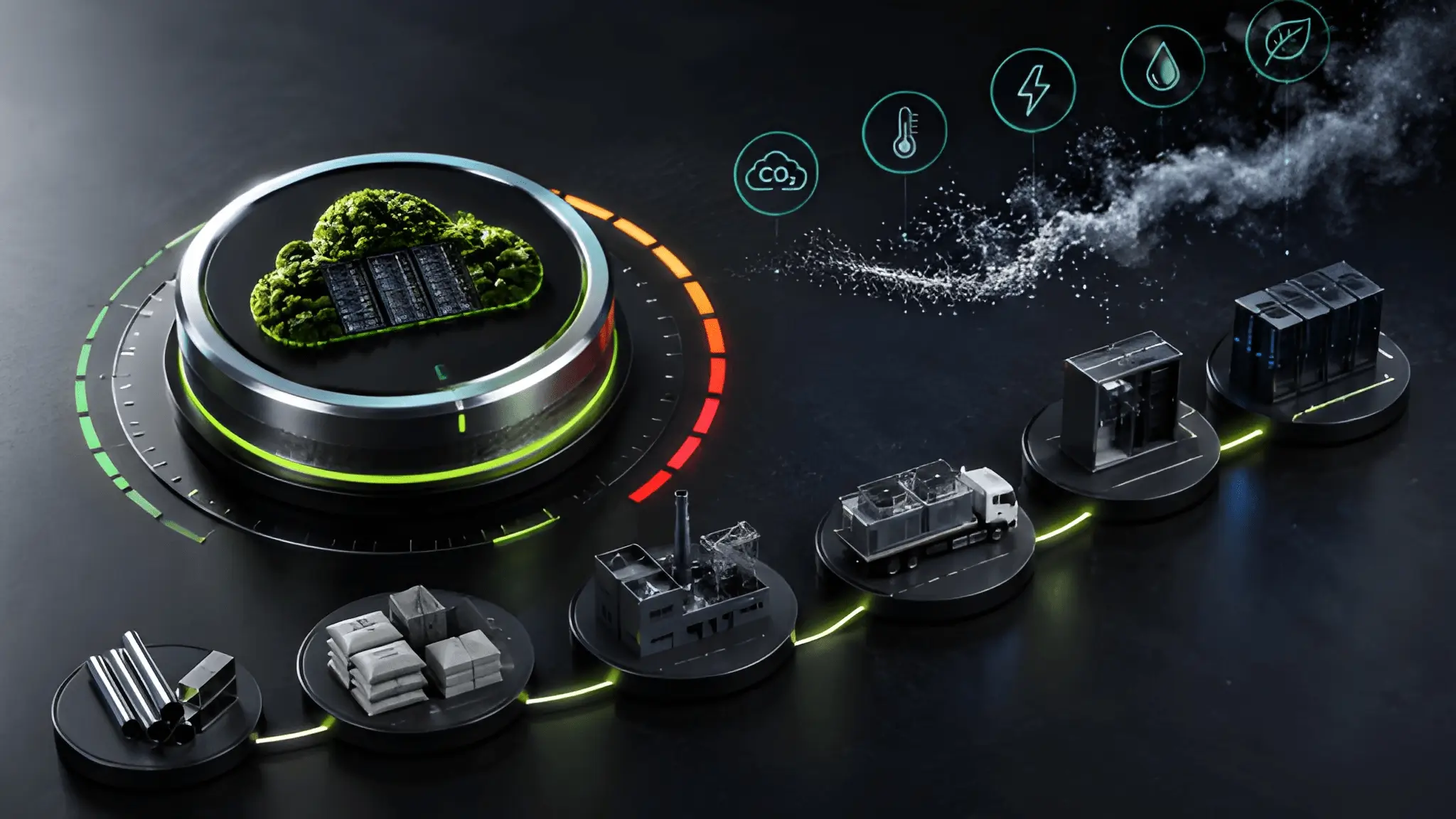
The data center industry has spent years optimizing the emissions it can see most clearly, from electricity consumption and cooling efficiency to renewable power procurement and Power Usage Effectiveness, or PUE. The next challenge sits earlier in the project timeline, where concrete, steel, electronics, cooling equipment, electrical systems and construction decisions can create a substantial carbon burden before a facility ever switches on. Artificial intelligence is accelerating that challenge as demand for computing capacity drives rapid data center expansion, higher power density and larger digital infrastructure investments across global markets. As a result, the industry has developed more mature approaches for managing operational emissions than for consistently assessing carbon embedded in buildings, equipment and construction supply chains. The Innovation for Cool Earth Forum’s (ICEF) 2025 Sustainable Data Centers Roadmap found that embodied emissions can exceed 40% of total greenhouse gas emissions in data centers powered primarily by very low-carbon electricity.

Carbon Gets Locked In Before Operations Begin
Embodied carbon differs from operational emissions because much of it enters the project’s footprint before operators generate their first workload. The category spans raw-material extraction, manufacturing, transportation, fabrication and installation across the building and the technology that fills it. Structural steel and cement remain major contributors, while chips, memory, servers, power supplies and other information-technology equipment can add substantial upstream emissions as computing infrastructure becomes increasingly intensive. Cooling systems, switchgear, batteries, cabling and other mechanical and electrical infrastructure further expand the footprint beyond the building’s familiar concrete-and-steel envelope. The ICEF roadmap estimates that chips and solid-state memory can represent significant portions of embodied emissions in a modern data center, illustrating why a building-only assessment can miss important sources. For developers, that changes the question from how efficiently a facility will operate to how much carbon the project commits before efficient operation even begins.
The Hardest Carbon To See Is Often The Hardest To Cut
Operational carbon has an obvious financial connection because electricity consumption appears directly in utility bills, forecasts and long-term operating models. Embodied carbon tends to sit several layers deeper, distributed among architects, engineers, contractors, equipment manufacturers, material suppliers, procurement teams, investors and eventual operators. Each participant can influence the footprint, yet no single party necessarily owns the full carbon outcome. This creates a familiar commercial paradox in which a lower-carbon material can look more expensive or complicated to one stakeholder while delivering value across the project’s entire lifecycle. In practice, procurement teams often prioritize product availability and delivery timelines, while designers, contractors and developers must balance technical performance, project schedules and capital investment alongside sustainability objectives. The carbon consequence can therefore disappear inside otherwise rational decisions that make sense at the individual level.
AI Construction Speed Is Making The Trade-Off Sharper
The rapid expansion of AI infrastructure is increasing the pace of data center development, creating additional pressure on project planning, procurement and construction decisions. Projects with aggressive delivery schedules often place greater emphasis on procurement certainty, supplier availability and construction timelines when selecting materials and equipment. Low-carbon concrete, steel and other products can also face limited supply, higher prices and geographic constraints, making them difficult to secure at the scale required by hyperscale development. The ICEF roadmap notes that low-carbon versions of several critical data center materials remain scarce and can carry significant cost premiums compared with conventional products. That scarcity turns carbon into a supply-chain issue rather than a sustainability checkbox, because the most consequential decisions increasingly depend on what manufacturers can produce and deliver on time.
Measurement Still Has A Major Weakness
The industry also lacks a single, consistently applied method for comparing embodied carbon across data center projects. Environmental Product Declarations can vary in availability and quality, certification systems use different boundaries and assumptions, and proprietary information can prevent buyers from seeing the carbon intensity of equipment deep inside the supply chain. Mechanical and electrical systems create another blind spot because conventional building assessments may not fully capture the contribution of dense power and cooling infrastructure. Estimates cited in the reference analysis suggest that mechanical and electrical systems can represent a significant share of embodied carbon in data centers, although the proportion varies by project design, equipment selection and assessment methodology. That uncertainty makes it harder for developers to establish meaningful benchmarks or determine whether one design genuinely performs better than another.
Whole-Life Analysis Needs To Start At Concept Design
The strongest opportunity for reducing embodied emissions arrives before the project team loses design flexibility. A Whole Building Life Cycle Assessment can allow developers and engineers to compare structural systems, material quantities, equipment choices and procurement strategies while major decisions remain changeable. That approach can expose carbon-intensive specifications that would otherwise survive into construction simply because the project has already advanced too far to revisit them economically. Structural optimization can reduce material demand, while more disciplined specifications can prevent over-engineering that adds cost and emissions without improving resilience or performance. Local sourcing can also reduce transportation impacts, although location alone does not guarantee a lower-carbon outcome because manufacturing intensity remains critical. Therefore, the most effective carbon strategy is not a late-stage offset exercise but an early design discipline that puts carbon beside cost, schedule, reliability and technical performance.

Procurement Could Become The New Carbon Control Point
Once carbon enters procurement, sustainability targets become much more tangible because buyers can begin asking suppliers for comparable emissions information and lower-carbon alternatives. Developers can use Environmental Product Declarations, supplier-specific disclosures and lifecycle assessments to distinguish between products that appear interchangeable on price and performance but carry very different upstream footprints. The same logic applies to IT hardware, where chip manufacturing, memory production and electronics supply chains can materially influence a facility’s embodied emissions. The ICEF roadmap identifies semiconductor manufacturing and fluorinated gases used in chip production among important sources of upstream greenhouse gas emissions, expanding the carbon conversation well beyond construction materials. Procurement decisions can encourage the adoption of lower-carbon steel, cement, electronics and equipment by incorporating lifecycle emissions and supplier disclosures into purchasing criteria. Over time, that demand could help suppliers justify investment in cleaner production capacity, particularly where buyers provide long-term commitments.
Carbon Is Becoming A Business Risk
Embodied emissions are increasingly moving into the territory of reporting, investment and risk management as companies face greater scrutiny over Scope 3 emissions and lifecycle impacts. European disclosure frameworks and investor expectations are pushing companies toward more detailed visibility across value chains, increasing the pressure on data center developers and operators to understand emissions that they do not directly control. That shift is increasing the commercial relevance of embodied carbon because more detailed lifecycle emissions data is becoming increasingly important for sustainability reporting, supply-chain transparency and investment disclosures. Investors are increasingly seeking more detailed information on lifecycle emissions and climate-related risks as sustainability reporting expectations continue to evolve across global markets. For developers, the issue is therefore no longer limited to whether a project can claim a sustainability credential.
The Industry Needs Better Data And Earlier Decisions
The industry is still developing more consistent approaches for measuring embodied carbon, and organizations are increasingly adopting lifecycle assessments even as common methodologies continue to evolve. Developers can start by publishing assumptions, establishing project-level baselines and measuring the largest sources even when supply-chain data remain incomplete. They can then compare alternatives at concept stage, create carbon thresholds for major procurement categories and require suppliers to improve disclosure over time. This approach also gives designers and contractors a commercial reason to treat carbon as a project constraint rather than an external sustainability objective. The ICEF roadmap recommends greater transparency, stronger assessment of Scope 3 emissions, material reduction and substitution, low-carbon procurement and longer equipment lifecycles as part of a broader strategy for cutting data center embodied emissions.
The Carbon Clock Starts Before The Power-On Date
Data center sustainability has reached a point where improving operational efficiency alone can no longer tell the whole story. As grids become cleaner and facilities become more efficient, the emissions embedded in buildings, equipment and global supply chains will represent a larger share of the remaining lifecycle challenge. AI is making that issue more urgent by accelerating investment in new data center infrastructure and increasing the scale of computing capacity required worldwide. The most consequential carbon decisions can occur when engineers choose a structural system, when procurement teams select a supplier or when developers approve an equipment specification, long before an operator can influence PUE. The industry’s sustainability performance will increasingly depend on decisions made during planning, design, procurement and construction, alongside improvements in operational efficiency throughout a facility’s lifecycle.











