 Skip to content
Each new generation of AI accelerators draws more power and produces more heat than the one before it, and the cooling infrastructure built for prior chip generations is approaching its functional ceiling. Microsoft has announced successful testing of a microfluidic cooling system that etches coolant channels directly into the silicon of a chip, removing heat up to three times more effectively than cold plates, the liquid cooling method most widely deployed in data centers today. The development, produced in collaboration with Swiss thermal engineering startup Corintis, addresses a constraint that industry analysts increasingly describe as the primary limiting factor on AI chip performance over the next several years.

The Thermal Ceiling Facing AI Hardware
Rack density in data centers has increased sharply over the past decade. According to Dell Technologies global industries CTO David Holmes, average rack density has risen from approximately 6 kilowatts eight years ago to racks now shipping at 270 kW, with 480 kW configurations expected within a year and megawatt-scale racks anticipated within two years. Each increase in power density translates directly into a proportional increase in heat that must be removed from the system.
Cold plates, the dominant liquid cooling technology in current data centers, sit on top of a chip package and circulate coolant through channels to draw heat away from the silicon below. The approach works, but it is constrained by the layers of packaging material between the coolant and the heat source materials that, while necessary for protecting the chip, also trap heat much like insulation. Sashi Majety, senior technical program manager for Cloud Operations and Innovation at Microsoft, framed the trajectory in direct terms: organizations relying heavily on cold plate technology within five years will find themselves constrained by it. Corintis CEO Remco van Erp described the scale of the coming challenge using the metric of coolant flow rate. The current industry standard sits at approximately 1.5 liters per minute per kilowatt. As chip power approaches 10 kW, that ratio implies roughly 15 liters per minute to cool a single chip a volume that strains both plumbing infrastructure and water consumption budgets at data center scale.
How Microfluidic Cooling Works
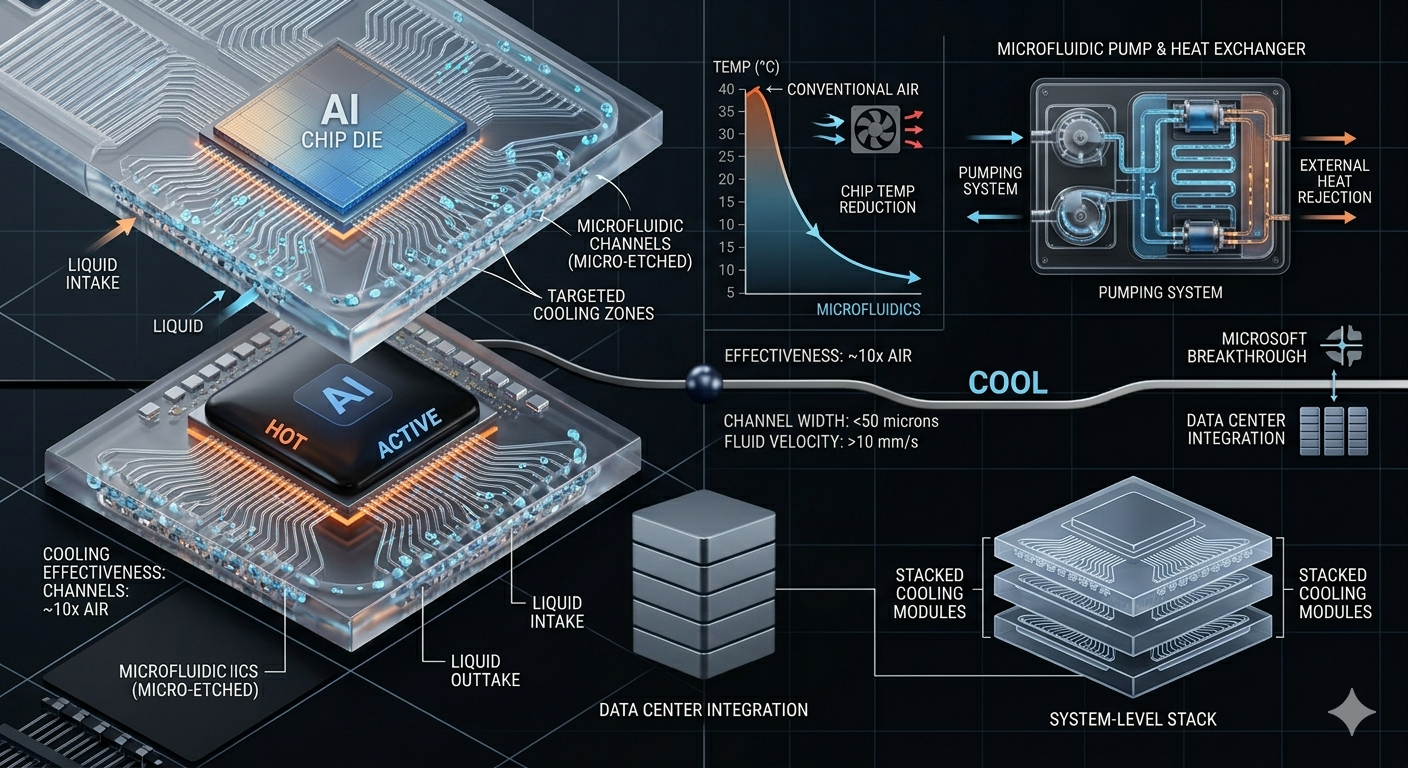
Microfluidic cooling takes a fundamentally different approach by bringing coolant inside the chip itself. Microsoft’s system etches microchannels directly onto the back of the silicon die, with channel dimensions comparable in scale to a human hair. Coolant flows through these channels in direct contact with the silicon, removing heat at its source rather than through the multiple packaging layers that separate a cold plate from the chip.
Microsoft’s lab-scale tests, conducted on a server running core services for a simulated Microsoft Teams meeting, recorded heat removal rates up to three times higher than cold plates, with results varying based on workload and configuration. The system reduced the maximum temperature rise of the silicon inside a GPU by 65%, according to Microsoft, while IEEE Spectrum reported chip temperature reductions exceeding 80% when compared against traditional air cooling. Because microfluidics removes the insulating packaging layers between coolant and silicon, the coolant itself does not need to run as cold to achieve the same cooling effect a difference that reduces the energy required to chill the coolant supply across an entire facility.
Husam Alissa, director of systems technology in Microsoft’s Cloud Operations and Innovation group, emphasized that microfluidics cannot be evaluated as a standalone component. Engineering the technology requires understanding interactions across silicon, coolant, server, and data center simultaneously using a systems-level approach rather than a chip-level fix.

Designing Channels Through AI and Bio-Inspiration
The engineering challenge in microfluidic cooling extends well beyond etching channels into silicon. Channels must be deep enough to circulate sufficient coolant without clogging, while remaining shallow enough that the silicon retains its structural integrity and does not risk breaking. Microsoft’s team produced four distinct design iterations over the past year addressing this balance.
To solve the channel layout problem, Microsoft partnered with Corintis and applied AI to identify the unique heat signature of each chip and direct coolant accordingly. The resulting designs are bio-inspired, modeled on the branching patterns found in leaf veins and butterfly wings natural structures that have evolved to distribute resources efficiently across a surface. Microsoft tested these branching layouts against straight up-and-down channel designs and found the bio-inspired geometry more effective at directing coolant to a chip’s hottest points. Corintis converted the AI-generated channel meshes into manufacturable layouts using its Glacierware design tool. The companies also worked to ensure the system uses standard data center coolant chemistry rather than specialized fluids, a decision that simplifies integration into existing facility infrastructure. Beyond channel geometry, the engineering effort included developing a leak-proof chip packaging design and a repeatable etching process suitable for integration into existing chip manufacturing workflows.
Operational Advantages: Density, Overclocking, and Energy
The practical implications of microfluidic cooling extend across several dimensions of data center operation. Jim Kleewein, technical fellow for Microsoft 365 Core Management, illustrated the workload variability problem using Teams as an example. Teams comprises roughly 300 distinct services connecting users to meetings, hosting sessions, merging audio streams, recording, and transcribing each placing different stress patterns on server hardware. Demand for these services spikes predictably around the start of each hour and half-hour, creating short bursts of intense load followed by quieter periods.
Operators currently address these spikes in one of two ways: provisioning expensive additional capacity that sits idle most of the time, or overclocking existing servers during peak periods. Overclocking generates additional heat and, if pushed too far with current cooling methods, risks damaging the chip. Kleewein noted that microfluidics removes that constraint, allowing servers to be overclocked during demand spikes without the risk of overheating delivering benefits in cost, reliability, and speed simultaneously.
Beyond workload management, Ricardo Bianchini, Microsoft technical fellow and corporate vice president for Azure compute efficiency, pointed to a grid-level benefit: cooling systems that require less power place less stress on the electrical grids serving the communities surrounding a data center. Microfluidics also enables higher-quality reuse of waste heat, since the heat is captured closer to its source at higher concentration. At the facility design level, microfluidics could allow servers to be packed more densely without overheating, reducing the latency that occurs when servers are spaced further apart — and potentially allowing data centers to increase compute capacity without constructing additional buildings.
Implications for Future Chip Architecture
Perhaps the most consequential long-term implication of microfluidic cooling concerns chip architecture itself. Bianchini noted that microfluidics could enable entirely new designs, including 3D-stacked chips, where multiple silicon layers are stacked vertically to reduce the physical distance and therefore the latency between components. Stacking chips vertically generates substantially more heat than a single planar die, a problem that has historically limited 3D chip designs to niche applications.
Microfluidics addresses this by bringing coolant extremely close to where power is consumed, potentially flowing liquid through the stack itself using cylindrical pin structures positioned between layers, a design Bianchini compared to pillars in a multilevel parking garage, with coolant flowing around them. Corintis executives have referenced thermal design power targets in the range of 4 kW to 10 kW per chip, compared to the roughly 1 to 2 kW that defines most devices in current data centers a range that would be difficult to sustain using cold plates without significant throttling.
Judy Priest, corporate vice president and chief technical officer of Microsoft’s Cloud Operations and Innovation group, framed the broader opportunity in terms of design freedom: removing the constraints imposed by heat opens the door to chip architectures that were previously impractical, enabling more powerful chips, higher core counts, and smaller physical footprints for equivalent compute capacity.
Path to Production and Industry Impact
Microsoft has stated it will continue investigating how microfluidic cooling can be incorporated into future generations of its first-party silicon, including its Cobalt and Maia chip families, while continuing to work with fabrication and silicon partners to bring the technology into production data centers. The company has framed the technology as part of a broader systems-level strategy spanning chips, servers, and facility-level design, rather than an isolated component upgrade.
For Corintis, the partnership represents a significant commercial validation. The company has stated plans to scale its cooling component manufacturing toward one million units annually and is in discussions with multiple semiconductor fabrication facilities to co-develop etching processes compatible with high-volume chip production. Industry analysts have characterized the technology as potentially disruptive to established cooling infrastructure providers; coverage following Microsoft’s announcement noted market reaction affecting Vertiv Holdings, a major supplier of traditional data center cooling equipment.
Matthew Kimball, vice president and principal analyst at Moor Insights & Strategy, described Microsoft’s work as having the potential to significantly change how cooling is delivered to chips and to be highly disruptive to the existing cooling supply chain. Whether microfluidics moves from prototype to widespread production deployment within the next several years will depend on Microsoft’s ability to integrate the technology into commercial chip manufacturing at scale, and on whether other chip designers including Nvidia, AMD, and IBM pursue comparable approaches. Jim Kleewein summarized Microsoft’s position on industry-wide adoption directly: broader adoption of microfluidics across the industry would accelerate the technology’s development for everyone, including Microsoft itself.












