
NVIDIA H200 shipments delayed to Q3  · BREAKING: Microsoft confirms 3GW data centre expansion in Asia-Pacific ·  AWS announces new sovereign cloud regions in India and UAE  · Arm-based servers now 24% of hyperscale deployments ·  EU AI Act enforcement enters phase two  · Global data centre investment hits $612B in 2026 ·  TSMC Arizona yields improve to 68% on 3nm process  · OpenAI valuation reaches $400B after latest funding round ·  NVIDIA H200 shipments delayed to Q3  · BREAKING: Microsoft confirms 3GW data centre expansion in Asia-Pacific ·  AWS announces new sovereign cloud regions in India and UAE  · Arm-based servers now 24% of hyperscale deployments ·  EU AI Act enforcement enters phase two  · Global data centre investment hits $612B in 2026

Hyperscalers Are Now Using AI to Run Their Own Data Centers. Here Is What That Looks Like.

There is a specific irony in the AI infrastructure buildout that the industry does not discuss enough. The companies spending

Share
AI data center operations hyperscalers using own AI 2026 DeepMind cooling predictive maintenance autonomous management

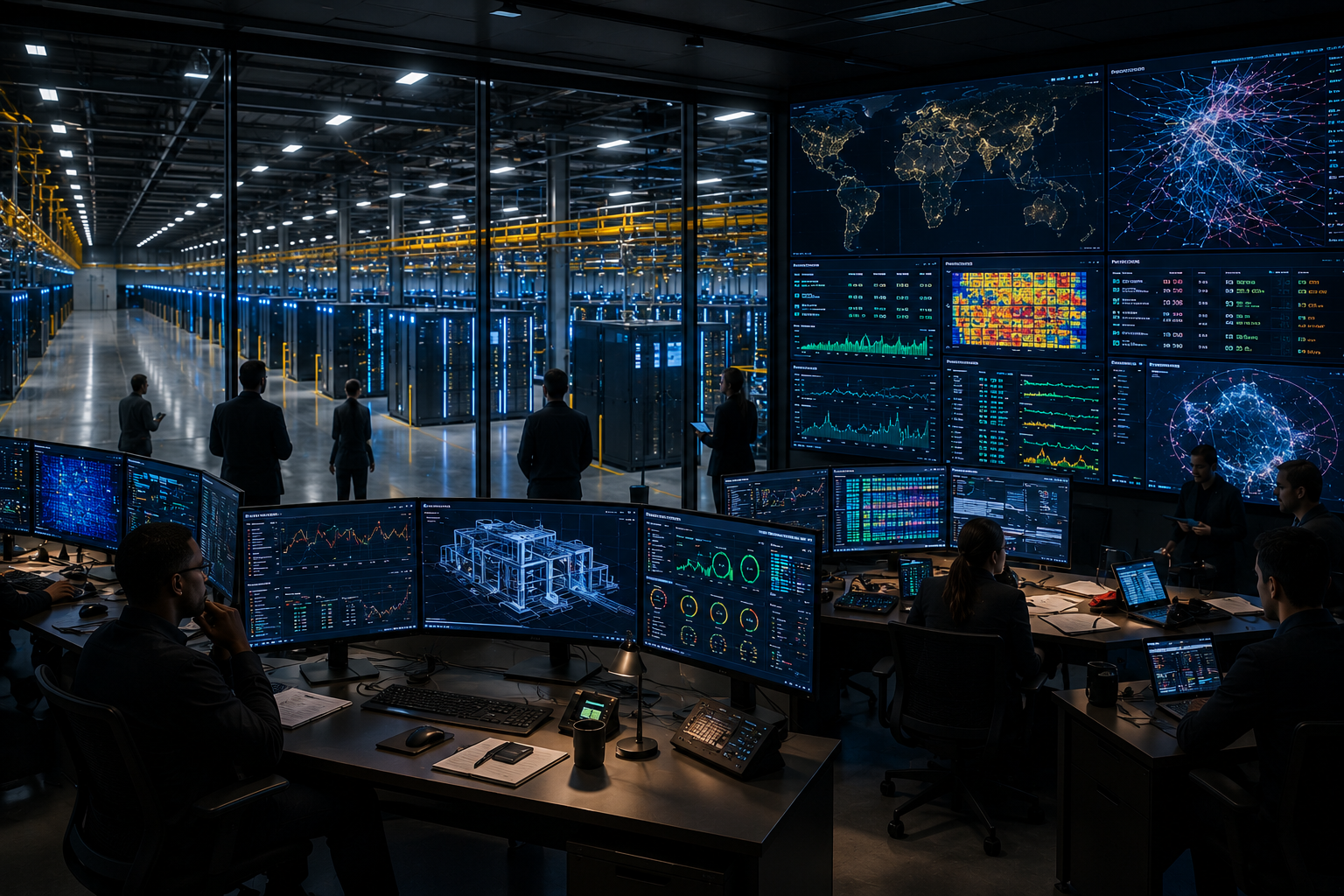
There is a specific irony in the AI infrastructure buildout that the industry does not discuss enough. The companies spending hundreds of billions of dollars to build the physical infrastructure that powers AI are also using AI to operate that infrastructure. The technology they are selling to the world is the same technology managing the cooling systems, predicting hardware failures, optimising power consumption, and scheduling workloads inside the campuses that house it. The AI data center is becoming an AI-operated data center, and that shift has significant implications for how operators design facilities, structure teams, and manage operations.

Google DeepMind’s machine learning system achieved a 40% reduction in the energy used for cooling at Google’s data centers, equating to a 15% reduction in overall PUE overhead. The system uses neural networks trained on thousands of sensor data points covering temperature, power usage, and pump speeds across the facility. It operates in an autonomous feedback loop, calculating optimal cooling adjustments every five minutes, with human operators able to exit AI mode at any time. That result was achieved on facilities that were already considered among the most efficient in the world. The marginal efficiency gain in that environment is significantly harder to achieve than in a conventional facility, which makes the 40% cooling energy reduction more impressive, not less.

What the Systems Are Actually Doing

Google’s cooling optimisation is the most documented case, but it is not the only one. Microsoft has deployed AI-driven predictive maintenance across its data center portfolio, using machine learning models trained on equipment telemetry to predict component failures before they cause downtime. The system flags hardware at elevated failure risk and schedules maintenance interventions during planned windows rather than responding to outages. Amazon Web Services uses AI workload placement algorithms that continuously route workloads across its global fleet to optimise power consumption, thermal load, latency requirements, and hardware utilisation simultaneously. None of these systems existed at scale five years ago. All of them are now standard operational infrastructure at the hyperscaler level.

The operational AI layer sits beneath the infrastructure that customers interact with and above the physical hardware that engineers maintain. It does not replace the engineering workforce. It changes what that workforce does. The engineer whose job was monitoring thermal sensor dashboards and adjusting cooling parameters manually now oversees a system that performs those adjustments autonomously and flags the exceptions that require human judgement. The workload scheduler who once managed job queues by hand now monitors the AI scheduler’s decisions and intervenes when the system encounters edge cases outside its training distribution. The operational AI layer is an amplifier for human expertise, not a substitute for it.

Why This Matters for Facilities Being Built Today

The operational AI layer changes the design requirements for new AI data center facilities in specific ways. Facilities designed to be operated by AI systems from the start can be instrumented more densely, because sensor data is the training input that makes the AI systems better. A facility with 10,000 thermal sensors produces a richer training dataset than one with 1,000. A facility with granular power metering at the rack level enables workload placement algorithms that facility-level metering cannot. The instrumentation investment required to support AI operations is not large relative to total facility cost, but it must be specified at the design stage because retrofitting sensor infrastructure into an operational facility is significantly more expensive than building it in from the foundation.

The facilities that are most likely to benefit from operational AI are the largest and most complex. A 10-megawatt enterprise colocation facility with a stable, predictable workload mix generates relatively little marginal value from AI-driven cooling optimisation, because the operating environment is simple enough that conventional controls produce near-optimal outcomes. A 500-megawatt AI training campus with thousands of GPU racks, variable workload densities, and complex thermal interdependencies between rack clusters is precisely the environment where AI operations systems produce the largest efficiency gains. The scale and complexity of the AI infrastructure buildout is creating the conditions in which operators can use the technology they are building to operate the infrastructure they are simultaneously deploying.

.

What This Means Beyond Efficiency

The adoption of AI operations systems at hyperscale has implications that extend beyond cooling efficiency and predictive maintenance. Facilities that are operated by AI systems accumulate operational data that trains those systems to be better. The hyperscaler that has been running AI cooling optimisation across 50 data centers for five years has a training dataset and a system performance level that a new entrant cannot replicate by purchasing the same underlying technology. The operational AI layer is building a competitive moat that is separate from hardware procurement, real estate, and power access.

This creates a compounding advantage for the operators who adopted AI operations systems earliest and at the largest scale. Their facilities are more efficient, their maintenance costs are lower, their hardware utilisation rates are higher, and their operational teams are more focused on high-value exception handling than routine monitoring. The cost per watt war replacing the PUE arms race documented that the competitive frontier in AI data center operations is moving from physical infrastructure efficiency toward operational intelligence efficiency. The hyperscalers who are furthest along that curve are building operational advantages that will be visible in their infrastructure economics long before they are visible in their public disclosures.

The Competitive Barrier Created by Operational Intelligence

The competitive moat that operational AI is building is also a barrier that will make the AI data center market harder to enter for new operators without the data history to train competitive systems. A new colocation entrant in 2026 can procure the same hardware, build the same facility, and hire the same engineers as the incumbent hyperscalers. It cannot replicate five years of operational AI training data from 50 facilities running at hyperscale density. The operational intelligence layer is becoming the most defensible competitive asset in AI infrastructure, and the operators who have been building it longest are the ones whose cost structures and reliability records will prove hardest to compete with as the market matures.


[simple-author-box]

More from AI Infrastructure

Power negotiations often conclude long before operational constraints reveal themselves inside a live facility.

Artificial intelligence infrastructure has compressed deployment timelines to the point where electrical capacity is

Boards increasingly expect organizations to support sustainability reporting with evidence that aligns with governance

COMPUTE WEEKLY

The briefing that 40,000+ tech leaders read every Monday. Sharp, fast, essential.

Great! We’ve received your information.

We couldn’t process your submission. Please retry

Building an AI Startup Without Owning GPUs

Not owning GPUs has become the default, deliberate strategy for building an AI company — not a compromise founders accept reluctantly. H100 rental rates fell 64-75% in fifteen months, a dense ecosystem of neoclouds and inference-as-a-service providers now lets startups skip infrastructure entirely, and credit programs can fund a company’s first year before a founder writes a check
Most Read

Infrastructure planning discussions often prioritize engineering, construction, and utility considerations before examining how end

AI infrastructure deployment schedules depend on coordinated progress across hardware availability, electrical infrastructure, cooling

Artificial intelligence has transformed the economics of digital infrastructure. Every new AI model requires

Data centers do not visibly smoke. They have no smokestacks, no visible exhaust, and

Artificial intelligence has transformed the economics of digital infrastructure. Companies once competed by acquiring

Disruptor Spotlight

Cerebras Systems

The chip that makes Nvidia nervous. Cerebras’ Wafer Scale Engine is rewriting the rules of AI inference at scale.
Faster
0 x
YoY Revenue
0 x
Transistors
0 T
Market Pulse
NVDA
$924.60
-2.11%
MSFT
$421.30
-2.94%
AMZN
$192.80
-4.87%
AMD
$924.60
-2.40%
TSMC
$924.60
-2.32%
Indicative only · Not financial advice
Upcoming Events
SEP
The AI Infrastructure Race (India)
WEBINAR · ONLINE
The AI Infrastructure Race: Won on Power, Land and Trust — Not Capital
MAY
0
AI Infrastructure Summit
DUBAI · IN PERSON
MEA’s premier AI infrastructure event.
JUN
0 0
Compute Forecast Summit
SINGAPORE · IN PERSON
Our flagship APAC event. Early bird open.
Latest Moves
Live
ecolab
Ecolab Deepens Cooling Strategy With $4.75B CoolIT Acquisition
Ecolab is making one of its biggest moves yet into AI infrastructure after completing its $4.75 billion acquisition of liquid cooling specialist CoolIT Systems
Pure DC AVK Europe data center microgrid Dublin 110MW AI infrastructure Ireland 2026
Pure DC and AVK Deploy Europe’s First 110 MW Data Center Microgrid in Dublin
The Pure DC Dublin microgrid has made history as Europe’s first large-scale on-site data center microgrid, launched in partnership with power solutions provider AVK at Pure DC’s campus in Ireland.
Pace Digitek
Pace Digitek Partners With MEGMEET to Expand AI Data Center Power Business
India’s AI infrastructure ecosystem continues to mature as domestic technology manufacturers move beyond traditional telecommunications and industrial markets toward high-growth digital infrastructure opportunities
Follow Compute Forecast
11K followers
1200 followers
Companies to Watch
CW
CoreWeave
Neo Cloud · $19B · IPO Watch
CB
Cerebras Systems
AI Hardware · $4.25B · Pre-IPO
G42
G42
Sovereign AI · Abu Dhabi
H
Humain
Saudi AI · $40B Fund
Latest Podcast
AI Capex, Cloud Margins & the Nuclear Bet
48 MIN · 25 APR 2026

Hyperscalers Are Now Using AI to Run Their Own Data Centers. Here Is What That Looks Like.

There is a specific irony in the AI infrastructure buildout that the industry does not discuss enough. The companies spending

Share
AI data center operations hyperscalers using own AI 2026 DeepMind cooling predictive maintenance autonomous management
27
847 SHARES

0
SHARES

[simple-author-box]

More from AI Infrastructure

Infrastructure planning discussions often prioritize engineering, construction, and utility considerations before examining how end

AI infrastructure deployment schedules depend on coordinated progress across hardware availability, electrical infrastructure, cooling

Artificial intelligence has transformed the economics of digital infrastructure. Every new AI model requires

Data centers do not visibly smoke. They have no smokestacks, no visible exhaust, and

COMPUTE WEEKLY

The briefing that 40,000+ tech leaders read every Monday. Sharp, fast, essential.

Great! We’ve received your information.

We couldn’t process your submission. Please retry

Global AI Infrastructure Outlook 2026

The briefing that 40,000+ tech leaders read every Monday. Sharp, fast, essential.
Download Free
Most Read

Infrastructure planning discussions often prioritize engineering, construction, and utility considerations before examining how end

AI infrastructure deployment schedules depend on coordinated progress across hardware availability, electrical infrastructure, cooling

Artificial intelligence has transformed the economics of digital infrastructure. Every new AI model requires

Data centers do not visibly smoke. They have no smokestacks, no visible exhaust, and

Artificial intelligence has transformed the economics of digital infrastructure. Companies once competed by acquiring

Disruptor Spotlight

Cerebras Systems

The chip that makes Nvidia nervous. Cerebras’ Wafer Scale Engine is rewriting the rules of AI inference at scale.
Faster
0 x
YoY Revenue
0 x
Transistors
0 T
Market Pulse
NVDA
$924.60
+2.4%
MSFT
$421.30
+1.1%
AMZN
$192.80
-0.6%
NVDA
$924.60
+2.4%
NVDA
$924.60
+2.4%
Indicative only · Not financial advice
Upcoming Events
MAY
0 0
DCD Global — London
LONDON · IN PERSON
World’s largest DC event. CF is media partner.
MAY
0
AI Infrastructure Summit
DUBAI · IN PERSON
MEA’s premier AI infrastructure event.
JUN
0 0

Compute Forecast Summit

SINGAPORE · IN PERSON
Our flagship APAC event. Early bird open.
Latest Moves
  • Live
Sam Altman
OpenAI appoints new Chief Infrastructure Officer to lead $100B DC programme
27 APR · OPENAI
Sam Altman
OpenAI appoints new Chief Infrastructure Officer to lead $100B DC programme
27 APR · OPENAI
Sam Altman
OpenAI appoints new Chief Infrastructure Officer to lead $100B DC programme
27 APR · OPENAI
Follow Compute Forecast
18.4K followers
12.1K followers
9.3K subscribers
41 episodes
Companies to Watch
CW
CoreWeave
Neo Cloud · $19B · IPO Watch
CB
Cerebras Systems
AI Hardware · $4.25B · Pre-IPO
G42
G42
Sovereign AI · Abu Dhabi
CW
Humain
Saudi AI · $40B Fund
Latest Podcast
AI Capex, Cloud Margins & the Nuclear Bet
48 MIN · 25 APR 2026
Scroll to Top








