
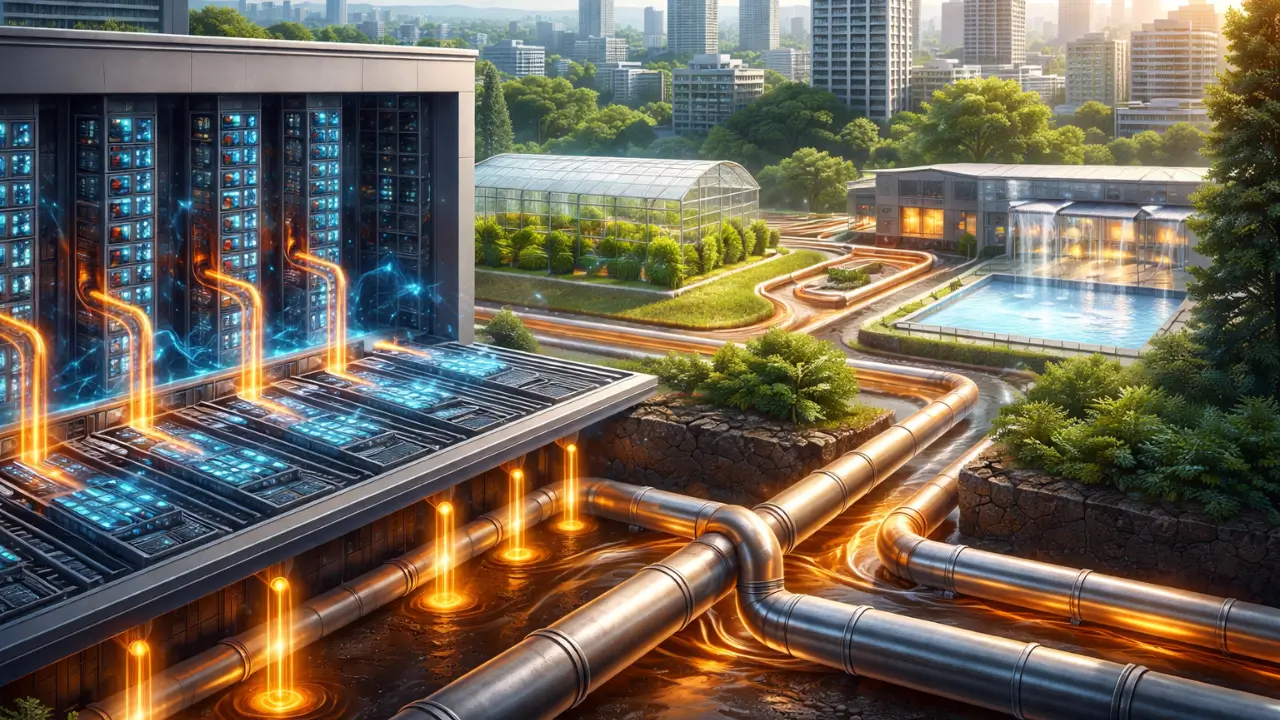
Cities rarely notice the invisible exchange taking place inside their digital backbone, yet every search, simulation, and streamed interaction generates more than just data. Modern infrastructure breathes in electricity and releases thermal energy as an inevitable outcome of processing intensity. This shift in perspective reflects a broader movement toward circular energy integration in data infrastructure, where heat no longer escapes unnoticed into the atmosphere. Engineers increasingly intercept that warmth through advanced liquid cooling systems designed to channel it with precision. Instead of treating excess heat as operational friction, facilities now structure it as a recoverable stream of usable energy. As a result, digital environments begin participating directly in the wider energy ecosystems that sustain surrounding communities.

The relationship between energy and information technology has always been complex, yet it now enters a more interconnected phase. Infrastructure planners increasingly evaluate facilities not only for performance and resilience but also for their thermal footprint within urban ecosystems. While efficiency remains important, the broader ambition centers on integration rather than isolation. Heat, once viewed as operational friction, gradually assumes a functional role within city energy systems. This shift does not depend on dramatic claims but on engineering clarity and spatial design discipline. As a result, data centers begin to resemble energy nodes within metropolitan landscapes instead of sealed computational fortresses.
The Journey of Heat: From Servers to the Environment
Inside dense compute halls, processors execute billions of operations while generating consistent thermal output. Electrical resistance converts computational intensity into heat, which must move somewhere to maintain stability. Traditionally, air-based systems dispersed that warmth across cooling towers or ventilation stacks, allowing it to dissipate into the open air. Liquid cooling introduces a more deliberate pathway by absorbing heat directly from components before it diffuses unpredictably. Coolant circulates through cold plates or immersion baths, capturing thermal energy at its source and preventing uncontrolled spread. Through this controlled capture, heat shifts from being an environmental byproduct to a contained energy stream with defined direction.
As coolant travels through closed-loop systems, it carries concentrated thermal energy away from processors with minimal loss. Engineers regulate flow rates and temperature differentials to preserve component integrity while maintaining predictable output streams. Unlike air cooling, which disperses heat across large volumes, liquid systems confine thermal movement within measurable channels. This confinement allows facilities to monitor and redirect energy flows before they blend into the broader environment. In effect, the journey of heat becomes visible, traceable, and architecturally intentional. Therefore, the environment receives less accidental discharge while operators gain a structured opportunity for reuse.

Liquid Cooling as the Bridge Between Compute and Communities
Once facilities capture heat in liquid form, the question evolves from removal to redistribution. Thermal energy carried by coolant can transfer through heat exchangers into secondary water systems designed for broader applications. This interface forms a bridge between computational infrastructure and municipal networks. Rather than existing as isolated technical environments, facilities integrate into district heating systems that circulate warmth through neighborhoods. Such integration requires collaboration between engineers, utility planners, and urban designers who align flow temperatures and infrastructure routes. As alignment strengthens, digital infrastructure participates in the daily thermal comfort of surrounding communities.
District heating networks distribute centrally generated warmth across residential and commercial buildings through insulated pipelines. Liquid-cooled facilities can feed captured heat into these networks when system compatibility aligns. By doing so, data centers contribute to urban energy continuity without altering their primary computing mission. Engineers manage temperature modulation carefully to ensure safe and consistent transfer between systems, often incorporating heat pumps or temperature-boosting technologies when network requirements exceed the outlet temperature of the captured heat. This technical handshake between compute halls and city grids symbolizes a broader philosophical shift toward interdependence. Consequently, infrastructure that once operated in isolation becomes woven into civic energy circulation.
Innovative Applications of Reclaimed Heat
Beyond district heating, reclaimed thermal energy finds expression in diverse local contexts. Office complexes located near data facilities can channel redirected warmth into building climate systems. Agricultural innovators experiment with greenhouse heating supported by captured thermal streams. Public swimming pools, educational campuses, and municipal centers also explore integration possibilities where proximity allows practical routing. Each application demonstrates that reuse depends more on creativity and infrastructure alignment than on scale alone, particularly when facilities operate in close physical proximity to the buildings or districts that can utilize the captured heat efficiently. Through thoughtful design, reclaimed heat supports spaces where people gather, learn, and cultivate resources.
Urban planners increasingly explore how mixed-use developments can anchor around energy-sharing nodes. In such ecosystems, computing infrastructure coexists with residential blocks and public amenities in mutually supportive arrangements. Thermal routing infrastructure becomes part of early-stage design rather than retrofitted addition. Architects collaborate with mechanical engineers to map potential heat flows before foundations even set. This approach transforms waste-avoidance thinking into resource choreography across entire districts. Accordingly, reclaimed warmth evolves from technical afterthought to community asset embedded in planning blueprints.
Designing Data Centers With Heat Reuse in Mind
When facilities prioritize heat recovery from inception, architectural decisions shift noticeably, although successful integration still depends on compatibility with local energy infrastructure and detailed feasibility assessments. Site selection now considers proximity to heating networks or potential development zones. Mechanical layouts allocate space for heat exchangers, piping corridors, and modular expansion pathways. Structural planning integrates thermal routing channels alongside power distribution infrastructure. These considerations reshape facility footprints without compromising computational density. As a result, heat reuse becomes structural intent rather than peripheral enhancement.
Operational strategy also adapts to support long-term thermal integration. Engineers maintain consistent coolant temperatures that align with downstream reuse requirements. Monitoring systems track flow stability to ensure seamless exchange between facility and network. Maintenance teams coordinate with municipal operators to synchronize inspection schedules and contingency planning. Through shared protocols, facilities maintain reliability while sustaining energy redirection commitments. Consequently, operational culture embraces collaboration beyond traditional infrastructure boundaries.
Technical evolution alone cannot sustain this transformation without cultural alignment. Engineers increasingly view energy not as linear input and output but as circulating resource within broader ecosystems. Operators discuss thermal management in strategic forums that include city planners and sustainability experts. Communities grow more curious about the infrastructure that supports their digital lives and its environmental implications. Educational institutions incorporate circular energy concepts into engineering curricula, reinforcing systemic thinking among emerging professionals. Gradually, energy narratives shift from consumption metrics toward interconnectivity stories.
Within organizations, leadership teams reassess how facilities communicate their energy role to stakeholders. Sustainability reports begin to highlight integration strategies rather than isolated efficiency gains. Cross-functional dialogue encourages collaboration between infrastructure, environmental, and community engagement departments. This internal recalibration strengthens trust between operators and the public. Moreover, transparent discussion about energy flow fosters informed urban partnerships. As mindset evolves, infrastructure transitions from silent utility to visible contributor within shared energy ecosystems.
Overcoming Perceptions: Heat Is Not Just Waste
For decades, operational manuals framed heat as an adversary to be neutralized quickly and quietly. That framing shaped both design habits and public perception of digital infrastructure. Liquid cooling challenges this assumption by proving that containment can coexist with opportunity. When engineers treat heat as a manageable medium rather than nuisance, they unlock broader conversations about reuse. This reframing requires patience, technical clarity, and stakeholder education. However, once perception shifts, practical pathways become easier to explore and implement.
Public understanding also evolves as facilities communicate the lifecycle of captured energy more transparently. Community forums and industry conferences increasingly showcase examples of collaborative thermal projects. By sharing design experiences, operators demystify what once seemed inaccessible engineering territory. Clear explanations help residents recognize how digital services intersect with everyday heating needs. Through dialogue, skepticism gives way to curiosity and pragmatic optimism. Thus, perception transforms from suspicion toward informed participation in circular energy discussions.
Reimagining Energy Ecosystems for the Future
Across metropolitan landscapes, energy systems once functioned in parallel silos, rarely intersecting in meaningful ways. Liquid cooling and thermal reuse invite these systems to converge into integrated networks that mirror the connectivity of digital architecture. Data centers, utilities, architects, and municipalities now share a common design language focused on flow rather than fragmentation. Instead of treating computation as detached from civic infrastructure, planners explore layered ecosystems where information and warmth circulate together. This evolving dialogue emphasizes continuity, resilience, and shared responsibility across sectors. Through such alignment, infrastructure becomes a participant in urban sustainability narratives rather than a distant observer.
Future developments will likely embed heat exchange corridors into master urban plans, reinforcing long-term integration. Designers may position facilities strategically within mixed-use districts to facilitate direct thermal exchange. Policy frameworks can support collaboration without dictating rigid structures, allowing innovation to flourish organically. Engineers will continue refining liquid systems to ensure stability while preserving flexibility for evolving urban demands. Communities, in turn, gain tangible connection to the infrastructure powering their digital economies. In this broader energy narrative, heat no longer escapes unnoticed but circulates intentionally within interconnected ecosystems that define modern cities.











