As models grow larger and training cycles intensify, the physical limits of infrastructure are becoming impossible to ignore. High-density GPU and AI racks now generate extraordinary thermal loads that strain conventional cooling systems. Air cooling struggles to cope. Even advanced liquid loops begin to falter as rack densities push past 50 kilowatts and continue climbing. In response, engineers are exploring more radical thermal strategies. Cryogenic cooling, especially with liquid nitrogen (LN₂), stands out as one of the boldest.
Why AI Compute Demands a New Cooling Paradigm
Cooling has always shaped data center design. However, AI workloads have redefined the scale of the problem.
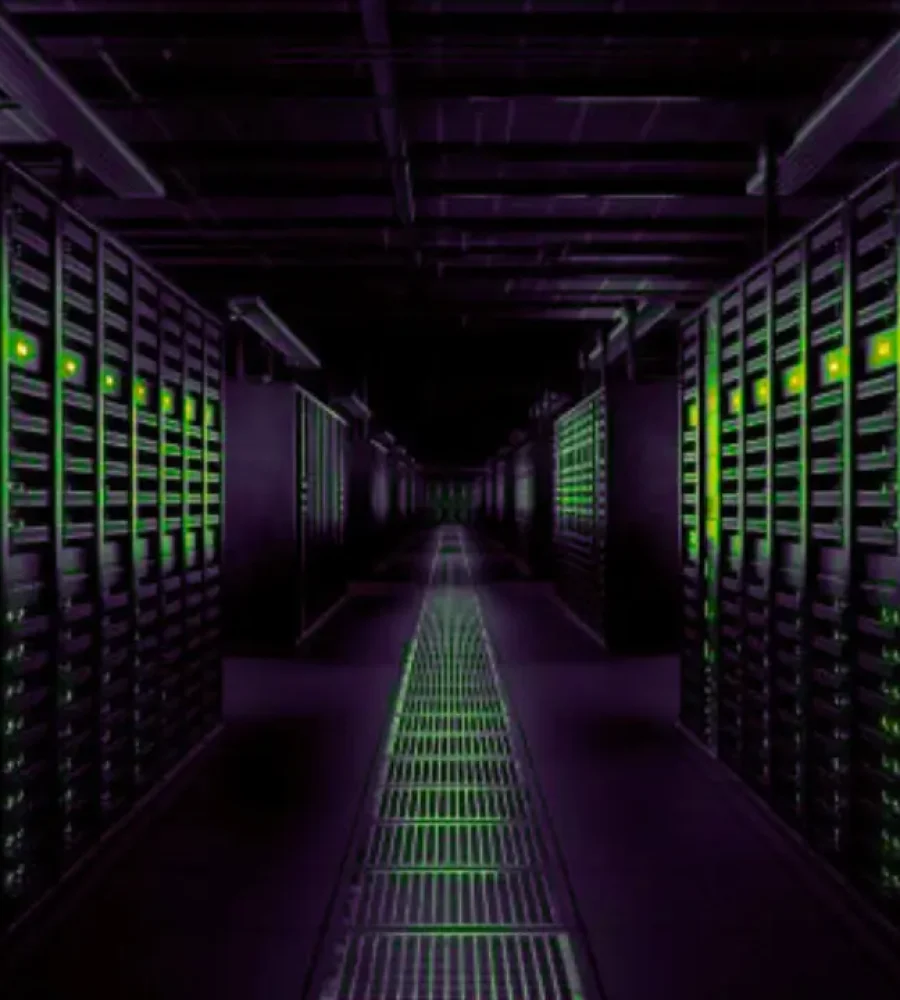
Modern racks pack dense arrays of GPUs and AI accelerators into compact footprints. These systems generate intense, localized heat that air and traditional liquid systems cannot dissipate efficiently at extreme densities. Fans, chillers, and fluid loops perform well within certain thresholds. Beyond that, their efficiency drops sharply.
When cooling lags behind thermal output, hardware throttles performance. Component lifespan declines. Operators face higher total cost of ownership and greater reliability risks. In many facilities, cooling infrastructure already consumes a substantial share of total electricity. In some cases, it rivals the energy used for compute itself.
Given these constraints, the industry cannot rely solely on incremental improvements. It must evaluate alternatives that fundamentally change heat removal dynamics. Cryogenic cooling represents one such alternative.
What Cryogenic Cooling Actually Means
Cryogenic cooling operates at extremely low temperatures, typically below −150°C. It relies on fluids that boil at these temperatures and absorb large amounts of heat during phase change. Cryogenic liquids are liquefied gases that have a normal boiling point below -150°C (-238°F). All cryogenic liquids produce large amounts of gas when they vaporize.
Liquid nitrogen has a boiling point of -195.8°C (-320.5°F). As it transitions from liquid to gas, it absorbs significant thermal energy. This phase-change property gives LN₂ exceptional heat absorption capacity.
Unlike many industrial refrigerants, nitrogen is inert and non-toxic. It does not react chemically with most materials under controlled conditions. These characteristics make it attractive from a chemical safety standpoint.
Industries already use LN₂ for precision manufacturing, cryopreservation, and scientific research. Applying it to data centers means leveraging an aggressive thermal gradient that conventional fluids cannot match.
How Liquid Nitrogen Absorbs Heat
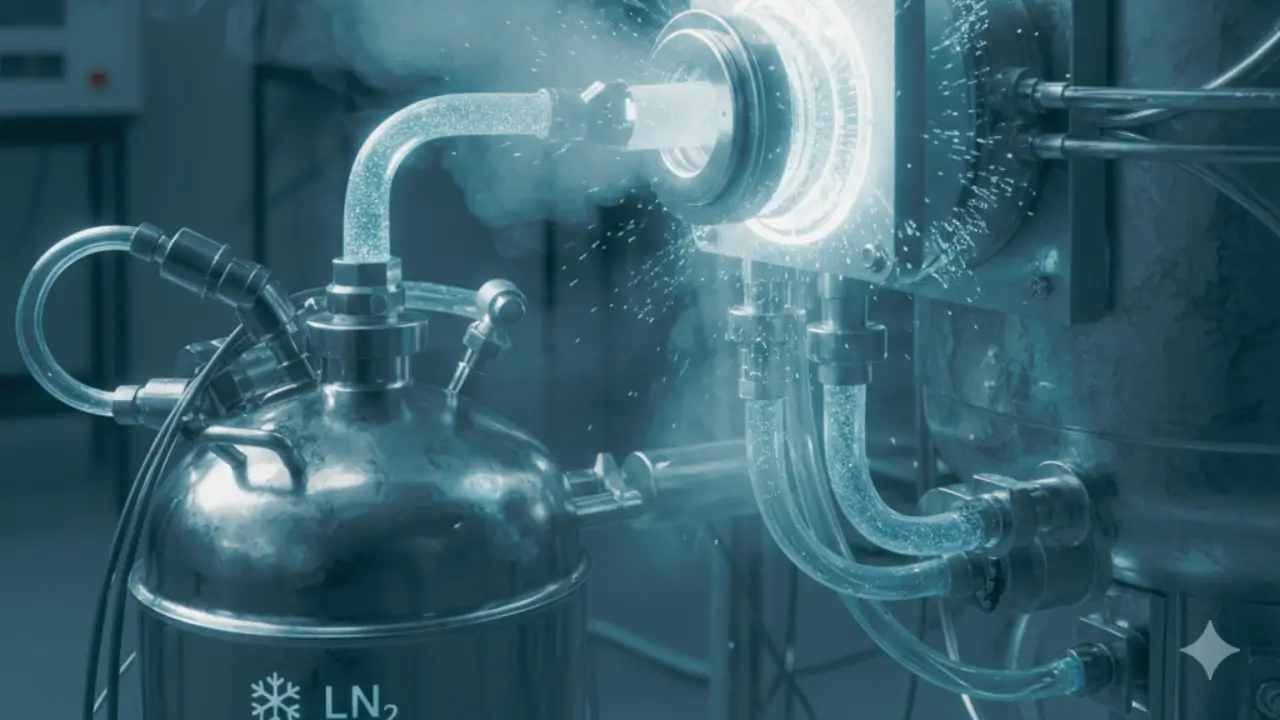
Cryogenic cooling relies on phase-change heat transfer. When LN₂ contacts a hot surface or heat exchanger, it boils instantly. During this transition, it absorbs a large amount of energy.
This mechanism allows LN₂ to remove more heat per unit mass than water or most dielectric coolants. Prototype systems have demonstrated rapid heat removal during thermal spikes. In high-performance environments, that responsiveness matters.
Such characteristics make LN₂ particularly appealing for peak shaving or emergency cooling. In edge or HPC deployments, sudden load surges can threaten hardware integrity. Cryogenic systems can respond almost immediately.
Cryogenic Systems: Components and Architecture
Engineers cannot simply pour LN₂ over processors. A viable cryogenic system requires tightly integrated components:
- Cryogen storage vessels designed for ultra-low temperatures and minimal boil-off
- Insulated delivery lines and precision valves built to withstand thermal extremes
- Heat exchangers optimized for phase-change transfer
- Monitoring and control systems that regulate pressure and flow in real time
Each component must operate reliably under severe thermal gradients. Engineers must also prevent localized overcooling, which can damage electronics. The architecture differs fundamentally from chilled water loops and demands advanced system integration.
Benefits Cryogenic Cooling Could Deliver
If implemented correctly, cryogenic cooling could offer several advantages.
1. Exceptional Heat Removal Capacity
Liquid nitrogen absorbs large amounts of heat quickly. This capability enables support for ultra-high-density racks with reduced mechanical overhead.
2. Reduced Water Dependence
Cryogenic systems do not rely on evaporative cooling or large volumes of chilled water. Operators in water-scarce regions may find this particularly valuable.
3. Edge Deployment Flexibility
LN₂ systems do not require massive cooling towers or centralized chiller plants. That flexibility may suit edge environments with limited space or infrastructure.
4. Emergency Redundancy
Cryogenic backup systems can absorb heat rapidly if primary cooling fails. This reduces downtime risk and protects expensive hardware.
When paired with low-carbon nitrogen production, these systems could align with broader sustainability goals. However, lifecycle emissions require careful evaluation.
Engineering Challenges That Cannot Be Ignored
Despite its promise, cryogenic cooling faces serious obstacles.
Material Stress
Most server components are not built for sustained cryogenic exposure. Rapid temperature cycling induces mechanical stress. Over time, that stress can degrade materials and solder joints.
Infrastructure Complexity
Cryogenic installations require insulated tanks, pressure relief systems, advanced sensors, and strict safety protocols. This complexity increases capital expenditure and operational overhead.
Supply Logistics
Operators must replenish liquid nitrogen regularly. Boil-off losses occur even in well-insulated systems. Without on-site production, supply logistics may become costly or impractical.
Safety Management
As LN₂ vaporizes, it expands rapidly and can displace oxygen. Poor ventilation can create asphyxiation hazards. Facilities must install monitoring systems and enforce rigorous safety training.
These constraints suggest that cryogenic cooling will likely serve specialized or hybrid roles before achieving widespread adoption.
Emerging Research and Hybrid Models
Researchers and industry groups continue to explore cryogenic heat transfer in controlled environments. Early experiments indicate that LN₂-based systems can stabilize temperatures during extreme load events that overwhelm traditional chillers.
Rather than replacing conventional cooling, future designs may integrate cryogenics as a supplemental layer. For example, operators could deploy LN₂ during peak demand events or integrate it into thermal storage strategies. Such hybrid approaches would decouple cooling intensity from immediate grid consumption.
As AI workloads intensify, hybridization may offer a practical path forward.
A Strategic View of Cryogenics in the AI Era
Cryogenic cooling with liquid nitrogen sits at the frontier of thermal engineering. Its physics enable extraordinary heat absorption. Yet practical deployment requires overcoming material limits, logistical constraints, and safety challenges.
The AI era demands infrastructure that is both powerful and resilient. Cryogenic systems may not replace traditional cooling in the near term. However, they could complement existing methods and unlock new deployment models for extreme-density compute. As rack power climbs and thermal margins shrink, the industry must explore every credible pathway.