
NVIDIA H200 shipments delayed to Q3  · BREAKING: Microsoft confirms 3GW data centre expansion in Asia-Pacific ·  AWS announces new sovereign cloud regions in India and UAE  · Arm-based servers now 24% of hyperscale deployments ·  EU AI Act enforcement enters phase two  · Global data centre investment hits $612B in 2026 ·  TSMC Arizona yields improve to 68% on 3nm process  · OpenAI valuation reaches $400B after latest funding round ·  NVIDIA H200 shipments delayed to Q3  · BREAKING: Microsoft confirms 3GW data centre expansion in Asia-Pacific ·  AWS announces new sovereign cloud regions in India and UAE  · Arm-based servers now 24% of hyperscale deployments ·  EU AI Act enforcement enters phase two  · Global data centre investment hits $612B in 2026

Battery Energy Storage Is Becoming a Core Component of AI Data Center Design

For most of the past two decades, battery storage in data centers meant one thing: uninterruptible power supply systems that

Share
data center battery energy storage AI infrastructure design BESS grid interconnection hyperscale

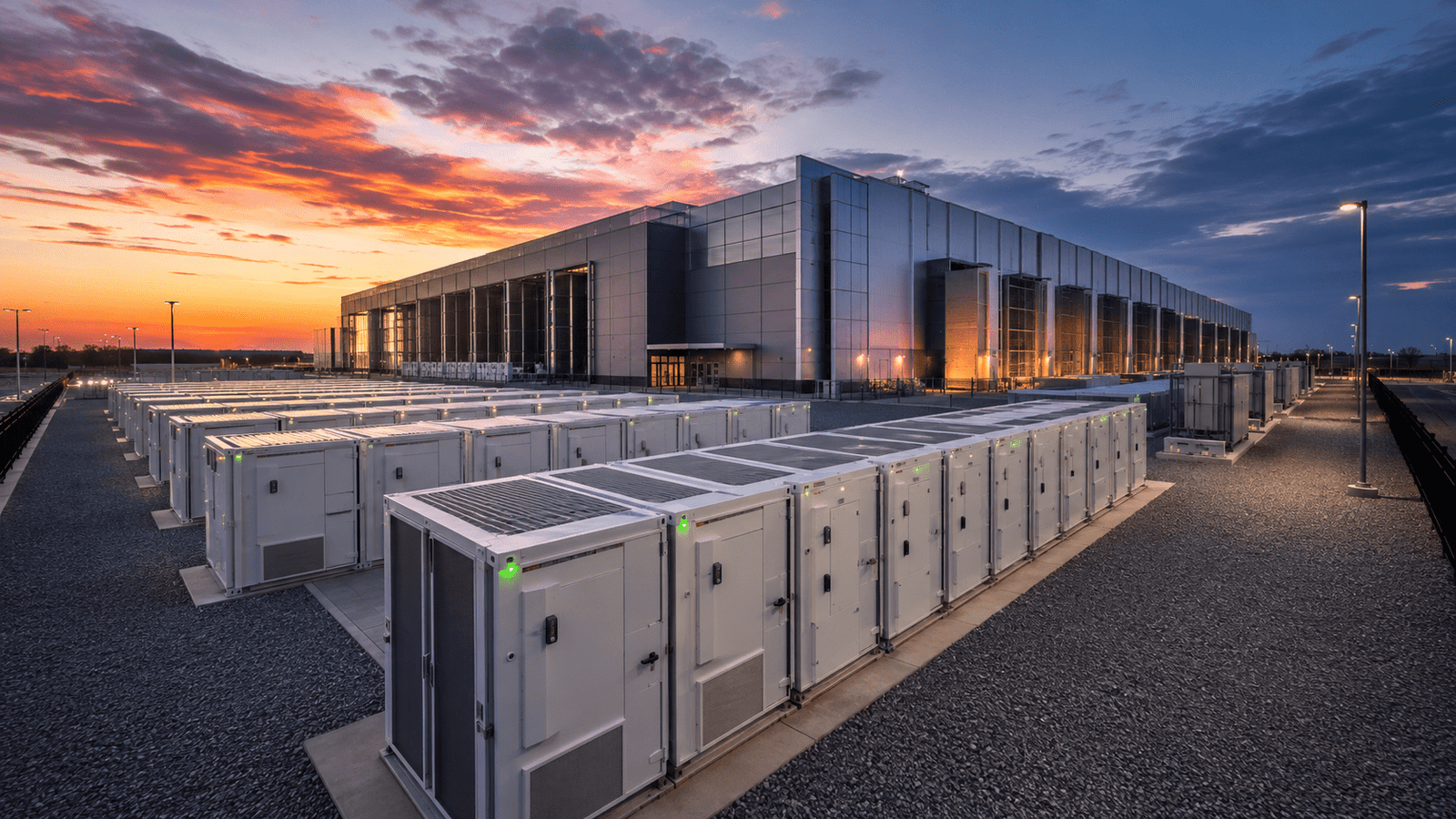
For most of the past two decades, battery storage in data centers meant one thing: uninterruptible power supply systems that kept servers running for the minutes needed to switch to generator backup during a grid outage. UPS batteries were important but ancillary, sized for short duration, designed for rare use, and treated as a reliability cost rather than a strategic infrastructure decision. That framing has not kept pace with what battery energy storage systems are actually doing in AI data center design in 2026.

BESS has shifted from a backup accessory to a primary design component that determines how quickly a facility can access the grid, how it manages the volatile power demands of AI workloads, and whether it can bring capacity online months or years ahead of competitors still waiting in interconnection queues. The global energy storage market for AI data centers is projected to grow from approximately $1.2 billion in 2025 to $4.1 to $6.0 billion by 2030, growing at 28 to 38% annually, two to three times faster than prior UPS-centric market estimates anticipated.

The Grid Interconnection Problem BESS Is Solving

Building a data center takes 12 to 24 months on average. Securing a firm grid connection can take up to three times as long, with interconnection queues in primary US markets extending seven to ten years in some cases. A developer who opts for an interruptible grid connection and installs BESS to ensure continuous operation during curtailment windows can receive interconnection approval significantly faster than a developer seeking a firm connection. The battery absorbs the gap between interruptible grid supply and the continuous power that AI workloads require, enabling the facility to operate reliably while accepting grid connection terms that do not require the utility to guarantee uninterrupted supply.

Josh Tucker, director of engineering in the energy storage group at Burns and McDonnell, described the dynamic directly: grid connections for high-demand facilities are now required on timelines that were unthinkable just a few years ago. BESS enables developers to bring capacity online sooner by bypassing the firm interconnection queue entirely where grid conditions allow. Some utilities, including Portland General Electric in Oregon, have already implemented flexible grid connection and bring-your-own-capacity models that formalise BESS as a path to faster interconnection approval. As covered in our analysis of the time-to-power crisis as AI’s hidden scaling ceiling, the gap between construction timelines and power access timelines is the defining constraint of the current AI infrastructure cycle. BESS is the most practical near-term tool for compressing that gap.

The AI Workload Volatility That Standard Power Infrastructure Cannot Handle

AI training clusters generate rapid power swings from 30% to 100% of rated load as they cycle between compute-intensive training phases and checkpointing or evaluation periods. Those swings occur on timescales fast enough to create frequency disturbances in local grid infrastructure and to stress power conditioning equipment designed for the gradual load changes of conventional enterprise IT. A facility running 100,000 Nvidia GPU training clusters without adequate load buffering creates power quality problems that extend beyond the facility fence to the grid infrastructure serving it.

BESS addresses this by acting as a buffer between the volatile AI workload and the grid, absorbing rapid load increases during training ramp-ups and discharging during load drops to maintain a stable power draw at the point of grid interconnection. This load smoothing function reduces the frequency regulation burden on the grid operator, improves power quality within the facility, and reduces the demand charge exposure that facilities with high peak-to-average load ratios face under utility tariff structures. Operators deploying BESS for load buffering alongside AI training clusters report demand charge reductions of 20 to 40% compared to facilities that manage GPU cluster power swings without battery buffering, a saving that materially improves the economics of AI compute hosting at scale.

The Four Roles BESS Now Plays in AI Data Center Design

The evolution of BESS from single-function backup power to multi-function infrastructure component is visible in the four distinct roles that battery systems now play in AI data center design. The first is the traditional UPS role, providing backup power to bridge between grid outage and generator startup. The second is interconnection enablement, allowing developers to accept interruptible grid connections that compress approval timelines from years to months. The third is load buffering, smoothing the volatile power demands of AI training clusters to protect power quality and reduce demand charges. The fourth is grid services provision, participating in frequency regulation, demand response, and ancillary services markets that generate revenue while supporting grid stability.

These four roles are not mutually exclusive, and the most sophisticated BESS deployments serve all four simultaneously, with control software that allocates battery capacity dynamically across functions based on grid conditions, workload schedules, and market pricing signals. US utility-scale battery capacity grew 66% in 2024, with 2025 expected to be another record year, reflecting the pace at which data center operators and grid developers are building BESS capacity into their infrastructure plans. Jefferies projects 20 gigawatts of hyperscaler BESS deployment by 2035, suggesting that battery storage will be a standard component of hyperscale campus design rather than an optional enhancement within a decade.

What This Means for Data Center Development Economics

The economic case for BESS in AI data center development has shifted from marginal to compelling as interconnection timelines have lengthened and AI workload volatility has increased. The cost of delayed interconnection, which can mean months or years of revenue not generated because a facility cannot access the grid, now routinely exceeds the capital cost of a BESS system sized to enable faster interconnection. Data center operators report total cost of ownership savings of 18 to 24% over ten-year infrastructure cycles for microgrid designs incorporating BESS compared to purely grid-dependent designs, driven by avoided interconnection delays, reduced demand charges, and ancillary services revenue.

The implication for AI infrastructure site selection and project finance is significant. A developer evaluating a new data center site now needs to assess not just the availability of grid capacity but the availability of grid capacity on a timeline compatible with its competitive position. In markets where firm interconnection timelines are measured in years, BESS-enabled interruptible connection strategies may be the only commercially viable path to bringing capacity online on a schedule that serves actual market demand. As covered in our analysis of the AI data center copper problem, the supply chain constraints on AI infrastructure extend across multiple material and equipment categories simultaneously. BESS adds a financing and design dimension to that picture that operators still treating battery storage as a backup power afterthought are systematically underweighting.


[simple-author-box]

More from AI Infrastructure

Power negotiations often conclude long before operational constraints reveal themselves inside a live facility.

Artificial intelligence infrastructure has compressed deployment timelines to the point where electrical capacity is

Boards increasingly expect organizations to support sustainability reporting with evidence that aligns with governance

COMPUTE WEEKLY

The briefing that 40,000+ tech leaders read every Monday. Sharp, fast, essential.

Great! We’ve received your information.

We couldn’t process your submission. Please retry

Building an AI Startup Without Owning GPUs

Not owning GPUs has become the default, deliberate strategy for building an AI company — not a compromise founders accept reluctantly. H100 rental rates fell 64-75% in fifteen months, a dense ecosystem of neoclouds and inference-as-a-service providers now lets startups skip infrastructure entirely, and credit programs can fund a company’s first year before a founder writes a check
Most Read

Infrastructure planning discussions often prioritize engineering, construction, and utility considerations before examining how end

AI infrastructure deployment schedules depend on coordinated progress across hardware availability, electrical infrastructure, cooling

Artificial intelligence has transformed the economics of digital infrastructure. Every new AI model requires

Data centers do not visibly smoke. They have no smokestacks, no visible exhaust, and

Artificial intelligence has transformed the economics of digital infrastructure. Companies once competed by acquiring

Disruptor Spotlight

Cerebras Systems

The chip that makes Nvidia nervous. Cerebras’ Wafer Scale Engine is rewriting the rules of AI inference at scale.
Faster
0 x
YoY Revenue
0 x
Transistors
0 T
Market Pulse
NVDA
$924.60
-2.11%
MSFT
$421.30
-2.94%
AMZN
$192.80
-4.87%
AMD
$924.60
-2.40%
TSMC
$924.60
-2.32%
Indicative only · Not financial advice
Upcoming Events
SEP
The AI Infrastructure Race (India)
WEBINAR · ONLINE
The AI Infrastructure Race: Won on Power, Land and Trust — Not Capital
MAY
0
AI Infrastructure Summit
DUBAI · IN PERSON
MEA’s premier AI infrastructure event.
JUN
0 0
Compute Forecast Summit
SINGAPORE · IN PERSON
Our flagship APAC event. Early bird open.
Latest Moves
Live
ecolab
Ecolab Deepens Cooling Strategy With $4.75B CoolIT Acquisition
Ecolab is making one of its biggest moves yet into AI infrastructure after completing its $4.75 billion acquisition of liquid cooling specialist CoolIT Systems
Pure DC AVK Europe data center microgrid Dublin 110MW AI infrastructure Ireland 2026
Pure DC and AVK Deploy Europe’s First 110 MW Data Center Microgrid in Dublin
The Pure DC Dublin microgrid has made history as Europe’s first large-scale on-site data center microgrid, launched in partnership with power solutions provider AVK at Pure DC’s campus in Ireland.
Pace Digitek
Pace Digitek Partners With MEGMEET to Expand AI Data Center Power Business
India’s AI infrastructure ecosystem continues to mature as domestic technology manufacturers move beyond traditional telecommunications and industrial markets toward high-growth digital infrastructure opportunities
Follow Compute Forecast
11K followers
1200 followers
Companies to Watch
CW
CoreWeave
Neo Cloud · $19B · IPO Watch
CB
Cerebras Systems
AI Hardware · $4.25B · Pre-IPO
G42
G42
Sovereign AI · Abu Dhabi
H
Humain
Saudi AI · $40B Fund
Latest Podcast
AI Capex, Cloud Margins & the Nuclear Bet
48 MIN · 25 APR 2026

Battery Energy Storage Is Becoming a Core Component of AI Data Center Design

For most of the past two decades, battery storage in data centers meant one thing: uninterruptible power supply systems that

Share
data center battery energy storage AI infrastructure design BESS grid interconnection hyperscale
32
847 SHARES

0
SHARES

[simple-author-box]

More from AI Infrastructure

Infrastructure planning discussions often prioritize engineering, construction, and utility considerations before examining how end

AI infrastructure deployment schedules depend on coordinated progress across hardware availability, electrical infrastructure, cooling

Artificial intelligence has transformed the economics of digital infrastructure. Every new AI model requires

Data centers do not visibly smoke. They have no smokestacks, no visible exhaust, and

COMPUTE WEEKLY

The briefing that 40,000+ tech leaders read every Monday. Sharp, fast, essential.

Great! We’ve received your information.

We couldn’t process your submission. Please retry

Global AI Infrastructure Outlook 2026

The briefing that 40,000+ tech leaders read every Monday. Sharp, fast, essential.
Download Free
Most Read

Infrastructure planning discussions often prioritize engineering, construction, and utility considerations before examining how end

AI infrastructure deployment schedules depend on coordinated progress across hardware availability, electrical infrastructure, cooling

Artificial intelligence has transformed the economics of digital infrastructure. Every new AI model requires

Data centers do not visibly smoke. They have no smokestacks, no visible exhaust, and

Artificial intelligence has transformed the economics of digital infrastructure. Companies once competed by acquiring

Disruptor Spotlight

Cerebras Systems

The chip that makes Nvidia nervous. Cerebras’ Wafer Scale Engine is rewriting the rules of AI inference at scale.
Faster
0 x
YoY Revenue
0 x
Transistors
0 T
Market Pulse
NVDA
$924.60
+2.4%
MSFT
$421.30
+1.1%
AMZN
$192.80
-0.6%
NVDA
$924.60
+2.4%
NVDA
$924.60
+2.4%
Indicative only · Not financial advice
Upcoming Events
MAY
0 0
DCD Global — London
LONDON · IN PERSON
World’s largest DC event. CF is media partner.
MAY
0
AI Infrastructure Summit
DUBAI · IN PERSON
MEA’s premier AI infrastructure event.
JUN
0 0

Compute Forecast Summit

SINGAPORE · IN PERSON
Our flagship APAC event. Early bird open.
Latest Moves
  • Live
Sam Altman
OpenAI appoints new Chief Infrastructure Officer to lead $100B DC programme
27 APR · OPENAI
Sam Altman
OpenAI appoints new Chief Infrastructure Officer to lead $100B DC programme
27 APR · OPENAI
Sam Altman
OpenAI appoints new Chief Infrastructure Officer to lead $100B DC programme
27 APR · OPENAI
Follow Compute Forecast
18.4K followers
12.1K followers
9.3K subscribers
41 episodes
Companies to Watch
CW
CoreWeave
Neo Cloud · $19B · IPO Watch
CB
Cerebras Systems
AI Hardware · $4.25B · Pre-IPO
G42
G42
Sovereign AI · Abu Dhabi
CW
Humain
Saudi AI · $40B Fund
Latest Podcast
AI Capex, Cloud Margins & the Nuclear Bet
48 MIN · 25 APR 2026
Scroll to Top








