Companies can secure funding, land, construction crews, and multibillion-dollar commitments for new data centers. However, a new reality has emerged: physical readiness no longer guarantees operational capacity. In regions like Santa Clara, California, completed facilities remain idle because the local grid cannot supply the required electricity. Similar challenges exist in Northern Virginia and other major tech hubs. Even fully built facilities may remain offline for years if the grid cannot handle their power demands, creating a significant operational bottleneck for digital infrastructure expansion.
What Interconnection Means in Practice
The Process of Connecting to the Grid
Interconnection refers to the formal process of connecting a new load, such as a data center, to the electrical grid. This ensures that power can flow reliably to the site. The process includes multiple steps: submitting a request, conducting feasibility and system impact studies, identifying required upgrades, and implementing infrastructure modifications. Today, completing this cycle often takes years rather than months.
Why Interconnection Has Grown in Complexity
Connecting a new facility was once a routine engineering task. Now, it carries system-wide significance. Studies can take 12 to 24 months or more, particularly when multiple developers compete for limited capacity. Utilities must evaluate the impact of large loads on transmission stability, voltage regulation, and local infrastructure. Permitting and coordination with regional transmission operators further extend timelines, transforming what used to be a predictable step into a major scheduling challenge.
Why Interconnection Has Become a Bottleneck
Several interrelated factors explain why connecting to the grid now takes significantly longer:
Unprecedented Demand Growth
AI data centers require massive, continuous power. Modern AI clusters can draw hundreds of megawatts each. In Texas alone, large interconnection requests quadrupled to over 220 gigawatts in 2025, with more than 70 percent tied to data center projects. This surge far exceeds what grid planners had anticipated.
At the same time, utilities are managing a pipeline of renewable projects, energy storage deployments, and electrification initiatives. Lawrence Berkeley National Laboratory data shows interconnection queues now exceed twice the existing generating capacity. Data centers are competing with renewables, electrification, and community projects for limited transmission pathways.
Transmission and Infrastructure Lag
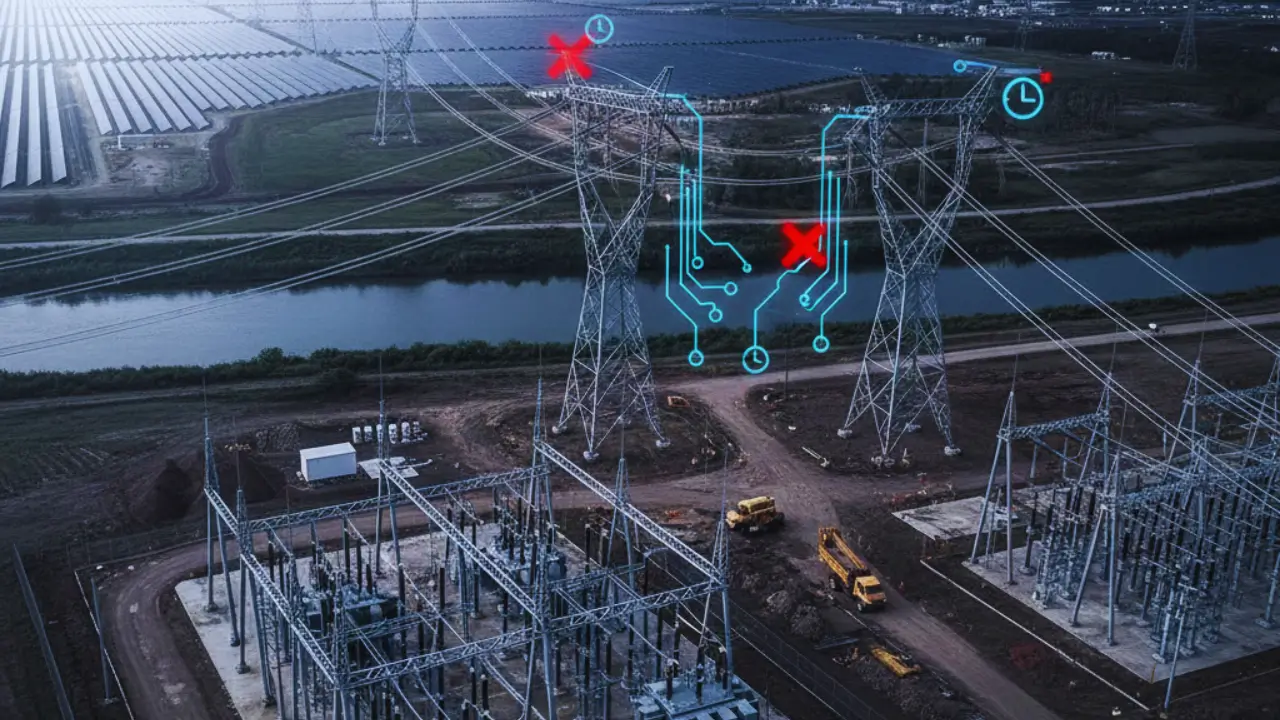
Constructing high-voltage transmission lines, the backbone for delivering large loads, often requires five to seven years. Equipment such as transformers and switchgear, once delivered in months, now faces multi-year waits due to supply chain pressures. Consequently, even completed data centers may remain powerless for years.
The disparity between rapid construction cycles (12–24 months) and slow grid upgrades makes interconnection the critical path in project schedules. Developers who once assumed power would be ready upon completion now face multi-year delays.
Regulatory and Study Complexity
Utilities and regional operators require multiple iterative studies, including feasibility, system impact, and facilities evaluations. Each stage can reveal additional upgrade needs, triggering new study cycles and further delays.
In some cases, preliminary studies alone can take up to 12 years. Major cloud providers have publicly identified interconnection timelines as one of their primary expansion obstacles, as projects may stall long before construction begins.
The Consequences for Data Center Growth
Idle Infrastructure and Opportunity Costs
Data centers built but not energized tie up capital and limit operational growth. For instance, a facility in Santa Clara may remain largely offline until transmission upgrades finish in 2028. Across high-demand corridors, similar delays are common.
Meanwhile, compute infrastructure- GPUs, servers, and energy systems; sits idle even as demand for AI capacity surges. This translates directly into lost revenue and competitive momentum for enterprises and hyperscalers.
Geographic Shifts and Secondary Markets
Developers are increasingly targeting secondary markets where grid capacity is available or interconnection timelines are shorter. Even when land, connectivity, or workforce considerations are less favorable, these areas become more attractive. This dynamic is reshaping the geography of digital infrastructure and reducing the dominance of traditional tech hubs.
Environmental Trade-offs
Until grids are expanded and modernized, developers are relying on interim solutions such as on-site generation. Hybrid systems that combine batteries with natural gas generators allow operations to begin while waiting for grid connections. However, these approaches raise sustainability concerns and may prolong reliance on fossil fuels.
How Developers Are Responding
On-Site and Microgrid Solutions
Operators are increasingly investing in microgrids, battery storage, and hybrid power plants to provide immediate energy without full dependence on the utility grid. These systems significantly accelerate operational readiness.
Early Planning and Strategic Site Selection
Site selection now prioritizes grid capacity and headroom. Developers engage with utilities early, sometimes even before acquiring land, to ensure that power availability is a primary criterion rather than an afterthought.
Regulatory Engagement
Industry participants are collaborating with regulators to streamline interconnection processes. Federal proposals aim to standardize procedures and incentivize faster grid access. However, reforms proceed slowly due to the need to balance reliability, fairness, and infrastructure investment costs.
A Structural Constraint, Not a Temporary Delay
Interconnection has evolved from a predictable engineering step into a structural bottleneck that can extend project timelines by a decade. The mismatch between rapid data center load growth and slow grid expansion, regulatory approvals, and infrastructure upgrades makes power access a defining factor for future growth. Electricity can no longer be assumed to be available on demand; instead, sufficient grid capacity will determine where and how AI infrastructure scales.
Power Is the New Competitive Frontier
For decades, data centers were sited based on fiber, talent, tax incentives, and proximity to customers. Today, power availability and the time it takes to connect has emerged as the central strategic consideration. Without addressing interconnection delays, digital infrastructure expansion risks stagnating even as demand for AI and cloud services accelerates.