
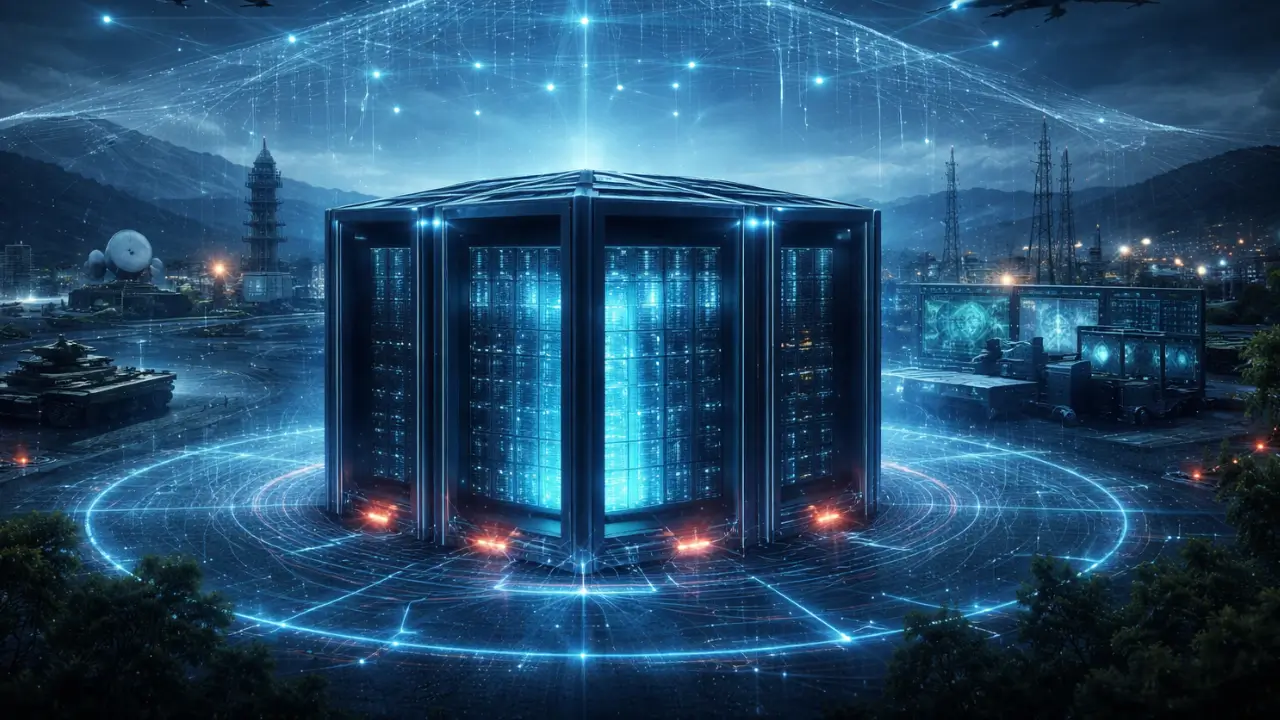
The future of national security lies not just in advanced weaponry but in the hidden digital foundations that drive decision‑making, data processing, and real‑time intelligence across mission‑critical sectors. Every nation grapples with unprecedented cyber threats, state‑level espionage, and AI‑driven disruption that could cripple critical infrastructure if core technologies remain exposed or improperly governed. Mission‑critical organizations now face a stark truth: generalized cloud environments built for broad commercial use cannot meet the autonomy and security demands of defense, energy grids, emergency services, and essential utilities. What emerges from this reality is a shift toward dedicated, secure, isolated cloud systems what architects call controlled AI clouds or NeoCloud environments crafted to deliver sovereignty, resilience, and precision AI capabilities within tightly regulated, air‑gapped ecosystems built for operational integrity under the most extreme conditions.

Mission‑Critical AI Demands Infrastructure Autonomy
Defense agencies and essential service providers cannot depend on generalized cloud offerings that expose sensitive workloads to multi‑tenant risks or broad internet connectivity. The autonomous nature of mission‑critical AI tasks from battlefield analytics to power grid management demands complete governance control over every layer of infrastructure. Standard public clouds, while versatile for commercial workloads, lack the rigorous isolation and sovereignty needed for classified data, secure training pipelines, and operational command systems. Industry leaders now insist on NeoCloud environments that embed strict policy enforcement and compartmentalization so that AI workloads do not bleed outside trusted boundaries. Infrastructure autonomy means retaining ownership of compute, storage, networking, and model execution, ensuring that no external dependencies can compromise mission continuity or data integrity. These environments are physically and logically isolated, reducing exposure to lateral attack vectors that plague conventional cloud platforms.
Isolation by Design: Building Air‑Gapped Intelligence Environments
Air‑gapped systems represent the gold standard of isolation for mission‑critical computing, where systems are physically disconnected from public networks and only interface with classified networks under strict cryptographic controls. Controlled AI clouds take this principle even further by weaving physical and logical isolation into all infrastructure layers, protecting models, data, and operational systems from unauthorized access, interception, or contagion from less secure environments. These platforms use specialized networking fabrics, secure enclaves, and hardware‑enforced segmentation so that even privileged internal users must authenticate under zero‑trust policies to access sensitive AI workloads. By operating outside public internet pathways, air‑gapped NeoCloud deployments thwart broad classes of cyber threats while enabling defense and infrastructure stakeholders to process classified intelligence with confidence. This isolation is crucial for maintaining national security posture, especially where compromise could endanger lives or destabilize entire regions.
The engineering of these environments often includes dedicated hardware chains, enclave‑protected virtual machines, and isolated data management pipelines that prevent cross‑tenancy contamination. Logical segmentation extends beyond merely separating workloads; it enforces that data flows only through vetted, auditable channels that align with regulatory and security frameworks. Cyber adversaries struggle to penetrate such defenses because the attack surface shrinks substantially when systems are cut off from external network influence. Stakeholders report that this approach is no longer theoretical but an operational imperative for securing AI that directs or supports mission‑critical decisions at scale.

Classified Workloads and Secure Model Lifecycles
Organizations align AI model lifecycles from initial training through deployment and ongoing maintenance with rigid national security protocols governing classified workloads. In mission‑critical settings, engineers orchestrate model creation within isolated environments that maintain compartmentalization, audit traceability, and restricted access policies at every step. NeoCloud operators keep training datasets containing sensitive or proprietary information within secure perimeters, and they deploy models only into environments that meet equivalent security criteria. IT teams enforce strict role‑based and attribute‑based access control policies, allowing only authenticated, authorized entities to interact with specific lifecycle elements. Versioning systems and immutable audit logs capture every modification, providing forensic fidelity that helps organizations comply with defense standards and regulatory oversight.
Secure model lifecycles also emphasize the capacity to update, patch, retrain, and retire AI systems without exposing operational networks to risk. In mission‑critical contexts, even a minor code change can cascade into significant system behavior shifts; thus, carefully controlled testing and deployment workflows are embedded inside NeoCloud frameworks. This discipline reduces the risk of errant AI decisions that could disrupt infrastructure operations or misinterpret sensory data in defense environments. With these guarded lifecycles, organizations elevate AI from an experimental utility to a reliable core component of strategic infrastructure.
Operational Continuity in High‑Risk Environments
Engineers design controlled AI clouds to ensure security and uninterrupted operation under geopolitical tension, cyber disruption, or infrastructure instability. Critical sectors face stark operational differences compared with commercial enterprises. Developers build resilience into NeoCloud environments using redundant network paths, isolated compute clusters, and failover mechanisms that operate independently from public cloud backbones. These architectures allow mission‑critical services to sustain operations even when broader networks experience contention or compromise. Disaster recovery unfolds across isolated nodes within a sovereign cloud construct, keeping data sovereignty and system readiness intact during contingencies.
Beyond technical configurations, operational continuity relies on comprehensive monitoring and predictive maintenance frameworks that anticipate faults before they manifest as failures. Advanced analytics and AI‑driven anomaly detection operate inside controlled clouds to manage and mitigate risks proactively. This intrinsic resiliency is vital when managing interconnected systems like power distribution, emergency response coordination, and defense intelligence networks that must function 24/7 without compromise. State actors and critical infrastructure teams alike view these capabilities as essential safeguards against disruptions that may arise from cyberattacks, natural disasters, or even supply‑chain shocks.
Embedded Governance and Command‑Level Oversight
A defining feature of controlled AI clouds is how governance and oversight are architected directly into their foundation. Unlike conventional clouds where governance often sits atop the stack as an add‑on, NeoCloud ecosystems embed policy enforcement, access controls, auditing, and compliance monitoring into every layer of infrastructure. This approach ensures that mission‑critical operations align with strategic priorities, operational mandates, and legal frameworks without requiring disparate, bolted‑on tools that introduce complexity. Policies governing data residency, encryption standards, key management, and workload authorization are uniformly enforced so that organizational leaders can maintain a clear, authoritative view of system activity. Integrated dashboards and audit feeds provide command‑level visibility into AI behavior, workflow execution, and anomaly alerts capabilities that bolster both security and strategic decision‑making in real time.
With built‑in compliance automation, controlled clouds help organizations adhere to frameworks like Department of Defense directives, national data protection laws, and critical infrastructure regulations. Automated evidence trails reduce audit overhead and provide verifiable proof of adherence to mandated practices, elevating confidence among auditors, regulators, and internal stakeholders alike. By internalizing governance, mission‑critical sectors avoid gaps that can arise when policy enforcement is an afterthought rather than a foundational design principle.
From Outsourced Compute to Strategic Infrastructure Ownership
Historically, many sectors outsourced compute and data processing to third‑party public clouds under the assumption that scale and cost efficiencies outweighed control concerns. However, mission‑critical sectors now recognize that relinquishing infrastructure sovereignty can undercut strategic autonomy and expose vulnerabilities at the worst possible moment. A paradigm shift has emerged: these sectors are reasserting ownership over their AI stacks, from core silicon resources through orchestration layers, driven by the need for resilience, sovereignty, and performance guarantees that commercial clouds cannot match under stringent security requirements. NeoCloud designs empower organizations to steward their infrastructure roadmap, optimize configurations for mission‑specific workloads, and retain intellectual property within secure perimeters. This ownership extends to choosing hardware accelerators tailored for sensitive AI workloads, dedicated networking fabrics that eliminate shared risks, and execution environments that reflect sovereign operational mandates.
By owning strategic infrastructure, critical sectors reduce dependency on external providers for essential updates, security patches, and compliance changes. This control translates into faster response times, tailored performance optimizations, and the ability to enforce bespoke governance protocols that reflect national priorities. In a landscape where technological edge and operational sovereignty are intertwined, controlled AI clouds deliver power and independence rather than reliance on generic platforms ill‑suited for high‑stakes missions.
A Southeast Asia Storyline: Oracle and Singapore’s Defense Cloud Transformation
In Southeast Asia, Singapore has become a focal point for the rise of controlled AI cloud adoption, marking a trend where nations invest in sovereign, isolated cloud infrastructure to support defense and critical systems. Oracle partnered with Singapore’s Defence Science and Technology Agency (DSTA) to deploy an Oracle Cloud Isolated Region that delivers air‑gapped, hyperscale cloud and AI services for the Ministry of Defence (MINDEF) and the Singapore Armed Forces (SAF). This collaboration represents Oracle’s first major defense cloud engagement in Southeast Asia and highlights regional demand for secure, sovereign compute foundations.
Oracle’s Vice President, Sovereign Regions, Rand Waldron, emphasized the significance of bringing generative AI and secure cloud capabilities into isolated environments tailored for defense workloads, asserting that Oracle’s air‑gapped offerings extend public cloud innovation into classified networks securely. His commentary reflects a strategic pivot in the industry where cloud providers must offer mission‑aligned solutions rather than one‑size‑fits‑all services.
Singapore’s leadership, through DSTA Chief Executive Ng Chad‑Son, noted that harnessing advanced cloud and AI technologies is essential to modernize operations and enhance decision‑making performance within national defense. The strategic planning and execution behind the Oracle‑Singapore partnership underscores how controlled AI clouds can transform how defense organizations integrate intelligence, analytics, and operational workflows while maintaining sovereignty and high performance.
This deployment has strong ripple effects across Southeast Asia, signaling to regional governments and critical sectors that secure, controlled AI infrastructure is not merely beneficial but essential for future readiness. Investments in localized, isolated cloud regions reflect a broader shift toward technological sovereignty and resilience amidst escalating global cyber threats and geopolitical competition.
Controlled AI Clouds as Strategic National Infrastructure
In mission-critical sectors, AI infrastructure is no longer a service layer, it is a pillar of national capability. Defense systems, energy grids, transportation networks, and emergency response frameworks cannot operate on generalized cloud assumptions. They require controlled, sovereign, and tightly governed AI environments where security, autonomy, and operational resilience are foundational design principles.
The rise of controlled NeoCloud ecosystems reflects a broader shift: AI is being treated not as an innovation experiment, but as strategic infrastructure. In this landscape, ownership, isolation, and embedded governance are no longer optional features, they are defining requirements of modern national resilience.











