
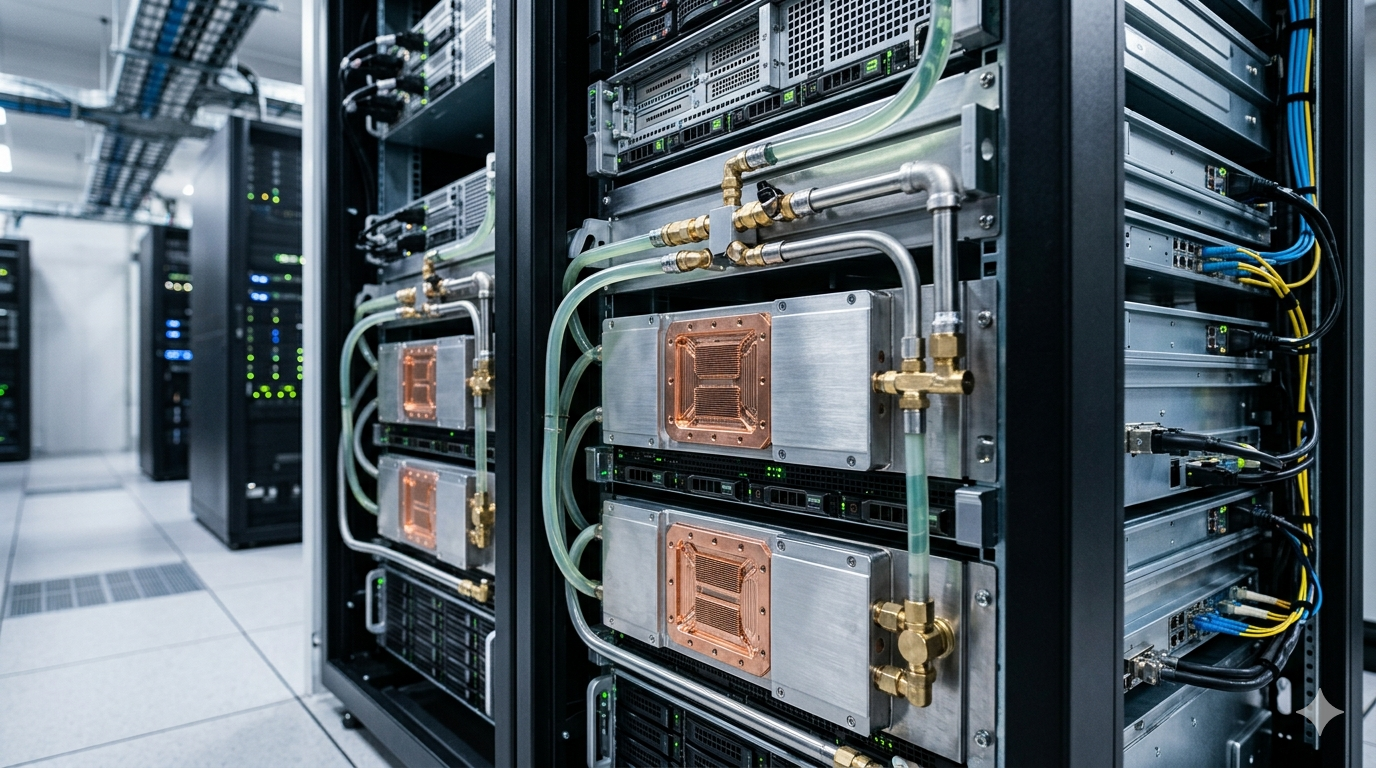
The data center cooling conversation has been heading in one direction for several years. Air cooling, the default for most of the industry’s history, is retreating from the frontier of AI infrastructure deployment. The question was never whether liquid cooling would become standard. It was always when. In 2026, the when has arrived. Liquid-cooled server racks will account for nearly half of all new deployments this year, and for facilities building around the latest AI accelerators, liquid cooling is not a premium option. It is a technical requirement.

The shift is not driven by efficiency preference. It is driven by physics. NVIDIA’s GB300 chips carry a thermal design power exceeding 1,400 watts per chip. At those heat flux densities, air cooling cannot remove heat from the silicon fast enough to prevent throttling. Direct-to-chip liquid cooling, which circulates coolant through cold plates mounted directly on the processor, is the only approach that handles those loads reliably at scale. Facilities that cannot support direct-to-chip cooling cannot run the latest generation of AI accelerators at rated performance.
Why Direct-to-Chip Is Different From Facility-Level Cooling
Cold plates and immersion represent fundamentally different approaches to removing heat from silicon at extreme density. Direct-to-chip cold plate cooling sits between conventional rear-door heat exchangers and full immersion in terms of engineering complexity, capital cost, and thermal performance. Most operators are adopting it for current AI hardware because it delivers the performance required without the full infrastructure overhaul that immersion demands.
The key difference between direct-to-chip and facility-level approaches is where the thermal work happens. Air cooling and rear-door heat exchangers manage heat after it leaves the chip and enters the rack airflow. Direct-to-chip cooling intercepts heat at the source, before it affects ambient rack temperatures. That difference matters at high power densities because engineers cannot manage the heat flux from a 1,400-watt chip effectively once it enters the rack airspace. The thermal gradient from chip to coolant must be minimised at the chip level, and that requires the coolant loop to contact the chip package directly.

What Operators Need to Retrofit and What They Need to Build
The practical challenge for operators managing existing facilities is that direct-to-chip cooling requires infrastructure that air-cooled designs never included. Operators must add coolant distribution units, in-rack plumbing manifolds, leak detection systems, and the secondary plant infrastructure to move heat from the coolant loop to a facility chiller or cooling tower. For facilities that designers never built with these systems in mind, the retrofit complexity is significant and the cost is not trivial.
Cooling the chip itself is an emerging frontier that goes further than current cold plate approaches. For facilities deploying today’s hardware, however, direct-to-chip cold plates are the immediate engineering challenge. Operators who have not yet mapped their facilities for plumbing routes, the structural load of filled coolant manifolds, and the secondary plant capacity needed at scale are building a gap between their infrastructure capabilities and the hardware they will need to deploy within the next 12 to 18 months.
New facilities have the advantage of designing direct-to-chip infrastructure from the outset. Their designers can optimise plumbing routes, floor loading specifications, secondary plant sizing, and facility management systems for liquid cooling as a baseline rather than an addition. Those facilities will serve the full range of current and next-generation AI accelerators without the compromises and costs that retrofitting imposes. The operators who understood three years ago that liquid cooling was the destination and designed accordingly are now the operators whose facilities can host the hardware that everyone else is scrambling to accommodate.
The Maintenance Reality Nobody Discusses Enough
Direct-to-chip cooling introduces maintenance requirements that air-cooled operations never faced. Operations teams must manage coolant chemistry to prevent corrosion, microbial growth, and scaling that reduce heat transfer efficiency and damage components over time. Leaks, however small, create risk in environments where compute hardware represents tens of millions of dollars per rack. The quick-disconnect fittings and manifold systems that make liquid-cooled racks serviceable in production environments minimise leak risk, but they introduce maintenance disciplines that operations teams must develop if they have not previously managed liquid-cooled infrastructure.
The operational learning curve is real. Facilities that invest in training their operations teams now are building a capability advantage over those that will develop it under operational pressure once high-density AI hardware is already deployed. The shift to liquid cooling is not just an infrastructure transition. It is an operational one, and the full cost includes the time and investment required to build the skills that make liquid-cooled infrastructure reliable at scale.
The Standardisation Gap That Is Slowing Adoption
One of the practical barriers to faster direct-to-chip cooling adoption is the absence of a mature standardisation ecosystem. Air-cooled data centers operate with well-established interoperability standards across rack formats, power distribution, and cooling infrastructure. Direct-to-chip liquid cooling is still working through that process. Different server vendors use different cold plate designs, different coolant connection formats, and different manifold specifications. A facility that standardises its liquid cooling infrastructure around one vendor’s ecosystem may face significant rework costs when deploying hardware from a different supplier.
A consortium of data center operators and chip manufacturers finalised a Direct-to-Chip Interoperability Standard in late 2025, aiming to ensure colocation facilities can support liquid cooling manifolds from different vendors without expensive retrofitting. That standard is a meaningful step forward, but adoption across the full range of hardware vendors and facility operators will take time. In the interim, operators deploying direct-to-chip cooling must make careful decisions about which vendor ecosystems their infrastructure is optimised for, knowing those decisions carry lock-in implications that air-cooled infrastructure decisions never created. The facilities that get standardisation right early, building infrastructure that accommodates the evolving hardware ecosystem without major rework, will hold a durable operational advantage as the liquid cooling market matures.











