
.Nscale Locks $3.5 Billion Figure Robotics Compute Deal  ·Qatar’s Meeza Lands Major Hyperscaler Deal for 8MW ·Qualcomm Strikes Amazon AI Chip Deal, Opens Door to $4 Billion Stock ·Hitachi Energy Bets $300M on China Grid Manufacturing Corvex Builds Toward 8MW Cloud Infrastructure Footprint LITEON Bets $176 Million on DCX Liquid Cooling EdgeConneX Backs Singapore’s AI-Ready Tropical Data Center Testbed

The FLAP-D Collapse: Where Europe’s AI Data Center Investment Is Moving Next

For more than a decade, Europe’s digital infrastructure industry revolved around five dominant markets: Frankfurt, London, Amsterdam, Paris, and Dublin.

Share
Europe AI Data Center Expansion

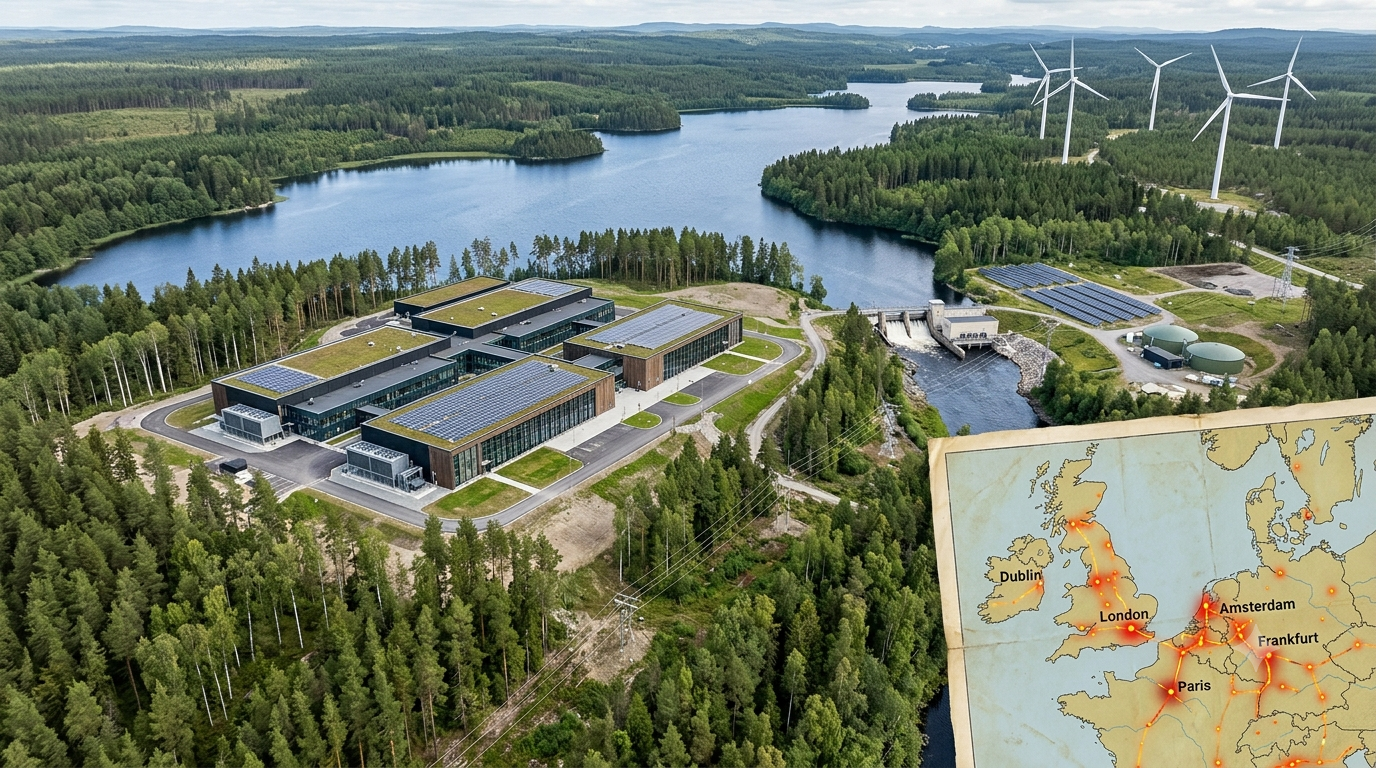
For more than a decade, Europe’s digital infrastructure industry revolved around five dominant markets: Frankfurt, London, Amsterdam, Paris, and Dublin. Together known as FLAP-D, these cities attracted hyperscalers, cloud providers, colocation operators, and enterprise workloads because they combined connectivity, capital, and proximity to customers. The AI era is changing that equation. Power availability has become the primary constraint on data center development, overtaking land, financing, and even permitting in many cases. Developers increasingly face a situation where facilities can be designed, financed, and constructed long before electricity becomes available. As a result, capital is beginning to flow toward a new generation of European markets that offer something increasingly scarce: access to power.

The FLAP-D Advantage Is Becoming a Liability

For years, the FLAP-D markets benefited from dense fiber networks, cloud regions, internet exchanges, and established ecosystems of infrastructure providers. Those advantages remain important, but AI workloads have introduced a new requirement. Large-scale AI facilities demand hundreds of megawatts of electricity, often delivered within timelines that existing transmission networks cannot support. Grid operators across Europe now face connection requests that exceed available capacity, creating waiting periods measured in years rather than months. The challenge has become so severe that power availability now plays a larger role in site selection than traditional location advantages. 

The scale of the bottleneck is significant. Industry data shows that grid connection lead times in major European hubs have reached seven to ten years, while some highly congested locations face delays extending to thirteen years. Amsterdam faces average waits approaching a decade, while new large-scale grid connections in Dublin remain heavily restricted. Amazon executives have publicly identified grid connection certainty as one of the most important factors shaping European investment decisions. For many developers, the constraint is no longer whether capital is available but whether electricity can be delivered within a commercially viable timeframe. 

AI Is Accelerating the Shift Away From Traditional Markets

Artificial intelligence is amplifying infrastructure pressures across Europe. Training clusters and inference environments consume substantially more power than conventional cloud deployments, creating demand for larger campuses and higher-density facilities. According to CBRE, AI-focused capacity transactions in Europe tripled during 2025, reflecting rapid expansion among cloud providers and AI infrastructure operators. Demand growth continues to outpace the ability of traditional hubs to add new capacity. 

This mismatch is forcing operators to reconsider where future capacity can realistically be deployed. Infrastructure planners increasingly evaluate regions based on grid access, renewable energy availability, cooling conditions, and long-term scalability rather than proximity to existing hubs. The result is a gradual redistribution of investment across Europe. Instead of concentrating development inside a handful of metropolitan regions, operators are expanding into locations that can support large AI campuses without facing decade-long power delays. 

Scandinavia Is Emerging as Europe’s New Hyperscale Frontier

The clearest beneficiary of this shift is the Nordic region. Finland, Sweden, Norway, Denmark, and Iceland offer a combination of advantages that are increasingly difficult to find elsewhere in Europe. Abundant renewable energy, colder climates, available land, and relatively uncongested electricity networks make these countries attractive destinations for AI infrastructure. Unlike traditional enterprise workloads, AI training environments often prioritize power availability over latency, making remote locations more viable. 

Recent investments illustrate the trend. Earlier this year, AI infrastructure company Nebius announced plans for a $10 billion data center development in Lappeenranta, Finland. The 310 MW facility will rank among Europe’s largest AI-focused campuses and was specifically attracted by Finland’s low-cost renewable power and favorable cooling conditions. Similar developments are emerging across Sweden and Norway, where operators increasingly view energy resources as strategic assets rather than supporting infrastructure. 

The Next Wave of European Data Center Cities

The most important story may not be the rise of entire countries but the emergence of specific secondary cities. Locations such as Lappeenranta and Mäntsälä in Finland, Borlänge in Sweden, and several Norwegian energy corridors are attracting serious attention from hyperscalers and AI infrastructure developers. These locations combine access to renewable generation with available industrial land and expanding connectivity infrastructure. 

Outside Scandinavia, markets such as Zaragoza in Spain, Milan in Italy, and parts of Eastern Europe are also attracting interest. Improved fiber connectivity and growing renewable energy capacity are making previously overlooked locations viable for large-scale deployments. Developers increasingly prioritize power certainty over geographic proximity to traditional internet exchanges. As connectivity becomes more distributed, the historical advantages of FLAP-D markets become less decisive for many AI workloads.

Power Has Become the New Currency of Digital Infrastructure

Europe’s data center industry is undergoing a structural transformation. For much of the cloud era, infrastructure decisions revolved around connectivity, customer proximity, and real estate availability. The AI era has elevated electricity to the top of the hierarchy. Regions capable of delivering hundreds of megawatts of reliable power are increasingly attracting the industry’s largest investments. Markets unable to expand grid capacity risk losing future projects regardless of their historical importance. 

This shift is reshaping investment strategies across the continent. Developers, investors, utilities, and governments now recognize that AI competitiveness depends as much on energy infrastructure as on computing hardware. The ability to secure power may determine which regions become Europe’s next hyperscale hubs. As grid constraints persist across FLAP-D markets, the winners of the next infrastructure cycle are likely to be regions that can deliver electricity, renewable energy, and expansion capacity at scale. 

[simple-author-box]

More from AI Infrastructure

Inference sits under a strange operational promise: the system should respond immediately, regardless of

AI rack cooling now depends on a relationship between two liquid environments that should

A cluster can have enough GPUs, power, cooling capacity, and rack space and still

COMPUTE WEEKLY

The briefing that 40,000+ tech leaders read every Monday. Sharp, fast, essential.

Building an AI Startup Without Owning GPUs

Not owning GPUs has become the default, deliberate strategy for building an AI company — not a compromise founders accept reluctantly. H100 rental rates fell 64-75% in fifteen months, a dense ecosystem of neoclouds and inference-as-a-service providers now lets startups skip infrastructure entirely, and credit programs can fund a company’s first year before a founder writes a check
Most Read

A compute node sitting behind a garage door can perform the same basic computational

A project can leave a site without leaving behind the conditions that made the

A commercial operation date can look precise long before the underlying project is capable

A 5 GW AI infrastructure plan can satisfy every conventional site-selection requirement and still

A fire strategy becomes expensive when the building has already decided where walls, equipment,

Disruptor Spotlight

Cerebras Systems

The chip that makes Nvidia nervous. Cerebras’ Wafer Scale Engine is rewriting the rules of AI inference at scale.
Faster
0 x
YoY Revenue
0 x
Transistors
0 T
Market Pulse
MSFT
+1.02%
NVDA
+0.66%
AMZN
-0.078%
AMD
-6.95%
TSMC
-2.98%
Indicative only · Not financial advice
Upcoming Events
SEP
The AI Infrastructure Race (India)
WEBINAR · ONLINE
The AI Infrastructure Race: Won on Power, Land and Trust — Not Capital
MAY
0
AI Infrastructure Summit
DUBAI · IN PERSON
MEA’s premier AI infrastructure event.
JUN
0 0
Compute Forecast Summit
SINGAPORE · IN PERSON
Our flagship APAC event. Early bird open.
Latest Moves
Live
ecolab
Ecolab Deepens Cooling Strategy With $4.75B CoolIT Acquisition
Ecolab is making one of its biggest moves yet into AI infrastructure after completing its $4.75 billion acquisition of liquid cooling specialist CoolIT Systems
Pure DC AVK Europe data center microgrid Dublin 110MW AI infrastructure Ireland 2026
Pure DC and AVK Deploy Europe’s First 110 MW Data Center Microgrid in Dublin
The Pure DC Dublin microgrid has made history as Europe’s first large-scale on-site data center microgrid, launched in partnership with power solutions provider AVK at Pure DC’s campus in Ireland.
Pace Digitek
Pace Digitek Partners With MEGMEET to Expand AI Data Center Power Business
India’s AI infrastructure ecosystem continues to mature as domestic technology manufacturers move beyond traditional telecommunications and industrial markets toward high-growth digital infrastructure opportunities
Follow Compute Forecast
11K followers
1200 followers
Companies to Watch
CW
CoreWeave
Neo Cloud · $19B · IPO Watch
CB
Cerebras Systems
AI Hardware · $4.25B · Pre-IPO
G42
G42
Sovereign AI · Abu Dhabi
H
Humain
Saudi AI · $40B Fund
Latest Podcast
AI Capex, Cloud Margins & the Nuclear Bet
48 MIN · 25 APR 2026

The FLAP-D Collapse: Where Europe’s AI Data Center Investment Is Moving Next

For more than a decade, Europe’s digital infrastructure industry revolved around five dominant markets: Frankfurt, London, Amsterdam, Paris, and Dublin.

Share
Europe AI Data Center Expansion
54
847 SHARES

0
SHARES

[simple-author-box]

More from AI Infrastructure

A compute node sitting behind a garage door can perform the same basic computational

A project can leave a site without leaving behind the conditions that made the

A commercial operation date can look precise long before the underlying project is capable

A 5 GW AI infrastructure plan can satisfy every conventional site-selection requirement and still

COMPUTE WEEKLY

The briefing that 40,000+ tech leaders read every Monday. Sharp, fast, essential.

Great! We’ve received your information.

Global AI Infrastructure Outlook 2026

The briefing that 40,000+ tech leaders read every Monday. Sharp, fast, essential.
Download Free
Most Read

A compute node sitting behind a garage door can perform the same basic computational

A project can leave a site without leaving behind the conditions that made the

A commercial operation date can look precise long before the underlying project is capable

A 5 GW AI infrastructure plan can satisfy every conventional site-selection requirement and still

A fire strategy becomes expensive when the building has already decided where walls, equipment,

Disruptor Spotlight

Cerebras Systems

The chip that makes Nvidia nervous. Cerebras’ Wafer Scale Engine is rewriting the rules of AI inference at scale.
Faster
0 x
YoY Revenue
0 x
Transistors
0 T
Market Pulse
NVDA
$924.60
+2.4%
MSFT
$421.30
+1.1%
AMZN
$192.80
-0.6%
NVDA
$924.60
+2.4%
NVDA
$924.60
+2.4%
Indicative only · Not financial advice
Upcoming Events
MAY
0 0
DCD Global — London
LONDON · IN PERSON
World’s largest DC event. CF is media partner.
MAY
0
AI Infrastructure Summit
DUBAI · IN PERSON
MEA’s premier AI infrastructure event.
JUN
0 0

Compute Forecast Summit

SINGAPORE · IN PERSON
Our flagship APAC event. Early bird open.
Latest Moves
  • Live
Sam Altman
OpenAI appoints new Chief Infrastructure Officer to lead $100B DC programme
27 APR · OPENAI
Sam Altman
OpenAI appoints new Chief Infrastructure Officer to lead $100B DC programme
27 APR · OPENAI
Sam Altman
OpenAI appoints new Chief Infrastructure Officer to lead $100B DC programme
27 APR · OPENAI
Follow Compute Forecast
18.4K followers
12.1K followers
9.3K subscribers
41 episodes
Companies to Watch
CW
CoreWeave
Neo Cloud · $19B · IPO Watch
CB
Cerebras Systems
AI Hardware · $4.25B · Pre-IPO
G42
G42
Sovereign AI · Abu Dhabi
CW
Humain
Saudi AI · $40B Fund
Latest Podcast
AI Capex, Cloud Margins & the Nuclear Bet
48 MIN · 25 APR 2026
Scroll to Top









