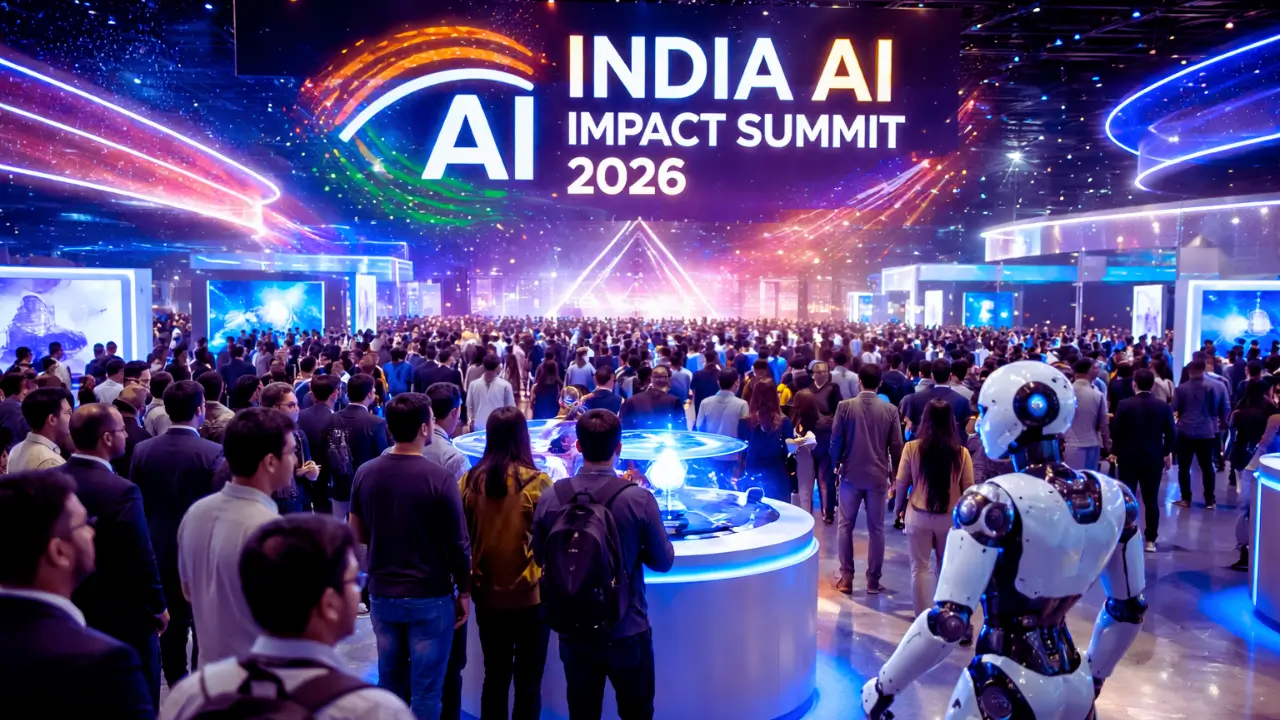
As the first major global AI gathering hosted in the Global South, the India AI Impact Summit 2026, taking place from February 16 to 20- has drawn participation from over 100 countries, more than 20 heads of state, 60 ministers, and 500 AI leaders from industry and academia. Following earlier summits in Bletchley Park, Seoul, and Paris, India has steered the discussion in a new direction. Discussions have focused on developmental opportunity and inclusive growth rather than existential risks alone.
Prime Minister Narendra Modi’s opening message, “Sarvajana Hitaya, Sarvajana Sukhaya” meaning welfare for all, happiness for all, established the central theme. Throughout the summit, that philosophy has resonated across policy announcements, corporate commitments, and technical demonstrations.
A Framework Anchored in People, Planet and Progress
At the core of the summit is a three-part framework structured around People, Planet and Progress. This approach has provided continuity across panels and announcements.
First, the People pillar emphasizes human-centric AI that protects dignity and expands access. Policymakers and industry leaders repeatedly stressed that AI must reduce inequality rather than widen it.
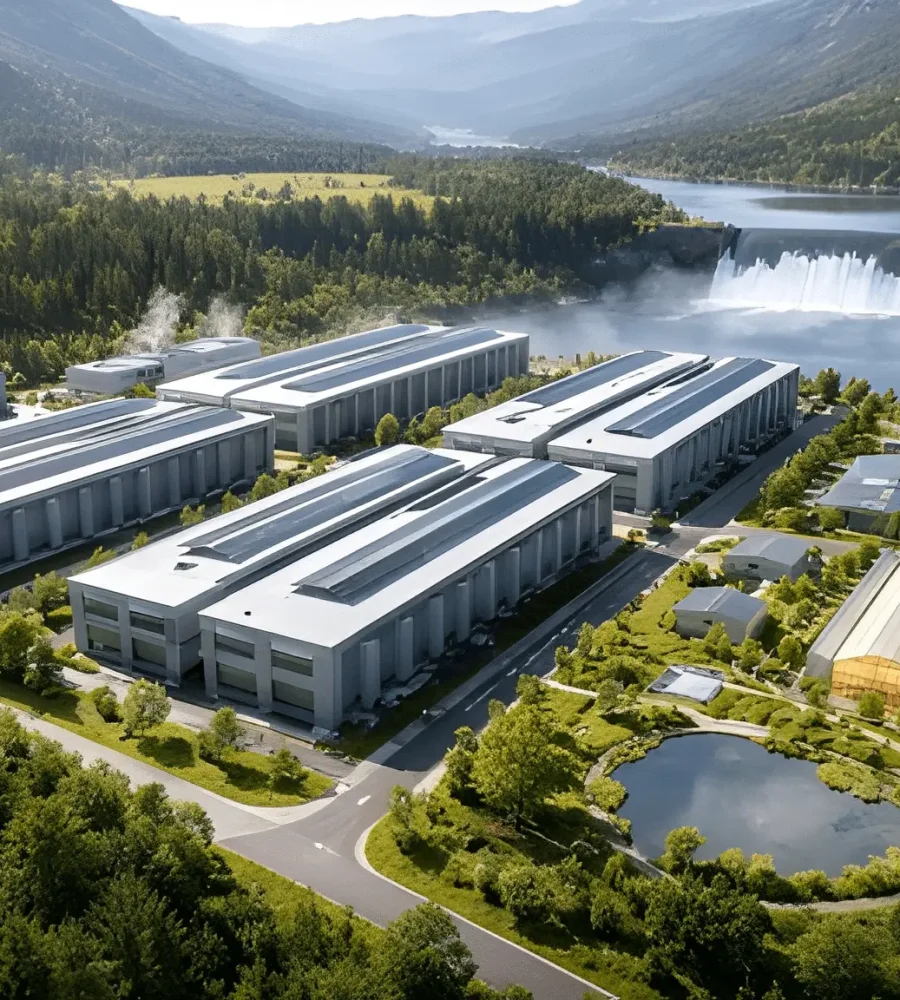
Second, the Planet pillar addresses sustainability. With data centers consuming vast amounts of energy and water, environmental impact has become inseparable from technological ambition. Consequently, discussions included climate-aligned AI infrastructure and more efficient compute models.
Third, the Progress pillar frames AI as a driver of broad-based economic development. The emphasis throughout has been on ensuring that growth reaches farmers, students, small businesses, and rural communities, rather than remaining concentrated within a narrow technology elite.
Taken together, these pillars reflect an effort to embed AI policy within social and economic priorities rather than treat it as a standalone technological race.
Sovereign AI and the 12 Indigenous Models
Alongside philosophical framing, the summit delivered concrete technical commitments. Under the IndiaAI Mission, the government announced the selection of 12 Indian startups and research groups to develop indigenous foundation models.
These models are being trained on domestic datasets and designed to support all 22 official Indian languages. As a result, India is working to reduce dependence on English-centric global systems while embedding local linguistic nuance and regulatory context into core AI infrastructure.
In parallel, initiatives such as BharatGPT and Bhashini are advancing multilingual capabilities. Bhashini, which enables real-time speech-to-speech translation across Indian languages, is already being deployed in public services and healthcare. This focus on language inclusion reflects a broader objective of building AI systems that function effectively in diverse, real-world environments.
Democratizing Compute and Building Infrastructure
Access to computing power remains one of the defining constraints of the AI economy. Recognizing this, the IndiaAI Mission announced that 38,000 GPUs have been onboarded to provide shared compute access to startups, researchers, and academic institutions.
By lowering the cost barrier to model training and deployment, the initiative seeks to prevent AI capability from being concentrated in a handful of global corporations. Moreover, infrastructure partnerships announced at the summit reinforce this strategy.
For instance, AMD is collaborating with Tata Consultancy Services to develop rack-scale AI infrastructure using its Helios platform. Meanwhile, Indian AI startup Neysa secured a 600 million dollar equity raise led by Blackstone and plans to deploy more than 20,000 GPUs. In addition, Bengaluru-based C2i raised 15 million dollars to build power solutions tailored for AI data centers.
Together, these developments signal a coordinated effort to expand both compute availability and supporting infrastructure.
AI for Social Good in Action
Beyond infrastructure and policy, the summit floor demonstrated practical applications at scale. Spread across more than 70,000 square meters, the expo featured over 300 pavilions and 600 startups. Approximately 500 sessions and 3,250 speakers contributed to discussions across thematic tracks.
Three global competitions titled AI for All, AI by Her, and YUVAi attracted nearly 4,650 entries from more than 60 countries. Seventy finalist teams presented solutions targeting development challenges.
Several applications stood out. AI-enabled tuberculosis screening tools reported an approximately 16 percent improvement in case detection. Startups showcased rapid disease surveillance systems and drug discovery analytics platforms. Tata Consultancy Services unveiled a quadruped inspection robot capable of navigating factory environments autonomously to enhance worker safety.
Programs such as AI Sakhi, which has trained 1,600 rural women to use AI tools for financial literacy and employment, further illustrated the emphasis on community-level impact. Similarly, BharatGen aims to simplify public service delivery through generative AI interfaces.
As a result, the summit connected high-level policy discussions with tangible deployments on the ground.
Responsible AI and Regulatory Balance
While innovation featured prominently, governance remained central to the conversation. Leaders emphasized transparency, fairness, and accountability across sectors.
Union Minister Ashwini Vaishnaw underscored that trust must underpin innovation. In healthcare, executives highlighted the importance of explainability, clinical validation, and continuous monitoring of AI systems. Additionally, policymakers discussed proposals such as mandatory watermarking and labeling of AI-generated content.
Seven thematic working groups have been established to translate dialogue into policy recommendations. These groups focus on areas including safe and trusted AI, data democratization, and AI for social good. Consequently, the summit has moved from conceptual debate toward institutional follow-through.
Global Partnerships and Capital Commitments
International collaboration has also accelerated. A U.S. business delegation led by Adobe CEO Shantanu Narayen signaled deeper engagement between the two countries. Australia proposed joint AI infrastructure initiatives. At the same time, Google, Microsoft, and Amazon have collectively pledged approximately 68 billion dollars in cloud and AI investments in India by 2030.
Anthropic announced that it will open its first India office in Bengaluru. OpenAI CEO Sam Altman revealed that India now accounts for more than 100 million weekly ChatGPT users, second only to the United States, and represents its largest student user base.
Domestically, the government earmarked 1.1 billion dollars for a state-backed venture capital fund targeting AI and advanced manufacturing startups. These financial commitments reinforce the sense that India’s AI push is being supported by both public and private capital at scale.
Workforce Transformation and Reskilling
The future of work formed another major theme. Some industry leaders offered stark assessments. Vinod Khosla suggested that sectors such as IT services and BPO could face significant disruption within five years. HCL’s leadership acknowledged that profitability, rather than large-scale job creation, may guide future strategies.
Nevertheless, the broader message centered on adaptation. Leaders such as Sanjeev Bikhchandani encouraged young professionals to master AI tools to remain competitive. Infosys and Salesforce executives highlighted lifelong learning as essential in an AI-driven economy.
In response, the government announced plans to establish 570 Data Labs to cultivate AI-native talent. Training initiatives within Mission Karmayogi are also integrating AI-driven learning and capacity planning tools for civil servants. Therefore, the workforce conversation has shifted toward reskilling at national scale.
Looking Ahead
Although the summit is still ongoing, its impact is already becoming clear. By combining policy frameworks, infrastructure development, financial support, and practical applications, India is charting a course for AI that prioritizes inclusion and social benefit.
Over the coming days, attention will turn to scaling pilots across healthcare, education, agriculture, and governance. Delegates are expected to further discuss ethical safeguards, interoperable data systems, and global collaborations. The remaining sessions will likely shape the next steps in India’s AI strategy and establish benchmarks for international cooperation.
The India AI Impact Summit 2026 is continuing to set the tone for how artificial intelligence can serve society, and the final outcomes may redefine India’s role in the global AI landscape.