
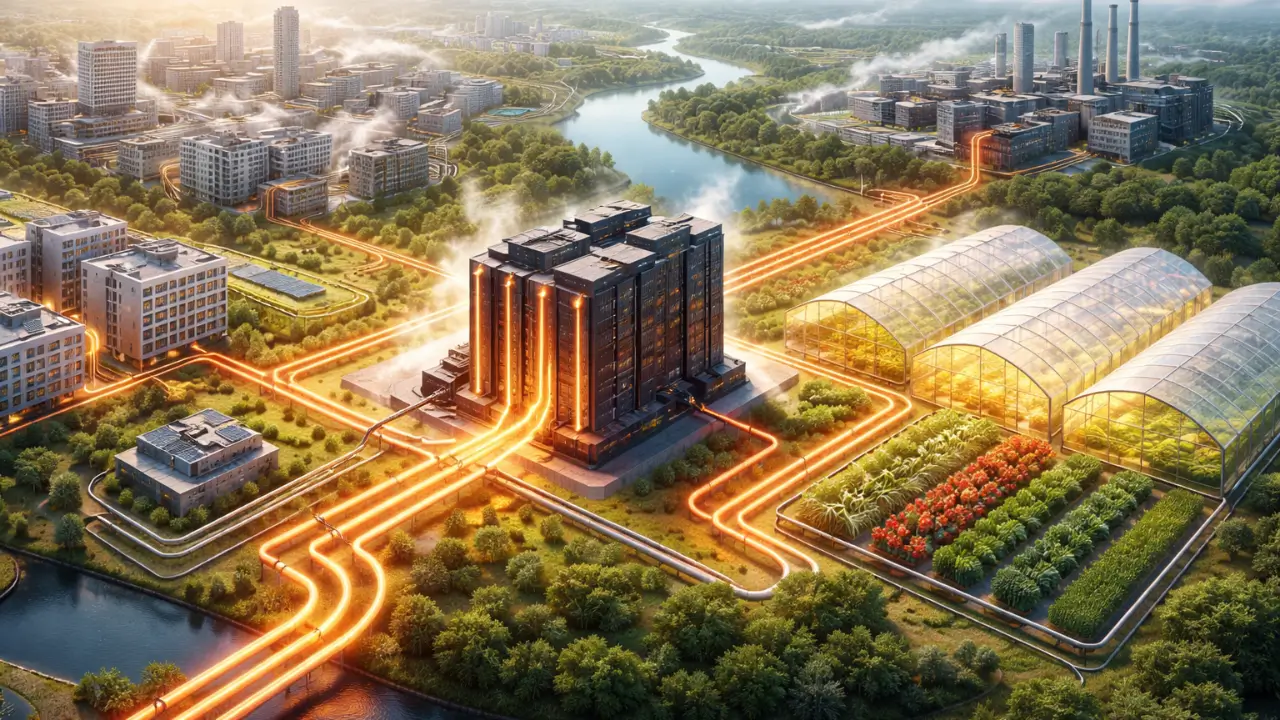
Digital infrastructure expands across metropolitan and industrial landscapes with an intensity that mirrors the acceleration of cloud computing, artificial intelligence, and distributed services. Servers process vast volumes of information, and in doing so they release consistent thermal output that traditionally exits facilities as exhaust. Facility operators historically treated that thermal output as a liability to manage through chillers, cooling towers, and airflow engineering. Energy strategies focused primarily on maintaining optimal inlet temperatures rather than examining the systemic role of heat beyond containment. However, a growing body of research and infrastructure pilots now reframes this thermal stream as a structured energy asset embedded within the built environment. This evolution signals the growing importance of regenerative heat integration in data centers as a defining principle of next-generation infrastructure strategy.

Thermal energy generated inside data centers remains continuous, predictable, and geographically fixed, which distinguishes it from intermittent renewable flows. Architects and mechanical engineers increasingly evaluate this output as a steady-state stream that can circulate through adjacent systems rather than dissipate into the atmosphere. Policy bodies have emphasized waste heat reuse as part of broader decarbonization pathways within energy system integration strategies. Infrastructure developers now analyze exergy levels, temperature gradients, and flow stability as design inputs for cross-sector planning. Urban planners begin to map digital infrastructure alongside district energy corridors, recognizing spatial alignment opportunities that previously escaped attention. This transformation reflects a technical evolution rather than a rhetorical one, grounded in thermodynamics and networked system design.
Rethinking Heat as a Living Energy Stream
Data centers operate as thermal ecosystems where power consumption converts directly into structured heat patterns across racks, containment aisles, and coolant loops. Engineers have begun to interpret that pattern not as random dissipation but as a managed, directional flow that mirrors fluid dynamics within industrial plants. Industry research outlines how modern facilities maintain predictable thermal envelopes through advanced airflow modeling and liquid cooling strategies. Designers can therefore treat that envelope as a controllable energy channel rather than a residual burden. Heat emerges from processors with measurable temperature profiles that enable capture, modulation, and transfer into adjacent loops. This perspective transforms exhaust air and warmed coolant into components of an extended thermal chain embedded within regional infrastructure.
Digital infrastructure no longer stands isolated from surrounding energy systems when planners adopt this lens. Thermal output aligns with the concept of sector coupling described by energy system analysts who advocate integration between electricity, heating, and industry. Facility operators increasingly collaborate with utilities to evaluate return temperatures, distribution distances, and seasonal balancing strategies. Technical teams assess how primary cooling circuits can interface with secondary heat exchange networks without compromising uptime. Design simulations model the cascading transfer of energy across boundaries that once appeared fixed. This reframing positions data centers as active nodes in a distributed thermal grid rather than endpoints of electrical consumption.

Designing for Circulation, Not Dissipation
Architectural planning now incorporates heat capture corridors at the earliest conceptual stages of site development. Mechanical engineers specify plate heat exchangers, buffer tanks, and low-temperature distribution loops that assume outward flow from day one. Technical guidance highlights the compatibility of higher operating temperatures with efficient heat recovery configurations. Designers align server inlet tolerances with recovery objectives to maintain reliability while enabling thermal export. Integrated layouts position heat exchange equipment adjacent to perimeter boundaries where district networks can connect seamlessly. This approach embeds circulation logic directly into the structural DNA of the facility.
Cooling technologies such as liquid immersion and rear-door heat exchangers further elevate the quality of recoverable heat. Fluid-based systems concentrate thermal energy at higher temperatures compared to traditional air cooling, which enhances reuse potential. Industry documentation shows how liquid cooling architectures enable more efficient heat capture pathways. Engineers can route warmed coolant through closed-loop circuits that interface with external distribution lines. Infrastructure planning thus shifts from managing rejection to orchestrating transfer across controlled gradients. Consequently, dissipation ceases to define the endpoint of thermal management strategies.
The Urban Exchange: When Data Centers Warm Cities
Urban density creates proximity between digital facilities and residential or mixed-use developments that require stable heating sources. District energy systems already circulate hot water through insulated pipelines that interconnect buildings across neighborhoods. Industry documentation shows how centralized thermal networks improve efficiency through shared infrastructure. Data centers located within or near these grids can inject captured heat into return loops that feed housing complexes and commercial spaces. Engineers coordinate supply temperatures and flow rates to ensure compatibility with existing substations. This arrangement establishes a reciprocal relationship between digital processing and urban habitation.
City planners increasingly integrate data centers into master plans that anticipate long-term energy interdependencies. Municipal energy strategies in Northern Europe illustrate how co-location of digital infrastructure and district heating strengthens system resilience. Project developers negotiate connection agreements that define thermal delivery parameters alongside electrical interconnection terms. Operators maintain service level commitments while exporting surplus heat under controlled conditions. Moreover, this configuration embeds digital facilities into the thermal rhythm of surrounding districts without disrupting operational security. Urban exchange therefore evolves from isolated pilot projects into structured infrastructure alignment.
Cultivating Growth: Heat in Agricultural Ecosystems
Controlled-environment agriculture depends on stable thermal conditions to sustain plant growth across seasonal cycles. Greenhouse operators regulate air and soil temperatures to optimize yield and maintain predictable production schedules. Research highlights the role of energy management in greenhouse efficiency. Data centers provide a consistent source of low-grade heat that can circulate through hydronic systems beneath cultivation beds. Engineers calibrate heat exchange interfaces to match agricultural requirements without imposing volatility. This cross-sector design aligns digital output with biological processes in a coordinated manner.
Agricultural integration requires careful synchronization between thermal supply profiles and crop cycles. Operators deploy heat pumps and buffer storage to adjust temperature levels when direct transfer does not meet horticultural thresholds. Research demonstrates how residual heat streams can support greenhouse ecosystems under controlled conditions. Facility planners collaborate with agronomists to define boundary conditions that protect both server uptime and plant health. However, coordination frameworks increasingly reflect mutual benefit rather than opportunistic reuse. Thermal exchange thus supports a shared energy logic between computation and cultivation.
Industrial Symbiosis and the Rise of Shared Energy Loops
Manufacturing facilities often require steady heat inputs for drying, washing, or low-temperature processing stages. Industrial symbiosis frameworks encourage companies to exchange byproducts to reduce overall system waste. Circular economy frameworks outline principles that promote cross-sector resource sharing. Data centers situated within industrial parks can route captured heat into adjacent process lines through insulated pipelines. Engineers evaluate temperature compatibility and flow continuity to ensure operational alignment. This configuration converts what once dissipated into ambient air into a structured industrial input.
Shared energy loops demand governance models that clarify ownership, reliability standards, and maintenance responsibilities. Industrial partners establish monitoring systems that track thermal delivery metrics in real time. Infrastructure contracts define contingency protocols to preserve uptime across interconnected facilities. Furthermore, digital control platforms coordinate valve operations and flow modulation to balance demand fluctuations. System architects design redundancy pathways that protect each participant from single-point disruptions. Industrial symbiosis therefore operates as an engineered ecosystem rather than an informal exchange.
From Byproduct to Backbone: The Emergence of Regenerative Infrastructure
Digital infrastructure now intersects with broader conversations about regenerative design within the built environment. Sustainability frameworks emphasize integrated resource cycles as a defining feature of next-generation infrastructure. Data centers occupy a strategic position because they anchor electrical demand while generating continuous thermal output. Engineers and planners increasingly embed heat reuse into corporate sustainability frameworks and capital allocation strategies. Select infrastructure investment frameworks, particularly those aligned with ESG-driven portfolios and municipal partnerships, have started to explore secondary energy flows alongside primary computing capacity where regulatory and market structures enable such integration.This mindset redefines value creation across interconnected systems.
Regenerative infrastructure demands coordination across utilities, municipalities, agricultural enterprises, and industrial operators. Stakeholders establish shared performance indicators that reflect thermal circulation rather than simple efficiency ratios. Digital twins and advanced analytics platforms monitor heat exchange performance across distributed networks. Policy frameworks evolve to support cross-sector energy transactions within regulated markets. Finally, the narrative surrounding data centers shifts from isolated energy consumers to integrated participants within circular economies. The future of digital infrastructure therefore rests not solely on reducing impact but on reintegrating energy streams into the systems that surround them.











