
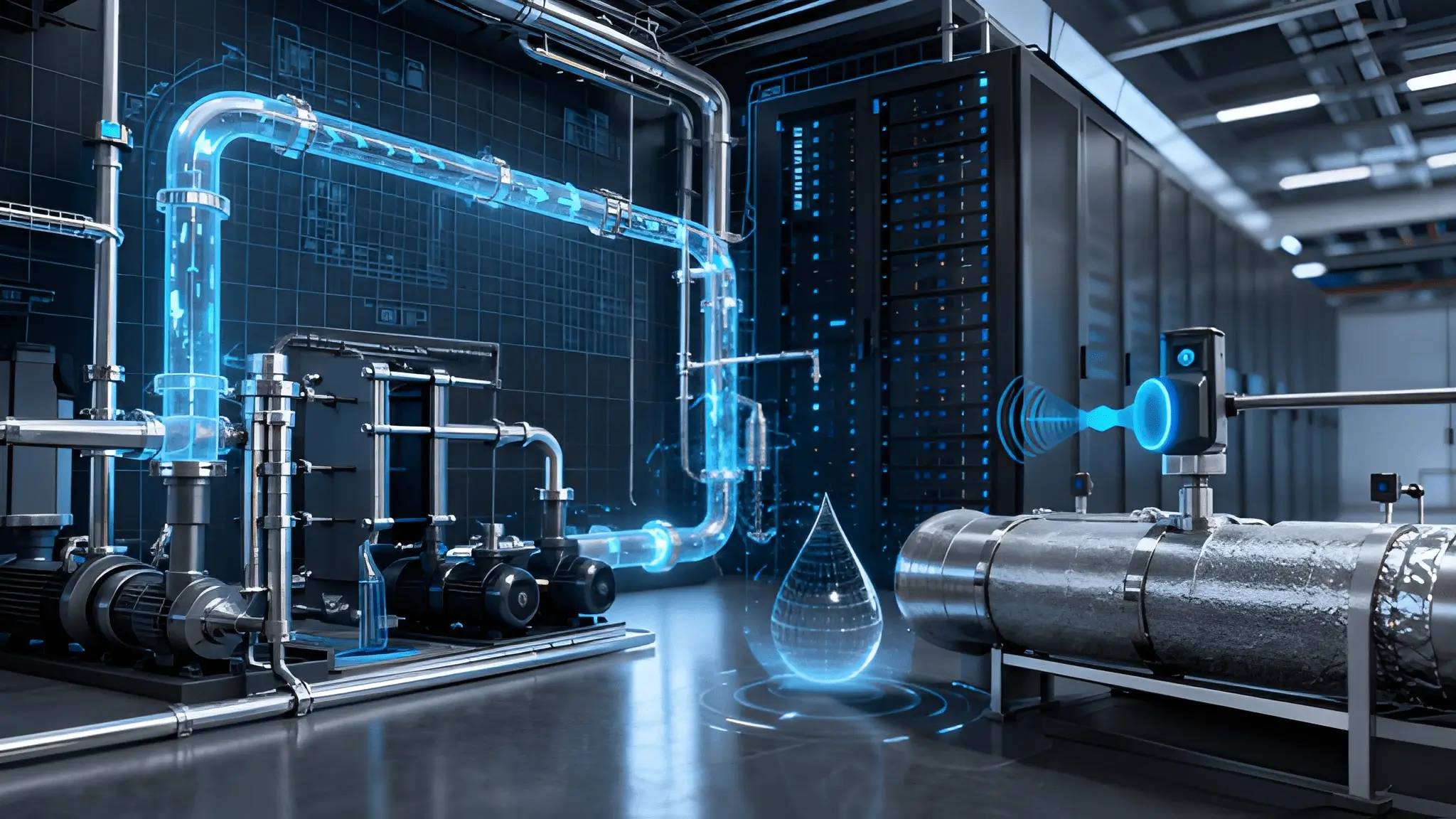
Water has traditionally influenced maintenance schedules, treatment systems, environmental reporting, and cooling decisions across the entire facility lifecycle. Removing nearly all operational water consumption reduces dependence on water treatment and makeup-water management while increasing operational emphasis on monitoring cooling system performance, fluid circulation, and mechanical reliability. Every discipline, from facilities operations to mechanical design and asset management, begins relying on different indicators once evaporation no longer dominates thermal management. Engineering discussions increasingly include circulation stability, thermal performance, and long-term equipment condition alongside reduced attention to water treatment infrastructure in facilities using closed-loop cooling systems. These operational changes require updated maintenance practices and monitoring strategies that extend beyond reporting improvements in water efficiency.

When Liters Become Liability: Rethinking Ops at Near-Zero WUE
Daily facility operations once revolved around tracking makeup-water consumption because evaporative systems continuously introduced fresh water into cooling infrastructure. Operators routinely compared replenishment volumes, blowdown rates, conductivity trends, and treatment efficiency to determine whether cooling assets performed within expected operating ranges. Near-zero operational water use substantially reduces recurring makeup-water measurements while increasing the importance of monitoring circulation integrity, hydraulic balance, equipment condition, and thermal performance. Mechanical teams begin evaluating pump efficiency, pressure consistency, fluid cleanliness, and heat exchanger effectiveness rather than focusing on refill schedules and treatment chemical inventories. Maintenance planning gradually becomes less dependent on water deliveries and increasingly aligned with predictive diagnostics generated from continuously monitored mechanical systems. Facility monitoring platforms increasingly combine resource-efficiency metrics with performance indicators that reflect equipment condition throughout the cooling loop.
Operational reporting also changes because sustainability measurements no longer depend primarily on annual water withdrawal figures that fluctuate with weather conditions or seasonal demand. Operational performance reviews commonly include thermal efficiency, equipment availability, pressure stability, sensor accuracy, and cooling system responsiveness alongside resource-efficiency measurements. Engineering teams develop maintenance routines that verify flow quality, monitor pressure deviations, inspect valve behavior, and evaluate circulation performance before thermal anomalies develop into operational concerns. Maintenance personnel spend less time coordinating chemical deliveries and considerably more time interpreting instrumentation that reflects conditions inside sealed mechanical systems. Reliability therefore depends increasingly on the accuracy of digital monitoring rather than visual confirmation from exposed cooling infrastructure or open treatment equipment. Facility management ultimately shifts from documenting resource consumption toward validating whether every component continues operating inside tightly controlled engineering tolerances over extended service periods.
Closed-Loop Chemistry: The New Failure Mode You Can’t Smell
Closed-loop cooling systems eliminate continuous exposure to outside contaminants, yet they introduce a different set of engineering responsibilities that remain largely invisible during normal operation. Stable fluid chemistry slows several degradation mechanisms associated with open evaporation, although even minor contamination can persist much longer inside a sealed circuit without obvious visual evidence. Engineers therefore monitor conductivity, dissolved oxygen, inhibitor concentration, particle counts, and fluid quality with greater precision because small deviations may remain isolated within the loop for extended periods. Visual inspections become less informative in fully enclosed cooling circuits because many operating conditions require confirmation through instrumentation and fluid analysis. Maintenance strategies increasingly depend on calibrated sensors capable of identifying gradual chemical drift before it influences pump performance, heat transfer efficiency, or component longevity. The operational challenge shifts from recognizing visible water quality issues to interpreting subtle trends hidden within continuously collected instrumentation data.

Corrosion behavior also changes because sealed systems maintain relatively consistent environmental conditions instead of experiencing repeated exposure to fresh oxygen through evaporation and makeup water. Stable chemistry generally reduces scaling potential, yet localized corrosion, inhibitor depletion, contamination during maintenance activities, or incompatible materials can still create reliability risks if operators overlook long-term fluid integrity. Biological growth becomes less likely inside properly maintained closed systems, although stagnant sections, commissioning contamination, or unexpected microbial introduction still require disciplined monitoring and validated treatment practices. Engineers routinely verify sensor calibration alongside laboratory analysis because inaccurate instrumentation can reduce confidence in cooling system chemistry measurements. Maintenance teams spend more effort validating digital measurements than responding to obvious visual deterioration because the earliest indicators frequently appear as unexpected sensor behavior rather than physical deposits.
The Materials Memo: What Water-Neutral Does to Your Pipe Spec
Material selection requires careful evaluation when cooling circuits operate as closed systems because long-term compatibility, durability, and fluid chemistry remain important design considerations. Designers evaluate compatibility across the entire hydraulic system because long-term chemical stability places greater emphasis on how metals, elastomers, seals, coatings, and engineered polymers interact over many years of uninterrupted service. Stainless steel often remains attractive for critical applications requiring corrosion resistance and mechanical durability, yet advanced thermoplastics and composite piping can offer compelling advantages where operating temperatures, pressures, and fluid chemistry remain carefully controlled. Material specifications place greater emphasis on permeability, chemical compatibility, pressure performance, and long-term dimensional stability within controlled closed-loop operating conditions. Welding procedures, gasket compounds, joining methods, and expansion characteristics receive additional scrutiny because replacing failed components inside sealed infrastructure creates operational disruption that outweighs modest material savings. Engineering decisions commonly evaluate lifecycle reliability alongside operating conditions, maintenance requirements, and long-term material compatibility.
Stable closed-loop chemistry allows engineers to evaluate piping materials under more consistent operating conditions than systems that rely on continuous evaporation and makeup water. Engineers compare thermal expansion characteristics, pressure ratings, fatigue resistance, maintenance accessibility, and expected service life rather than focusing primarily on mineral scaling or aggressive water treatment requirements. Seal materials receive greater attention because elastomer compatibility directly influences long-term leak prevention inside continuously pressurized closed circuits where fluid loss should remain exceptionally low. Procurement teams increasingly evaluate supplier consistency, traceability, fabrication quality, and installation practices because failures frequently originate from connection details instead of base material limitations. Furthermore, commissioning procedures become more rigorous since contaminants introduced during construction may remain inside the loop unless carefully removed before full operation begins. Material specifications ultimately reflect an engineering philosophy centered on preserving stable operating conditions rather than continuously correcting changing water characteristics after the facility enters service.
Air’s Revenge: When Humidity Takes Over as the Silent Killer
Reducing operational water consumption shifts engineering attention toward atmospheric conditions that previously received less operational scrutiny inside cooling environments. Humidity control remains a critical reliability factor because condensation can develop wherever surface temperatures fall below the surrounding air’s dew point. Mechanical teams therefore spend more time validating air distribution, containment integrity, insulation performance, and environmental monitoring than managing water treatment infrastructure. Even small variations in humidity control may create localized condensation around chilled distribution equipment, pipe penetrations, cable pathways, or structural interfaces if airflow patterns change unexpectedly. Equipment reliability increasingly depends on maintaining stable psychrometric conditions instead of compensating for fluctuating evaporative cooling performance through additional water treatment measures. Facility operators gradually recognize that eliminating one operational dependency simply elevates another engineering discipline into a critical reliability function.
Environmental monitoring consequently becomes more granular because average room humidity provides limited insight into localized conditions surrounding high-density compute infrastructure. Engineers deploy additional sensing near supply air paths, containment boundaries, overhead services, and return air zones to detect subtle deviations before condensation risks materialize. Air balancing routines receive greater operational priority because uneven airflow can produce isolated thermal pockets even when overall facility conditions remain within specification. Mechanical maintenance schedules increasingly include insulation inspections, vapor barrier verification, and calibration checks for humidity instrumentation alongside conventional HVAC servicing activities. Operational planning also considers seasonal weather transitions more carefully because outdoor air characteristics directly influence internal environmental stability through ventilation and heat rejection systems. Reliable performance ultimately depends on understanding moisture behavior in the air rather than concentrating almost exclusively on water circulating inside cooling infrastructure.
The Hall You Design After Water Disappears
Engineering priorities change as facilities reduce dependence on replenishment schedules, chemical deliveries, blowdown management, and routine water treatment activities through closed-loop cooling designs. Maintenance workflows place greater emphasis on monitoring systems, circulation equipment, and diagnostic infrastructure as facilities reduce reliance on water treatment operations. Designers can evaluate equipment layouts around service accessibility, inspection routes, and operational efficiency while accounting for the reduced infrastructure requirements of closed-loop cooling systems. Teams also develop different maintenance habits as digital condition monitoring replaces many traditional inspection routines that depended on observing visible water behavior. Facility operations increasingly rely on validated engineering data and continuous monitoring to support maintenance planning and system performance evaluation. Buildings designed around these principles reflect a maintenance philosophy that favors prediction, stability, and controlled operating conditions over continuous intervention.
Long-term facility planning also benefits from a broader understanding of how resource independence influences reliability beyond sustainability reporting alone. Mechanical decisions increasingly integrate materials engineering, environmental control, instrumentation strategy, and lifecycle maintenance into a unified operating model that supports predictable performance over extended service periods. Reducing operational dependence on evaporation increases the importance of precise monitoring, environmental control, and disciplined maintenance within closed-loop cooling systems. Finally, organizations that recognize this shift can build operating procedures reflecting measurable engineering behavior instead of historical maintenance assumptions inherited from conventional cooling architectures. Strategic investments can improve operational consistency, maintenance efficiency, infrastructure resilience, and environmental performance when supported by appropriate engineering practices. Facilities designed around these principles provide a structured engineering framework that supports scalable compute deployments while maintaining disciplined operational control throughout the asset lifecycle.











