
Executive Summary
The rapid maturation of generative artificial intelligence and the rise of large language models have transformed the physical and economic landscape of modern data centers. At the core of this shift lies a critical thermal challenge: the energy density of modern AI accelerators exceeds the capacity of traditional air-based cooling systems. This report provides a technical analysis of innovations redefining thermal management, moving cooling from a secondary facility concern to a key enabler of computational performance and infrastructure sustainability.
The central thesis of this analysis argues that air cooling for high-performance computing (HPC) has reached its limit. Modern GPUs now reach thermal design power (TDP) thresholds of 1,000 watts per chip, with projections climbing toward 4,400 watts. As a result, the industry increasingly adopts liquid-based solutions. Innovations like direct-to-chip cooling with 3D jet-channel microstructures can manage localized heat fluxes exceeding 600 W/cm^2. Meanwhile, pumped two-phase systems use the latent heat of vaporization to reduce cooling energy consumption by up to 82%.
Integration of artificial intelligence into cooling control is also enabling a shift from reactive to predictive thermal management. Systems such as the LC-Opt framework, modeled on the Frontier supercomputer, apply multi-agent reinforcement learning to optimize cooling tower and server-level valve actuation. These systems can cut carbon footprints by as much as 24%. Beyond the rack, this report examines broader facility impacts, including modular AI factory designs and the integration of data centers into urban district heating networks through waste heat recovery in countries like Finland and Sweden. Together, these trends suggest a future in which data centers act as thermally integrated, intelligent components of the global energy grid.
The Thermal Landscape: Why AI Cooling Matters
The shift from general-purpose CPUs to massively parallel AI accelerators has created a vertical spike in power consumption and thermal density. Legacy server racks consumed between 5 kW and 15 kW, whereas modern AI clusters now require between 40 kW and 120 kW per rack. This growth results from the need for higher transistor density and interconnect bandwidth to train models with trillions of parameters.
Architectural Trends and Power Consumption
Modern AI accelerators, including the NVIDIA Blackwell B200 and AMD Instinct MI300 series, contain hundreds of billions of transistors in complex chiplet-based designs. For example, the NVIDIA B200 packs 208 billion transistors across a dual-die configuration with a 10 TB/s interconnect. This high transistor count, combined with HBM3e memory and high-speed NVLink, drives unprecedented TDP levels.
Power requirements have risen steadily, from the NVIDIA A100 (400W) to the H100 (700W) and now the B200 (1,000W). Future architectures like NVIDIA Rubin may reach 1,800W by 2026, while theoretical designs such as NVIDIA Feynman could hit 4,400W.
As accelerators approach 2,000 watts and beyond, heat density becomes a major constraint. Certain silicon regions generate more heat than the average TDP, creating hotspots that risk thermal throttling or mechanical failure if not cooled precisely. Traditional air cooling, which moves heat into ambient air, cannot manage these densities without extreme fan speeds and air velocities.
The Physics of Heat Transfer Limitations
Air performs poorly as a cooling medium due to its low density and specific heat capacity. The convective heat transfer equation, Q = hA \Delta T, shows that heat removal (Q) depends on surface area (A), temperature difference (\Delta T), and the convective heat transfer coefficient (h).
In dense AI servers, surface area is limited by the chip and rack size. Raising the temperature difference requires chilling air to extreme levels, which consumes excessive energy and risks condensation. Therefore, systems increase h by speeding up fans. However, fan power rises cubically with air velocity (P \propto v^3). Doubling air speed increases power consumption eightfold.
For architectures like Blackwell or Rubin, fan power alone could add 30% to 60% to a rack’s total consumption. This creates an air-cooling wall where energy, noise, and vibration costs become unsustainable at scale.
Implications for Data Center Design and PUE
High-TDP accelerators are forcing operators to rethink Power Usage Effectiveness (PUE). Historically, a PUE of 1.5 was acceptable, meaning that 0.5 watts were spent on cooling for every watt delivered to IT equipment. For exascale AI, such inefficiency is no longer viable.
As rack densities exceed 40 kW, traditional CRAC and CRAH units struggle to provide uniform cooling. Some GPUs become overcooled while others throttle due to hot air recirculation. These inconsistencies prolong training times and slow inference, reducing the ROI of AI projects. Consequently, the industry is adopting liquid-to-the-chip architectures that aim for a PUE of 1.2 or lower, directing almost all power to computation rather than cooling.
Liquid Cooling: Direct-to-Chip and Two-Phase Innovations
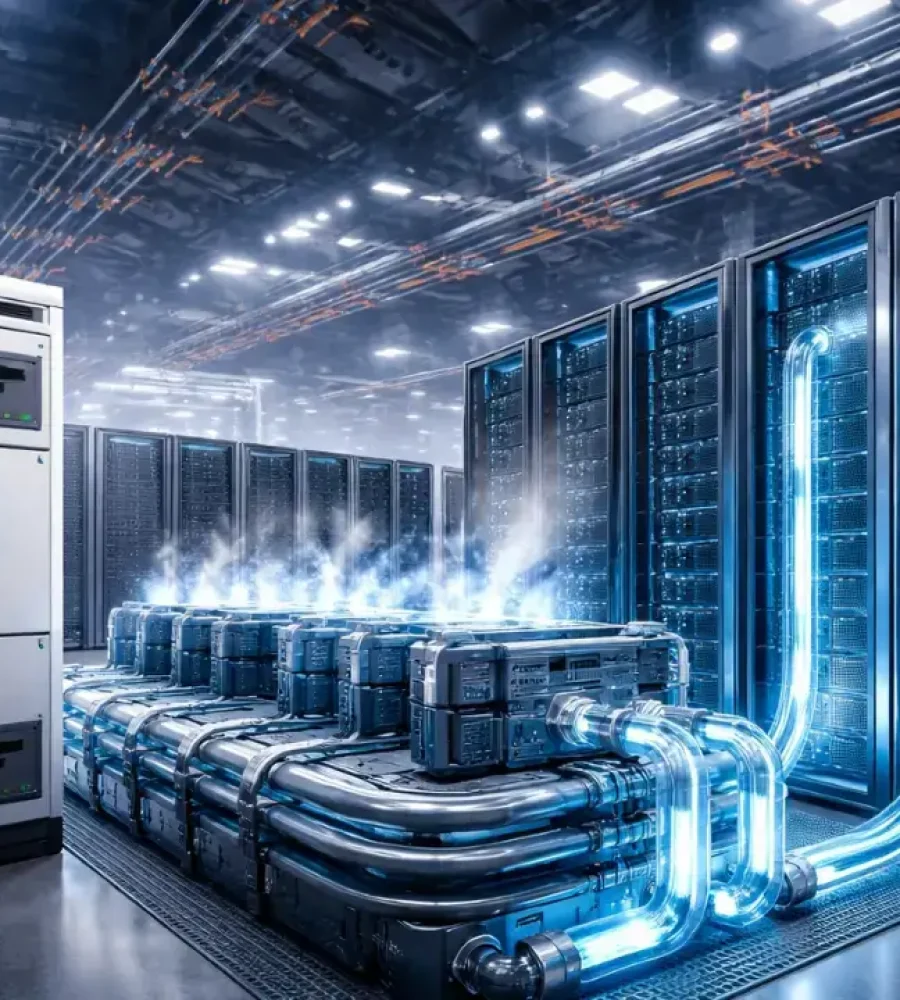
Liquid cooling has become the standard for managing the thermal loads of next-generation AI silicon. By using fluids with higher thermal conductivity and heat capacity than air, these systems remove heat at the source with far greater efficiency.
Direct-to-Chip (D2C) Coldplate Mechanics
Direct-to-chip cooling mounts a liquid-cooled coldplate, typically made of high-conductivity copper, directly onto the processor. A coolant distribution unit (CDU) circulates fluid through the coldplate, which contains internal microchannels to maximize surface area for heat exchange.
A notable innovation is the LiquidJet coldplate developed by Frore Systems. Traditional coldplates use skived 2D microchannels that are several centimeters long, creating high hydraulic resistance and pressure drops. LiquidJet addresses this by using semiconductor manufacturing techniques to etch 3D short-loop jet-channel microstructures into metal wafers.
This 3D design delivers coolant directly to GPU die hotspots, reducing pressure loss fourfold (from 0.94 psi to 0.24 psi). On the NVIDIA Blackwell Ultra, LiquidJet supports hotspot densities of 600 W/cm² and reduces temperatures by 7.7°C compared to standard solutions. The result is higher tokens-per-second performance, 75% greater heat removal efficiency per liter of flow, and a 50% lighter coldplate.
Pumped Two-Phase (P2P) Systems
Single-phase liquid cooling relies on the fluid’s sensible heat. Pumped two-phase cooling, however, uses the latent heat of vaporization through flow boiling. In a P2P system, a refrigerant passes through coldplates at a pressure that allows it to boil while absorbing heat from the chip.
The phase change occurs at a constant temperature, creating highly efficient heat transfer. This method offers cooling energy savings of up to 82% compared to air-cooled approaches. Because boiling maintains a uniform temperature, the GPU surface experiences minimal thermal stress. CDUs in P2P systems can respond to rapid IT load changes (0–100%) by regulating refrigerant pressure between 2 and 32 PSID, preventing dry-out, which happens when liquid becomes superheated and loses cooling efficiency.
Vertiv has demonstrated Refrigerant-to-Air (R2A) CDUs that deliver up to 40 kW of cooling in a standard 600 mm rack. This approach allows air-cooled data centers to transition to high-density liquid-cooled servers without a complete facility redesign.
Immersion Cooling: Single and Two-Phase
Immersion cooling submerges the entire server in a non-conductive dielectric fluid. This eliminates the need for coldplates and fans, as the fluid contacts every component directly.
In single-phase immersion, a pump circulates the fluid through a heat exchanger. In two-phase immersion, the fluid boils on component surfaces, and the vapor condenses via a cooling coil at the tank’s top. Immersion cooling suits hyperscalers because it captures all server heat, including from VRMs and optical interconnects that coldplates often miss.
Partnerships such as ExxonMobil and Infosys are advancing immersion fluids. By combining ExxonMobil’s thermally conductive dielectric fluids with Infosys’s Topaz AI platform for real-time optimization, operators can reach PUE values as low as 1.03 while supporting rack densities exceeding 100 kW.
Microfluidic and On-Chip Cooling Breakthroughs
The most advanced thermal management research moves cooling from the chip’s exterior directly into the silicon. This approach eliminates the thermal resistance caused by layers between the transistor and the coolant, such as the silicon substrate, thermal interface material (TIM), and copper spreader.
Microfluidics Embedded in Silicon
Microsoft has developed a method that etches microfluidic channels directly into the silicon die’s backside. This brings liquid coolant within micrometers of active circuits.
Laboratory tests show this technique can reduce maximum GPU silicon temperatures by 65% and outperform conventional coldplates by three times. AI-optimized channel geometries guide the fluid to high-heat regions, enabling dissipation of more than 1 kW/cm². This handles 2–3 times the heat flux of standard coldplates and allows significant overclocking without risk of chip overheating.
Topology-Optimized Designs: Glacierware
Microchannel design now goes beyond simple parallel lines. The Glacierware project uses topology optimization to create microfluidic networks tailored to a chip’s specific power map. An adjoint-based sensitivity analysis iteratively refines channel structures over roughly 200 iterations to minimize maximum junction temperatures.
These designs often resemble biological systems, such as arterial branches or leaf veins. High-heat areas feature small, densely packed fins to maximize heat transfer. Cooler areas use larger, sparsely packed channels to reduce pressure drop and conserve pumping energy. Evaluations show these designs achieve 13% lower temperature rise or 55% lower pressure drop than the best straight-channel designs.
Hybrid Chip-Level Thermal Strategies
Emerging approaches combine microfluidics with traditional systems for multi-layer thermal management. A chip may include embedded microchannels for primary compute dies while using a coldplate for peripheral HBM stacks. Researchers are also exploring embedded heat pipes and vapor chambers integrated during manufacturing, providing high-conductivity paths to external cooling without increasing chip height.
AI-Assisted Cooling Control and Smart Operations
Managing complex liquid cooling requires more than static rules; it requires dynamic, intelligent control. AI now optimizes the infrastructure supporting AI computing.
Reinforcement Learning and the LC-Opt Framework
Liquid cooling systems consist of interconnected components, including cooling towers, pumps, heat exchangers, and thousands of server blades. Traditional rule-based controls, such as ASHRAE Guideline 36, often fail to account for dynamic AI workloads.
Oak Ridge National Laboratory (ORNL) developed LC-Opt, a benchmarking framework using reinforcement learning (RL) to manage liquid cooling. Built on a high-fidelity digital twin of the Frontier supercomputer, LC-Opt allows RL agents to optimize global cooling tower setpoints, CDU flow rates, and fine-grained valve actuation.
Benchmark tests show multi-agent RL policies reduce carbon footprints by 24% and cooling tower power by 21% compared to standard controls. Agents maintain 92.6% thermal compliance even when scaled to larger, unseen systems, whereas traditional methods experience performance collapse.
IoT and Predictive Maintenance
IoT sensors in cooling loops provide real-time infrastructure monitoring. Temperature, humidity, and flow-rate data feed AI models that forecast potential failures.
For example, a predictive model might detect a minor pressure drop in a secondary loop, signaling a micro-leak that could damage hardware. Operators can shift workloads and schedule maintenance hours or days in advance, preventing energy waste and unplanned downtime.
System and Data Center Architecture Implications
High-density cooling is reshaping data center layouts, moving from large, air-filled halls to modular, liquid-centric “AI factories.”
Rack and Facility Design Evolution
Advanced cooling supports higher compute density. A GIGABYTE GIGAPOD cluster, for instance, reduces from nine racks to five when moving from air to direct liquid cooling (DLC). This densification requires higher floor load capacity to support liquid-cooled racks and heavy piping. Many facilities use hybrid approaches, combining DLC for primary compute nodes with rear-door heat exchangers (RDHx) or in-row cooling for secondary heat sources.
Energy Efficiency and Waste Heat Reuse
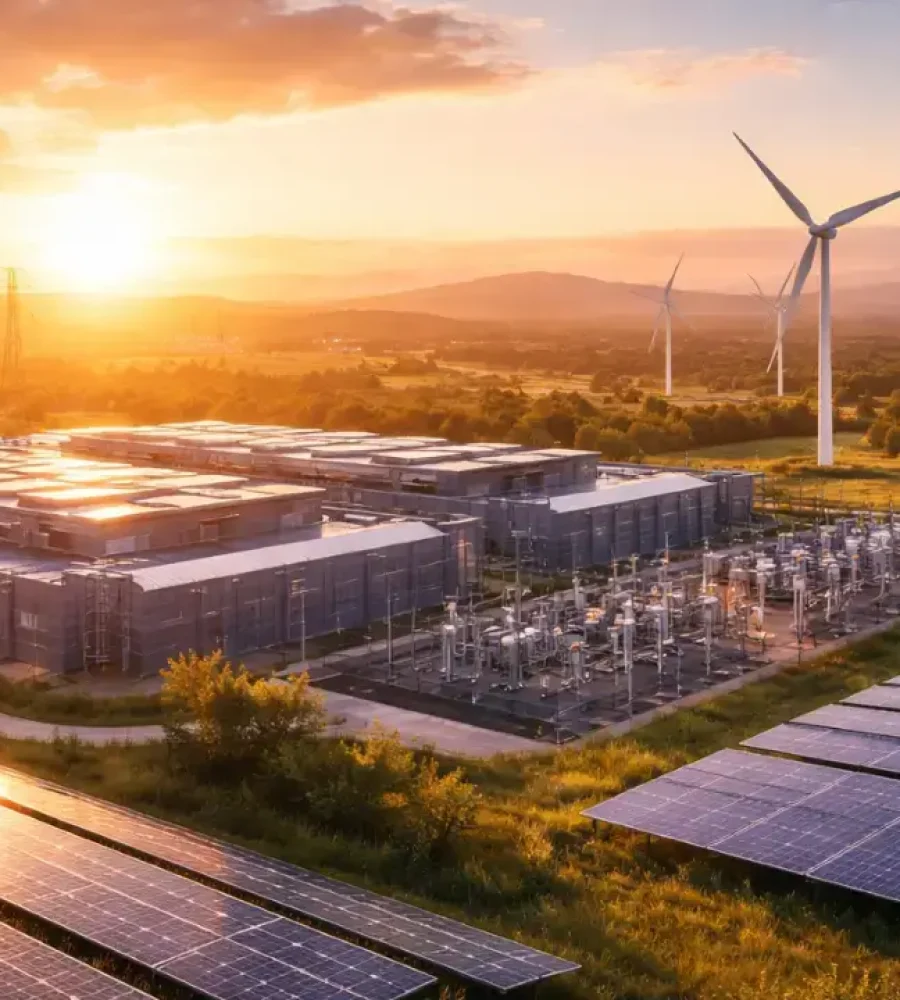
Liquid cooling enables waste heat reuse. Coolants capture heat more efficiently than air, producing temperatures suitable for secondary applications. In Espoo, Finland, Microsoft’s data center region provides district heating to the city. Google’s Hamina data center meets 80% of local annual heat demand, while Stockholm Data Parks targets zero-waste heat networks, converting roughly 81% of electricity consumption into usable heat for homes and industries.
Retrofit Challenges and Standards
Upgrading legacy air-cooled data centers for liquid cooling is challenging. Older facilities may lack structural integrity for heavy racks, plenum depth for new piping, or space for secondary CDUs.
Material compatibility is also critical. In direct-to-chip systems, incompatible metals in coolant can cause galvanic corrosion, producing debris that clogs microchannels and damages IT equipment. Operators must follow strict maintenance protocols, including biocide additives to prevent microbial growth in stagnant coolant lines.
Future Directions and Emerging Research
As AI workloads expand, researchers are pushing the limits of physics to find even more efficient heat management solutions.
Next-Gen Materials: Nanofluids and Composites
The industry is moving beyond standard water-glycol coolants toward nanofluids, colloidal suspensions of nanoparticles such as TiO_2 or graphene. These fluids exhibit unusually high thermal conductivity even at low concentrations. They can significantly improve convective heat transfer coefficients in microchannels. Researchers are using AI and machine learning to predict thermophysical properties and optimize fluid compositions for specific data center applications.
Bioinspired and Adaptive Cooling
Building on topology optimization, research now explores adaptive cooling systems inspired by nature. Some systems use shape-memory materials that alter channel geometry in response to temperature changes, effectively self-regulating coolant flow to hotspots. Other bio-inspired approaches include fractal cooling networks that branch like leaf veins. These designs distribute fluid more efficiently and reduce energy needed to overcome hydraulic resistance.
Alternative Paradigms: Phonons and Acoustic Management
Researchers are also exploring phonon-based computing, where information travels via vibrational modes rather than electrons. Since phonons carry heat in solids, a phonon-based system could manage its thermal state as part of its computational logic. Acoustic heat management is another emerging idea, using specific sound frequencies to control high-energy phonon modes.
Conclusion
Cooling technology has evolved from a peripheral concern to a cornerstone of AI infrastructure. As chips’ thermal design power grows from hundreds to thousands of watts, the innovations described in this report provide the thermal headroom necessary for the data age.
The shift to liquid cooling and intelligent, AI-driven thermal management enables higher performance, greater sustainability, and lower total cost of ownership. By transforming data centers into thermally efficient, integrated components of the energy grid, these solutions prevent AI growth from being throttled by its own heat. Over the next decade, the successful convergence of materials science, mechanical engineering, and digital twins will define the next generation of global compute infrastructure.