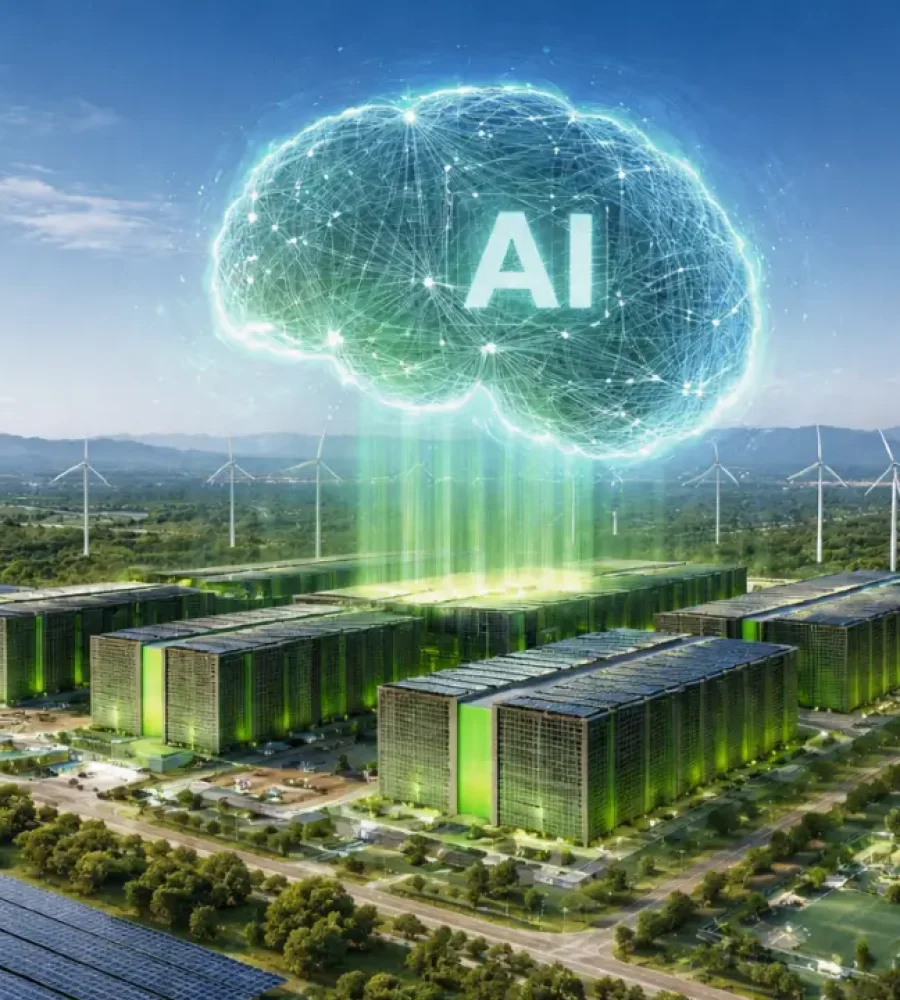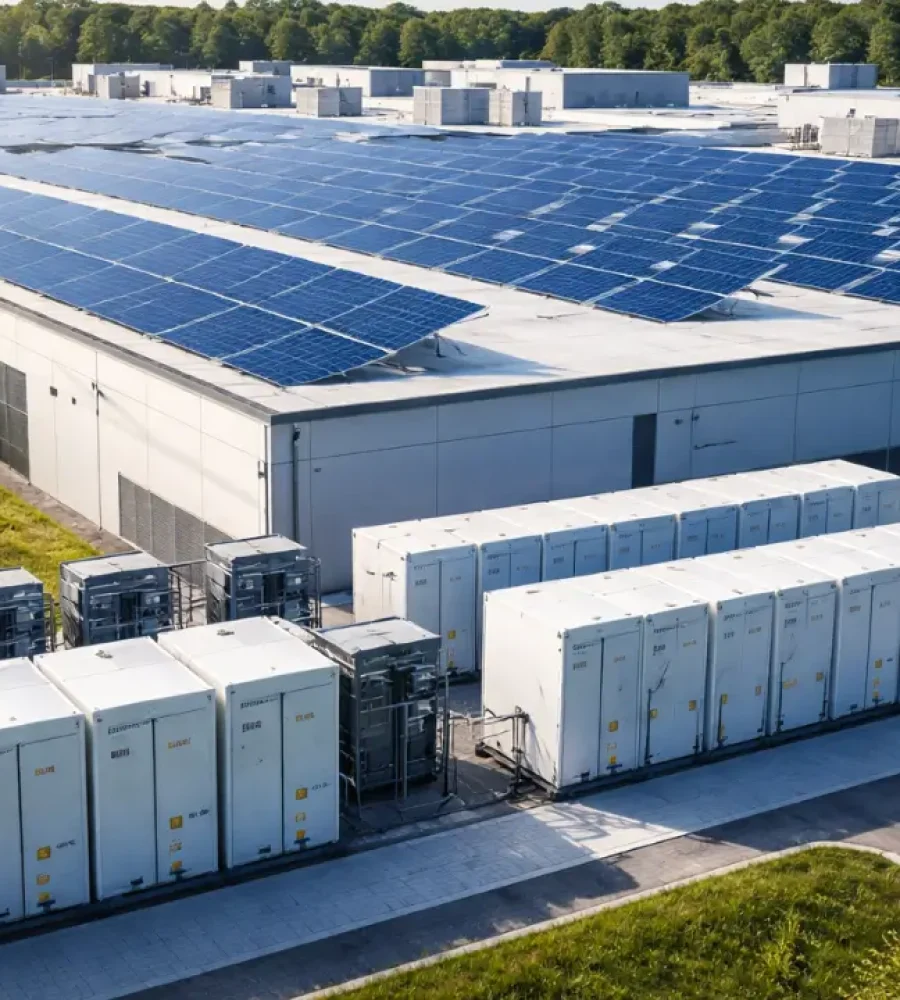

Colocation data centers are central to the global digital economy, and the shift toward clean energy colocation data centers is now becoming strategically essential. These facilities, where third-party providers host computing infrastructure and network connectivity for enterprises, cloud platforms, and digital services, support a rapidly growing share of workloads, especially those linked to artificial intelligence, machine learning, cloud services, and high-performance computing.
According to energy-system modeling by the International Energy Agency and analysts such as Gartner, electricity consumption from data centers is projected to more than double by 2030. Current demand stands at roughly 415 to 448 terawatt-hours. By the end of the decade, it could reach 945 to 980 terawatt-hours. AI-optimized servers and accelerated compute workloads drive much of this growth.
As a result, energy demand is rising at an unprecedented pace. In many markets, grids already face strain. Therefore, energy strategy now shapes operational risk, cost stability, and competitive positioning for colocation operators. Moreover, customers increasingly require credible sustainability performance. Large enterprises and hyperscale cloud providers now evaluate renewable sourcing and carbon transparency during vendor selection. Consequently, clean energy has is now an undeniable factor of commercial success.
At the same time, regulatory frameworks are tightening.
National and regional regimes are strengthening emissions reporting rules and expanding incentives such as renewable energy tax credits and renewable portfolio standards. These policies directly affect procurement costs and compliance obligations. Operators without clear clean energy strategies face rising regulatory exposure. In addition, they risk exclusion from major contracts and may experience valuation disadvantages compared with competitors that demonstrate decarbonized supply chains and energy resilience.
From an economic perspective, clean energy integration provides measurable advantages. Direct renewable power purchase agreements, on-site generation, grid-interactive storage, and advanced energy management systems reduce exposure to volatile electricity prices. Furthermore, these strategies unlock access to green financing and investment tax benefits. They also enhance long-term asset value. By adopting clean energy early, operators can stabilize operating costs and strengthen grid partnerships. Therefore, clean energy now functions as a core operational requirement across the colocation sector.
II. Colocation’s Unsustainable Growth Trajectory
A. The Scale and Velocity of Demand Growth
Colocation data centers have evolved from niche infrastructure into critical nodes within the global digital ecosystem. Their importance continues to grow as cloud-native architectures expand and AI workloads intensify. Unlike enterprise data centers, which primarily serve internal systems, colocation facilities host a diverse customer base. This shared model concentrates energy demand within dense physical locations. As a result, it influences power planning, infrastructure investment, and environmental outcomes.
The International Energy Agency projects that global data center electricity demand will grow at approximately 15 percent annually through 2030. Under this trajectory, total consumption will approach 945 terawatt-hours by the decade’s end. Gartner projects a similar increase, estimating growth from about 448 terawatt-hours to nearly 980 terawatt-hours between 2025 and 2030. Notably, AI-optimized servers account for a large share of incremental demand. These systems require higher power density and advanced cooling, which amplifies their energy footprint.
Additional forecasts from organizations such as McKinsey and ABI Research present higher scenarios. In some projections, data center electricity use could reach 1,400 terawatt-hours by 2030. That level would represent about 4 percent of global power demand. The United States and China would likely experience especially strong impacts. Although estimates vary, the overall trend remains consistent. Without strategic intervention, data infrastructure will significantly influence regional power systems. Moreover, this growth coincides with rising global electricity demand, which intensifies pressure on grid expansion and decarbonization timelines.
B. Distinguishing Total and Local Energy Impacts
Aggregate projections tell only part of the story. Location-specific effects also matter. Colocation facilities often cluster in regions with strong connectivity and favorable regulations. Consequently, energy demand can concentrate in particular grid zones.
For example, Northern Virginia represents one of the world’s densest data center markets. There, facilities account for a substantial share of local electricity use. This concentration contributes to peak demand growth and infrastructure upgrades. In certain U.S. scenarios, data center consumption could reach 8 to 11 percent of national electricity demand by 2030. Some regional interconnections may experience even higher shares.
Internationally, similar dynamics appear. In Great Britain, studies have examined nearly 140 proposed data center projects. Together, these projects could require up to 50 gigawatts of new capacity. Such demand could approach or exceed current peak levels. Regulatory authorities have recognized this risk, especially as AI workloads expand.
In emerging markets, energy pressure can influence broader policy outcomes. In India, rapid data center growth has increased strain on existing grids. In some cases, it has slowed coal plant retirements due to capacity constraints. In Mumbai, expanding colocation activity has correlated with continued coal use and elevated local pollution. Therefore, energy strategy intersects with public health and industrial policy in meaningful ways.
These examples highlight an important distinction. The sustainability challenge involves both global emissions and localized grid impacts. Grid reliability, peak load stability, and regional air quality all form part of the equation. Consequently, operators must consider system-level effects, not only corporate carbon targets.
C. Colocation’s Dual Opportunity and Risk Profile
Unmanaged energy growth introduces operational risks. First, grid interconnection for large loads faces permitting delays and cost disputes. Utilities also confront community concerns when approving new capacity. In response, some regulators have expanded generation plans specifically to accommodate data center demand. For instance, approvals in Georgia included significant generation increases to support digital infrastructure expansion.
Second, reliance on fossil-heavy grids increases exposure to carbon pricing and regulatory penalties. It also raises vulnerability to price volatility. Therefore, long-term financial forecasting becomes more difficult. In contrast, operators that secure renewable contracts reduce exposure to market swings. They also improve energy resilience through distributed generation and storage.
At the same time, the transition creates strategic opportunity. Enterprises now prioritize sustainability in procurement decisions. As a result, operators with credible clean energy roadmaps gain competitive advantage. They improve success rates in procurement cycles and strengthen customer relationships. Additionally, participation in renewable contracts and grid services opens new revenue pathways. Clean energy thus enables both risk mitigation and market differentiation.
III. Competitive Forces and Customer Expectations
Competitive dynamics are transforming energy strategy in colocation markets. Customers increasingly evaluate sustainability alongside cost and reliability. Consequently, clean energy integration has become a central differentiator.
Customer ESG Requirements Drive Procurement Change
Many enterprises now embed environmental, social, and governance criteria into vendor selection. These requirements reflect internal net-zero commitments and external regulatory pressure. Customers must often disclose Scope 2 emissions from purchased electricity. Therefore, they demand measurable renewable sourcing and transparent reporting.
As expectations rise, operators without credible clean energy strategies risk losing contracts. Increasingly, customers seek carbon-neutral hosting options. They also request clear progress toward renewable targets. Moreover, enterprises expect more than offset-based claims. They prefer direct renewable deployment, 24/7 clean energy matching, and verified emissions data.
Advanced technologies support these expectations. On-site solar systems, battery storage, and green hydrogen solutions enhance operational flexibility. In addition, these tools strengthen sustainability performance and align with customer goals.
Hyperscale Influence and Procurement Power
Hyperscale cloud providers exert significant influence on colocation strategy. Companies such as AWS, Microsoft Azure, and Google Cloud integrate renewable requirements into procurement processes. They frequently issue requests for proposals that include carbon tracking and renewable sourcing criteria.
These hyperscalers have also signed long-term renewable power purchase agreements. As a result, they shape broader market standards. Colocation operators must align with these expectations to secure partnerships. In some regions, customers require 24/7 renewable matching through dispatchable contracts or virtual agreements. Consequently, smaller operators adapt procurement models and collaborate with renewable developers.
Brand Reputation and Market Differentiation
Beyond contracts, reputation influences financial performance. Investors increasingly evaluate climate commitments when allocating capital. Employees also consider sustainability performance when choosing employers. Therefore, transparent renewable strategies enhance credibility.
Operators that communicate clean energy roadmaps often attract stronger valuations and financing access. They may also form partnerships with sustainability-focused enterprises. In contrast, companies that delay adaptation risk being viewed as laggards. As the technology sector advances toward emissions targets, credibility becomes a competitive asset.
Market Evidence and Operational Trends
Industry surveys indicate steady growth in renewable energy adoption across colocation portfolios. Many operators expand long-term renewable power agreements to secure clean supply. Others explore 24/7 carbon-free frameworks that link generation directly to consumption.
Customers also demand real-time energy and emissions data. To meet this need, operators deploy smart meters, carbon dashboards, and integrated reporting tools. These systems connect with enterprise sustainability platforms. Consequently, transparency now extends beyond contractual language into daily operations.
Overall, competitive and customer pressures are reshaping the colocation energy model. Operators that integrate clean energy across procurement, reporting, and branding improve resilience and market position. Meanwhile, those that fail to adapt risk losing ground to competitors with stronger sustainability performance.
IV. Regulatory and Policy Environment
Although customer demand and competition strongly influence energy strategy, regulatory frameworks also accelerate clean energy adoption across the colocation sector. These frameworks operate at local, regional, national, and international levels. In addition, they connect emissions reporting, energy sourcing, and renewable integration to compliance obligations, incentives, and penalties.
Renewable Standards and Reporting Requirements
Renewable Portfolio Standards, Clean Energy Standards, and similar mandates require utilities or large consumers to source a defined share of electricity from renewable or low-carbon sources. These rules vary by jurisdiction. However, they directly shape procurement strategies in markets with ambitious 2030 targets and beyond.
In certain regions, such as parts of China, renewable targets extend specifically to data centers. For example, new facilities in national hub zones must procure a minimum share of green electricity in some cases. As a result, operators must integrate renewable sourcing to maintain compliance.
In the European Union, frameworks such as the Energy Efficiency Directive and the EU Taxonomy emphasize energy performance disclosure. These policies require reporting of key metrics, including Power Usage Effectiveness, renewable energy share, and waste heat reuse. While many measures begin with transparency requirements, they may evolve toward stricter performance thresholds aligned with decarbonization goals.
Incentives, Tax Credits, and Policy Accelerators
Governments also promote clean energy through incentives. These include renewable energy tax credits, accelerated depreciation, and grants for renewable and storage technologies. Consequently, financial barriers to adoption decrease, and investment timelines shorten.
In the United States, production tax credits and investment tax credits have lowered the cost of wind, solar, and storage projects. Therefore, they support long-term renewable power purchase agreements. These incentives improve project economics and encourage partnerships between developers and colocation operators.
Similarly, carbon pricing systems and emissions trading mechanisms in regions such as the European Union create direct financial costs for carbon-intensive electricity. As a result, fossil-based procurement becomes more expensive. Renewable sourcing therefore becomes increasingly competitive in total cost comparisons.
Industry Self-Regulation and Pact Agreements
Beyond government policy, industry-led agreements are shaping expectations. One example is the Climate Neutral Data Centre Pact, supported by European stakeholders. This initiative encourages operators to commit to carbon-free energy procurement and measurable efficiency improvements. Participants undergo independent audits to verify progress.
Although these agreements are voluntary, they influence industry benchmarks. They also shape investor expectations and customer evaluations. Furthermore, they contribute to policy discussions by demonstrating sector-wide commitments. Over time, such initiatives may inform more formal regulatory frameworks.
Compliance Risk and Market Access
Failure to align with emerging regulations can create compliance risks. Operators may face fines, delayed permits, or restricted expansion approvals. In some jurisdictions, regulators evaluate renewable plans before granting data center licenses. Therefore, operators without credible clean energy strategies may experience longer review cycles and higher compliance costs.
In regions where air quality and grid reliability remain sensitive issues, local authorities may impose additional scrutiny. Community stakeholders may also challenge projects that rely heavily on fossil-based grids. Consequently, regulatory alignment directly affects both operational continuity and public perception.
Geopolitical Variation and Regional Complexity
Regulatory conditions vary widely across regions. Europe emphasizes reporting and carbon pricing. China sets renewable targets tied to infrastructure planning. The United States presents a mix of federal incentives and state-level policies. In emerging markets such as India, sustainability provisions differ across states and development zones.
Because of this variation, global colocation operators must navigate complex compliance environments. Therefore, they integrate regulatory analysis into long-term energy planning. By doing so, they avoid reactive adjustments and reduce strategic uncertainty. Proactive compliance planning also strengthens competitive positioning.
V. Economic Imperatives: CapEx, OpEx, and Value Creation
Clean energy integration increasingly serves economic objectives as well as environmental goals. As renewable costs decline and financial markets prioritize sustainability, operators link energy strategy with cost control, asset value, and long-term growth. Consequently, clean energy functions as a financial lever rather than a peripheral initiative.
A. Cost Stability Through Clean Power Contracts
Electricity price volatility presents a major operational risk. Fuel costs, geopolitical disruptions, and demand surges can shift grid prices rapidly. In contrast, renewable power purchase agreements typically establish fixed pricing over long terms, often ranging from 10 to 25 years.
Under a standard PPA, a developer finances and operates a renewable facility. The colocation operator then purchases electricity at agreed rates. This structure reduces upfront capital needs and transfers construction risk to the developer. Additionally, virtual agreements allow operators to receive renewable energy credits without physical proximity to generation assets.
Because of these arrangements, operators improve budget predictability. They can forecast long-term expenses more accurately. As a result, financial planning becomes more stable, and lease pricing strategies become more consistent. Investors also value this predictability, since it supports steady cash flows and risk-adjusted returns.
B. Operational Savings and Efficiency Improvements
Clean energy adoption also generates operational benefits. Onsite renewable generation can reduce peak demand charges. These charges often represent a significant portion of total electricity costs in high-density facilities.
Energy management systems further enhance efficiency. For example, AI-driven platforms can balance workloads with renewable availability. Research indicates that dynamic management systems can reduce energy costs substantially when compared with traditional load approaches. By aligning consumption with renewable supply, operators minimize peak pricing exposure.
In addition, advanced cooling strategies can integrate with renewable systems. Improved thermal management reduces total energy consumption. Over time, these incremental gains compound across the lifecycle of a facility. Therefore, operational efficiency becomes a long-term cost advantage.
C. Access to Green Financing and Asset Valuation
Financial markets increasingly reward sustainability performance. Banks and institutional investors evaluate environmental metrics during underwriting. Consequently, facilities with renewable contracts and transparent reporting often secure favorable financing terms.
Green bonds and sustainability-linked loans provide interest rate incentives tied to emissions targets or renewable milestones. Operators can use these instruments to finance expansion and modernization. As a result, capital costs decline, and balance sheet flexibility improves.
Furthermore, asset valuation increasingly reflects sustainability credentials. Real estate markets and independent assessors recognize that renewable-aligned facilities carry lower regulatory risk. Therefore, these assets often attract broader investor interest and stronger tenant demand.
D. Customer Economics and Total Cost of Ownership
Enterprise customers now evaluate total cost of ownership. This assessment includes direct lease costs, energy exposure, and carbon-related liabilities. In organizations with internal carbon pricing, clean energy access can reduce internal cost burdens.
Additionally, companies subject to emissions reporting requirements often prefer partners with renewable sourcing. By hosting workloads in facilities backed by clean energy, enterprises can lower their reported emissions intensity. Therefore, colocation operators with credible renewable strategies strengthen their value proposition.
E. Strategic Hedging and Competitive Advantage
Clean energy integration functions as a hedge against future policy and market changes. As regulations tighten and utilities prioritize renewable capacity, fossil-dependent operators may face higher compliance costs and grid constraints.
By contrast, proactive renewable adoption reduces exposure to carbon pricing and regulatory risk. It also supports participation in emerging sustainability-driven markets. In this way, clean energy shifts from a cost center to a strategic asset. Over time, it enhances resilience, competitiveness, and financial performance across the colocation sector.
VI. Technologies and Implementation Strategies
Meaningful clean energy integration requires coordinated deployment of advanced technologies. Intent alone does not achieve transformation. Instead, operators must combine generation, storage, control systems, and architectural design. In addition, they must align these components with reliability requirements and service-level agreements.
A. On-Site Renewable Generation
On-site renewable generation represents one of the most visible strategies for clean energy adoption.
Solar photovoltaic systems: Rooftop and adjacent solar installations can supply a portion of facility demand directly. As a result, grid dependence decreases and operational costs decline. Solar systems are modular and scalable. Therefore, operators can deploy them across colocation campuses where land availability allows expansion.
Wind generation: In regions with strong wind resources, turbines can complement solar production. This approach improves output during seasonal periods when solar performance declines.
Hybrid renewable systems combine multiple sources, such as wind, solar, and storage. Consequently, generation profiles become more stable than single-source setups. Research indicates that off-grid hybrid microgrids may reduce costs and emissions over long lifecycles. Even in moderate-resource regions, these systems can outperform sole reliance on grid power.
However, on-site generation faces constraints. Land limitations, intermittency, and permitting delays can restrict deployment. In multitenant environments, solar installations typically cover only part of total demand. Therefore, operators must integrate complementary solutions.
B. Microgrids and Resilient Power Architectures
Microgrids are localized energy networks that operate independently or in coordination with the main grid. They integrate distributed generation, storage systems, and intelligent controls. As a result, they enhance resilience and enable low-carbon power delivery.
Microgrids provide several advantages.
First, they strengthen energy resilience. If grid interruptions occur, the facility can “island” and maintain operations. This capability supports strict service-level agreements.
Second, microgrids improve renewable integration. They balance intermittent generation with storage and demand management. Therefore, renewable penetration increases without compromising reliability.
Third, advanced microgrids can support grid services. Through AI-driven controls, they participate in demand-response programs. Consequently, operators may earn incentives or revenue while stabilizing regional grids.
Microgrids prove especially valuable where utilities face peak demand stress or interconnection delays. As AI workloads expand, these challenges intensify. Therefore, resilient architectures become increasingly important for expansion timelines.
C. Energy Storage Solutions
Energy storage plays a central role in managing renewable variability. Storage systems capture surplus generation and release it during periods of high demand.
Battery Energy Storage Systems: Lithium-ion batteries, flow batteries, and emerging chemistries provide fast response and scalable capacity. Operators use them for peak shaving, frequency regulation, and short-duration balancing.
Long-duration storage technologies: Hydrogen-based systems convert electricity into hydrogen through electrolysis. Later, fuel cells reconvert hydrogen into power when needed. This approach supports longer storage cycles and aligns with net-zero strategies.
Thermal storage and other emerging technologies further expand balancing options. As costs decline, storage shifts from a supplementary feature to a foundational element of clean energy design.
D. Grid-Interactive and Control Technologies
Advanced energy management systems coordinate interaction among renewables, storage, grid supply, and facility loads. These systems rely on real-time analytics and predictive algorithms.
They forecast renewable output using weather and demand data. In addition, they schedule flexible workloads during periods of high renewable generation. They also optimize battery charging cycles to reduce total energy expenses. Furthermore, they integrate with utility demand-response programs.
AI-enabled optimization improves cost efficiency and renewable utilization. Research demonstrates that intelligent control systems can significantly reduce energy expenses compared with conventional methods. Therefore, software intelligence becomes a critical infrastructure component.
E. Facility Architecture and Efficiency Design
Clean energy strategies work best alongside efficiency improvements.
Advanced cooling systems: Free cooling, liquid cooling, and adaptive airflow designs reduce electrical consumption. As a result, renewable generation covers a larger share of total demand.
Modular power infrastructure: Prefabricated systems accelerate deployment. They also improve scalability across multiple facilities. Consequently, operators can replicate clean energy frameworks efficiently across portfolios.
Efficiency improvements amplify the impact of renewable sourcing. Therefore, architecture and energy strategy must evolve together.
F. Integrated Campus Strategy
Forward-looking operators increasingly adopt integrated campus models. Rather than treating energy as a separate utility expense, they plan generation, storage, land use, and infrastructure together.
These campuses may include dedicated solar farms, shared storage assets, and centralized microgrid controls. As a result, they achieve system-level efficiencies. They also reduce permitting complexity and accelerate deployment timelines.
Integrated planning strengthens cost control and resilience. Moreover, it creates synergies that individual facilities cannot achieve independently.
VII. Case Studies and Real-World Deployments
Clean energy integration is already shaping the colocation landscape. Through long-term power agreements, infrastructure partnerships, and campus-scale developments, operators demonstrate practical pathways toward renewable alignment. These examples show how strategy translates into execution.
A. Renewable Procurement Contracts and Power Deals
Long-term power purchase agreements now play a central role in data infrastructure energy planning.
For instance, Google signed a 15-year solar agreement with TotalEnergies to secure approximately 1.5 terawatt-hours of renewable electricity from a project in Ohio. This contract supports long-term supply stability while advancing renewable goals. It also demonstrates how extended agreements can align cost certainty with sustainability objectives.
In another example, AES Corp entered a 20-year power supply agreement with Google for a data center project in Texas. The arrangement includes co-located generation assets. Consequently, new clean capacity connects directly to facility expansion. This model addresses grid reliability concerns while supporting renewable integration at scale.
These agreements illustrate how operators structure long-term contracts to manage both environmental and financial outcomes. Furthermore, they show how collaboration between utilities, developers, and operators supports large-scale energy transformation.
B. Corporate Renewable Energy Initiatives
Major technology companies continue to expand renewable commitments.
Microsoft announced plans to match 100 percent of its electricity consumption with renewable energy purchases. The company has secured more than 40 gigawatts of renewable contracts worldwide. Because data centers account for a significant portion of its energy use, these commitments directly influence infrastructure planning.
Meta has also expanded renewable sourcing through agreements such as a 150-megawatt geothermal deal in New Mexico. By diversifying beyond wind and solar, the company strengthens regional alignment and resource resilience. Therefore, renewable portfolios now include multiple technologies tailored to geography and grid conditions.
These initiatives demonstrate that renewable integration operates at strategic scale. They are not symbolic gestures. Instead, they represent long-term infrastructure commitments aligned with growing compute demand.
C. Localized and Campus-Scale Renewable Projects
Some developments integrate renewable generation directly within data center campuses.
One notable example is the YTL Green Data Center Park in Johor, Malaysia. The project includes a dedicated 500-megawatt solar farm designed to power the campus. By pairing generation capacity with compute infrastructure, the model reduces grid strain and strengthens sustainability credentials. It also aligns with enterprise customer expectations for renewable sourcing.
Campus-scale integration highlights the benefits of co-location between energy and data infrastructure. When operators plan generation and facilities together, they improve efficiency and reduce transmission losses. Consequently, system-level performance improves.
D. Microgrids and Local Power Innovation
Microgrid deployments continue to expand across regions with advanced grid architectures. These localized systems combine generation, storage, and intelligent control to provide flexible power solutions.
In California, utility-backed clean energy microgrid projects demonstrate how distributed systems can enhance resilience. Although not exclusively designed for data centers, these models influence colocation energy planning. They show how renewable generation and storage can operate in coordinated frameworks.
As operators face rising load densities, microgrids provide a pathway for balancing reliability with decarbonization. Therefore, localized architectures increasingly complement centralized grid strategies.
E. Key Lessons from Deployment
Several consistent themes emerge from real-world examples.
First, long-term procurement contracts provide price stability and supply visibility. These factors are essential for energy-intensive operations.
Second, diversified renewable portfolios enhance resilience. Solar, wind, geothermal, and storage together address variability and demand fluctuations.
Third, localized generation and campus integration reduce grid dependence. They also support peak load management.
Finally, collaboration among utilities, renewable developers, operators, and hyperscale customers enables scalable solutions. Through coordinated planning, stakeholders align technical requirements with sustainability and economic objectives.
VIII. Risks, Trade-offs, and Integration Challenges
Although the strategic case for clean energy integration is strong, the transition involves operational complexity and financial trade-offs. Therefore, operators must manage risk carefully while preserving reliability and long-term performance. A balanced approach helps align sustainability goals with technical and economic realities.
A. Technical Complexity and Reliability Challenges
Data centers require near-continuous uptime. Even brief interruptions can create financial losses and service disruptions. Consequently, reliability remains the primary design constraint in any energy transition.
Renewable sources such as solar and wind introduce variability. Solar output peaks during daylight hours and declines at night. Wind generation fluctuates with weather patterns and seasonal changes. Therefore, operators must coordinate renewable supply with storage and grid backup systems.
Energy storage reduces variability. However, storage systems increase design complexity and operational oversight. They require integration with forecasting tools, real-time controls, and load management platforms. As a result, operators must develop advanced technical expertise beyond traditional facility management.
Microgrids further enhance resilience. They allow facilities to operate independently during grid disruptions. At the same time, they require careful synchronization with utility systems. Islanding procedures, load balancing, and grid reconnection demand precise control mechanisms. Therefore, microgrids improve reliability only when operators implement strong system governance and risk management frameworks.
B. Financial Barriers and Upfront Investment Risks
Clean energy delivers long-term economic value. Nevertheless, initial capital expenditures can be substantial. Solar arrays, wind installations, storage systems, and control infrastructure require upfront investment.
Power purchase agreements and sustainability-linked financing reduce immediate cost burdens. However, these structures transfer certain risks rather than eliminate them. Operators remain exposed to contract terms, counterparty credit stability, and market changes over time. In addition, regulatory shifts may alter the financial assumptions underlying long-term agreements.
Ownership models also influence outcomes. When operators own generation assets, they must manage land acquisition, permitting processes, operational maintenance, and potential technology obsolescence. These factors can affect returns if planning does not account for lifecycle dynamics.
C. Policy Uncertainty and Regulatory Shifts
Clean energy strategies depend partly on policy frameworks. Incentives, tax credits, carbon pricing mechanisms, and grid access rules differ across regions. Therefore, changes in these policies can influence project economics.
In some jurisdictions, regulations require data centers to align with specific generation commitments. Where such mandates exist, operators must adapt development models accordingly. However, in regions without consistent policy signals, uncertainty may complicate long-term investment decisions.
Because regulatory landscapes evolve, operators must design strategies that remain resilient under multiple policy scenarios. Forward planning reduces exposure to sudden changes in incentive structures.
D. Grid Integration Constraints and Interconnection Delays
Grid interconnection represents a critical challenge. Utility approval processes can take significant time, especially in rapidly expanding data center markets. As demand rises, transmission capacity may become constrained.
Operators may encounter infrastructure upgrades, queue backlogs, and additional costs. These factors can delay project timelines and increase budgets. Therefore, early engagement with utilities becomes essential.
Distributed generation and microgrid deployment also require regulatory review. Grid studies and compliance assessments extend implementation schedules. In regions experiencing rapid colocation expansion, utilities may prioritize broader system upgrades over individual project requests. As a result, coordination between operators and grid authorities becomes increasingly important.
E. Environmental and Community Trade-offs
Clean energy projects can introduce local environmental considerations. Large-scale solar or wind installations require significant land areas. Consequently, land-use debates may arise in densely populated regions.
Wind installations may also raise ecological concerns in areas near migratory routes. Although these projects reduce carbon emissions, local stakeholders may still question their environmental impact. Therefore, operators must engage communities transparently and address regional sensitivities.
In some cases, limited grid availability has encouraged off-grid or near-site generation strategies. However, when these solutions rely on fossil backup systems, concerns about emissions and air quality can emerge. Even when renewable credits are purchased, stakeholders may evaluate physical generation sources when assessing environmental impact. As a result, operators must balance energy independence with broader system considerations.
F. Technological Evolution and Integration Pace
Energy technologies evolve rapidly. New storage chemistries, long-duration hydrogen systems, and advanced thermal solutions continue to emerge. Therefore, infrastructure decisions must account for future innovation.
If operators invest exclusively in current-generation technologies, they may face replacement costs as newer systems become more efficient or cost-effective. Consequently, phased deployment strategies often provide greater flexibility.
Emerging technologies, while promising, may not yet have large-scale commercial maturity. For example, advanced battery chemistries and hydrogen storage systems continue to develop. Operators must evaluate performance data, reliability metrics, and long-term viability before committing to full-scale deployment.
Synthesis of Risks and Trade-offs
Clean energy integration represents a strategic transformation rather than a single operational change. It requires balancing reliability, cost control, regulatory compliance, environmental considerations, and technological readiness.
Although challenges exist, they also create opportunities for structured planning. Phased investments reduce financial exposure. Strong partnerships distribute risk across developers, utilities, and customers. Proactive regulatory engagement strengthens approval processes. Additionally, integrated design approaches improve operational performance.
Therefore, successful clean energy adoption depends on deliberate strategy, continuous evaluation, and collaborative execution. When operators address risks systematically, they position themselves for long-term resilience and competitive advantage.
IX. The Future of Clean Colocation
The future of colocation data centers will be shaped by technological innovation, grid modernization, and evolving market structures. In addition, strategic partnerships will align economic performance with sustainability goals. Clean energy integration therefore represents an ongoing transformation rather than a fixed milestone.
A. Renewable Penetration as a Strategic Imperative
Global data center electricity demand is projected to double by 2030. This trajectory places significant pressure on energy systems worldwide. AI-driven workloads accelerate this growth, and electricity consumption continues to rise at roughly 15 percent annually in baseline projections. As a result, operators must prioritize renewable integration to manage emissions, grid reliability, and cost exposure.
Renewable deployment is expected to expand as part of standard colocation planning. Industry forecasts indicate that the share of renewable energy in data center portfolios will grow steadily each year. Solar, wind, and other clean sources will account for a larger portion of total supply.
This shift reflects both sustainability commitments and economic logic. Renewable diversification reduces supply risk and strengthens energy security. Furthermore, operators that rely heavily on fossil-based grids face increasing exposure to volatility. Consequently, many providers are restructuring energy portfolios to balance cost stability with environmental performance.
B. Emerging Energy Technologies
The next phase of clean colocation will extend beyond traditional renewables. New technologies will redefine what clean integration means in practice.
Green hydrogen and long-duration storage: Operators can produce hydrogen using excess renewable electricity. Later, fuel cells can convert hydrogen back into power. This approach supports multi-day storage needs and provides zero-emission backup capabilities. Therefore, hydrogen complements battery systems and grid supply.
Advanced storage systems: Technologies such as iron-air batteries are advancing toward large-scale deployment. These systems offer extended storage durations, potentially reaching hundreds of hours. For example, some projects now combine solar and wind generation with long-duration storage to support data center campuses. As a result, reliability improves while renewable utilization increases.
Small modular nuclear and other baseload options: Certain operators and cloud providers are evaluating carbon-free baseload solutions. Small modular reactors represent one example under consideration. These systems could provide steady zero-carbon power while supporting deep decarbonization goals.
Together, these technologies suggest a future in which colocation facilities actively participate in energy markets. Rather than acting solely as large consumers, they may generate, store, and dispatch clean electricity. Consequently, energy strategy becomes an integrated component of infrastructure design.
C. Grid and Market Evolution
Electricity grids will evolve alongside data center expansion. Rising demand already challenges capacity planning in several major markets. Therefore, utilities and regulators are exploring modernization strategies that incorporate data infrastructure into broader energy systems.
Some planning frameworks now treat data centers as integrated grid participants. Academic research proposes joint optimization models that coordinate generation, storage, and compute expansion. This approach can reduce total system costs while lowering emissions. In addition, it supports more efficient infrastructure investment.
Future grids are likely to become more flexible and interactive. Advanced demand-response systems, spatial load balancing, and cloud-to-grid coordination will improve renewable integration. Furthermore, workload mobility across regions may allow operators to shift compute tasks to areas with higher clean energy availability. As a result, both environmental performance and operational efficiency improve.
D. Strategic Partnerships and Ecosystem Integration
Clean energy transformation requires collaboration. No single operator can manage grid evolution independently. Therefore, partnerships will remain essential.
Collaboration with utilities can accelerate renewable integration and infrastructure upgrades. Agreements with renewable developers can secure long-term supply. Coordination with regional planners can align data center growth with energy system capacity. Consequently, shared planning reduces delays and strengthens reliability.
In addition, regional clean energy zones may emerge as preferred development hubs. These areas could combine abundant renewable generation with grid capacity and supportive policy environments. Operators that locate facilities in such zones may benefit from reduced carbon intensity and improved cost structures.
E. Evolving Customer Expectations and Sustainability Metrics
Customer expectations continue to evolve. Enterprises and hyperscale clients increasingly evaluate sustainability as a core performance metric. Therefore, energy transparency and carbon accountability now influence procurement decisions.
Advanced frameworks such as 24/7 carbon-free energy matching align hourly renewable supply with consumption. These systems rely on predictive analytics and scheduling tools. Research indicates that such frameworks can enhance both cost efficiency and carbon accuracy.
In future models, sustainability performance may integrate directly into service agreements. Operators could include clean energy benchmarks within contractual commitments. As a result, environmental metrics may become embedded in commercial structures alongside uptime and performance standards.
X. Conclusion and Strategic Recommendations
Clean energy integration has become a strategic necessity for colocation operators. Rapid growth in electricity demand, especially from AI workloads, intensifies pressure on grids and accelerates the transition toward renewable systems. Therefore, operators must align energy strategy with long-term competitiveness.
To succeed in this evolving environment, several priorities stand out.
Embed Renewable Procurement Deeply
Operators should pursue long-term renewable contracts and direct clean energy investments. These agreements improve price stability and reduce exposure to fossil fuel volatility. In addition, they strengthen sustainability performance during customer evaluations. As procurement standards tighten, renewable alignment will increasingly influence contract outcomes.
Invest in Advanced Energy Technologies
Long-term planning should include storage systems, microgrids, green hydrogen, and other emerging solutions. These technologies enhance resilience while supporting renewable variability. Furthermore, diversified energy portfolios allow facilities to maintain high uptime standards under changing grid conditions.
Collaborate With Energy Stakeholders
Partnerships with utilities, developers, and regional planners will remain essential. Coordinated planning supports grid reliability and accelerates renewable deployment. Through collaboration, operators can scale infrastructure while contributing to shared decarbonization objectives.
Prioritize Operational Intelligence and Flexibility
Advanced energy management systems improve efficiency and adaptability. Predictive controls, carbon-free scheduling, and spatial load balancing allow operators to respond dynamically to renewable availability and market conditions. Consequently, both cost control and sustainability performance improve.
Align With Policy and Market Frameworks
Regulatory environments will continue to evolve. Operators that anticipate policy changes and engage proactively with stakeholders will reduce compliance risk. Moreover, participation in emerging market mechanisms positions colocation providers as responsible contributors to energy transitions.
Together, these strategies demonstrate that clean energy integration functions as a foundation for future competitiveness. It supports financial stability, strengthens risk management, and aligns infrastructure with the demands of AI-driven growth. Operators that adopt comprehensive clean energy strategies will be better prepared for the next decade of digital expansion.