Data centers rank among the world’s most critical infrastructure assets. They power digital economies, cloud computing, artificial intelligence, and enterprise IT. However, their environmental footprint continues to expand. Recent projections estimate that the global data center industry could emit approximately 2.5 billion tCO₂e by 2030 if current trends persist. Sustainability discussions often center on operational metrics such as Power Usage Effectiveness, or PUE. While useful, PUE captures only a narrow slice of the carbon story. Data center carbon emissions arise not only from electricity used during operations but also from the full lifecycle of facilities and equipment. Without a comprehensive assessment, strategies that optimize operations alone overlook major emission sources and weaken alignment with climate goals such as the Paris Agreement.
Operational and Embodied Emissions
Lifecycle carbon in data centers falls into two primary categories.
Operational emissions include greenhouse gases released during electricity use for servers, cooling systems, lighting, and backup power.
Embodied emissions occur before a facility becomes operational and continue through maintenance and end-of-life. These emissions stem from raw material extraction, manufacturing, transport, construction, equipment replacement, and disposal.
Recent analyses indicate that embodied carbon can account for 20 to 30 percent of total lifecycle emissions. As electricity grids decarbonize, embodied emissions will represent a growing share of the total footprint. Even in regions with low-carbon power, materials such as concrete, steel, copper, and IT hardware generate substantial emissions during production.
High-Impact Decarbonization Strategies
Effective carbon reduction requires action across the entire lifecycle. Several interventions offer meaningful impact.
Using low-carbon construction materials such as recycled steel, lower-clinker cement, or alternative structural systems can significantly reduce embodied emissions at the outset.
Modular and adaptable designs reduce construction waste while enabling reuse and reconfiguration over time.
Long-term renewable energy procurement and on-site clean generation lower Scope 2 emissions.
Energy-aware computing and advanced cooling strategies cut electricity use and better align workloads with grid carbon intensity.
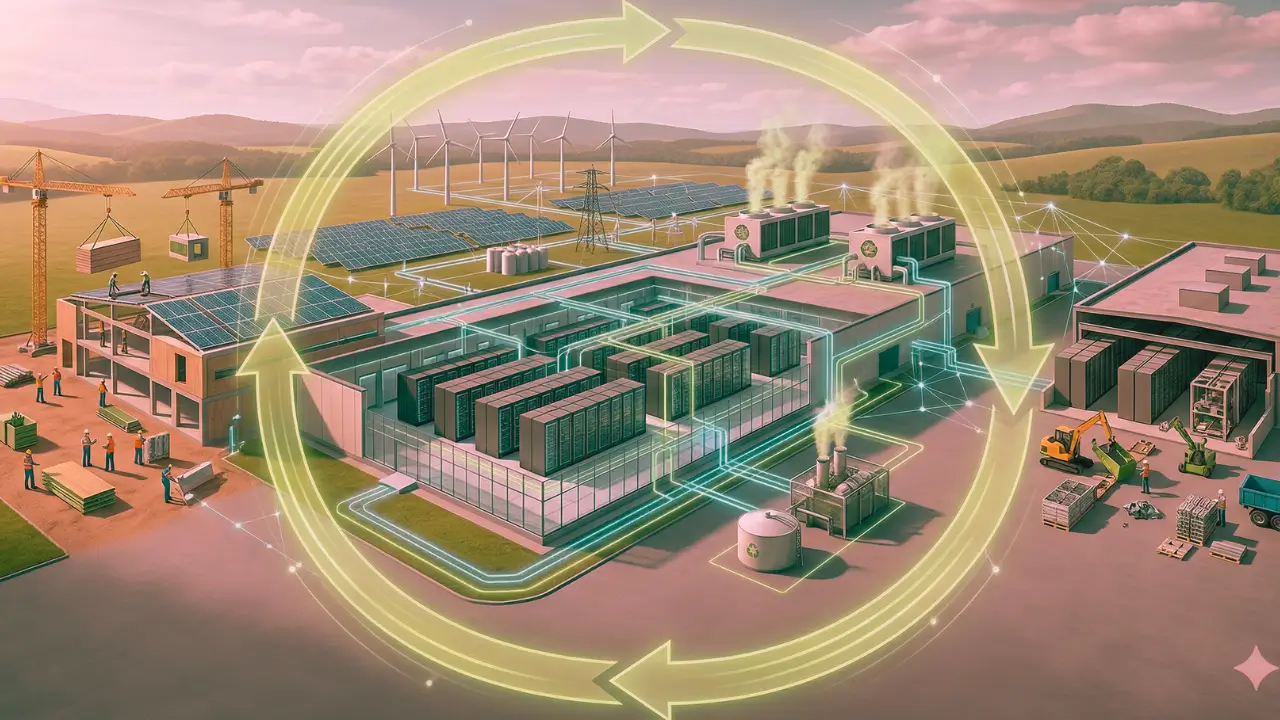
Circular economy approaches extend hardware lifespans, improve rare material recovery, and reclaim value at end-of-life.
Policy frameworks and reporting standards, including Scope 3 disclosure requirements and green building certifications, increasingly incentivize lifecycle accountability.
Core Recommendation
To reduce total lifecycle carbon meaningfully, the industry must move beyond operational efficiency alone. Stakeholders should embed lifecycle thinking into design, procurement, operations, and decommissioning. This shift demands technological innovation, improved measurement frameworks, stronger standards, and supportive policy structures. Only then can sustainability strategies align with long-term climate commitments.
2. Why Lifecycle Thinking Matters
The rapid expansion of digital services has driven significant growth in global data center capacity. These facilities consume large amounts of electricity. When combined with manufacturing and transport emissions, their carbon impact becomes substantial.
Historically, sustainability initiatives have focused on operational carbon. Operators targeted emissions from day-to-day electricity consumption because energy use was visible and measurable.
Operational carbon directly reflects electricity demand. Facilities track metrics such as PUE to benchmark efficiency. Yet operational data reveals only part of the total footprint. As grids integrate more renewable energy, the carbon intensity of electricity declines. Consequently, the share of emissions linked to operations decreases. Meanwhile, emissions embedded in materials and supply chains remain largely unchanged. A lifecycle perspective therefore becomes essential.
Operational vs. Embodied Carbon: A Lifecycle Framework
Within data centers, operational emissions primarily fall under Scope 1 and Scope 2 of the GHG Protocol. These emissions originate from electricity and other on-site energy sources used to power IT equipment, cooling systems, lighting, and building services throughout the facility’s operating life. Because operators can measure electricity use annually, operational emissions have traditionally dominated sustainability strategies.
Embodied emissions encompass greenhouse gases released before operations begin and throughout the asset’s life outside direct electricity use. They arise from raw material extraction, processing, manufacturing, transportation, construction, maintenance, refurbishment, and end-of-life treatment such as recycling or disposal.
Supply chains often obscure embodied carbon, making quantification more complex than tracking electricity use. Nevertheless, lifecycle assessments show that embodied emissions can represent 20 to 30 percent or more of total emissions under current grid conditions. In decarbonized energy scenarios, this share increases further.
How Lifecycle Thinking Reshapes Decarbonization
A narrow focus on operational energy risks underestimating both total emissions and reduction opportunities.
First, embodied emissions are front-loaded. Most emissions from materials and construction occur before the facility processes any data. Once embedded in infrastructure, they cannot be reversed through later operational improvements.
Second, grid decarbonization shifts the balance. Cleaner electricity reduces operational intensity. However, embodied emissions persist unless stakeholders address them directly. Over time, their relative contribution grows.
Third, early design decisions influence both embodied and operational performance. Material selection, structural systems, and modular configurations affect long-term energy efficiency and total carbon impact. Early intervention therefore delivers greater cumulative reductions than incremental operational adjustments.
A whole-life carbon framework captures emissions from cradle to grave. By integrating both operational and embodied phases, stakeholders can identify reduction pathways that remain invisible under PUE-focused approaches. This broader view encourages early sustainability engagement and supports alignment with net-zero and science-based targets.
3. Embodied Carbon: Upstream Impacts
Embodied carbon includes greenhouse gas emissions generated before a facility begins operation and throughout processes unrelated to daily electricity use. In data centers, upstream emissions primarily arise from material production, equipment manufacturing, and deployment. Because these emissions often go under-reported, organizations must assess them early to unlock meaningful decarbonization opportunities.
a) Material Sourcing and Manufacturing
Construction materials and IT components drive the largest share of embodied carbon. Emissions occur during extraction, processing, fabrication, and transportation, well before operational energy use begins.
Concrete and Cement
Concrete, particularly its cement component, ranks among the most carbon-intensive construction materials. Cement production contributes roughly 8 percent of global CO₂ emissions due to energy-intensive calcination and fossil fuel combustion in kilns. A medium-sized data center can require thousands of tons of concrete for foundations and structural elements. Material production alone can release several thousand tons of CO₂.
Steel
Steel production represents another major source of embodied emissions. Traditional blast furnace methods emit approximately 1.5 to 2.0 tCO₂ per ton of steel. Coke-derived energy and high thermal demands drive these emissions. Data centers rely heavily on steel for framing, racks, and mechanical systems, which amplifies its upstream impact.
Advanced production methods offer alternatives. Electric arc furnaces powered by low-carbon electricity significantly reduce emissions compared to conventional processes. Hydrogen-based direct reduction steel promises deeper cuts, though scale and infrastructure constraints limit widespread deployment.
IT Hardware Manufacturing
Embodied emissions extend beyond construction materials to IT equipment. Servers, storage systems, networking hardware, and electrical components all require energy-intensive manufacturing. Semiconductor fabrication demands ultra-high temperatures and complex chemical processing. Broader electronics research shows that manufacturing can account for more than 70 percent of lifecycle emissions in computing hardware, with semiconductors as key contributors.
Collectively, these upstream activities generate substantial emissions before operations begin. Because organizations lock in embodied carbon during procurement and construction, early decisions exert lasting influence.
b) The Scale of Embodied Emissions
Lifecycle assessments reveal that facilities powered by low-carbon electricity can see embodied carbon represent 50 to 80 percent of total lifecycle emissions. As renewable energy reduces operational intensity, embodied sources assume greater prominence.
Under the GHG Protocol, most upstream impacts fall within Scope 3 emissions, particularly purchased goods and services. In many technology organizations, Scope 3 categories dominate overall carbon footprints. Supply chain analyses across sectors consistently show that upstream emissions often exceed direct operational emissions. These findings underscore the need for supplier engagement and transparency.
Embodied emissions also arise from backup systems, cooling infrastructure, electrical components, copper cabling, and aluminum housings. Together, these elements create a substantial yet often hidden carbon burden. If stakeholders ignore them, operational gains may fail to deliver meaningful total reductions.
c) Low-Carbon Alternatives and Green Sourcing
Organizations can reduce upstream embodied carbon through targeted procurement and supplier collaboration.
Green Concrete Alternatives
Cement substitutes and supplementary materials such as fly ash, ground granulated blast furnace slag, and calcined clays lower the carbon intensity of concrete. In some cases, optimized mixes can cut emissions by up to 50 percent compared to traditional Portland cement formulations without sacrificing structural performance.
Low-Emission Steel
Sourcing steel from electric arc furnaces powered by renewable electricity offers significant reductions relative to basic oxygen furnace production. High-strength steel grades can further decrease material quantities while maintaining performance. In parallel, investment in hydrogen-based reduction processes signals longer-term potential for deep decarbonization.
Environmental Product Declarations and Transparency
Requiring Environmental Product Declarations strengthens visibility into material carbon profiles. Procurement teams can compare options and prioritize lower-carbon alternatives. Transparency frameworks and certification schemes also support recyclability assessment and responsible sourcing.
Together, these measures enable upstream emissions reductions before construction begins, creating cumulative benefits across the facility’s lifespan.
d) Supply Chain Dynamics and Carbon Flows
Embodied carbon travels through multi-tiered supply chains. Resource extraction, processing, manufacturing, and transport embed emissions into intermediate goods. These emissions then flow into final products such as servers and structural components.
Supply chain modeling demonstrates that carbon intensity often concentrates several tiers upstream. Therefore, effective mitigation requires collaboration beyond direct vendors. Engagement must extend to raw material producers and fabricators.
Transport and logistics emissions add further complexity. Although diffuse, they can materially increase embodied totals. Lifecycle assessment tools help organizations map these flows, identify emission hotspots, and prioritize high-impact interventions across supplier networks.
4. Design and Construction Choices
Early design and construction decisions offer some of the strongest levers for reducing lifecycle carbon in data centers. These choices determine how much material teams use, which materials they select, and how easily the facility can operate efficiently and adapt over time. As a result, design decisions influence both embodied carbon and operational performance for decades.
The following sections examine how modular construction, adaptive reuse, low-carbon material selection, integrated site planning, and supply chain engagement reduce carbon across the lifecycle.
a) Modular and Adaptable Builds
Modular construction has gained traction as a cost-effective and carbon-conscious alternative to conventional on-site builds. In modular data centers, manufacturers fabricate prefabricated components such as steel-framed units off-site under controlled conditions. Crews then assemble these modules quickly at the project location.
This method delivers several sustainability advantages.
Lower embodied carbon. Lifecycle assessments comparing modular steel-shell units with conventional concrete facilities show up to 3.5 times lower embodied carbon per unit of IT capacity. Modular designs use less structural material and generate significantly less on-site waste. Across a portfolio, these reductions translate into substantial absolute carbon savings. In addition, prefabrication sharply reduces waste compared with wet on-site construction.
Reduced construction emissions. Modular builds shorten project timelines and limit heavy equipment use. Consequently, they reduce emissions from machinery operation and material transport.
Improved end-of-life circularity. Steel modules allow easier disassembly, reuse, and recycling than monolithic concrete structures. This flexibility lowers total lifecycle carbon and supports circular construction practices.
Construction methodology therefore becomes a strategic carbon decision rather than a purely logistical choice.
b) Repurposing Existing Structures
Avoiding new construction often delivers the largest embodied carbon savings. Repurposing or retrofitting existing buildings such as warehouses or industrial facilities dramatically reduces emissions that new construction would otherwise lock in.
Refurbishing an existing structure can cut embodied carbon by up to four-fifths compared with building from the ground up. Developers retain the carbon already embedded in the original materials and avoid demolition-related emissions.
Moreover, upgrading an existing shell reduces demand for new raw materials, transportation, and large-scale site preparation. In many regions, brownfield redevelopment and adaptive reuse also shorten permitting timelines and lower overall lifecycle costs.
Lifecycle modeling consistently identifies reuse and retrofits as high-impact strategies for early carbon reduction. When feasible, adaptive reuse offers a direct path to immediate embodied carbon savings.
c) Low-Carbon Material Choices and Early Lifecycle Modeling
Material selection during early design strongly shapes embodied carbon outcomes. When teams integrate carbon analysis into schematic design, they unlock meaningful reductions.
Low-carbon concrete and cement alternatives. Many hyperscale operators now specify mixes with high proportions of supplementary cementitious materials such as slag, fly ash, or low-clinker binders. When introduced early in procurement, these alternatives can reduce embodied carbon by 20 to 40 percent below regional baselines.
Material optimization. Design teams can reduce emissions by minimizing total material volumes. For instance, eliminating unnecessary slabs or optimizing air system layouts lowers both steel and concrete demand. This approach targets material efficiency at its source.
Alternative reinforcing and bio-based materials. Recycled steel, high-recycled-content alloys, and engineered wood products typically generate lower embodied carbon than virgin materials. In addition, sourcing materials locally reduces transport emissions and strengthens regional supply chains.
To support these decisions, teams increasingly use embodied carbon calculators and lifecycle tools such as EC3 during early design stages. Rather than conducting analysis after specifications are fixed, designers compare options in real time. This process integrates sustainability directly into structural and architectural decisions.
d) Integrated Site and Civil Design
Comprehensive site planning also influences lifecycle emissions. Decisions about layout, grading, and infrastructure affect material use and long-term performance.
Site orientation and landscape planning can minimize earthwork and structural reinforcement. By preserving existing topography and limiting paved areas, planners reduce concrete use and mitigate heat island effects.
Natural stormwater strategies such as bioswales and vegetated buffers enhance resilience while reducing reliance on energy-intensive engineered systems. Although these measures may not yield large direct carbon reductions, they support efficient civil design and broader sustainability objectives.
In addition, phased expansion planning allows future growth without extensive new footprints. By leveraging existing infrastructure, operators limit additional embodied carbon during capacity increases.
e) Green Sourcing and Supply Chain Engagement
Design decisions increasingly incorporate green sourcing policies. Developers now prioritize transparency and supplier collaboration as core elements of construction planning.
Mandating Environmental Product Declarations strengthens visibility into material carbon footprints. Procurement teams can compare verified data and favor lower-carbon alternatives in contract specifications.
Engaging suppliers in lifecycle assessments for structural steel, concrete, mechanical systems, and generators encourages upstream innovation. When buyers request carbon transparency, suppliers respond with improved processes and lower-carbon product lines.
Regional sourcing further reduces transport emissions and improves supply chain resilience. At the same time, integrating circular design principles such as material passports and design for disassembly supports future reuse and refurbishment.
Together, these strategies shift procurement from upfront cost minimization toward total lifecycle carbon optimization.
f) Whole-Building Lifecycle Assessment
To quantify these strategies, practitioners increasingly adopt whole-building lifecycle assessments at the outset of design. Conducted under ISO 14040 and 14044 standards, lifecycle assessments measure impacts from raw material production through end-of-life processes.
By evaluating alternative materials, construction methods, and site strategies within one framework, decision-makers can weigh carbon trade-offs alongside cost and performance. For example, lifecycle comparisons between modular and conventional builds clearly demonstrate how construction methods alter embodied carbon outcomes.
When organizations set design targets or publish sustainability disclosures, lifecycle assessment data provides credible and actionable evidence. Early adoption of these tools ensures that carbon considerations shape decisions from the beginning.
5. Operational Lifecycle Strategies
Operational emissions arise during a data center’s active use. Electricity for IT equipment, cooling systems, power distribution, lighting, and backup systems drives these emissions. For years, operators concentrated sustainability efforts in this area.
However, organizations must now integrate operational strategies with broader lifecycle thinking. Doing so reduces Scope 1 and Scope 2 emissions while supporting long-term carbon objectives.
a) Renewable Energy Integration
Procuring renewable electricity directly reduces operational emissions by displacing fossil fuel generation. Major operators deploy several approaches.
Long-term power purchase agreements secure large volumes of wind or solar generation to match annual electricity demand.
On-site generation such as solar installations supplies clean energy directly where geography permits.
Virtual power purchase structures aggregate demand across regions and stimulate additional renewable development.
Through these strategies, leading cloud providers have built substantial renewable portfolios. Clean energy procurement decouples data center growth from fossil fuel emissions and steadily reduces operational carbon intensity.
b) Advanced Cooling Solutions
Cooling typically accounts for 30 to 40 percent of total energy use. Therefore, improving cooling efficiency significantly lowers operational emissions.
Free-air and economized cooling systems draw outside air when conditions allow. In cooler climates, these systems can reduce cooling energy demand by up to 80 percent compared with traditional chilled systems.
Liquid cooling technologies circulate coolants directly around high-heat components such as CPUs and GPUs. These systems reduce power consumption and manage high-density AI workloads more effectively than air-based cooling.
AI-driven cooling management further enhances efficiency. Machine learning systems adjust setpoints and airflow in real time based on workload and environmental data. By preventing overcooling, operators achieve measurable energy savings while maintaining reliability.
Together, these innovations reduce electricity demand and stabilize thermal conditions, which can extend hardware lifetimes.
c) Energy-Aware Management and Smart Workload Scheduling
Operational carbon depends not only on hardware efficiency but also on when and where workloads run.
AI-based workload shifting schedules delay-tolerant tasks during periods of lower grid carbon intensity. Aligning compute demand with high renewable output reduces total emissions.
Geo-distributed scheduling routes workloads to facilities operating on cleaner grids. Distributed cloud architectures allow dynamic steering based on real-time carbon signals.
Carbon-aware orchestration tools integrate grid emission data into scheduling algorithms. Instead of optimizing solely for performance or cost, operators can prioritize carbon minimization.
When combined with virtualization and container orchestration, these strategies reduce unnecessary energy use and lower the carbon intensity of active workloads.
d) Hardware Utilization and Virtualization
Under-utilized servers consume energy without delivering proportional value. Improving utilization therefore reduces operational emissions.
Virtualization consolidates workloads onto fewer physical machines, increasing average server utilization and reducing idle power draw. Multi-tenant cloud environments often achieve higher utilization than isolated on-premises deployments.
Dynamic resource allocation scales infrastructure in real time. Automated right-sizing and load balancing prevent excess capacity from running continuously.
Software-defined infrastructure further integrates energy awareness into scheduling decisions. These tools align computing demand with efficiency objectives and reduce the need for premature hardware expansion.
Collectively, improved utilization strategies lower energy consumption and enhance carbon efficiency without compromising performance.
e) Backup Systems and Microgrid Integration
Resilient operations require backup power, yet traditional diesel generators generate significant emissions. Operators increasingly explore cleaner alternatives.
Battery storage systems can replace or supplement diesel-based uninterruptible power supplies. Batteries reduce direct emissions and may provide grid services such as frequency regulation.
Microgrid integration combines renewables and storage to manage energy dispatch locally. By optimizing energy flows, facilities can maintain resilience while reducing carbon intensity during grid peaks.
Although still evolving, these approaches link operational sustainability with energy resilience and system flexibility.
Operational Summary
Operational strategies now extend beyond basic energy efficiency. Clean power procurement, advanced cooling, carbon-aware workload management, improved hardware utilization, and flexible energy systems collectively reduce real-time emissions. When integrated with lifecycle planning, these measures lower operational baselines and reinforce long-term carbon reduction goals.
6. Circular Economy and End-of-Life Policies
Reducing carbon beyond daily operations requires a shift toward circular economy principles. By maximizing reuse, refurbishment, recycling, and responsible disposal, operators reduce embodied carbon and limit resource extraction.
a) Reuse and Refurbishment
Extending hardware lifespans remains one of the most effective ways to reduce embodied emissions.
Refurbishment programs repair and upgrade components, allowing servers to operate longer. Major providers have extended average server lifetimes and consolidated storage components to avoid unnecessary purchases. These efforts prevent the manufacture of hundreds of thousands of new hard drives and reduce associated emissions.
Secondary markets also play a role. Operators can redeploy decommissioned equipment internally, sell functional hardware to secondary users, or donate systems for educational use. Redirecting components back into service reduces demand for new manufacturing and transport.
By prioritizing reuse, organizations avoid emissions tied to new hardware production.
b) Advanced Recycling
When reuse is no longer possible, responsible recycling becomes essential.
Metals and rare earth elements such as copper, aluminum, gold, and specialized magnets can be recovered from retired equipment. Recycling these materials reduces reliance on virgin extraction and significantly lowers associated emissions.
Certified e-waste recyclers following standards such as e-Stewards or R2 ensure safe handling of hazardous materials and maximize material recovery. Operators increasingly embed these requirements into decommissioning contracts.
Battery recycling also remains critical. Repurposing or recycling lead-acid and lithium-ion batteries prevents toxic waste and recovers valuable materials for future use.
Advanced recycling programs therefore reduce upstream mining emissions and reintegrate materials into productive supply chains.
c) Smart Disposal and Reclamation Standards
Structured policies strengthen circular outcomes.
Design for disassembly encourages manufacturers to create equipment that technicians can easily repair, dismantle, and recycle. This approach lowers downstream labor requirements and increases material recovery rates.
Material passports document component composition and enable precise sorting at end-of-life. With accurate data, recyclers can optimize recovery processes.
Regulatory developments, including recycling targets and recycled content mandates, further incentivize circular design. As frameworks evolve, operators increasingly align procurement and disposal practices with regulatory expectations.
d) Economic and Policy Drivers
Economic instruments accelerate circular adoption.
Extended Producer Responsibility schemes require manufacturers to take back equipment at end-of-life, encouraging design for recyclability.
Tax incentives and infrastructure credits support investment in recycling facilities.
Circular procurement standards that mandate recycled content stimulate demand for secondary materials and close material loops.
These measures internalize environmental costs and support systemic transitions toward circular supply chains.
e) Integration with Lifecycle Carbon Goals
Circular economy strategies directly reduce embodied carbon by delaying new manufacturing, recovering materials for reuse, and preventing landfill emissions.
When operators embed circular principles across procurement, operations, and decommissioning, they lower total lifecycle carbon while improving cost efficiency and reporting transparency. Over time, integrating circularity strengthens both environmental performance and long-term resilience.
7. Advanced Innovations and Emerging Tactics
Beyond core construction and operational strategies, emerging technologies are reshaping how data centers reduce carbon. Increasingly, operators rely on real-time optimization, artificial intelligence, and integrated energy systems to bridge computing performance with lifecycle emissions management. These innovations move carbon reduction into software, controls, and system coordination.
a) AI-Driven Energy Optimization and Workload Management
Artificial intelligence and machine learning now enable energy-aware operations that respond dynamically to changing conditions.
AI-assisted cooling management systems continuously adjust cooling parameters based on temperature, workload intensity, and weather forecasts. For example, Google has reduced cooling energy use by up to 40 percent through AI-based thermal management, significantly improving carbon performance.
Deep reinforcement learning models also optimize renewable integration, storage dispatch, and grid interaction in real time. Modeled scenarios in e-commerce data centers show potential carbon reductions of up to 45 percent compared with traditional optimization approaches. These systems balance supply and demand while minimizing reliance on carbon-intensive electricity.
Intelligent workload scheduling further enhances efficiency. AI platforms can shift non-urgent computing tasks to periods or regions with lower grid carbon intensity. By aligning compute demand with cleaner energy availability, operators reduce operational emissions without sacrificing service reliability.
Together, these approaches treat carbon intensity as a core optimization variable alongside performance and cost.
b) Integration of Novel Cooling and Thermal Systems
Cooling remains one of the largest energy consumers in data centers. As workloads intensify, particularly in AI-driven facilities, next-generation thermal systems are becoming essential.
Direct evaporative and phase-change cooling technologies improve heat dissipation efficiency. Advanced heat exchangers and phase-change materials reduce dependence on electricity-intensive chillers, lowering energy demand.
Liquid and immersion cooling systems circulate coolant directly around high-heat components. Compared with traditional air cooling, these systems support higher rack densities while reducing power draw and associated emissions.
Waste heat reuse offers additional system-level benefits. Some facilities capture excess heat and redirect it to district heating networks or industrial processes. This strategy converts thermal byproducts into usable energy and improves overall efficiency.
By reducing cooling loads and stabilizing operating conditions, these technologies also extend hardware lifetimes and support broader lifecycle sustainability.
c) Integrated Energy Systems and Smart Grid Participation
Data centers increasingly function as active participants in energy ecosystems rather than passive consumers.
Integration with smart grids allows facilities to provide demand response services and absorb surplus renewable energy. Digital twin platforms and AI-based forecasting tools enable real-time grid coordination, enhancing both carbon performance and grid stability.
On-site renewable generation combined with battery storage strengthens this integration. Facilities can draw from stored energy during periods of high grid carbon intensity, reducing emissions while maintaining operational resilience.
Although these systems require capital investment, they deliver dual benefits. Operators reduce operational carbon while enhancing energy security in grids with growing renewable penetration.
d) Lifecycle and Design Innovations Beyond Hardware
Emerging strategies also influence lifecycle emissions through software design and materials research.
Carbon-aware software engineering reduces computation intensity by selecting energy-efficient algorithms and optimizing processing pathways. By lowering compute demand, software innovation decreases both operational electricity use and embedded infrastructure requirements.
Next-generation processors and memory architectures improve performance per watt. More efficient GPUs and specialized accelerators deliver higher output with lower energy input. As a result, facilities require fewer hardware refresh cycles and reduced cooling capacity.
Advanced materials research also shows promise. Concrete blends that sequester CO₂ during curing could reduce embodied emissions if scaled commercially. Continued innovation in carbon capture materials may significantly reshape future construction footprints.
Collectively, these advanced tactics demonstrate how digital optimization, hardware efficiency, and material science converge to reduce lifecycle carbon.
8. Policy, Certification, and Industry Standards
Technological progress alone cannot drive sector-wide decarbonization. Policy frameworks, certification systems, and industry standards create accountability, transparency, and shared benchmarks. These mechanisms accelerate adoption of lifecycle carbon reduction practices across the data center ecosystem.
a) Industry Initiatives and Public-Private Frameworks
iMasons Climate Accord.
This coalition of hyperscalers, suppliers, and technology firms has established voluntary frameworks for carbon accounting across power, materials, and equipment. Its maturity model provides a roadmap for measuring decarbonization progress and promotes transparent reporting of both embodied and operational emissions.
In collaboration with the Open Compute Project Foundation, the Accord has also developed an open taxonomy for carbon disclosure. This standardized specification enables consistent reporting of equipment and material impacts across supply chains. By improving traceability, the taxonomy reduces duplication and strengthens measurement rigor.
These initiatives help buyers benchmark sustainability performance and integrate lifecycle carbon metrics into procurement decisions.
b) Global and Regional Policy Standards
Corporate Sustainability Reporting Frameworks.
The Greenhouse Gas Protocol defines methodologies for Scope 1, Scope 2, and Scope 3 emissions. Data center operators rely on these standards to report comprehensive lifecycle impacts. Transparent reporting enhances investor confidence and supports regulatory compliance.
Climate Neutral Data Centre Pact in the European Union.
European operators have committed to achieving climate neutrality by 2030. The pact includes verifiable targets for energy efficiency, renewable procurement, circular reuse, recycling, water conservation, and waste heat recovery. Independent audits ensure accountability and provide performance benchmarks.
National renewable power mandates.
Some governments now link data center growth to renewable sourcing requirements. In certain Chinese regions, new facilities must obtain at least 80 percent of their electricity from renewable sources. These mandates align infrastructure expansion with national decarbonization goals and accelerate green power adoption.
Public policy therefore reinforces operational and embodied carbon reductions by setting enforceable expectations.
c) Green Building Certifications
Leadership in Energy and Environmental Design and Building Research Establishment Environmental Assessment Method certifications incorporate material and energy sustainability criteria into building evaluation.
These systems award credits for third-party verified Environmental Product Declarations, which disclose product-level embodied carbon. By rewarding transparency and low-carbon materials, certification programs drive demand for sustainable construction practices.
Participation in recognized certification schemes signals holistic environmental commitment and often satisfies investor and regulatory expectations.
d) Carbon Disclosure and Market-Based Incentives
Environmental Product Declarations increasingly influence procurement decisions. By quantifying cradle-to-gate emissions, EPDs allow purchasers to compare products and select lower-carbon alternatives. Integrating EPD requirements into contracts and building standards strengthens market demand for sustainable materials.
Mandatory ESG disclosure regimes, such as the European Union’s Corporate Sustainability Reporting Directive, further expand lifecycle reporting requirements. As regulators require Scope 3 emissions transparency, companies invest more heavily in supply chain decarbonization and lifecycle measurement tools.
Market-based incentives therefore complement policy mandates and drive systemic change.
e) Standardization Challenges and Opportunities
Despite progress, several challenges remain.
Different regional frameworks and voluntary disclosures can produce inconsistent methodologies. Without harmonization, comparing carbon data across jurisdictions becomes difficult.
Robust third-party verification remains essential to ensure credibility and prevent superficial reporting.
Global alignment of standards requires coordination among industry bodies, governments, and supply chain partners.
Nevertheless, initiatives such as shared maturity models and open disclosure taxonomies indicate growing convergence. As standards harmonize, the market for low-carbon digital infrastructure will expand and become more transparent.
Through coordinated innovation, policy alignment, and standardized reporting, the data center sector can accelerate lifecycle carbon reduction at scale.
9. Challenges & Barriers
Despite growing momentum behind carbon reduction in data centers, significant technical, economic, and structural barriers hinder holistic lifecycle emissions mitigation. These barriers span planning, implementation, reporting, and broader industry adoption.
a) Measurement & Reporting Limitations
One of the most fundamental challenges is incomplete measurement of embodied and Scope 3 emissions. While operational emissions (Scope 1 and Scope 2) can be quantified from electricity meters and energy reports, embodied carbon spans materials, manufacturing, transportation, construction, hardware refresh cycles, and end-of-life disposal — areas that are often poorly tracked or omitted from corporate reporting.
In addition:
- Inconsistent LCA methodologies vary in system boundaries, assumptions, and data quality.
- Limited Environmental Product Declarations (EPDs) restrict material-level transparency.
- Fragmented reporting standards reduce comparability across projects and operators.
Although industry groups such as Infrastructure Masons (iMasons) are working toward standardization, the absence of harmonized, transparent lifecycle data remains a major obstacle to benchmarking and cross-project learning.
b) Cost & Economic Constraints
Economic factors remain a primary barrier:
- High upfront capital costs for low-carbon materials, modular construction, advanced cooling systems, and renewable energy installations constrain adoption — particularly for smaller operators.
- Land and space scarcity in urban or suburban regions limits on-site renewables, waste heat recovery systems, or facility expansion.
- Green material premiums (e.g., low-carbon concrete, recycled steel, rare earth components for advanced cooling systems) can involve higher procurement costs and longer lead times.
These costs often compete directly with performance, uptime, and reliability priorities in a highly competitive market.
c) Technical & Infrastructure Barriers
Waste Heat Reuse Challenges
Data center waste heat is typically low-grade and requires supporting infrastructure — such as heat pumps, district heating networks, or high-temperature distribution loops — to become usable at scale. In many regions, this infrastructure does not exist.
Integration with urban heat systems also requires:
- Long-term contractual agreements
- Coordinated municipal planning
- Alignment between data center lifecycles and city energy infrastructure
Without these conditions, reuse may be technically possible but economically unviable.
Retrofitting Complexity
Retrofitting legacy facilities for circular economy strategies, renewable integration, or heat recovery is often expensive and technically complex, especially where facilities were not originally designed for modularity or adaptability.
d) Supply Chain & Material Transparency
Supply chain opacity — particularly within mechanical, electrical, and plumbing (MEP) systems, complicates embodied carbon reduction.
Key barriers include:
- Lack of verified lifecycle data
- Limited EPD availability
- Poor upstream emissions visibility
Greater transparency from manufacturers is essential to enable informed procurement and realistic embodied carbon benchmarking.
e) Competing Priorities & Operational Trade-offs
Performance vs. Embodied Emissions
Replacing legacy hardware may improve energy efficiency but increases embodied carbon from manufacturing new equipment. Operators must balance:
- Operational energy savings
- Manufacturing emissions
- Remaining useful life of existing servers
Traditional energy-centric decision models rarely capture this full trade-off.
Water–Carbon Trade-offs
Certain low-carbon cooling strategies (e.g., evaporative cooling) may increase water consumption, introducing competing sustainability objectives.
f) Policy & Regulatory Gaps
While voluntary frameworks, such as the iMasons Climate Accord, are expanding, governmental lifecycle carbon regulation remains fragmented globally.
Existing ESG reporting mandates (e.g., within the EU) often focus on disclosure rather than enforceable decarbonization pathways tied to:
- Construction materials
- Waste heat reuse
- Circular equipment design
Stronger policy incentives, including tax credits, low-carbon material mandates, and infrastructure investment, remain underdeveloped in many jurisdictions.
10. Case Studies & Practical Examples
Concrete examples demonstrate how lifecycle carbon strategies can translate into measurable outcomes.
a) Waste Heat Reuse in Ostrobothnia, Finland
In Ostrobothnia, Finland, modeling of a planned 21 MW data center showed that integrating waste heat into the regional district heating network could:
- Reduce 36% of CO₂ emissions from district heating supply
- Cut heat production costs by nearly 19%
By substituting biomass and peat combustion with recovered waste heat, the project illustrates how data centers can function as decentralized heat plants when aligned with local energy systems.
Nordic countries — including Finland — benefit from extensive district heating infrastructure, making them particularly well positioned for scalable waste heat reuse.
b) LCA Best Practices from iMasons Climate Accord
The iMasons Climate Accord provides tailored guidance for whole-building lifecycle assessments (LCAs) in data center construction.
Best practices emphasize:
- Early and iterative LCAs during conceptual design
- Consistent system boundaries
- Transparent assumptions and data quality
- Identification of high-impact materials (steel, concrete, MEP systems)
These approaches help embed embodied carbon reduction into early-stage decision-making rather than treating it as a post-construction reporting exercise.
c) Circular Server Design
Emerging research highlights the potential of circular server design, where hardware is engineered for:
- Easier disassembly
- Component reuse
- Enhanced recyclability
- Material recovery
Prototype analyses using reverse-engineered server material inventories indicate substantial reductions in embodied energy and emissions when circular principles are applied.
Although empirical OEM data remains limited, circular design presents one of the most promising strategies for reducing upstream manufacturing impacts.
d) Hyperscale Operator Initiatives
The Berlin 2 Data Centre operated by NTT DATA feeds waste heat into the Marienpark district network, supplying heating and warm water to more than 1,000 buildings.
Additional initiatives include:
- Investment in solar and wind projects
- Power purchase agreements (PPAs)
- Reverse-osmosis water conservation systems
This demonstrates how operational decarbonization, heat reuse, and water management can coexist within a comprehensive sustainability strategy.
11. Roadmap Forward
Key Takeaways
Carbon emissions from data centers occur across the entire lifecycle:
- Material sourcing
- Construction
- Operation and maintenance
- End-of-life disposal
As electricity grids decarbonize, embodied carbon will represent an increasing share of total emissions, making lifecycle accounting a strategic necessity.
Barriers remain, including measurement challenges, economic constraints, infrastructure gaps, and policy fragmentation, yet real-world examples demonstrate that meaningful reductions are achievable.
Roadmap for Action
For Operators & Developers
- Integrate whole-building LCAs early in design.
- Establish embodied carbon targets alongside PUE goals.
- Extend hardware lifespans and scale refurbishment programs.
- Require supplier-level EPDs and transparent carbon data.
For Architects & Engineers
- Prioritize low-carbon concrete and recycled steel.
- Design modular, adaptable facilities.
- Minimize over-specification and material waste.
For Policymakers & Standards Bodies
- Mandate lifecycle carbon reporting (including Scope 3).
- Provide incentives for low-carbon materials.
- Invest in district heating and waste heat infrastructure.
For Industry Collaboratives
- Harmonize lifecycle carbon methodologies.
- Enable cross-industry benchmarking.
- Promote supplier data disclosure standards.
Final Thoughts
Cutting carbon across the data center lifecycle demands coordinated action across operators, designers, manufacturers, policymakers, and utilities.
Operational efficiency alone is no longer sufficient. As embodied carbon grows in relative importance, sustainability must be embedded into every stage — from design and procurement to operation and decommissioning.
By advancing standards, investing in infrastructure, deploying circular design, and aligning economic incentives, the industry can build digital infrastructure that supports both technological growth and long-term climate stability.