 Skip to content
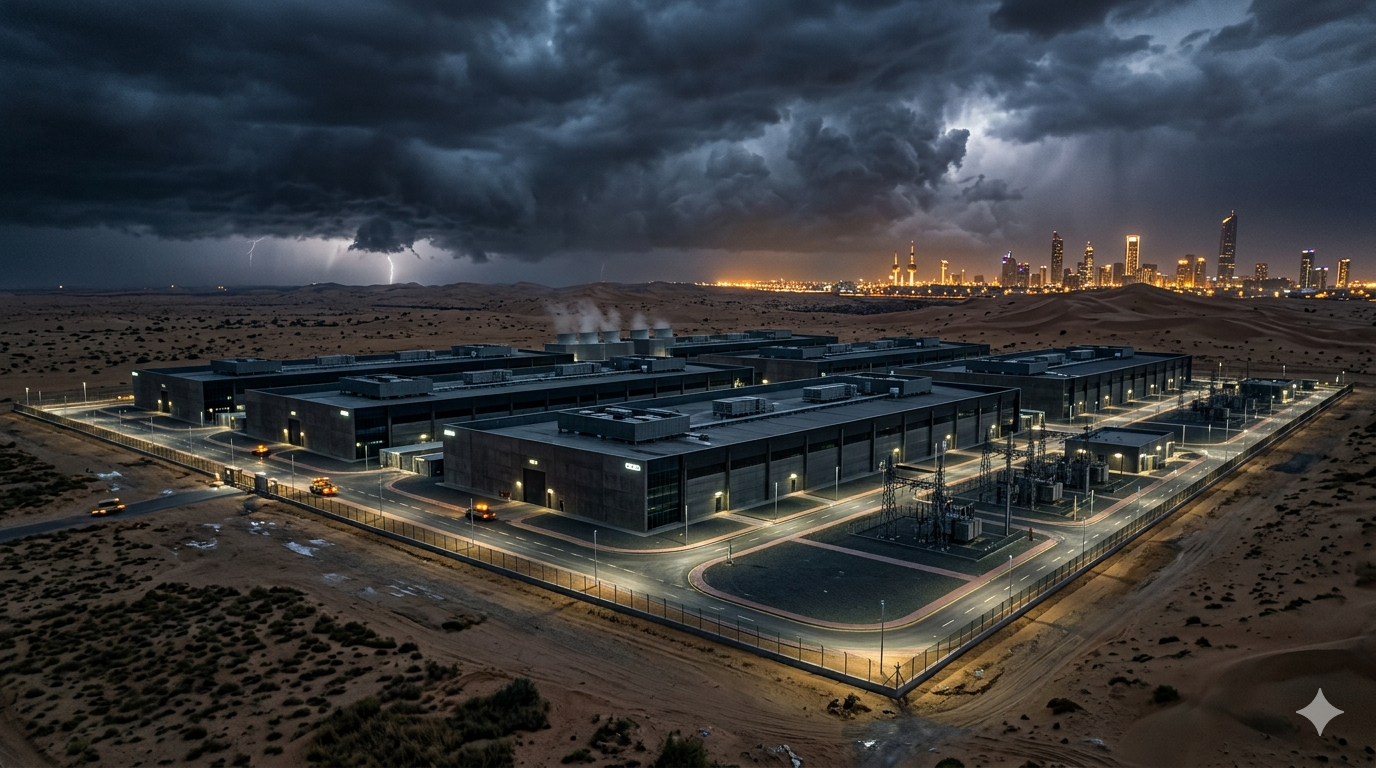
Less than a year ago, the Gulf was being celebrated as the next great frontier for artificial intelligence infrastructure. US President Donald Trump’s four-day tour of Saudi Arabia, Qatar, and the UAE in May 2025 produced more than two trillion dollars in investment pledges. The region offered what AI infrastructure developers had been seeking globally: political alignment with US technology policy, sovereign capital willing to co-invest at scale, land without the permitting friction of democratic planning systems, and a stated national commitment to becoming a global AI hub alongside the United States and China. The pitch was compelling. The commitments were real. And then in March 2026, Iranian drones struck three AWS data centers in the UAE and Bahrain, knocking them offline and forcing AWS to tell customers to consider migrating workloads out of the Middle East entirely.

The Gulf’s AI infrastructure ambitions did not end with those strikes. The capital remains committed, the national strategies remain intact, and the hyperscaler programs continue. However, the strikes exposed a fundamental assumption that had been embedded in every Gulf AI infrastructure deal without being explicitly examined. The assumption was that the Gulf offered physical safety alongside political alignment and capital availability. That assumption is now openly in question, and its failure has consequences that will shape Gulf AI infrastructure investment for years.
What the Strikes Actually Revealed
The physical security framework that Gulf data center operators deployed before March 2026 was built for a different threat model. Perimeter security protected against intruders. Cybersecurity teams defended against state-sponsored hackers and ransomware operators. Redundant power and cooling systems protected against equipment failures. Air filtration and environmental controls protected against sand and dust. None of these frameworks contemplated what actually happened: an adversary sending drones at buildings from outside the perimeter.
The vulnerability exposed by the strikes is not primarily a failure of security design. It reflects a failure of underlying assumptions. Gulf states maintain robust air defense capabilities and have invested heavily in military infrastructure to counter the kind of missile and drone attacks that Iran launched. However, they deployed those systems to protect military assets, government facilities, and critical national infrastructure. Operators did not integrate commercial data centers, even those processing workloads for US military-adjacent customers, into the air defense architecture that protects more explicitly strategic targets. As a result, the distinction between commercial and strategic infrastructure, which appeared reasonable in peacetime, collapsed under conflict conditions.

The Dual-Use Problem
The dual-use nature of AI infrastructure makes Gulf data centers more attractive targets than conventional commercial facilities and exposes a gap in air defense planning that military models did not anticipate. Multiple news organisations reported that Anthropic’s Claude model, running on AWS, supported intelligence assessments, target identification, and battle simulations during the US and Israeli strikes on Iran. Iranian state media also claimed that the Bahrain facility was targeted for its role in supporting military and intelligence activities, while AWS declined to confirm or deny those claims.
Even without confirming specific workloads, the broader pattern carries strategic weight. The US military’s Joint Warfighting Cloud Capability and its intelligence computing infrastructure run on the same commercial cloud platforms used by banks, retailers, and media companies. The boundary between commercial and military cloud has effectively collapsed in practice. As a result, adversaries seeking to disrupt US military AI capabilities have a clear incentive to target the commercial infrastructure that hosts them. That infrastructure operates across facilities that lack the hardening, air defense integration, and operational security of purpose-built military installations. Gulf data centers hosting any mix of commercial and military-adjacent workloads therefore fall into a target category that regional air defense systems were not designed to protect.
The Investment Calculus Has Changed
The financial implications of the strikes extend well beyond the immediate physical damage and service disruption. A burning AWS data center in the UAE is a visible demonstration of a risk that every AI infrastructure investor had modeled as theoretical. When theoretical risks become observable events, insurance pricing changes, financing terms change, and the expected return calculations on which investment decisions rest change. All three of those changes are now underway in the Gulf AI infrastructure market.
Insurance coverage for Gulf data centers was already difficult before March 2026. Standard commercial property policies include war and terrorism exclusions that limit coverage for losses arising from armed conflict. The strikes on AWS facilities fall into legal territory that insurers and their counsel are still evaluating, particularly whether to classify the event as an act of war, a terrorist attack, or a category that existing policy language does not clearly address.
As we have shown in our analysis of the AI data center insurance market under stress, insurers were already struggling to price concentration risk, GPU collateral mismatches, and financing opacity before physical conflict risk entered the picture. The Gulf strikes introduce a new category of peril that existing frameworks cannot price accurately because insurers lack actuarial data for commercial data centers targeted by military drones.
Financing Terms Are Responding
The debt markets that finance Gulf data center construction are incorporating the new risk information faster than the equity markets. Lenders underwriting construction loans for Gulf data center projects are applying additional risk premiums that reflect the demonstrated vulnerability of commercial facilities in the region. Some lenders are requiring enhanced insurance coverage that may not be commercially available at reasonable cost. Others are imposing operational requirements around redundancy and geographic distribution that add capital cost to project economics. The sovereign co-investment structures that anchor many Gulf data center deals provide some protection against pure financing market pressure, because sovereign co-investors are not subject to the same capital adequacy requirements as commercial lenders. However, even sovereign-backed projects must access commercial debt markets for a portion of their financing, and those markets are now pricing Gulf risk differently than they were before March 2026.
The equity investment picture is more complex. Hyperscalers that committed to the Gulf before the strikes are not reversing those decisions publicly. The strategic rationale for building infrastructure in a region with two trillion dollars in sovereign AI investment remains strong, and withdrawing would carry significant reputational cost. However, new commitment announcements have slowed in the weeks following the strikes, and newer deals now include protections and contingencies that earlier agreements did not contain.
What Physical Security for Data Centers Actually Requires
The strikes have forced a conversation about what physical security for commercial data centers actually requires in a world where those facilities process strategically significant workloads in regions with active conflict risk. The answers are not comfortable for an industry that built its physical infrastructure around assumptions that have now been falsified.
Hardening commercial data centers against drone and missile attack requires capabilities that are neither standard in data center design nor readily available as retrofit additions to existing facilities. Reinforced structural elements that can withstand blast overpressure from near-miss events. Dispersed critical system components that prevent a single strike from taking down an entire facility. Independent power generation and cooling that can sustain operations through a grid disruption caused by a strike on upstream infrastructure. These requirements add substantial capital cost to facility construction and do not have established standards or validated designs that operators can implement with confidence.
The more fundamental protection would be integration of commercial data centers into national air defense architecture. But this is not primarily a data center design question. It is a geopolitical question about how host nation governments define critical infrastructure and what protection obligations they accept toward commercial facilities that host strategically significant workloads. The UAE and Bahrain both maintain sophisticated air defense systems. The fact that drones reached AWS facilities suggests either that air defense systems did not cover those sites or that the volume and variety of the Iranian attack overwhelmed those systems. As covered in our analysis of the AI data center security nuclear-grade thinking framework, the physical security requirements for AI infrastructure at strategic scale have no precedent in conventional data center operations and require a fundamentally different approach to threat modeling, facility design, and operational security than the industry has previously applied.
The Geographic Diversification Response
Hyperscalers can respond immediately by geographically diversifying Gulf workloads across multiple facilities and locations so that no single strike disables a critical mass of capacity. AWS has already advised customers to consider migrating workloads out of the Middle East, but that guidance reflects a short-term crisis response rather than a sustainable strategy. A more durable approach involves building redundancy into Gulf infrastructure so workloads can fail over between facilities in the UAE, Bahrain, Saudi Arabia, and Qatar when one location is disrupted.
However, this approach has clear limits. Geographic diversification within the Gulf does not protect against scenarios in which a conflict threatens multiple states at the same time. The 2026 conflict showed that Iran can coordinate strikes across several Gulf locations simultaneously. If such attacks escalate and continue over time, they could threaten facilities across multiple countries at once, making intra-Gulf diversification insufficient as a resilience strategy. A more robust solution requires maintaining enough capacity outside the Gulf to absorb critical workloads during regional disruption. That approach demands substantial investment in alternative regions, effectively recreating the capacity redundancy that Gulf consolidation was originally intended to eliminate.
The Sovereign AI Strategy Remains Intact
The Gulf states’ national AI strategies have not been abandoned in response to the March strikes. Saudi Arabia’s Vision 2030, the UAE’s AI Strategy, and Qatar’s National AI Strategy are all long-term national commitments that represent decades of policy planning and billions of dollars of sovereign investment. The setback of a single conflict event, however dramatic, does not reverse those commitments. What it does is force a more honest reckoning with the assumptions that underpinned the physical safety dimension of those strategies.
Saudi Arabia’s position is the most analytically interesting. The kingdom was not a direct party to the March 2026 conflict, and its geographic position, air defense capabilities, and diplomatic posture give it a different risk profile from the UAE and Bahrain. Saudi Arabia also has the largest sovereign AI investment program in the region through Humain, its state-backed AI entity, and the most ambitious plans for domestic AI infrastructure development. The strikes in the UAE and Bahrain may paradoxically strengthen Saudi Arabia’s competitive position within the Gulf AI infrastructure market, by demonstrating that not all Gulf locations carry the same conflict exposure risk. Investors evaluating Gulf AI infrastructure deals will increasingly distinguish between Gulf locations based on their specific conflict exposure geography, political posture toward the US and Iran, and air defense architecture.
The Long-Term Structural Question
The Gulf strikes raise a long-term structural question: do commercial data centers qualify as legitimate military targets under international humanitarian law, and what does that answer imply for where operators can safely build AI infrastructure. The IRGC claimed it targeted AWS facilities because they supported military and intelligence functions, invoking a legal framework that would classify commercial cloud infrastructure hosting military-adjacent workloads as legitimate military objectives. International law scholars dispute that interpretation and no authority has formally adjudicated it, but the strikes show that adversaries will act on it regardless of its legal status.
If state adversaries treat commercial data centers hosting dual-use AI workloads as legitimate targets, the set of locations where operators can run those facilities without meaningful conflict exposure becomes much smaller than hyperscalers have assumed. US and NATO air defense systems protect primary markets such as Northern Virginia, Silicon Valley, and major European hubs, while Gulf commercial facilities operate without comparable protection. As a result, the Gulf’s entry into the first tier of global AI infrastructure brings vulnerabilities that US and European markets do not face. To address that gap, operators must either integrate Gulf data center infrastructure into military-grade protection systems or accept a persistent risk premium that does not apply in the US and Europe.
As explored in our analysis of the hyperscaler consolidation of AI infrastructure, the competitive dynamics of global AI infrastructure investment are already concentrating capacity in locations that combine power access, regulatory stability, and operational security. The Gulf strikes have added physical security to that set of determinants in a way that will be visible in investment patterns for years.
Where This Leaves Gulf AI Infrastructure
The Gulf’s AI infrastructure ambitions are real, the capital behind them is committed, and the national strategies driving them are durable. None of that has changed as a result of the March strikes. What has changed is the honest acknowledgment of a risk that was previously theoretical, and the beginning of a process of adapting infrastructure design, insurance frameworks, financing terms, and operational procedures to a threat environment that turns out to be more demanding than the original investment theses assumed.
That adaptation will take years and will require funding that original project budgets did not include. Developers will delay some projects while they establish security frameworks. They will redesign others to incorporate hardening that increases capital costs. At the same time, some investors will decide that Gulf AI infrastructure no longer meets their risk-adjusted return thresholds and will redirect capital elsewhere.
However, Gulf states will not abandon their sovereign AI strategies, and hyperscalers that have already committed to the region will move forward because the strategic rationale for Gulf engagement remains compelling, even after accounting for the risks exposed by the March strikes. The Gulf’s AI infrastructure wall is real, but it can be overcome. The central question is who will bear the cost and how long that process will take.












