 Skip to content
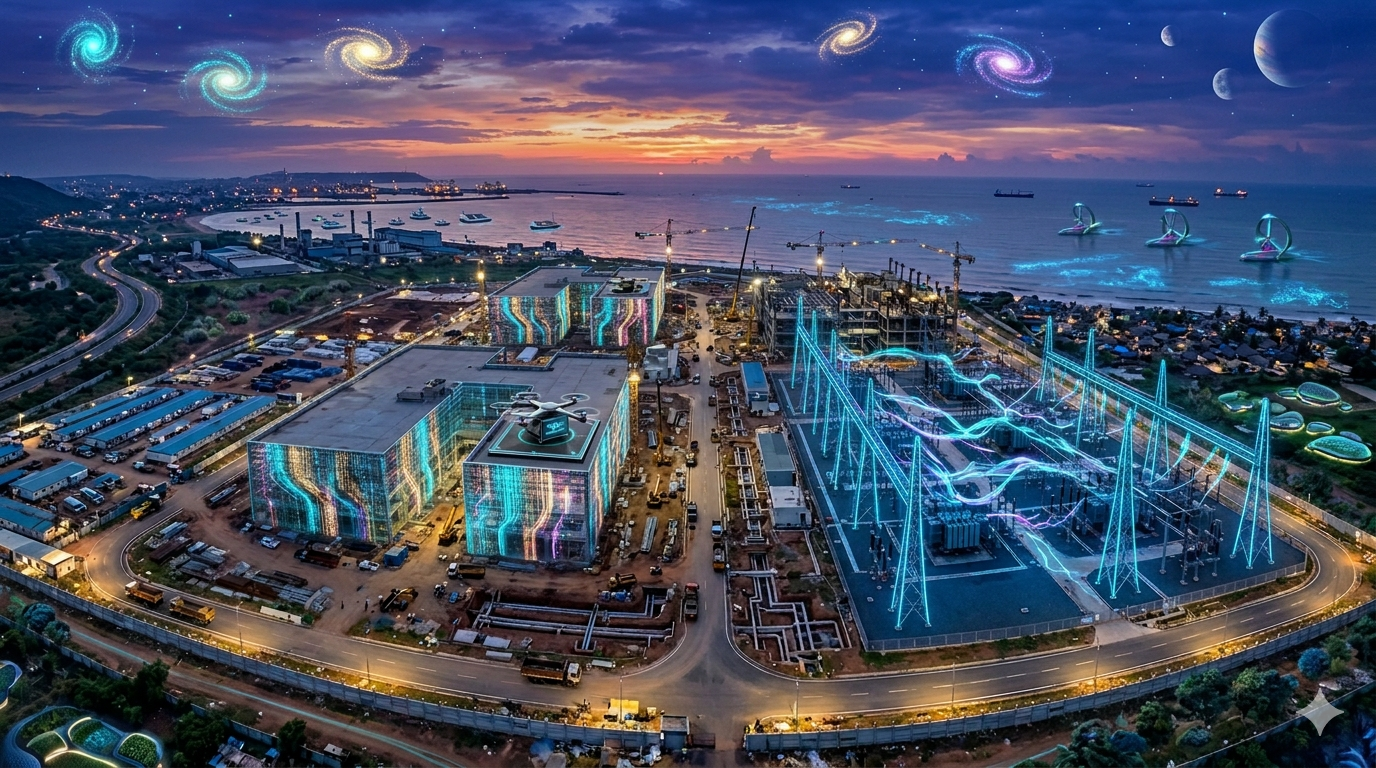
The conversation about India’s AI infrastructure has followed a familiar arc for most of the past five years. Large announcements. Cautious qualification about execution. Acknowledgment of the demand story. Concern about the delivery story. That arc is not wrong — India’s track record of converting infrastructure investment announcements into operational capacity has historically lagged the pace and scale that headline investment numbers imply. However, something has changed in the past twelve months that the cautious qualification framework has not fully processed. The scale of what is being built in India right now, the capital committed, the construction underway, the GPU capacity being deployed, and the hyperscaler relationships being locked in, has crossed a threshold that makes India the largest AI infrastructure buildout outside the United States by any reasonable measure of actual activity rather than announced intent. That claim requires evidence. This piece provides it.

Google’s Thomas Kurian described the Visakhapatnam campus that Google is building as “the largest AI hub that we are going to be investing in anywhere in the world outside of the United States.” That is a statement from the CEO of Google Cloud about a $15 billion, gigawatt-scale facility that begins construction in 2026 and scales to multiple gigawatts through 2030. It is not a statement about announced intent. It is a statement about a project whose site selection is complete, whose partnerships with AdaniConneX and Airtel are signed, and whose subsea cable landing is under development. A single facility of this scale, from a single operator, would put India in the conversation about the world’s most significant AI infrastructure markets. It is not a single facility. It is the largest of several gigawatt-scale commitments that are simultaneously in various stages of development across the country.
The Scale of Capital That Has Already Been Committed
The more than $200 billion in AI-related investment commitments announced at the India AI Impact Summit in February 2026 was the headline that captured global attention. That figure is aspirational in the way that summit announcements always are — it represents the aggregate of stated intentions rather than contracted capital with binding delivery timelines. The figure that is more analytically meaningful is the committed capital from operators who have moved past the announcement stage into the site selection, permitting, and construction phases. That figure exceeds $50 billion across hyperscalers and domestic operators, with the majority of it representing capital that is already deployed or contractually committed to deployment within defined timelines.
Microsoft’s $17.5 billion commitment through 2029 is the largest single hyperscaler commitment to India in the market’s history, and it is backed by physical construction activity across Chennai, Hyderabad, Pune, and a new fourth cloud region designated India South Central in Hyderabad that was scheduled to go live by mid-2026. Amazon Web Services has committed $12.7 billion through 2030, with $8.3 billion explicitly allocated to Maharashtra. Google’s $15 billion covers the Visakhapatnam gigawatt campus and continued expansion of existing cloud regions. Together, the three largest US hyperscalers have committed more than $45 billion to Indian AI infrastructure on timelines that are measured in years rather than decades. These are not exploratory positions. They are the largest commitments these companies have made to any single non-US market and they reflect a commercial assessment that India’s AI infrastructure market will generate returns that justify capital at this scale.

The Domestic Operator Ambition That Matches the Hyperscaler Commitment
The hyperscaler commitments are matched by domestic operator ambitions that are unusually well-capitalised for an emerging market AI infrastructure cycle. Reliance Industries, through its partnership with Nvidia, is developing a 1 gigawatt AI data center facility in Gujarat using Nvidia Blackwell GPUs, with a roadmap to 2,000 megawatts of eventual capacity to support the JioBrain platform serving 450 million customers. Tata Group and Tata Consultancy Services announced plans at the February 2026 AI Impact Summit to build AI-optimised data centers beginning at 100 megawatts and scaling toward 1 gigawatt, with OpenAI confirmed as the first anchor tenant. AdaniConneX has set a target of 1 gigawatt of capacity backed by a $10 billion investment roadmap.
Larsen and Toubro is building sovereign, gigawatt-scale Nvidia AI factory infrastructure with initial expansions to 30 megawatts in Chennai and a new 40-megawatt facility in Mumbai as the first phase of a much larger buildout. CtrlS Datacenters has committed $2 billion for AI-ready green campuses. NTT DATA is developing a $1.2 billion AI cluster in Hyderabad.
Why Domestic Operators Matter
The combined domestic and hyperscaler pipeline targeting delivery by 2030 implies a total installed capacity of 4 to 5 gigawatts, up from approximately 950 megawatts in 2024 and a projected 2 gigawatts by end 2026. That capacity trajectory is comparable to the Gulf states collectively, exceeds Europe’s largest single national market by installed capacity, and is larger than any other market outside the United States and China. The domestic operator layer is particularly important because it creates a self-reinforcing ecosystem dynamic that pure hyperscaler investment does not produce on its own. When Reliance, Tata, and Adani build AI infrastructure at gigawatt scale, they create demand for local engineering talent, local construction contractors, local power infrastructure, and local equipment suppliers that compounds the development of the broader ecosystem in ways that hyperscaler campuses operating as isolated facilities do not.
The GPU Deployment Picture
The GPU deployment picture in India is more developed than most global market analyses acknowledge, in part because a significant share of Indian GPU capacity sits within sovereign and semi-sovereign programs that are not captured in commercial cloud market data. The IndiaAI Mission has empanelled 34,000 GPUs under its Compute Pillar, with plans to add another 20,000 through the IndiaAI Compute initiative and private analysts projecting private sector orders for an additional 100,000 GPUs through 2026. The Finance Ministry has confirmed a 40% subsidy on approved GPU hours, reducing average charges to approximately Rs 67 to 116 per hour, a pricing level that makes India one of the most cost-competitive sovereign AI compute markets in the world for qualified domestic developers and enterprises.
India’s Expanding GPU Ecosystem
Yotta Data Services leads the private GPU deployment pool, operating approximately 60 to 70% of India’s current GPU capacity according to its own disclosures and expanding its Shakti Cloud to 20,736 Nvidia Blackwell Ultra GPUs by August 2026. E2E Networks is building an Nvidia Blackwell GPU cluster on its TIR platform at the L&T Vyoma Data Center in Chennai. Jio, through its Reliance partnership with Nvidia, is deploying GH200 Grace Hopper Superchips and DGX Cloud services for enterprise customers. The national supercomputing backbone contributes the AIRAWAT system at C-DAC Pune, ranked 75th globally with 13,170 teraflops peak performance, alongside the PARAM series of supercomputing systems.
More than 250,000 Indian developers have certified on CUDA programming through Nvidia’s Deep Learning Institute, creating a practitioner base that gives India one of the largest developer communities capable of utilising GPU infrastructure effectively outside the United States. As covered in our analysis of the custom silicon AI accelerator race entering its most consequential phase, the developer ecosystem is as important as the hardware base in determining whether a country’s AI infrastructure investment produces economic value rather than stranded compute assets.
The Sovereign AI Model India Is Building
India’s approach to sovereign AI infrastructure differs from the Gulf model and the European model in ways that reflect its specific policy priorities, economic structure, and technological capabilities. The Gulf model is primarily capital-driven — sovereign wealth funds deploying large amounts of capital into hyperscaler partnerships and AI campus development with relatively limited domestic developer ecosystems. The European model is primarily regulatory-driven — attempting to create competitive conditions for European AI development through data governance frameworks, AI regulation, and public funding programs without a domestic hyperscaler to anchor demand. India’s model combines genuine domestic demand from 1.4 billion people generating some of the highest data consumption per user in the world, a large and rapidly growing domestic developer community, a regulatory framework that creates data localisation incentives for infrastructure investment, and sovereign programs that provide subsidised compute access to startups and researchers who cannot afford commercial cloud pricing.
The IndiaAI Mission’s Innovation Center Pillar is developing foundation models trained on India-specific data, including the Sarvam AI selection as the first sovereign large language model with Indian language capabilities. India has 22 constitutionally recognised languages and over 1,500 more recorded by census, creating a model development requirement that is uniquely suited to domestic infrastructure and domestic training pipelines. OpenAI has established a memorandum of understanding with the IndiaAI Mission to create an AI Academy offering instruction in Hindi, English, and regional languages. These are not peripheral activities. They are the demand-side foundations that will determine whether India’s AI infrastructure investment produces a domestic AI industry or simply hosts foreign operators serving foreign customers from Indian facilities.
The Regulatory Architecture That Is Accelerating Investment
India’s regulatory environment for AI infrastructure investment has undergone a structural shift in the past two years that the global investment community has not fully priced into its assessment of India as a technology market. The Digital Personal Data Protection Act, passed in August 2023 and now in active implementation, creates data localisation requirements that make Indian data center investment commercially necessary rather than strategically optional for any company serving Indian customers with regulated data categories.
Healthcare records, financial data, government applications, and consumer data from India’s 1.4 billion internet users all face localisation requirements that require processing within Indian jurisdiction. That requirement is a structural demand floor for Indian AI infrastructure that does not depend on the quality of government policy execution, the speed of permitting, or the pace of power infrastructure development. It exists because the law requires it, and the enterprises serving Indian customers have no choice but to invest in Indian infrastructure to comply.
The DPDP Act sits alongside a broader policy framework that has progressively made India a more attractive destination for AI infrastructure investment at every level of the stack. The Production Linked Incentive scheme for electronics manufacturing is building domestic semiconductor assembly and testing capacity that reduces India’s dependence on imported components for its data center buildout. The IndiaAI Mission’s compute subsidy program, which provides a 40% reduction on approved GPU hours for qualified domestic users, creates a price point for AI compute access that competes directly with commercial cloud pricing for the startup and research communities that produce the developer talent the ecosystem needs. The government’s decision to select Sarvam AI as the developer of India’s first sovereign large language model, with state funding and compute access, signals a commitment to domestic AI capability development that goes beyond hosting foreign operators’ workloads.
The Competition Among Indian States
A dimension of India’s AI infrastructure buildout that receives less attention than the national-level investment picture is the competition among Indian states to attract data center investment through state-level incentives, expedited permitting, and infrastructure support. Andhra Pradesh, which is hosting Google’s gigawatt campus in Visakhapatnam and Reliance’s $11 billion AI mega-center in the same city, has set a state-level target of 6 gigawatts of data center capacity by 2029 and is offering land acquisition support, power connection guarantees, and single-window permitting for qualifying investments. Maharashtra has established a dedicated data center policy that provides capital subsidies, reduced stamp duty, and expedited environmental clearances for investments above a defined threshold. Telangana has developed the T-Fiber broadband backbone and established data center parks with pre-approved power connections in Hyderabad that reduce the permitting timeline for new facilities from years to months.
This state-level competition is creating a market structure where operators have genuine choices among Indian markets rather than being concentrated in a single location, which reduces the infrastructure concentration risk that has historically made single-city data center ecosystems vulnerable to grid constraints and local permitting bottlenecks. The geographic distribution of major commitments across Andhra Pradesh, Maharashtra, Karnataka, Telangana, and Tamil Nadu means that India’s AI infrastructure buildout is developing a genuinely national footprint rather than replicating the concentration dynamic that produced infrastructure bottlenecks in Northern Virginia, Amsterdam, and Dublin. That distribution is not accidental. It reflects deliberate state-level policy competition that has made India’s regulatory environment more supportive of data center development than any other emerging market and more responsive to operator needs than several developed markets.
The Subsea Cable Infrastructure That Connects India to the World
A dimension of India’s AI infrastructure buildout that market analyses focused on data centers and GPU capacity frequently overlook is the subsea cable infrastructure connecting Indian AI facilities to the global internet and to the hyperscaler backbone networks that carry AI workload traffic. AI infrastructure is only as valuable as its connectivity to the users, data sources, and model serving endpoints it needs to reach, and India’s subsea cable position has historically constrained its ability to serve as a genuine AI infrastructure hub rather than primarily a domestic market.
That constraint is being resolved at a pace that matches the data center buildout. Google’s Visakhapatnam campus includes a private subsea cable landing that connects the facility directly to Google’s global backbone network, bypassing the public internet exchange infrastructure that creates latency and reliability vulnerabilities for AI workload traffic. Meta has invested in the 2Africa cable system which lands in India, providing additional transatlantic and Africa-to-India connectivity. Jio has developed its own submarine cable network connecting India to Southeast Asia, the Middle East, and Europe. The collective investment in Indian subsea cable infrastructure over the past three years represents one of the largest additions to the country’s international connectivity in its history, creating the bandwidth foundation that AI infrastructure at hyperscale requires.
As covered in our analysis of the hyperscaler consolidation of AI infrastructure, the operators building the most durable competitive positions in global AI infrastructure are those integrating compute, power, and connectivity into vertically controlled campuses that do not depend on third-party infrastructure at any critical layer. India’s most significant AI infrastructure investments are being structured on exactly this model.
Why India’s AI Infrastructure Position Will Compound Over Time
The compounding dynamic of India’s AI infrastructure buildout is the most important long-term feature of the market and the one that makes the next five years structurally different from the previous five. When Google builds a gigawatt campus in Visakhapatnam, it does not simply add gigawatt-scale compute capacity to India’s AI infrastructure inventory. It adds a reference site that other operators evaluate when making location decisions, a talent development anchor that trains engineers whose skills compound into the broader ecosystem, a supply chain stimulus that develops local contractors and equipment suppliers, and a credibility signal that reduces the perceived risk of competing investments in the same market. Each major investment makes the next investment easier to justify, faster to execute, and more likely to succeed.
The same compounding logic applies to the developer ecosystem. Every Indian engineer who trains on CUDA, every startup that accesses IndiaAI compute credits, every enterprise that deploys a language model on Indian sovereign infrastructure, and every IT services firm that builds an AI practice serving global clients from Indian data centers is adding to a capability base that compounds in value with every additional participant.
India already has 250,000 CUDA-certified developers, more than any country outside the United States. It has a startup ecosystem raising hundreds of millions annually for AI-specific ventures. It has IT services firms with global client relationships that create guaranteed demand for Indian AI compute capacity regardless of what the domestic consumer market produces. These are not aspirational outcomes. They are existing realities that the investment flowing into Indian AI infrastructure in 2026 is building on rather than starting from scratch. The compounding has already begun. The question is how fast it accelerates from here.
The Power and Execution Challenge That Remains Real
The honest assessment of India’s AI infrastructure buildout requires confronting the execution challenge that has historically limited India’s ability to deliver on large infrastructure commitments. Data center capacity doubled from 950 megawatts in 2024 to a projected 2 gigawatts by 2026, which is genuinely impressive absolute growth. Reaching 4 to 5 gigawatts by 2030 requires sustaining that growth rate across a buildout that is simultaneously navigating grid interconnection queues, state-level permitting processes, renewable energy procurement pipelines, and specialist construction contractor availability that are all under pressure from the same demand surge that is driving the investment.
Power is the binding constraint in India’s AI infrastructure buildout in the same way that it is the binding constraint globally. The difference is that India’s power infrastructure challenges are compounding with a grid that serves 1.4 billion people across a geographically vast country where transmission infrastructure quality varies enormously between markets. The markets where AI infrastructure investment is most concentrated — Mumbai, Chennai, Hyderabad, Bengaluru — are also the markets where the grid is most congested and where new large-scale connections require the most infrastructure investment to enable.
As covered in our analysis of India’s data center transmission problem, the gap between the investment commitment flowing into Indian data centers and the power transmission infrastructure needed to serve that investment is a structural constraint that policy support has not yet resolved. Operators building behind-the-meter renewable generation into their campuses are addressing this constraint more effectively than those depending on grid connections, and campuses designed with power self-sufficiency from the start are disproportionately the ones coming online on schedule.
The Talent and Ecosystem Depth That Differentiates India
The factor that most differentiates India’s AI infrastructure buildout from comparable programs in the Gulf, Southeast Asia, and Europe is the depth of its domestic talent and developer ecosystem. India produces more engineering graduates annually than any other country. The IT services sector, including TCS, Infosys, and Wipro, has trained hundreds of thousands of employees in AI and machine learning over the past two years. TCS alone has trained over 100,000 employees in AI, with more than 250 generative AI opportunities active in its client pipeline. Infosys has over 100 new generative AI agents under development. Wipro has trained 180,000 employees in generative AI principles. These companies are not simply consumers of AI infrastructure. They are deployers of AI applications on behalf of the global enterprises they serve, creating sustained commercial demand for Indian AI compute capacity that goes beyond the sovereign and hyperscaler investment layer.
A Multi-Layered Demand Stack
The startup ecosystem adds a third demand layer. Indian AI startups raised $780.5 million in 2024 to 2025, a 40% increase from the previous year. Over 100 generative AI startups have raised more than $1.5 billion since 2020. Infrastructure-focused startups including NxtGen, Netweb Technologies, and Neysa are building critical components of the GPU ecosystem from within India rather than depending entirely on imported solutions. Netweb alone has installed more than 5,000 AI-focused GPU systems and reached a market capitalisation that reflects investor confidence in the domestic AI infrastructure supply chain.
The combination of multinational hyperscaler investment, domestic conglomerate ambition, sovereign AI programs, IT services sector deployment, and startup ecosystem development creates a demand stack for AI infrastructure that no other non-US market currently matches in depth or diversity. India’s AI infrastructure buildout is the largest outside the United States not simply because of the capital being committed but because of the ecosystem being built around it.
Why the Global AI Industry Needs India to Succeed
The global AI infrastructure market has a concentration problem. As covered in our analysis of the global GPU deployment picture in 2026, the United States accounts for 77% of global AI infrastructure spending, creating single points of failure, supply chain dependencies, and geopolitical vulnerabilities that a more distributed global AI infrastructure market would reduce. India’s buildout is the most credible path to meaningful geographic diversification of global AI infrastructure that currently exists. If India delivers on even 60% of its committed pipeline by 2030, it will have created the second-largest AI infrastructure base in the world outside the US-China duopoly, providing a market, a developer community, and a manufacturing base that the global AI industry needs to reduce its dependence on a handful of US hyperscaler facilities in a handful of US markets.
Why India’s Execution Matters Globally
The stakes of India’s execution on this opportunity are therefore not limited to India’s own economic development trajectory. They extend to the resilience, diversity, and geographic distribution of the global AI infrastructure market that every country building AI applications depends on. The operators, investors, and enterprise buyers who are evaluating India’s AI infrastructure market in 2026 are not simply evaluating a commercial opportunity in a large emerging market. They are evaluating whether the physical foundation of global AI compute can become meaningfully less concentrated than it is today, and whether India can build the infrastructure, talent, and ecosystem that would make that diversification real.
The evidence of the past twelve months suggests that India is executing on this opportunity more effectively than the cautious qualification framework that has historically governed how analysts assess Indian infrastructure ambitions would predict. That does not mean execution risk has disappeared. It means the probability that India delivers a transformational AI infrastructure outcome is higher than it has ever been, and the case for taking it seriously as a primary market rather than an emerging one is now compelling.










