Data centers once symbolized order, symmetry, and predictability, yet the next generation of compute already bends those assumptions at the edges. Engineers who walk through facilities optimized for GPU clusters and high-density racks increasingly confront prototypes that resemble laboratory instruments rather than server hardware. As quantum processors and neuromorphic chips leave research labs and enter early commercial environments, infrastructure architects must rethink what a computing facility actually supports. The question no longer centers on megawatts alone, because coherence, stability, and signal precision now define operational success. Therefore, infrastructure strategy must evolve from thermal containment and density stacking toward environmental stewardship and hardware heterogeneity. The next layer of data center design will not replace the classical era, but it will sit beside it and challenge nearly every inherited convention.
When Compute Stops Looking Like Compute
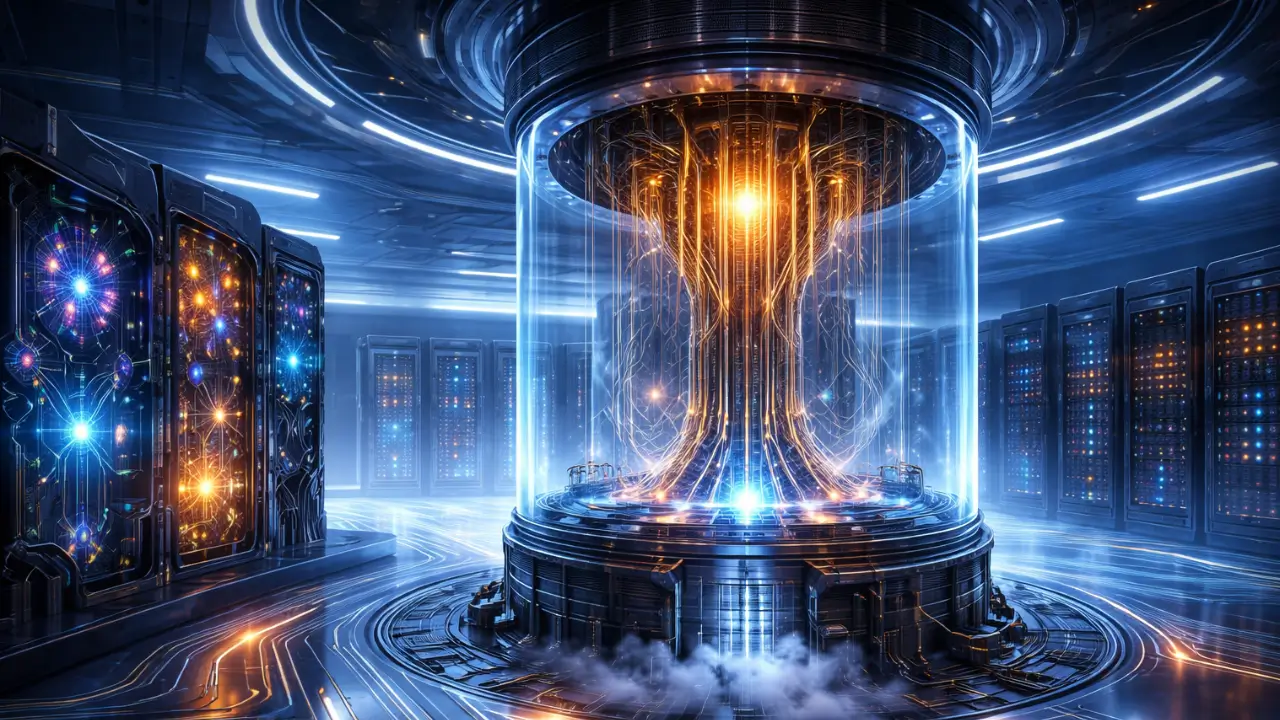
Traditional data centers grew around rack-based symmetry, predictable airflow corridors, and standardized enclosures that simplified maintenance and scaling. In contrast, quantum systems such as those developed by IBM and Rigetti Computing rely on dilution refrigerators that tower vertically and suspend superconducting qubits inside cryogenic chambers. These structures resemble precision laboratory equipment more than IT appliances, which immediately disrupts the visual and architectural identity of a white space. Neuromorphic systems such as Intel’s Loihi platform, introduced by Intel, further complicate expectations because they emphasize event-driven architectures rather than continuous high-power computation. Consequently, operators cannot assume uniform power draw, predictable thermal exhaust, or rack-aligned service pathways when these systems enter shared facilities. This shift signals a deeper architectural transition, where the data center floor increasingly accommodates heterogeneous experimental forms rather than strictly modular rack assemblies.
Spatially, classical compute depends on repeatability, while emerging paradigms depend on isolation and calibration. Quantum processors require shielding from electromagnetic noise and mechanical vibration, both of which commonly exist in large-scale facilities that prioritize throughput over delicacy. Neuromorphic hardware, by contrast, reduces energy per operation but introduces analog characteristics that demand signal fidelity and timing accuracy. Instead of rows of identical cabinets, facilities may incorporate equipment that spans floor-to-ceiling cryostats, optical tables, and vibration-damped platforms. Such diversity breaks the predictable symmetry that once defined hyperscale design and forces architects to rethink circulation paths and service clearances. As a result, compute stops looking like compute, and infrastructure teams must learn to support instruments rather than just servers.
Architectural Identity Under Pressure
The architectural identity of a data center traditionally reinforces reliability through repetition and standardization. However, as quantum hardware matures, providers deploy bespoke enclosures that defy uniform rack geometry. Companies pursuing photonic quantum systems, including PsiQuantum, experiment with optical components and waveguides that demand entirely different spatial relationships than superconducting stacks. Meanwhile, cryogenic platforms developed in collaboration with research institutions such as MIT highlight how academic laboratory layouts influence early commercial deployments. Consequently, the boundary between research lab and data center begins to blur, especially in facilities that support hybrid workloads. Infrastructure planners therefore must incorporate flexibility at the architectural level rather than treating non-rack equipment as temporary exceptions.
The transformation also alters how operators perceive risk and resilience. Classical racks tolerate minor airflow turbulence or vibration without catastrophic performance loss. Quantum systems, on the other hand, experience decoherence when environmental instability disrupts fragile quantum states. Therefore, resilience shifts from redundancy of servers toward stability of environment. That shift requires architects to integrate structural engineering, electromagnetic management, and thermal precision at earlier design stages. Ultimately, the visual language of compute evolves from repetitive grid to calibrated ecosystem.
Beyond the Rack: Spatial Design in a Post-Classical Era
For decades, spatial planning revolved around the rack as the atomic unit of compute deployment. Engineers calculated power density per cabinet, optimized hot aisle containment, and scaled facilities through linear expansion models. However, quantum systems disrupt this logic because dilution refrigerators demand vertical clearance, reinforced flooring, and dedicated service access. Instead of packing compute nodes side by side, designers must allocate buffer zones that minimize vibration and electromagnetic coupling. In addition, optical interconnects and photonic components may require line-of-sight pathways or shielded conduits that differ from copper or fiber routing norms. As a result, spatial planning transitions from density maximization toward isolation optimization.
Quantum hardware often operates at temperatures close to millikelvin levels, achieved through complex cryogenic stacks that extend upward and downward from a central processing region. These systems require proximity to cryogenic compressors, helium circulation lines, and monitoring instrumentation, which collectively reshape equipment adjacency rules. Moreover, designers must incorporate shielding zones that mitigate electromagnetic interference from nearby transformers, switchgear, or high-current busways. Facilities that host both classical and quantum systems may therefore segment floor space into graded stability tiers, each with its own tolerance thresholds. Instead of uniform white space, operators define controlled micro-environments embedded within the broader facility envelope. Consequently, the post-classical era introduces architectural zoning as a core design discipline rather than a secondary refinement.
Spatial evolution also intersects with urban land constraints and sustainability targets. Cryogenic systems typically consume less total power than massive GPU clusters, yet they impose strict mechanical and acoustic requirements. Therefore, architects cannot simply repurpose existing rack halls without structural assessments and vibration analysis. In metropolitan environments where retrofitting dominates new builds, this challenge intensifies because legacy floors may lack necessary damping characteristics. Providers must weigh whether to embed experimental compute inside established campuses or develop specialized annexes that isolate sensitive equipment. That strategic choice will influence capital allocation, regulatory compliance, and long-term scalability.
Rethinking Environmental Control as a Precision Discipline
Data centers historically pursued brute-force cooling capacity to counter escalating thermal loads from CPUs and GPUs. However, quantum systems invert this equation because they demand extreme cold at the processor core while rejecting heat at higher temperature stages. Dilution refrigerators rely on multi-stage cooling cycles that progressively reduce temperature from ambient to near absolute zero. Consequently, environmental control extends beyond airflow management toward cryogenic thermodynamics and vibration mitigation. Neuromorphic hardware also reshapes assumptions because it reduces overall energy per operation and therefore changes heat distribution patterns across a facility. Infrastructure teams must therefore engineer environments for delicacy and calibration rather than simply for capacity and redundancy.
Thermal, Acoustic, and Electromagnetic Stability
Thermal stability in quantum environments does not tolerate rapid fluctuations that classical servers easily absorb. Even small mechanical vibrations from cooling units or external traffic can disrupt qubit coherence times, which remain limited despite rapid progress. Electromagnetic interference from adjacent electrical infrastructure can also introduce noise that degrades quantum fidelity. Therefore, designers increasingly consider acoustic dampening materials, non-magnetic construction components, and shielded cable pathways. These measures transform environmental control into a precision discipline that aligns more closely with laboratory engineering than traditional facility management. As emerging paradigms mature, operators who master environmental stability will hold a strategic advantage in hosting advanced compute workloads.
Environmental precision also intersects with monitoring sophistication. Quantum systems integrate dense sensor networks that track temperature gradients, vibration spectra, and electromagnetic conditions in real time. Operators must integrate this telemetry into facility management platforms without introducing additional noise sources. Moreover, maintenance workflows must respect calibration cycles and avoid abrupt environmental shifts during service operations. Consequently, environmental control becomes an active, data-driven stewardship function rather than a passive background utility.
Coexistence of Classical, Quantum, and Neuromorphic Systems
The immediate future of advanced compute will not eliminate classical infrastructure, because most enterprise workloads still depend on conventional processors and accelerators. Instead, facilities must orchestrate coexistence between classical clusters, quantum processors, and neuromorphic platforms within a shared operational envelope. Hybrid workflows already demonstrate this interdependence, as quantum algorithms rely on classical pre-processing and post-processing layers to interpret measurement results. Providers such as IBM integrate quantum processors into cloud-accessible frameworks that depend on conventional servers for orchestration and error mitigation. Similarly, partnerships between Amazon Web Services and multiple quantum hardware startups show how classical hyperscale infrastructure anchors experimental compute access. At present, most hybrid orchestration occurs through cloud-mediated access models rather than widespread on-premise physical integration, although pilot facilities are beginning to explore co-located deployments.
Hybrid Compute Orchestration
Hybrid environments introduce orchestration complexity that surpasses traditional virtualization models. Classical nodes must manage job scheduling, circuit compilation, and error correction routines before and after quantum execution cycles. Neuromorphic processors, meanwhile, excel in pattern recognition and sparse data inference tasks that complement AI pipelines running on GPUs. Therefore, infrastructure architects must ensure deterministic latency between modalities while preventing environmental interference across zones. Physical separation may reduce risk of electromagnetic cross-talk, yet network fabric must preserve ultra-low jitter to maintain computational integrity. As hybrid stacks mature, orchestration software and facility design must evolve together rather than independently.
Operational governance also shifts under hybrid coexistence. Classical uptime metrics focus on availability percentages and redundancy topologies, whereas quantum performance depends on coherence time and gate fidelity. Neuromorphic systems measure success through energy efficiency per inference and spike-based processing stability. Operators must therefore track heterogeneous performance indicators without oversimplifying them into uniform service-level agreements. This governance challenge encourages the creation of tiered reliability frameworks that distinguish environmental precision zones from high-throughput compute halls. Consequently, coexistence requires both architectural separation and management convergence.
The Rise of Cryogenic and Ultra-Stable Infrastructure Zones
Cryogenic infrastructure currently defines superconducting quantum research and early commercial pilot deployments, though it has not yet reached broad data center standardization.. Dilution refrigerators cool qubits to millikelvin temperatures by leveraging helium-3 and helium-4 isotopic mixtures in multi-stage refrigeration cycles. These systems introduce mechanical compressors, gas handling circuits, and vacuum chambers that demand dedicated spatial zoning. Unlike traditional chilled water systems, cryogenic stacks operate within extremely narrow tolerance margins that require continuous calibration. Therefore, operators must treat cryogenic zones as specialized infrastructure layers rather than auxiliary mechanical add-ons. This shift elevates thermal physics to a central architectural discipline within advanced facilities.
Structural Stability and Vibration Management
Ultra-stable zones must mitigate vibration from both internal and external sources. Nearby cooling towers, vehicular traffic, and even seismic microtremors can degrade qubit stability when isolation measures remain insufficient. Facilities that host superconducting hardware often incorporate vibration-dampened slabs or isolated plinth foundations to decouple sensitive equipment from broader structural motion. Research institutions such as National Institute of Standards and Technology emphasize environmental control as a prerequisite for reliable quantum measurement. Consequently, infrastructure teams must integrate structural engineers early in facility planning rather than relying solely on mechanical consultants. Stability becomes a first-order requirement that shapes the entire building envelope.
Cryogenic zoning also affects operational workflows and safety protocols. Helium management demands monitoring systems that detect leaks and maintain appropriate ventilation to protect personnel. Moreover, cryogenic maintenance cycles require controlled access schedules that prevent abrupt environmental shifts. Operators must train staff in both IT operations and specialized cryogenic procedures to avoid procedural conflicts. Therefore, ultra-stable infrastructure zones introduce multidisciplinary coordination between facilities engineering, quantum scientists, and safety teams. As adoption expands, cryogenic competence will distinguish general-purpose campuses from advanced compute hubs.
Electromagnetic Silence and the Architecture of Isolation
Electromagnetic noise permeates modern infrastructure environments through switchgear, transformers, wireless systems, and high-frequency electronics. Classical servers tolerate moderate electromagnetic fluctuation without measurable performance degradation. Quantum processors, however, rely on superconducting or trapped-ion systems that respond sensitively to electromagnetic disturbance. Consequently, architects must design for electromagnetic silence through shielding strategies, cable management discipline, and equipment placement planning. Providers working with trapped-ion architectures, including IonQ, emphasize stability and low-noise environments for sustained qubit coherence. Isolation therefore transforms from optional refinement into structural necessity.
Minimizing Vibration, Interference, and Environmental Noise
Electromagnetic shielding may involve Faraday cages, non-magnetic construction materials, and separation from heavy electrical infrastructure. Designers must analyze harmonic distortion from power systems and mitigate potential coupling pathways into sensitive compute chambers. Moreover, acoustic noise from compressors or adjacent mechanical rooms can induce micro-vibrations that affect calibration stability. Facilities piloting advanced quantum systems may deploy layered barriers that combine physical separation with active monitoring systems, although such measures remain confined to specialized installations. Therefore, electromagnetic silence requires architectural layering rather than a single engineering intervention. Precision zones must remain insulated from both predictable and incidental disturbances.
Isolation strategies also influence campus layout decisions. Locating advanced compute modules away from substations and high-voltage feeders reduces risk of electromagnetic interference. However, distance increases cable length and introduces potential signal attenuation challenges that require careful compensation. Engineers must therefore balance proximity to power distribution with separation from electromagnetic noise sources. This balancing act underscores how infrastructure design now demands interdisciplinary fluency across electrical engineering, materials science, and quantum physics. As compute sensitivity increases, architectural isolation becomes synonymous with computational integrity.
Hardware Diversity as a Foundational Principle
Classical data centers standardized around homogeneous x86 servers, storage arrays, and networking appliances to simplify scaling and maintenance. Emerging compute paradigms dismantle that homogeneity by introducing superconducting circuits, photonic interconnects, analog neuromorphic chips, and experimental substrates. Companies such as Intel advance neuromorphic research through Loihi processors that mimic spiking neural networks rather than clock-driven architectures. Photonic quantum developers, including PsiQuantum, explore silicon photonics to manipulate qubits via light instead of electrical current. This diversity demands infrastructure that accommodates non-standard form factors, signal pathways, and power profiles. Therefore, hardware heterogeneity must become a foundational design principle rather than an operational exception.
Moving Beyond Uniform Server Assumptions
Infrastructure frameworks built solely around rack-mounted uniformity risk constraining future compute innovation. Neuromorphic chips may operate efficiently at lower power densities, which reduces cooling demand but increases sensitivity to analog signal noise. Superconducting elements require cryogenic envelopes that disrupt traditional airflow planning. Photonic systems may prioritize optical fiber routing and low-loss waveguide alignment over copper cable management. Consequently, forward-looking facility designers must begin anticipating varied physical and operational requirements, even though most commercial environments still prioritize homogeneous server infrastructure. Adaptability, not uniformity, will define the resilience of next-generation data centers.
Hardware diversity also reshapes procurement and lifecycle strategies. Vendors may iterate rapidly as research advances refine qubit counts, coherence times, and neuromorphic architectures. Operators must design infrastructure layers that tolerate hardware turnover without extensive structural retrofits. Modular utility distribution, flexible mounting systems, and configurable shielding zones can support this evolutionary pace. Therefore, diversity extends beyond hardware itself and permeates the philosophy of infrastructure adaptability. Facilities that embrace heterogeneity will remain aligned with compute evolution rather than lagging behind it.
Redefining Density Without Chasing Heat
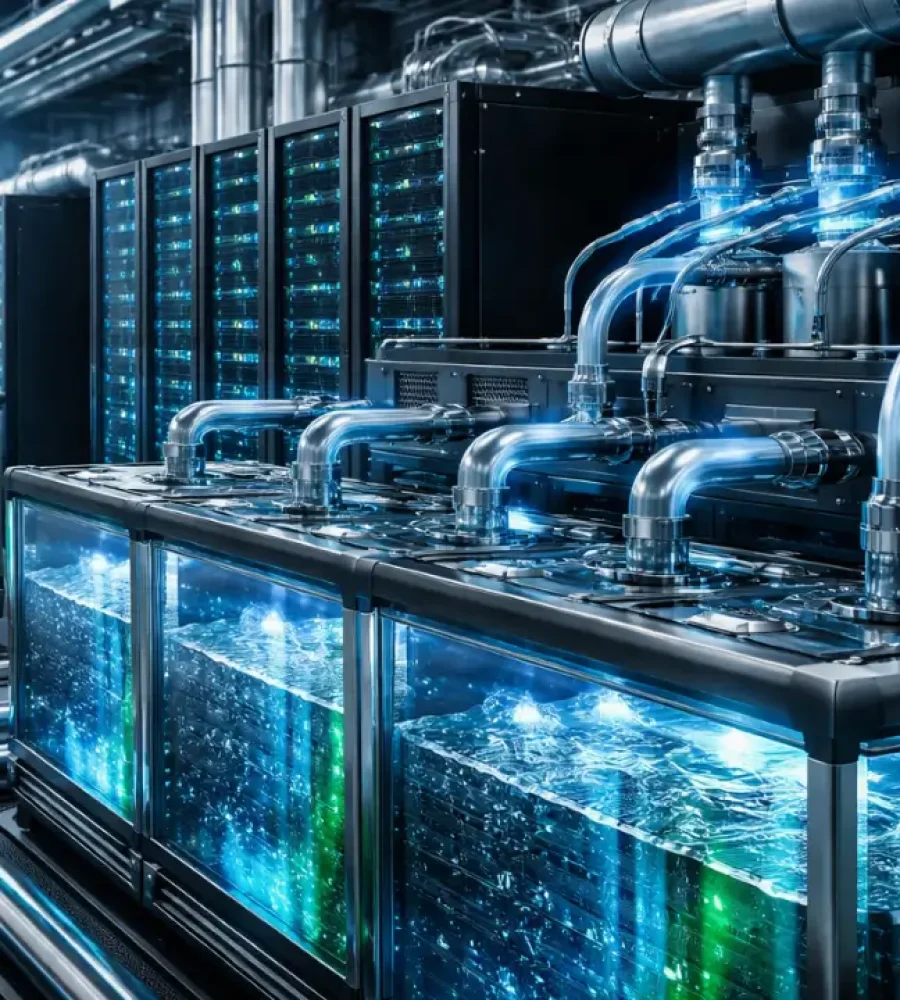
For two decades, the industry equated performance scaling with thermal escalation, because higher compute density almost always translated into greater heat rejection requirements. Hyperscale operators optimized liquid cooling loops, rear-door heat exchangers, and immersion tanks to manage GPU clusters that exceeded 30 kilowatts per rack. However, neuromorphic processors disrupt this correlation because they prioritize event-driven efficiency rather than clock-speed escalation. Research from Intel demonstrates that spiking neural architectures can execute inference tasks at dramatically lower energy per operation compared to conventional CPUs. Similarly, quantum processors consume modest electrical power at the chip level, even though their supporting cryogenic systems introduce specialized overhead. Therefore, density must be redefined around functional performance per environmental constraint rather than watts per square meter alone.
Classical scaling models focused on maximizing computational throughput within confined rack footprints. In contrast, neuromorphic scaling emphasizes synaptic parallelism and sparse activation patterns that do not require proportional thermal expansion. Quantum scaling follows an entirely different path, because qubit count increases depend on error rates, coherence time, and interconnect fidelity rather than raw power density. Consequently, the pursuit of higher density without contextual nuance risks misallocating space and capital. Facilities must evaluate performance scaling metrics that integrate energy efficiency, stability requirements, and orchestration latency across modalities. Density therefore becomes a multidimensional calculation rather than a thermal benchmark.
This recalibration also influences site selection and sustainability narratives. Traditional density increases often demanded access to large power feeds and extensive water resources for cooling. Neuromorphic and certain quantum platforms may reduce electrical intensity per workload, yet they introduce precision constraints that limit facility placement flexibility. Operators must balance environmental sustainability goals with architectural stability needs. As a result, redefining density requires an integrated planning model that aligns compute evolution with infrastructure capability. The industry can no longer assume that higher performance inevitably requires higher thermal burden.
From Airflow Engineering to Signal Integrity Stewardship
Airflow engineering long defined the operational art of data center management. Designers refined hot aisle containment, computational fluid dynamics models, and raised-floor pressure balancing to maintain predictable temperature gradients. However, quantum and neuromorphic systems shift attention from bulk airflow toward signal integrity and coherence protection. Superconducting qubits require stable microwave control signals with minimal distortion, because minor phase errors degrade computational accuracy. Institutions such as National Institute of Standards and Technology emphasize calibration and measurement fidelity as core determinants of quantum reliability. Consequently, infrastructure teams must treat signal pathways with the same rigor once reserved for chilled water distribution.
Signal integrity stewardship demands precise cable routing, impedance control, and electromagnetic isolation. Microwave lines that connect room-temperature electronics to cryogenic processors must preserve phase stability across temperature gradients. Neuromorphic systems also depend on accurate spike timing to maintain inference consistency across distributed networks. Therefore, infrastructure engineers must collaborate closely with hardware architects to ensure that facility layout does not compromise computational pathways. This collaboration blurs the boundary between IT operations and experimental physics. As performance metrics evolve, signal integrity joins uptime as a defining indicator of facility excellence.
Monitoring frameworks must also expand to capture subtle degradation trends. Traditional building management systems track temperature, humidity, and power draw, yet advanced compute requires phase noise analysis and electromagnetic spectrum monitoring. Operators must integrate these telemetry streams into cohesive dashboards without overwhelming teams with noise. Furthermore, maintenance interventions must respect calibration cycles that protect coherence stability. Consequently, the stewardship of signals becomes a central infrastructure responsibility. Airflow remains relevant, yet it no longer monopolizes the narrative of performance protection.
The Materials Question: Floors, Walls, and Structural Stability
Material selection once focused on fire resistance ratings, load-bearing capacity, and cost efficiency. Emerging compute paradigms elevate materials to a strategic variable that influences computational viability. Vibration-dampening foundations, non-magnetic fasteners, and shielding composites now shape infrastructure performance at a granular level. Quantum systems respond to micro-vibrations and stray magnetic fields that traditional server farms largely ignore. Research collaborations involving MIT highlight the interplay between material science and quantum device stability. Therefore, construction materials migrate from peripheral consideration to central architectural determinant.
Engineering the Physical Envelope
Floors that support cryogenic stacks must resist resonance frequencies that amplify environmental vibration. Walls may incorporate layered composites that attenuate electromagnetic interference from adjacent equipment rooms. Ceiling assemblies must accommodate suspended cable trays without transmitting mechanical oscillation into sensitive chambers. Consequently, structural engineers must model dynamic load behavior alongside classical static calculations. The physical envelope becomes an active participant in computational stability rather than a passive shell. Designers who ignore material nuance risk undermining advanced hardware performance.
Material selection also intersects with sustainability and lifecycle planning. High-performance shielding materials may carry embodied carbon implications that challenge environmental targets. Operators must therefore balance computational precision with responsible sourcing and recyclability. Modular material systems can support future retrofits as hardware formats evolve. Consequently, the materials question integrates environmental ethics with performance imperatives. Infrastructure strategy now demands fluency in both physics and sustainability metrics.
Modularity Reimagined for Experimental Eras
Modularity historically meant repeatable rack pods, containerized data halls, and prefabricated power skids that accelerated deployment. Experimental compute, however, evolves faster than traditional hardware refresh cycles and resists strict standardization. Quantum roadmaps project increasing qubit counts, alternative error-correction schemes, and novel interconnect architectures over short research intervals. Companies such as IBM publish quantum development milestones that anticipate rapid iteration in both hardware and control systems. Therefore, modularity will need to evolve toward reconfiguration rather than repetition as experimental compute matures beyond controlled research deployments.Infrastructure frameworks must anticipate flux rather than freeze a single configuration.
Reimagined modularity may include adaptable utility corridors, adjustable shielding panels, and scalable cryogenic interfaces. Instead of fixed rack rows, facilities might deploy configurable zones that accommodate evolving form factors. Electrical distribution systems can incorporate programmable power routing to serve heterogeneous loads without extensive rewiring. Moreover, digital twins can simulate infrastructure adjustments before physical intervention occurs. Consequently, modularity becomes a dynamic capability rather than a static blueprint. Facilities that embrace reconfigurability will align more effectively with experimental momentum.
Rapid evolution also affects vendor relationships and procurement cycles. Hardware developers may refine architecture annually as qubit fidelity improves or neuromorphic topologies mature. Infrastructure teams must avoid rigid contracts that assume long-term uniformity. Flexible service agreements and upgrade pathways can reduce friction as experimental compute scales. Therefore, modularity extends beyond construction technique into governance and commercial strategy. The experimental era rewards adaptability over predictability.
Designing for Uncertainty: Preparing for Paradigm Shifts
Technological history demonstrates that dominant paradigms rarely persist without disruption. Classical computing achieved remarkable scale, yet quantum and neuromorphic research signals that alternative models may augment or transform portions of the workload landscape. Infrastructure strategy must therefore embrace uncertainty as a design parameter rather than an external risk. Organizations such as National Institute of Standards and Technology continue to develop standards that guide quantum experimentation and measurement consistency. These efforts underscore that the field remains dynamic and subject to rapid refinement. Consequently, facilities must cultivate architectural elasticity that accommodates change without compromising operational integrity.
Architectural Elasticity as Strategic Discipline
Architectural elasticity represents a strategic planning approach that forward-looking operators are beginning to evaluate, rather than a universally adopted infrastructure standard.Instead of optimizing solely for present workloads, designers must allocate buffer capacity for experimental integration. Scenario modeling can evaluate how future compute forms might influence spatial and environmental requirements. Moreover, cross-disciplinary governance structures can align infrastructure evolution with hardware research trajectories. Therefore, preparedness hinges on institutional learning as much as physical design. Facilities that internalize uncertainty will navigate paradigm shifts with measured confidence.
Uncertainty also reshapes workforce competencies and organizational culture. Engineers must understand not only airflow management but also coherence preservation and signal stability principles. Collaboration between facility managers and quantum scientists will intensify as experimental deployments expand. Continuous training programs can bridge knowledge gaps and sustain operational excellence. Consequently, preparedness extends beyond concrete and steel into human capital development. The next layer of data center design will belong to organizations that combine architectural foresight with intellectual agility.
Engineering the Next Layer with Discipline and Foresight
The evolution of data center architecture has always followed compute demand, yet the age of quantum and neuromorphic systems introduces a different kind of inflection point. Classical infrastructure scaled through repetition, density optimization, and thermal engineering discipline, which created a predictable blueprint for global digital expansion. However, emerging paradigms do not simply require more power or more cooling, because they introduce sensitivity, heterogeneity, and calibration as primary constraints. Therefore, the next layer of infrastructure strategy must elevate environmental precision to the same strategic tier once reserved for uptime and redundancy. This transformation does not invalidate the classical model, yet it compels operators to think beyond it. Ultimately, the facilities that thrive will balance present reliability with future adaptability rather than privileging one at the expense of the other.
Environmental Precision as Strategic Differentiator
At the same time, environmental stewardship will increasingly shape competitive differentiation. Classical compute rewarded operators who optimized airflow, minimized power usage effectiveness, and engineered redundancy across mechanical systems. Advanced compute introduces metrics such as coherence time stability, electromagnetic silence, and vibration damping consistency. These factors may not yet define mainstream service-level agreements, but they will influence trust in facilities that host experimental workloads. Therefore, infrastructure providers who cultivate environmental precision expertise can position themselves as partners in scientific and technological advancement rather than merely as space and power vendors. This shift subtly transforms the identity of the data center from industrial utility to calibrated ecosystem.
Hybrid orchestration also reframes how facilities integrate with digital services. Most quantum access today occurs through cloud-mediated platforms, where classical servers orchestrate quantum tasks remotely. Nevertheless, as pilot installations expand, selective co-location within specialized zones may emerge to reduce latency and enhance experimental control. Infrastructure design must therefore maintain interoperability between conventional clusters and advanced modules without assuming universal physical integration. Flexible network fabrics, deterministic timing architectures, and segmented environmental tiers provide a pragmatic foundation for that coexistence. In this way, the facility evolves into a multi-modal compute campus rather than a single-architecture engine.
Material science and structural engineering will likewise gain prominence in executive planning discussions. Vibration-dampened foundations, non-magnetic construction components, and shielding composites no longer represent niche laboratory considerations when quantum systems enter semi-commercial environments. Although large-scale deployment remains limited, early adopters already demonstrate that structural stability directly affects computational reliability. Consequently, infrastructure leadership must collaborate with structural engineers, physicists, and materials specialists earlier in project cycles. This interdisciplinary coordination ensures that future retrofits do not undermine experimental viability. As a result, floors and walls assume strategic importance alongside transformers and chillers.
Modularity, long celebrated for accelerating deployment, requires reinterpretation in this context. Traditional modularity prioritized repeatability and uniform rack pods, which aligned with predictable hardware refresh cycles. Experimental compute advances through research-driven iteration, where hardware formats may shift annually as architectures mature. Therefore, modular frameworks must emphasize reconfigurability, accessible utility corridors, and adaptable zoning rather than strict replication. This evolution supports incremental adoption while preserving long-term flexibility. Infrastructure that resists rigidity will accommodate progress without incurring disproportionate retrofit costs.
Workforce development represents another decisive variable in preparing for paradigm shifts. Data center engineers historically specialized in electrical distribution, cooling optimization, and network reliability. Advanced compute environments require familiarity with coherence protection, signal integrity management, and cryogenic safety considerations. Cross-training initiatives and collaborative governance structures can bridge knowledge gaps before pilot deployments scale. Furthermore, operators must cultivate partnerships with research institutions and hardware developers to align infrastructure capabilities with technological roadmaps. Human capital, therefore, becomes as critical as structural capital in navigating the next compute era.
Sustainability narratives also demand recalibration in light of emerging paradigms. Neuromorphic processors promise energy efficiency gains per inference task, while quantum processors may address complex optimization problems that improve grid management and materials discovery. Yet supporting cryogenic systems and environmental controls introduce new resource considerations. Consequently, sustainability metrics must incorporate both operational efficiency and infrastructure overhead with transparent accounting. Balanced evaluation prevents overstated environmental claims while preserving legitimate innovation potential. In this way, responsible infrastructure design aligns environmental accountability with scientific ambition.
Uncertainty remains the defining characteristic of this transitional moment. The trajectory of qubit scalability, error correction breakthroughs, and neuromorphic commercialization timelines continues to evolve. Infrastructure strategy cannot eliminate uncertainty, yet it can absorb it through architectural elasticity and disciplined experimentation. By allocating buffer capacity, designing adaptable zones, and maintaining modular upgrade pathways, operators create optionality without sacrificing present performance. This posture reframes uncertainty from threat to strategic variable. The facilities that endure will not predict the future perfectly, but they will remain structurally prepared to engage with it.
Ultimately, the next layer of data center evolution hinges on a philosophical shift as much as a technical one. Operators must transition from designing exclusively for throughput toward designing for integrity, stability, and heterogeneity. Classical compute will continue to anchor digital economies, yet adjacent paradigms will test the elasticity of established infrastructure assumptions. Precision will complement power, and calibration will stand beside capacity as a defining metric of excellence. Therefore, the path forward lies not in abandoning proven models but in expanding them with disciplined foresight. In the age of quantum and neuromorphic compute, the data center becomes less a warehouse of servers and more an engineered environment for possibility.