Advanced Micro Devices Inc. is escalating its race with Nvidia Corp. in one of the most consequential AI growth markets, India. The US semiconductor maker has joined forces with Tata Consultancy Services Ltd. to roll out its newest AI data center architecture, marking a calculated push to expand domestic compute capacity as the country accelerates efforts to localize artificial intelligence workloads.
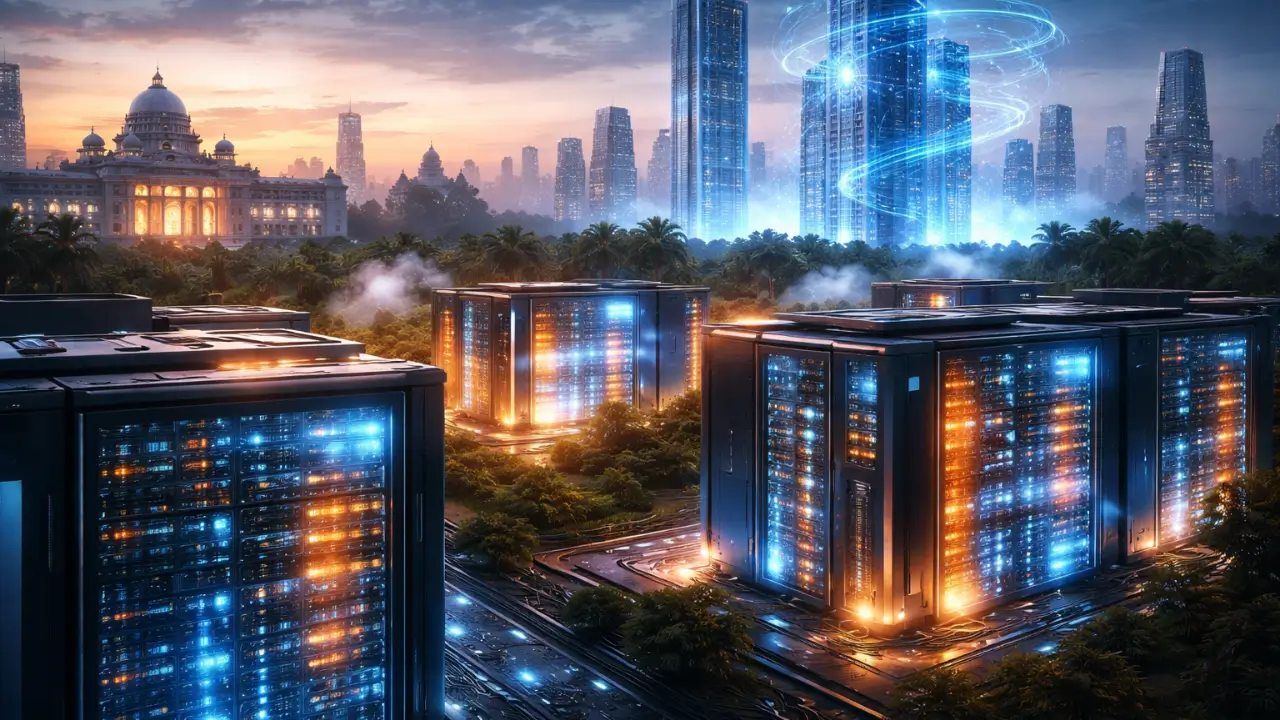
Under the agreement, AMD will introduce its Helios data center blueprint and collaborate with TCS to support up to 200 megawatts of AI infrastructure capacity across India, the companies said in a statement on Monday. The scale of that commitment signals long-term intent rather than a pilot-phase experiment.
India’s technology evolution reinforces the opportunity. Although the country arrived late to the personal computing era, it transformed into a global software services powerhouse. Moreover, it leapfrogged from limited landline penetration to nearly a billion smartphone users within two decades, a pace few large economies have matched.
According to Stanford University’s Institute for Human-Centered AI, India ranks third globally in AI competitiveness, behind the US and China. Consequently, the country now stands at the center of semiconductor and infrastructure expansion strategies.
Competitive Pressure Mounts as Market Share Shifts
AMD’s India expansion aligns with its broader strategy to deliver end-to-end AI infrastructure rather than compete solely at the accelerator level. Helios functions as a scalable blueprint for AI-native data centers, positioning AMD as a systems architect, not just a chip supplier.
Tata Consultancy Services Ltd. has begun building its own infrastructure footprint. Late last year, the IT services major announced plans to enter the data center market with ambitions to target as much as 1.2 gigawatts of capacity. The AMD alliance now injects high-performance silicon depth into that roadmap.
“AI adoption is accelerating from pilots to large-scale deployments, and that shift requires a new blueprint for compute infrastructure,” Chief Executive Officer Lisa Su said in Monday’s statement. “Together with TCS, we are enabling enterprises across India to deploy AI at scale today while building the compute foundation of tomorrow.”
The competitive backdrop has also started to evolve. Arista Networks Inc., an AMD partner, said last week that it is seeing about 20 per cent to 25 per cent of chip deployments going to AMD, compared with 99 per cent of AI chip deployments going to Nvidia in 2025.
That data indicates early diversification among enterprise and cloud customers. Buyers increasingly seek multi-vendor strategies to reduce supply concentration risks and pricing dependency. Therefore, India becomes both a growth market and a strategic proving ground.
Sovereign Compute Becomes Strategic Priority
Beyond corporate rivalry, national priorities add another layer of urgency. Governments across Asia are pushing to localize compute capacity amid data sovereignty concerns. India has intensified efforts to build domestic data center infrastructure that can support sovereign AI models and large-scale public digital systems.
The 200-megawatt target represents foundational capacity for generative AI workloads, enterprise automation, and digital public infrastructure expansion. As AI applications move from experimentation to production, compute density will define economic leverage.
AMD’s India AI infrastructure strategy embeds the company deeper into the country’s long-term digital transformation. By pairing Helios architecture with TCS’s execution scale, AMD is positioning itself not only as Nvidia’s competitor, but as a structural participant in India’s next compute cycle.