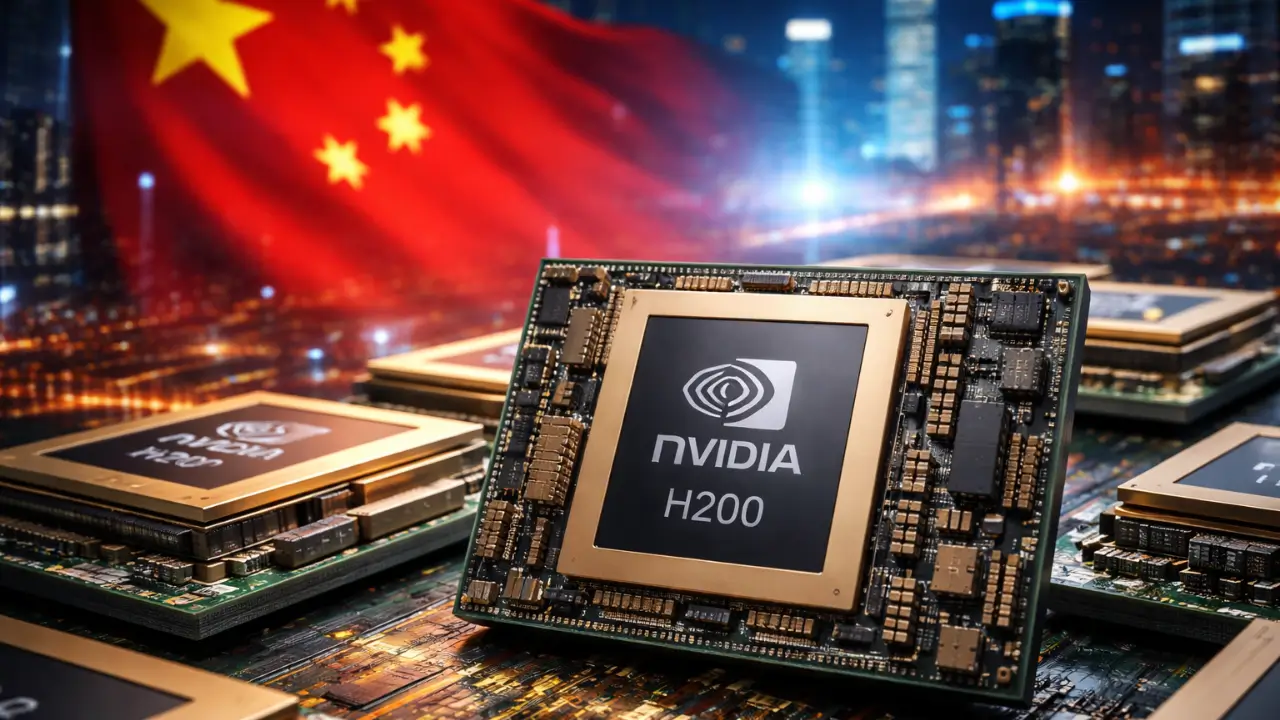
Beijing has begun approving imports of Nvidia’s H200 Graphics Processing Units, ending weeks of regulatory uncertainty that disrupted AI infrastructure planning across China’s largest technology firms. The decision allows more than 400,000 of the advanced AI chips to enter the country, primarily for leading internet companies racing to scale foundation models and enterprise AI platforms.
According to two sources familiar with the matter, the first approvals target private-sector technology leaders with urgent demand for high-performance computing. Meanwhile, access for state-backed firms, including major telecommunication network operators, remains tightly restricted. The staggered approach highlights Beijing’s effort to manage AI capacity growth while retaining oversight over strategic infrastructure.
The approvals, first reported by Reuters, cover shipments to ByteDance, Alibaba Group Holding, and Tencent Holdings. Other companies continue to await regulatory clearance. Alibaba owns the Post.
Beijing Balances AI Demand With Self-Reliance Strategy
The move follows a temporary suspension earlier this month, when Beijing paused H200 shipments shortly after Washington approved exports. That halt underscored how geopolitical oversight now shapes the flow of advanced semiconductors. With approvals now moving forward, regulators appear to be striking a narrow compromise between immediate compute needs and long-term industrial policy.
The H200, Nvidia’s second most powerful AI chip, remains one of the few options available to Chinese firms seeking to train and deploy large-scale models at competitive speeds. Washington cleared exports earlier this month under conditions that shipments must not exceed 50 per cent of the volume sold domestically in the US. That constraint continues to frame how much capacity Chinese buyers can secure.
Industry analysts describe the approval as neither a full opening nor a symbolic gesture. Instead, it reflects a calibrated response to market pressure.
Imports of the H200 reflected a “balanced outcome”, said Randy Abrams, Head of Taiwan research at UBS Group. Unlimited access to Nvidia’s advanced chips could hinder the growth of China’s domestic industry, making some form of framework necessary for regulators to limit adoption percentage and manage demand, he added.
That framework appears to prioritize private-sector innovation while limiting systemic dependence. As a result, regulators have kept approvals selective, particularly for firms tied to national infrastructure.
Strategic Motives Behind the Approval
The decision also carries broader strategic implications. Beijing has repeatedly emphasized the importance of developing indigenous semiconductor capabilities, even as domestic alternatives lag behind Nvidia’s performance for large-scale AI workloads.
“Beijing’s approval of the H200 is driven by purely strategic motives,” said Alex Capri, a senior lecturer at National University of Singapore’s business school. “Ultimately, this decision is taken to further China’s indigenous capabilities and, by extension, the competitive capabilities of China tech.”
By allowing limited imports, policymakers can relieve short-term compute bottlenecks while buying time for domestic chipmakers to advance. The approach also prevents a sudden surge in foreign chip dependency that could undermine long-term self-reliance goals.
China’s appetite for computing power remains intense. AI development across consumer platforms, enterprise services, and industrial applications has pushed demand beyond what domestic suppliers can currently meet.
Expanding Demand Beyond Internet Giants
While the first wave of approvals focuses on internet platforms, demand for the H200 extends far beyond social media and e-commerce. Advanced GPUs play a growing role in autonomous driving, financial modeling, industrial automation, and scientific research.
The GPU would have massive market potential in China, with its demand likely to extend beyond internet firms to sectors such as autonomous driving and finance, Liu added.
That broader demand explains why regulators have opted for phased approvals rather than a blanket green light. By controlling distribution, Beijing can steer where the most advanced compute capacity concentrates and how quickly it scales. For Nvidia, the decision restores access to one of the world’s largest AI markets, albeit under strict conditions. For China’s tech giants, it offers breathing room at a moment when AI competition intensifies globally.
Still, uncertainty remains. Additional approvals will depend on geopolitical developments, domestic policy priorities, and the pace at which China’s own semiconductor ecosystem matures. For now, however, Beijing’s clearance of the H200 signals a pragmatic pause in the chip standoff, even as the long-term push for technological independence continues.