The news that Lausanne-based deeptech startup Corintis has secured an additional $25 million in Series A1 funding is a powerful validation of a thesis we have long held: the future of high-performance computing (HPC) and Artificial Intelligence (AI) will be won or lost at the thermal layer. This latest round, led by Applied Digital, brings the company’s total funding to $58 million, signaling a massive appetite for solutions that can break the thermal constraints currently limiting the power of next-generation GPUs.
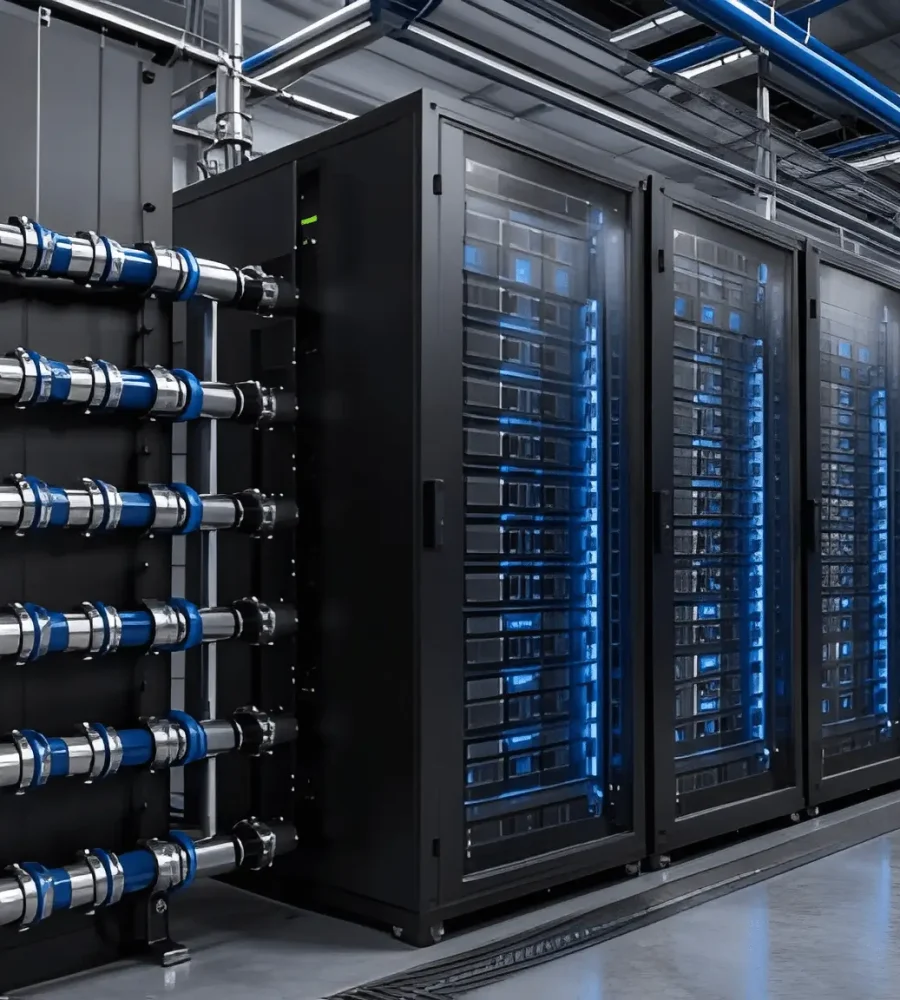
We interpret this rapid scaling of investment as definitive proof that conventional liquid cooling methods are nearing their practical limit in the age of AI. As AI workloads push power densities to unprecedented levels, liquid cooling is no longer a niche luxury; we see it as a fundamental prerequisite.
Corintis is positioning itself at the vanguard of this transition with its direct-to-chip microfluidic cooling systems. Our analysis suggests the company’s key differentiator lies in its ability to offer solutions that can be either “drop-in replacements” for standard cold plates or integrated directly into GPUs. More compellingly, the technology has already been validated in collaboration with Microsoft to achieve up to three times lower chip temperatures compared to existing liquid cooling approaches. Beyond performance, this microfluidic approach supports higher power densities and improved energy efficiency, metrics that are non-negotiable for hyperscale operators struggling with PUE and environmental impact.
The participation of a data center operator like Applied Digital underscores the strategic importance of advanced cooling not just for component manufacturers, but for the digital infrastructure ecosystem itself. Applied Digital designs and operates high-performance facilities optimized for AI, and we believe they view Corintis’s technology as a critical enabler of efficiency, reliability, and, crucially, future capacity at scale.
This $25 million infusion will directly fund the company’s transition from pilot deployments to massive commercialization. It will support the opening of a U.S. office, significant scaling of manufacturing capacity for their microfluidic systems, and the acceleration of customer deployments with major technology and data center operators, many of whom are already signed on.
We gather that Corintis, an EPFL spin-off, exemplifies how deeptech innovation is now driving the core infrastructure of the AI era. The global race to build high-density compute infrastructure is accelerating, and the capital flow here confirms that the path forward is through revolutionary thermal management.