 Skip to content
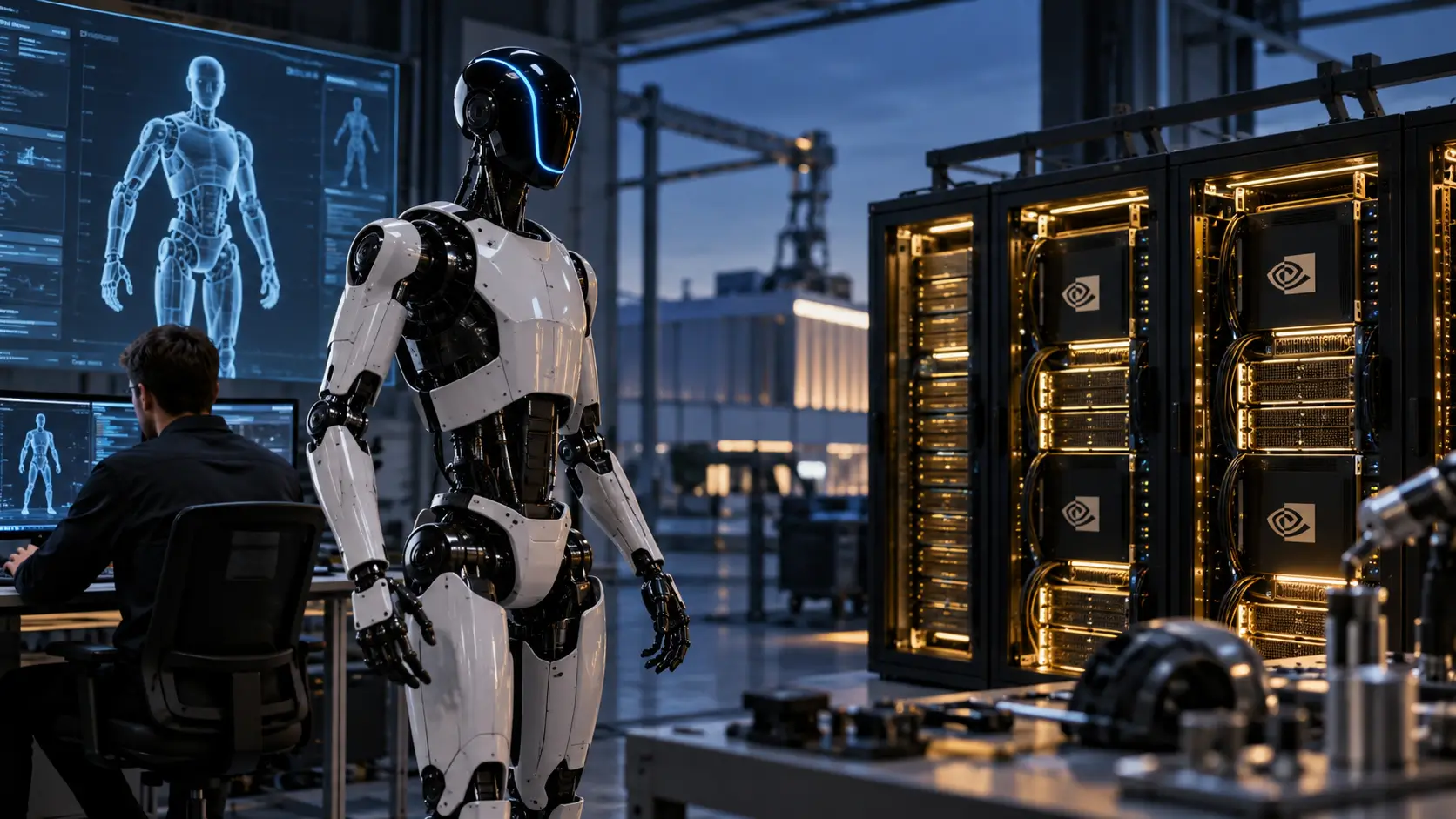
Nscale has secured a multiyear strategic partnership with humanoid robotics company Figure that could turn physical AI into a major new source of hyperscale compute demand. The agreement starts with a $3.5 billion compute commitment and carries an intent to scale beyond $6 billion, creating a substantial infrastructure runway for Figure’s robotics development. The companies could deploy the NVIDIA Vera Rubin platform with up to 100,000 NVIDIA GPUs, with initial deployment targeted for the second half of 2027 in Barstow, Texas. The arrangement puts large-scale AI infrastructure directly behind Figure’s effort to train increasingly capable Helix models for general-purpose humanoid robots.

Nscale Becomes Figure’s Preferred Compute Provider
The agreement extends beyond a conventional cloud-capacity contract because Nscale will become Figure’s preferred compute provider and take an equity position in the robotics company. Nscale said the infrastructure will support the next generation of Figure’s Helix models and humanoid robotics platform, connecting its AI cloud capacity with a rapidly developing physical AI workload. Figure said Nscale is making a strategic investment in the company, although the announcement did not disclose the size or terms of that investment. Both parties will explore whether Figure’s humanoids could eventually help scale elements of Nscale’s supply chain, creating another potential connection between robotics and the infrastructure supporting its intelligence.
The structure gives the partnership strategic significance beyond the headline GPU count because Figure is reserving a path toward computing capacity before its future model requirements fully materialize. Nscale gains a major physical AI customer while strengthening its exposure to a workload category that could demand increasingly large training environments as robotic models absorb more real-world data. Figure, in turn, gains access to infrastructure intended to support a significant expansion of the compute available for training Helix. The agreement therefore links the economics of humanoid robotics more closely with the same large-scale computing infrastructure already reshaping advanced AI development.
Figure Targets Up to 100,000 NVIDIA GPUs
The potential infrastructure scale puts Figure’s ambitions alongside some of the largest announced dedicated GPU deployments, although the agreement describes up to 100,000 GPUs rather than an immediate deployment of the entire amount. The companies plan to use NVIDIA’s Vera Rubin platform, with the first GPUs targeted to begin deployment in Barstow during the second half of 2027. Figure describes the $3.5 billion figure as an initial compute commitment and says the parties intend to expand the arrangement beyond $6 billion. That distinction matters because the announced GPU ceiling, investment value and deployment schedule represent a multiyear expansion plan rather than 100,000 operational GPUs available today.
However, the strategic importance lies in what Figure says is driving that infrastructure requirement: the combination of data and compute needed to train Helix. The robotics company recently introduced Index, an initiative designed to build a large and diverse humanoid training dataset from real-world human activity. Figure said Index was generating 35 minutes of data every second when it announced the Nscale partnership, increasing the volume of information available for future model training. More training data creates a corresponding requirement for computing infrastructure capable of processing it into increasingly capable physical intelligence models.
Helix Pushes Humanoid Robotics Toward Infrastructure Scale
Figure has positioned Helix as the intelligence layer behind its humanoid systems, making compute capacity an increasingly important part of the company’s technology roadmap. Its infrastructure strategy now resembles the capacity planning associated with frontier AI development, where future model progress depends partly on access to large GPU clusters rather than software development alone. Figure’s announcement directly links the Nscale agreement to the compute runway required for training future generations of AI models designed to solve general robotics problems. That shifts infrastructure procurement from a supporting technology decision toward a central component of Figure’s attempt to scale physical AI.

The agreement could carry broader implications for AI infrastructure providers because humanoid robotics introduces another potential source of concentrated accelerator demand alongside language models, inference systems and AI agents. Training systems that learn from visual, spatial and physical-world information can require substantial centralized computing resources before intelligence reaches robots operating in factories, warehouses or other environments. Figure’s planned capacity illustrates how robotics developers may increasingly secure compute through long-term infrastructure relationships instead of depending entirely on shorter-term cloud consumption. Nscale’s preferred-provider position gives it a direct role in that model if Figure expands Helix and its robot deployments at the pace envisioned by the partnership.
Barstow Becomes Central to the Deployment Plan
Barstow, Texas, will provide the initial location for the GPU deployment targeted to begin during the second half of 2027. The location makes physical infrastructure delivery a crucial part of the partnership because a deployment of this potential size requires more than access to accelerator hardware alone. Networking, storage, cooling and power infrastructure must support the computing environment as capacity moves from contractual commitment toward operating clusters. Nscale recently said financing for its Ward County, Texas, campus would support GPU infrastructure together with networking, storage and liquid-cooling equipment, highlighting the broader systems required around dense AI compute.
Meanwhile, the Figure agreement gives Nscale another large workload tied to a clearly defined AI application rather than generic capacity expansion. Figure expects the infrastructure to train future Helix models, giving the planned deployment a direct connection to the development of humanoid intelligence. That relationship could become strategically important if physical AI emerges as a substantial infrastructure market alongside generative and agentic AI workloads. The deal therefore tests whether large AI infrastructure platforms can translate their GPU, power and data center investments into long-duration capacity relationships with robotics developers.
8090 Industries Sees a Physical AI Flywheel Emerging
Rayyan Islam of 8090 Industries, an investor in Nscale, described the partnership as part of a wider connection between infrastructure, artificial intelligence and machines operating in the physical world. In his LinkedIn post, Islam wrote that “The physical AI flywheel is coming to life,” framing the transaction as evidence that computing infrastructure and embodied intelligence are becoming increasingly interconnected. He highlighted the $3.5 billion initial commitment, plans to scale beyond $6 billion and potential deployment of as many as 100,000 NVIDIA GPUs. Islam also pointed to Nscale becoming Figure’s preferred compute provider, strategic investor and shareholder as evidence of a relationship extending beyond infrastructure supply.
That framing captures the larger infrastructure question surrounding the transaction: humanoid robotics could become a meaningful new customer class for high-density AI compute if model development continues to scale. Nscale is positioning itself to capture that demand through a combination of cloud infrastructure, dedicated capacity and strategic relationships with AI developers. Figure is securing the compute runway it believes Helix will need as the company expands its datasets and pushes toward more general robotic capabilities. The $3.5 billion commitment consequently marks more than a capacity agreement; it places large-scale compute procurement directly inside the commercial strategy for developing the next generation of humanoid intelligence.












