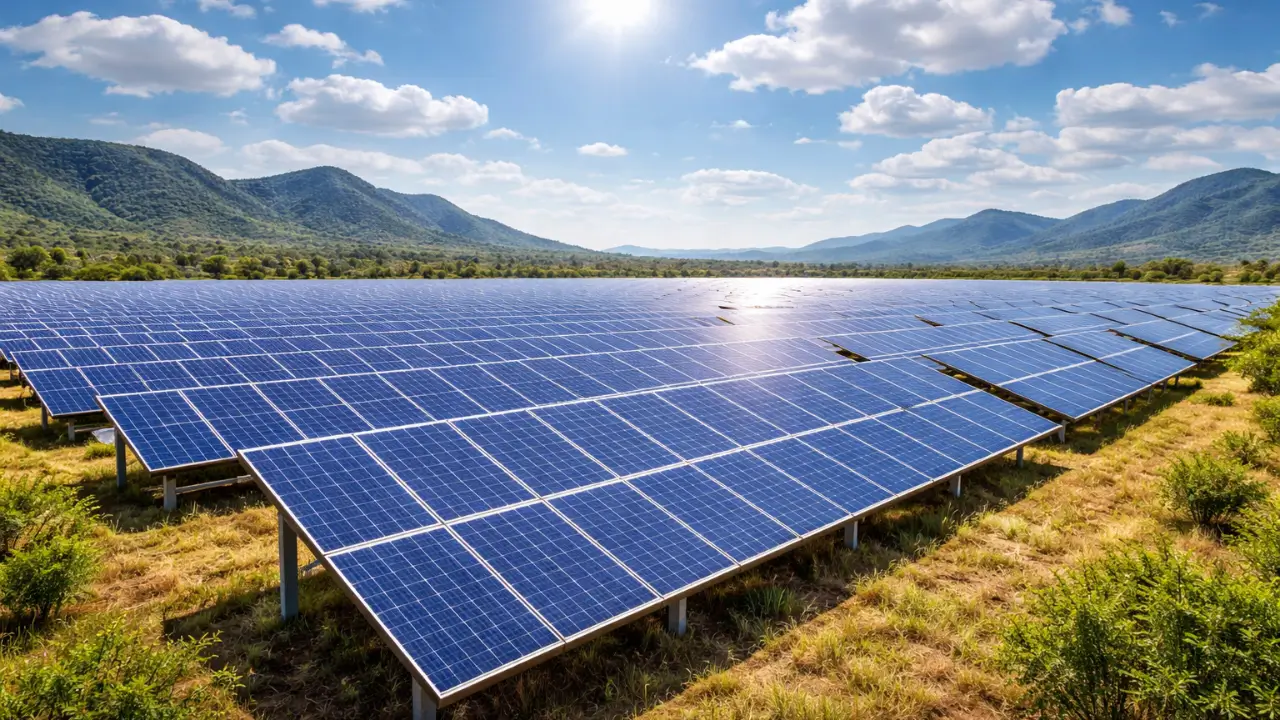
South Africa’s private power market is moving from ambition to execution. Lyra Energy has signed power purchase agreements with three major commercial and industrial customers, anchoring demand for a 255MW solar facility known as Thakadu and signaling a deeper structural shift in corporate energy procurement.
The agreements cover a significant portion of the Thakadu solar plant’s output. Although the company has not disclosed the names of the offtakers, the structure underscores how private-sector buyers are increasingly driving large-scale renewable deployment outside traditional utility frameworks.
Lyra operates as a joint venture platform owned equally by Scatec, Standard Bank and Stanlib. Together, the partners have positioned the vehicle to aggregate demand from commercial clients that seek scale without assuming development risk individually.
Importantly, Scatec will oversee engineering, procurement and construction (EPC) for the project. In addition, it will provide asset management and operations and maintenance services, reinforcing vertical integration across development and lifecycle management.
Scatec CEO Terje Pilskog said: “The announcement of Lyra Energy’s first solar plant in South Africa is a milestone for this trading platform.
“Securing offtake agreements with private sector customers for the Thakadu project demonstrates the growing appetite amongst businesses for reliable, cost-effective clean power.
“Our aggregator model is making renewable energy more accessible, helping South African companies reduce costs and emissions while supporting the country’s energy transition.”
Aggregation Model Reshapes Corporate Energy Procurement
The Thakadu Solar Project will unfold in two phases. The first phase is expected to reach financial close and begin construction in the first quarter of 2026. The second phase will follow later in the same year. The company will disclose capital expenditure, financing structures and further EPC details at financial close.
Strategically, Lyra’s model pools renewable capacity and distributes it across multiple corporate buyers under flexible, risk-managed contracts. That approach lowers entry barriers for medium-to-large energy users that lack the balance sheet or technical depth to develop standalone projects.
Lyra head Eben de Vos said: “We are proud to launch the Thakadu solar power plant with strong commercial and industrial partners onboard. By pooling resources and offering flexible, risk-managed contracts, Lyra Energy is empowering businesses of all sizes to benefit from large-scale renewable energy.
“This project is a testament to the strength of our partnership and our commitment to building a sustainable future for South Africa.”
Financing Milestones and Regional Expansion Signal Scale
Consequently, the platform functions as both aggregator and de-risking intermediary. It consolidates renewable generation while tailoring contractual frameworks to client needs. For corporates navigating volatile grid supply and rising tariffs, this structure offers predictability. For developers, it secures diversified revenue streams and strengthens project bankability.
South Africa’s energy transition increasingly depends on such hybrid structures. Rather than relying solely on state procurement rounds, private PPAs now anchor new capacity. Corporate buyers, in turn, lock in long-term supply that aligns cost management with decarbonization strategies.
Moreover, Scatec’s role extends beyond domestic borders. Last month, the company signed a power purchase agreement with the Egyptian Electricity Transmission Company for 1.95GW of solar capacity and 3.9 gigawatt-hours of battery energy storage in Egypt. That transaction highlights Scatec’s broader push across emerging markets where grid constraints and energy demand converge.
Against this backdrop, the Thakadu Solar Project reflects more than incremental capacity addition. It illustrates a structural evolution in how African corporates procure power through aggregation, private offtake and vertically integrated delivery.
As financial close approaches in 2026, market participants will watch the funding architecture and contract tenor closely. However, the immediate signal is clear: commercial demand now anchors utility-scale solar growth, and platforms such as Lyra are turning that demand into bankable infrastructure