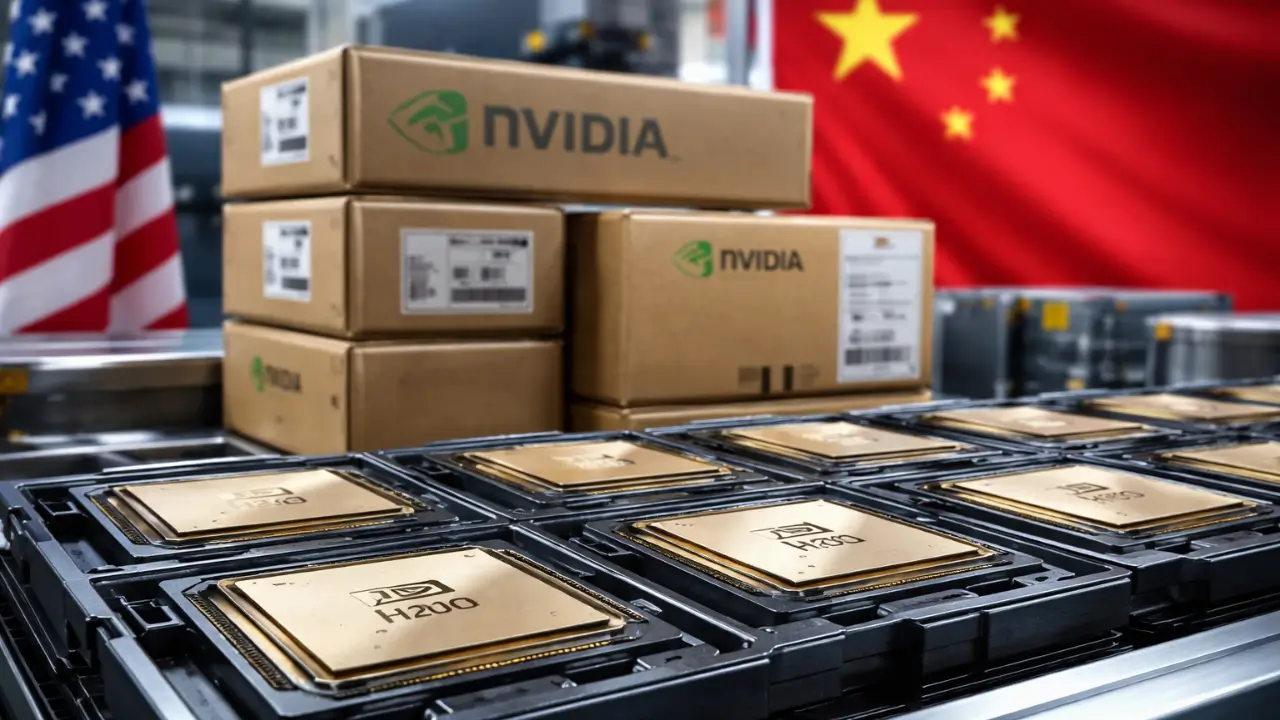
Nvidia Corp has secured a restricted US government licence to export a limited volume of its H200 artificial intelligence accelerators to customers in China, marking a cautious but symbolically significant shift in its China strategy.
However, the approval stops well short of a commercial reopening. The licence permits only a small quantity of shipments, mandates US-based inspection, and imposes a 25% duty. More importantly, regulatory clarity in Beijing remains unresolved. Consequently, Nvidia has excluded any China data-centre revenue from its first-quarter sales guidance.
The measured response underscores a broader reality: market access now hinges less on product capability and more on political choreography between Washington and Beijing.
Revenue Uncertain Despite Approval
“While small amounts of H200 products for China-based customers were approved by the US government, we have yet to generate any revenue, and we do not know whether any imports will be allowed into China,” Chief Financial Officer Colette Kress told investors on an earnings call.
That uncertainty tempers what might otherwise appear to be a breakthrough. Although Washington has created a narrow pathway for exports of the H200, an older-generation processor, Nvidia cannot book revenue until Chinese authorities formally permit the imports. As a result, Nvidia’s shares were little changed in after-hours trading on Wednesday, reflecting investor caution rather than enthusiasm.
A Strategic Market at Stake
China represents one of the largest long-term growth opportunities for AI accelerators. Nvidia chief executive officer Jensen Huang has previously estimated the country’s AI chip market could approach $50 billion in the coming years. Yet geopolitical friction continues to reshape the competitive field. The political stand-off between Beijing and Washington has prevented Nvidia from selling its most advanced processors into China, effectively accelerating domestic substitution.
Chinese authorities have channelled support toward national champions including Huawei Technologies Co, Cambricon Technologies Corp, MetaX Integrated Circuits Shanghai Co, and Moore Threads Technology Co. This industrial policy push signals Beijing’s intent to reduce structural reliance on US-origin semiconductors.
Chinese chipmakers “have the potential to disrupt the structure of the global AI industry over the long term”, Kress said, repeating earlier comments by Nvidia executives.
Signals from Beijing
Recent reporting by Bloomberg News indicated that Chinese officials have informed major technology firms, including Alibaba Group Holding Ltd that they may begin preparing H200 orders. That communication suggests Beijing is nearing formal approval for imports of components essential to developing and operating AI models.
Export Controls Define the Competitive Frontier
The H200 falls within a category that the administration of Donald Trump permits for export to China. By contrast, more advanced AI processors remain restricted on national security grounds, reflecting Washington’s effort to cap China’s access to frontier compute capabilities. Therefore, Nvidia’s limited licence should be viewed less as a commercial surge and more as a calibrated reopening, one that preserves optionality without meaningfully altering near-term revenue.
In strategic terms, the development illustrates how AI infrastructure has become a policy instrument as much as a product category. Nvidia’s ability to compete in China now depends not only on silicon leadership but also on diplomatic alignment.
For now, Nvidia H200 Exports represent a narrow corridor through a widening geopolitical divide, commercially modest, yet structurally consequential.