
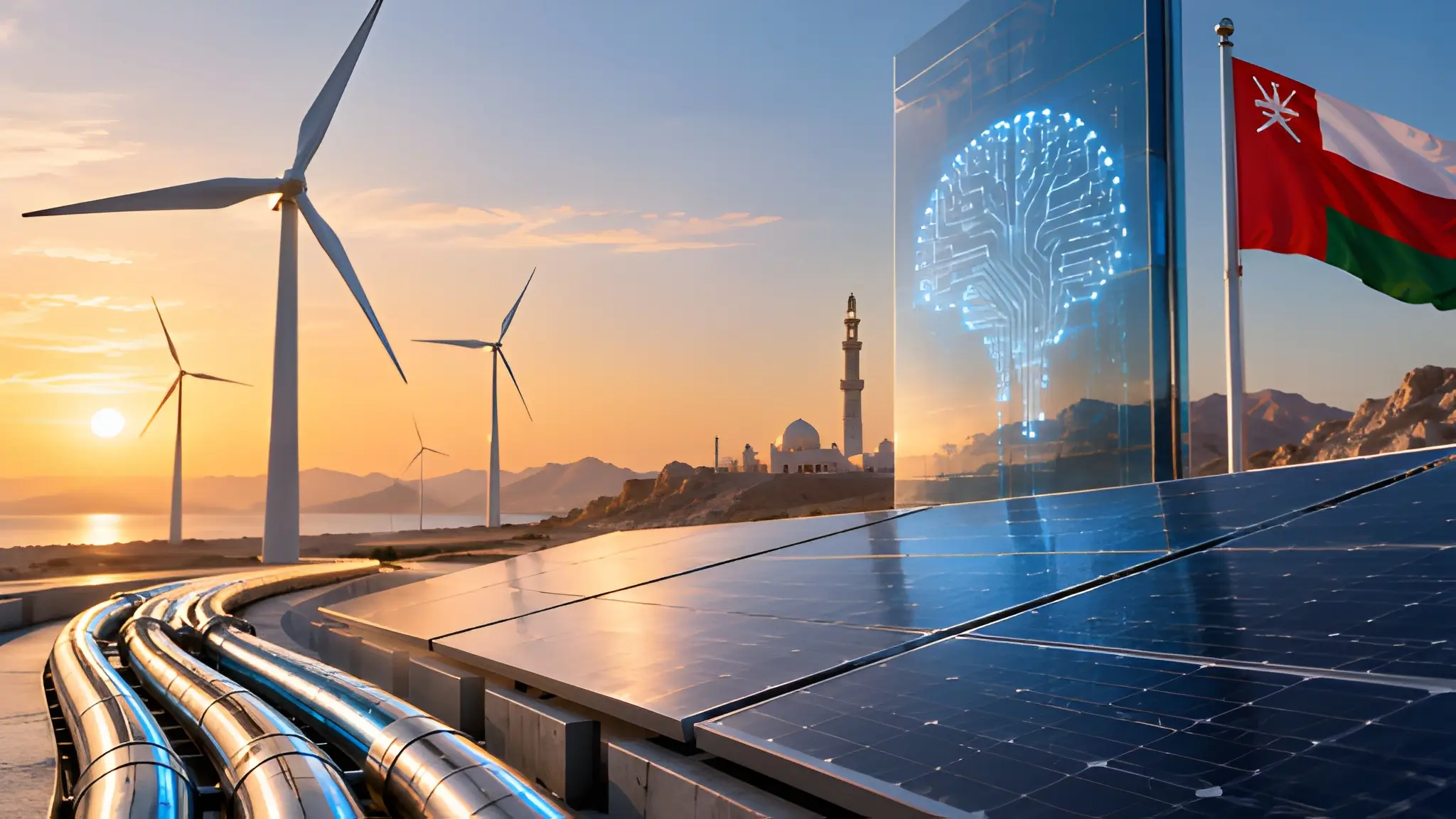
O-Green, a state-backed renewable energy company in Oman, plans to bring more than 200MW of data center capacity into service by 2028, positioning the company at the intersection of the sultanate’s energy transition and expanding AI infrastructure market. The company said on LinkedIn that its pipeline will support AI-ready data centers across Oman, Spain and other European markets, with renewable power forming a central part of the development strategy. The target gives O-Green a significant role in Oman’s push to develop digital infrastructure alongside new clean-energy generation. Its approach links data center expansion with access to lower-cost renewable electricity rather than treating computing capacity as a standalone infrastructure buildout.

Founded last year, O-Green was established to accelerate the energy transition through an integrated “clean energy platform.” Its shareholders include state-owned Naqaa Sustainable Energy and OQ Alternative Energy, giving the company direct links to Oman’s broader energy ecosystem. O-Green operates through three divisions covering renewable power, technology manufacturing and digital infrastructure. O-Green Power develops international green-energy projects, O-Green Technologies manufactures wind turbines and advances green technology innovation, while O-Green Compute & Data Centers develops AI-ready, cloud and hyperscale facilities powered by renewable energy.
Renewable Power Forms the Infrastructure Base
O-Green Power already has a project portfolio spanning 12 countries and exceeding 11GW, according to the company. Its secured portfolio includes more than 3.3GW of wind and solar capacity, along with more than 2.3GWh of battery energy storage systems across Oman and Botswana. That portfolio provides the company with a generation and storage platform that can support its strategy for power-intensive digital infrastructure. The connection is particularly relevant as AI workloads increase electricity requirements and data center developers seek greater certainty around long-term power availability.
O-Green has also installed what the company claims is the largest onshore wind turbine outside mainland China at Duqm, Oman. The turbine stands near the OQ8 refinery and represents a major piece of the company’s renewable-energy development in the industrial zone. O-Green describes the installation as a “new landmark” of Oman’s Vision 2040, the national strategy aimed at diversifying the economy and expanding renewable energy. The project also illustrates how Oman is pairing industrial development with new power infrastructure as it reduces its dependence on oil-driven economic activity.

Oman Builds Its Digital Infrastructure Ambition
Oman’s data center ambitions extend beyond O-Green, with state initiatives, submarine cable networks and international partnerships supporting the country’s emergence as a regional digital hub. In May, Omani, Emirati and Italian companies signed an agreement to develop a 150MW hyperscale AI data center in Oman, adding another large-scale project to the country’s digital infrastructure pipeline. The development points to growing interest in Oman as a location for power-intensive computing capacity serving regional and international markets. Meanwhile, the combination of renewable generation, strategic connectivity and available industrial infrastructure is creating a broader platform for hyperscale and AI deployments.
Oracle launched its second OCI Dedicated Region in Oman last year, adding enterprise cloud infrastructure to the country’s expanding technology footprint. The development gives organizations in Oman access to dedicated cloud services while supporting the government’s wider digitalization objectives. In addition, O-Green’s plan places renewable generation and data center capacity within the same corporate strategy, potentially allowing the company to develop power and compute assets in tandem. For Oman, the 200MW target adds another layer to a national infrastructure push that increasingly connects energy policy, cloud computing, AI demand and economic diversification.
The Strategic Shift Toward AI-Ready Capacity
The significance of O-Green’s plan extends beyond the headline capacity figure because AI data centers require a different infrastructure equation from conventional enterprise facilities. Developers must coordinate electricity generation, storage, transmission access, cooling systems and high-density computing infrastructure before large AI clusters can operate at scale. O-Green’s existing renewable portfolio gives the company a foundation for pursuing that integrated model across multiple markets. Its 2028 target will therefore test how effectively the company can translate renewable-energy assets into operational AI and hyperscale capacity.
For Oman, the strategy reflects a broader attempt to convert its energy resources and geographic position into digital infrastructure advantages. O-Green’s expansion across Oman and Europe also gives the company a cross-border platform for applying its renewable-power and data center model. The outcome will depend on project execution, grid access, financing, customer commitments and the pace at which AI infrastructure demand develops through the end of the decade.











